Sunday, July 28, 2013

CHAYA THE REVISIONIST

Half-a-century and more ago, they used to tell us in Hebrew school about the pioneers who went to the Holy Land and made the desert bloom, wiped out malaria and established and defended the first Jewish state in two thousand years. They made it sound so pure, so unifying.

It was not exactly that - and I am not talking about Jew vs. non-Jew.

The Labour Zionist yishuv was a rough-and-tumble place and the new Jewish establishment was the roughest. They knew what they wanted and how to manipulate, co-opt or destroy those who stood in their way. They knew how to reward those who did things their way and how to make life difficult for those who dared to think differently.

I have alluded to this before in this blog, but this week I want to bring a specific example straight from the heart of the establishment of those days.

Chaya Pickholz was a well-known high school English teacher in Tel Aviv. She hobnobbed with the likes of the poet Haim Nachman Bialik and taught English to people who would go on to positions of leadership. I have heard it said, for instance, that Zalman Shoval - formerly the ambassador to the US - called her a great influence on him, a tough and effective teacher.

Chaya was born in Rozdol on 20 September 1902, the tenth child of David Samuel Pickholz and Pesa Roza Lucaczer, who died in childbirth. Three of the ten died in childhood. The family of the eldest brother went to Buenos Aires and one sister came here, but the others were lost in the Holocaust.

David Samuel married again and had three more children. One of those went to New York and the others were killed in Stryj. (The second wife was from Stryj and they lived there.)

Chaya came to Palestine in the 1920s, but went to England for a time, which is apparently where she became proficient in English. In 1927, she was back in Stryj.making arrangements to return here.
The file also contains a typed version.

Quite a few years ago, when someone mistakenly let me look at actual files at the Central Zionist Archives, I found one featuring this letter of 21 April 1927, written by a representative of the Labour Zionist Party in Stryj, and sent to the Aliyah Department in Jerusalem.

The young woman Chaya Pickholz from here, who returned after a year in Eretz Israel, is now attempting to return. As she has been telling libelous stories and lies about the Yishuv [the Jewish community in Palestine] in general and its leadership in particular,  and has been spreading anti-Zionist propaganda, we therefore think it necessary not to allow her aliyah and not to issue any permission or positive recommendation.

With the blessings of Zion and Labour,

In other words, (horrors!) she was not following the prevalent socialist line. A veritable Revisionist! Perhaps even a follower of Jabotinsky!

There is nothing further in the file, but we know she did return. Perhaps someone she met when she was here earlier vouched for her. Chaya Pickholz received citizenship from the Mandatory Government  about 1934 or 1935.  (There is an index reference, but the actual citizenship file is lost.) Citizenship required her being here at least five years previous.

Chaya Pickholz lived in Tel Aviv  until her death in August 1984, just shy of her eighty-second birthday, on 26 Av which falls this Friday. She never married. She is buried in Kiryat Shaul Cemetery in Tel Aviv.
Noble of spirit, educator, poet
- - - - - - - - - - - - - - - - - - - - - - - - - - - - -
Housekeeping issues:
The IAJGS 33rd International Conference on Jewish Genealogy which takes place next week in Boston will be live-streaming some of their meetings and lectures. (Mine is not one of them.)
See details at www.live.iajgs2013.org.

I am supposed to be participating in a Q&A panel on archives, which it turns out is being live-streamed. However I do not feel comfortable being broadcast saying things I have not prepared in advance, so I'll be withdrawing from that panel.

Sunday, July 21, 2013

AUGUST ABROAD

THE NINTH OF AV
Another year and another day of mourning for our lost Temple and sovereignty. This is not just history. It's not only mostly history. This is now.

The Talmud teaches "Any generation in which the Temple is not built, it is as if it had been destroyed in their times" (Yerushalmi, Yoma 1a)

But it is even more than that.

"A Jew does not expel a Jew" - so we thought
And I am not even talking about the fact that our own government used our own Jewish soldiers and police to evict some 8600 Jews from their legally-held homes, destroyed synagogues and uprooted a cemetery - only eight years ago a few days after we had mourned our earlier destructions.
The Temple remains destroyed and our own authorities are ensuring that it remains inaccessible, even though it is permissible by law
Jewish worshippers hoping to ascend the Temple Mount in commemoration of Tisha B'Av were bitterly disappointed as, once again, police prevented them from ascending.
The hundreds of Jewish worshippers who waited Tuesday morning to enter the Temple Mount were turned away by the Jerusalem Police, who informed them that the district commander had ruled that entry to the Mount is forbidden to Jews.
The group included Members of Knesset Shuli Mualem-Rafaeli (Bayit Yehudi) and Deputy Foreign Minister Ze'ev Elkin (Likud). Several yeshivot (religious academies) were present as well.
Police spokesman Micky Rosenfeld said in a statement that after "security assessments" the decision was made "to close the Temple Mount to all visitors, in order to prevent disturbances."
However, it appeared that only non-Muslim visitors were included in that decision.
And as far as sovereignty is concerned, on this very day we hear,
[The European Union directive] also requires that any contracts between EU member countries and Israel henceforth include a clause stating that East Jerusalem and the West Bank are not part of the State of Israel, a senior Israeli official told Haaretz
So we have no Temple and our own government will not let us visit the place because they have been threatened with mob violence.

And the Europeans who failed to kill us seventy years ago threaten us again, this time with demands on our sovereignty., We have much to mourn. Today.


AUGUST ABROAD

This trip divides into three - the genealogy conference in Boston, seeing family in several; different places and the bar mitzvah of my grandson in Chicago. That is similar to the structure of my trip two years ago, which also began with a conference and featured a Chicago-area bar mitzvah.

A few bits are still vague, but for those who are interested, here is the plan, laid out in one place.

33rd IAJGS International Conference on Jewish Genealogy
Boston Park Plaza Hotel & Towers, 4-9 August

I arrive in Boston the Thursday afternoon before the conference and will be staying in Brookline until Sunday morning. (A neighbor of mine who used to live in Boston set me up with a family in Brookline for Shabbat.)

During the conference, I'll be staying at the conference hotel, sharing a room with a third cousin of my wife's whom I have only met online. He lives in Monument Colorado. He is on my wife's father's mother's father's mother's side, from Obertyn in east Galicia. The ancestral surname is BUCHHALTER.

The conference program has as many as eight lectures going on at once from Sunday morning until Friday noon. I am speaking Tuesday at five and will be on a panel Wednesday at three-thirty.

My lecture "A DNA Skeptic Turns His Family On Its Head - And Remains A Skeptic" is not my first at one of these conferences, but it's the first that is scheduled after the conference has actually begun. (The others were early Sunday, when most people hadn't yet arrived.) It may make for a bigger crowd.

The lecture description is thus: 
As a genealogy research tool, DNA is very tempting because it tests the scientific genealogical makeup of possible family members, but at the same time uses analysis based on statistics and probability that can lead to incorrect or unfounded conclusions. The experts' explanations often confuse more than they illuminate, especially when you consider that some of these experts are the ones selling the testing services. So what is the lay researcher to do?


This talk will tell the story of one researcher, strictly a layman, who – despite his skepticism – used DNA testing to turn his basic family structure on its head, with more plans on the way. And despite his intentions to continue with this kind of research, remains something of a skeptic.

I'll be introduced by Barbara Stern Mannlein, a member of the Wachs family to whom I once thought we were closely related. The lecture is an hour plus fifteen minutes for questions.

As readers of this blog know, DNA has become an important part of my research tool-kit and we have quite a few Pikholz family members who are now testing. In fact, there are several DNA lectures planned and I hope to learn how to more fully use the results of these tests.

The sessions I certainly intend to attend are
  • Understanding, Interpretation and Use of DNA Results
  • Haplogroups - What They Are and What They Mean for Jews 
  • DNA Project Administrators BOF
  • Computer Workshop (PC): Genetic Genealogy Demystified: A Hands-On Guide to myFTDNA and Understanding Your Family Tree DNA Results
All of these are sponsored by the testing company we use, family Tree DNA and the first two will be presented by their president.

On Wednesday I will be one of eight panel members for "Ask the International Archival Experts," each prepared to answer questions about archives in different countries.


I may or may not catch the first Friday lecture, as I am flying to Miami after the conference.

Travelling and Visiting
I will be in Miami from Friday afternoon until early Tuesday, spending Shabbat in Boca Raton. (I was in Florida only once before and then only as far south as Gainesville.) The purpose of this part of the trip is two-fold - I want to visit with some of the Pikholz descendants and to visit some Pikholz graves. 

The cemeteries are Lakeside (Miami), Palm Memorial (Sarasota, Eternal Light (Boynton Beach) and Menorah Gardens (North Palm Beach, Fort Lauderdale and Weston). That's twenty-four graves altogether and I hope I get to them all. (I'll be with a rental car.)

Thus far, I am meeting with a Skalat Pikholz Sunday morning and one of the Rozdol Pikholz is trying to put together a group of cousins for Monday morning. Then another Skalater Monday late afternoon.

The most important part of the visit will be to see my father's cousin Herb, with whom I have been in correspondence the last few years. he is the oldest left of my father's family and our only previous meeting was when I was fourteen.


The two boys, two years ago.
Next stop is Baltimore, again picking up a rental car. My grandsons Yaakov Meir and Avrohom are in yeshiva, one in Philadelphia and one in Baltimore, and they will already have started the new term by the time I get to Chicago, so I decided to see them in school. I plan to see Avrohom Tuesday and Yaakov Meir Wednesday.

I am staying both nights with Uncle Bob and Ro in their house in the woods and will see my cousin Beverly Wednesday morning and my cousin Chevy Thursday morning. I look forward to seeing Jerry & Marcia and the kids and anyone else who comes to the house Tuesday evening.

Thursday ends at Greyhound where I take a bus to Pittsburgh, arriving Thursday evening.

That weekend I'll be with Aunt Betty and Uncle Ken. I may be reading the Torah Shabbat at the Poale Zedeck.


Noga
Sunday I have an overnight bus to Indianapolis, but with an important stop in Columbus. It's at 10:30 PM and less than an hour, but my young cousin Merissa and I plan to get together at Greyhound. Merissa is critical to all my genealogy research, because she is the one who pushed my into doing it twenty years ago at Nana's ninetieth birthday party. Actually, that is the one and only time Merissa and I have met. She was not ten years old at the time.

The bus trip ends at 2:30 AM in Indianapolis and my son Eliezer will pick me up there for a day with him, Naomi and Noga in Bloomington.


More than a year ago.
From there it is back to Indianapolis Tuesday morning and a bus to Chicago, where my son Yerachmiel will pick me up at Greyhound downtown. They have just moved from Buffalo Grove to West Rogers Park, which among other things means they are no longer a ten minute walk from my sister Amy. I am leaving it to all of them to figure out the logistics of seeing everyone.

Shlomo Zalman's birthday is that week and they'll be having some kind of a Shabbat bar mitzvah, though the official bar mitzvah will be during the holidays so the older boys can be there.

Monday afternoon I fly home, arriving Tuesday afternoon. These trips get harder every year.

If anyone is looking for me, I will have a US cell phone - 812-327-6621.

I hope to continue blogging during my trip, but perhaps in a shorter format.

Sunday, July 14, 2013

MOSHE HERSCH PIKHOLZ

When I first met Rita, back at the beginning of the Pikholz Project fifteen years ago, the central character in her family history was her great-grandfather Arie Leib Pikholz. Based on the ages of his children, he was probably born in the early 1850s. There doesn't seem to be anyone named for him and he doesn't appear in any death records, so we have no idea when he died.

He lived in Proszoma and or Kosowka, a bit south of Skalat. His wife was Risie Epstein from Grzymalow.

Rita had a pretty good grasp of Arie Leib's descendants - aside from several who died young and one son who made aliyah in maybe the 1920s and left no trace that we could find. One of her first cousins is the granddaughter of a first-cousin marriage - Sophie being a daughter of Ari Leib, but we don't know the parents of her husband Solomon.

Rita also knew (or knew of) several of her grandmother's first cousins: Bassie, the daughter of Arie Leib's brother Jacob, and Morris (Moshe Hersch) and Nathan, probably the sons of Arie Leib's brother Josef. (There is some doubt and debate about Josef, but that is another topic for another time.)

In the course of our research we found additional births to some of the older couples, without knowing what happened to the children who survived childhood.

We also found that Arie Leib had a brother Simon, who had four children by each of two wives. Simon may also be the father of Solomon, whom I mentioned above.

All these families lived in smaller towns around Skalat - Mikulince, Tarnoruda, Kosowka, Proszoma - though Jacob lived for a time in Tarnopol.

Bassie died 30 December 1875
At some point, even before JRI-Poland came into play, I found a Skalat death record from 1875 for fifty-eight year old Bassie Pikholz of Kozowka, who appeared to be the mother of Arie Leib and the others. This even though Jacob seems to be the only one with a descendant named Bassie.

That same batch of Skalat death records included forty year old Getzel Pikholz in 1866. He too was from Kozowka and it appeared to me that he would have been Bassie's husband, even though he was eight or nine years her junior. This fit well from another standpoint. Rita's family had some Nachmans and the other two Skalat-area family with Nachmans also had a Getzel.

Of course, I did not record either of these as fact. I just noted that they may have been a married couple and may have been the parents of Arie Leib and his cohort.

That is more or less where we stood for eight or ten years. Until this showed up in the newest batch of records. A death record from Mikulince.
Simon Pikholz of Kozowka, son of Moses Hersch and Basie, died 19 Nov 1906. Buried in Mikulince. Age 58.
So I was right about Bassie's being the mother, but the father was not Getzel, but Moshe Hersch. And I am certain enough to have recorded them in my database.

That sent me back to a table that I had begun preparing a few years ago, listing every known Moshe Hersch in the Skalat Pikholz families. I am still fiddling with it, but here it is today.
The third entry on the list is Rita's great-great-grandfather.


The most senior of the Nachman-Getzel families begins with Nachman Pikholz (1795-1865), the great-great-great-grandfather of Jacob Laor and my guess is that Rita's Moshe Hersch is his son. That would make Rita and Jacob fourth cousins. Fourth cousins is well-within the capability of an autosomal DNA test, though it depends on exactly how the DNA has been passed down the generations. Jacob and another of his branch have ordered tests as has Rita. I have asked a couple of Rita's cousins to test as well, including the one with the cousin-grandparents. They have not yet replied to that request.

(I have asked descendants of the third Nachman-Getzel family as well, but here too I do not yet have any replies.)

The thirteen Moshe Hersch in the chart above include Rita's ancestor (#3) and three of his descendants (#s 10, 11, 13).

Entry number seven is the head of a family with no known living descendants, but Jacob has long been convinced that they are part of his family, based largely on the proximity of Kaczanowka, where they lived, and Klimkowce, where Jacob's great-grandfather lived.

It is possible that the first entry on the list is the same person as Rita's ancestor. A couple of DNA tests from Steve's family would be helpful here, but that family is complicated by an adoption and I have no real connection with the biological descendants. (Steve's great-grandfather is here on the right.)

The second entry is the father of a girl who died in 1842 at age three and he is almost certainly the same as #1 or #3.

Entry number four is named, with his wife Jente, on the birth records of some of his grandchildren. The first we know of was born about 1869, so his 1825 birth year is a guess based on that. He could be the same as Rita or Steve's ancestor, though if Rita's we would have  an issue of multiple wives. This Moshe Hersch has living descendants but testing them might be a hopeless task as there are several cousin-marriages muddying up the water.

Number five died in 1872 at age thirty. We know nothing else about him. He is too old to be the grandson of any of the others, but he could be a nephew.

Numbers six and twelve are the sons of Pikholz mothers. We do not know who the grandparents are, but I'd really like to.

Number eight was born in 1877 to Leib Pikholz, whose parents are not known. But they could include one of the Moshe Hersch listed above.

And that's about where we are for now. Other than the DNA, we have no plan for moving forward.

Sunday, July 7, 2013

SEMINAR AT THE NATIONAL LIBRARY

A DAY AT THE LIBRARY
I spent a day at the National Library, on the Givat Ram campus of the Hebrew University, the week before last. The library staff, particularly Mrs. Elona Avinezer, the Head of the Judaica Reading Room, want to better serve visitors who come with genealogy questions, so they invited several genealogists to give talks to the staff about what we do and how we do it.

We had the whole morning, from about nine o'clock until nearly one. I was the last of the morning presenters and I did a case study of the family of Peretz Pikholz of Skalat. I wanted to touch briefly on a large number of sources, ending up with a non-document that moved our main question from "beyond a reasonable doubt" to "beyond a shadow of doubt." As time was running out, I tacked on a bonus conclusion about the next generation up, even though the supporting evidence is far from conclusive.

After a break to visit the cafeteria, we had several presentations by library staff about resources that they thought we may not have known about. We finished up at about a quarter past five.

The whole program was generally well-received by the forty-fifty participants. It was open to the public, though it did not get much publicity.

A few things that I learned. Irit Shem-Tov, of the Israel Genealogical Society, discussed the notion of family numbers. These numbers were assigned to a family unit and remained with it no matter where they went. Irit was mostly interested in Lwow, but this idea is relevant to Hungarian research as well.

Professor Yitzhak Kerem is a Sephardic researcher and it would not be much of an exaggeration to say that he seems to find Sephardim every place you look, even in Ashkenazic communities. I spoke with him afterwards about the Scharf family tradition that Shimshon Scharf (who married Bassie Ruchel, the daughter of Peretz Pikholz) was in fact a Turkish Jew named Arak. I gave our Scharf-Pikholz researcher his address and perhaps he'll be able to help out with that.

I also spoke to him about the theory that our Pikholz family might have come from Vyskovo (then Hungary, now sub-Carpathian Ukraine) where there were some minor Hungarian land-owning nobility named Pikholcz. The idea here is that our family were living on their land and when required to take surnames, too the name of the landowner - as happened with for instance many of the newly-freed slaves in the United States. Kerem thought that made perfectly good sense and as I type these words I realize that can solve another problem that has been nagging me for the last ten years and has been aggravated by our latest DNA results. Finding actual evidence, however, is another matter entirely.

Shalom Bronstein gave a better idea about what is actually going on with the Paul Jacobi Archives, a subject which until now has generated much talk.

Gil Weissblei of the library staff spoke about a number of lesser-known collections. I was intrigued by the David Tidhar collection. Tidhar published a nineteen-volume set (in Hebrew) called "The Encyclopedia of the Founders and Builders of Israel" which has some 6000 brief biographies of Israeli personalities in the years leading up to 1960. It turns out that Tidhar had sent questionnaires to all these people and those questionnaires are available for research at the National Library. I imagine that they contain information which was not included in the completed work. Tidhar was also a private detective and his files from that work are also in the Library's collection.

 - - - - - - - - - - - - - - - - - - - - - - - - - - - - - - - - - - - - - - - - - - - - - -
Housekeeping notes:

I have an article in the next issue of Avotaynu. I have not seen the final version yet, but I assume the title "GETTING IT WRONG" will remain intact. The article is about being careful about possibly recording incorrect information and how such information is likely to cause damage later on. That has been a mantra of mine of late.

I sat down a few days ago to look at my presentation for the conference in Boston, four weeks from now. I knew it needed a bit of reworking and updating since I last gave the talk six months ago. What I had forgotten until now is that the entire Power Point presentation is in Hebrew, so I have to redo the whole thing.

Barbara Stern Mannlein has graciously agreed to introduce my talk at the conference.

I have approached a large number of Pikholz descendants about DNA testing lately, prompted by the company's $99 sale on Family Finder (autosomal) tests. Some ordered kits immediately. No one said "no." Most are either ignoring me or thinking about it. The sale lasts until 25 July.

A couple of months ago, I wrote about redoing my office. Here are some photos of the more-or-less finished product.


Jewish law requires leaving an unplastered piece of wall
as a rembrance of the Temple in Jerusalem.
I have incorporated twelve illustrations from an old Passover Haggaddah
so that the redemption of old will remind us of the redemption to come.
Curse you, Blogger, for not leaving these images where I put them!


Sunday, June 30, 2013

PICKHOLTZ, BERNSTEIN and FRIENDS (or maybe relatives)

(Part two of two - see part one here)

Last week, I looked at the Pickholtz-Bernstein family who came to the United States from Skalat in 1890. We do not have all the details of their first years in the US, but the main gap in the story is what happened to David Bernstein, who was eleven months old when the ship sailed.

This week, I want to have a closer look at the other two Skalat families who followed the Pickholtz-Bernstein family on the passenger manifest, almost consecutively.
Lines 206 and 212-214 are people who seem
to be unconnected to the Skalat families.
You can see the actual manifest, but it is easier to work from the transcribed information presented here on the right.

I spent a morning looking at the JRI-Poland vital records for both the Kaczors and the Aberbuchs. (This was complicated by the fact that their "sounds-like" algorithm does not think that Aberbuch sounds like Auerbach, even though the same people are listed both ways.)

I'll spare you the details, but I did find two connections between Aberbuch and Kaczor. The more obvious (but perhaps less useful) is Nuchim Kaczor who married Lea Auerbach. They had six children in the period 1891-1901 in Podwoloczysk and in one of the birth records, Lea is identified as being from Skalat.  I don't see anything connecting them to anyone else in our story.

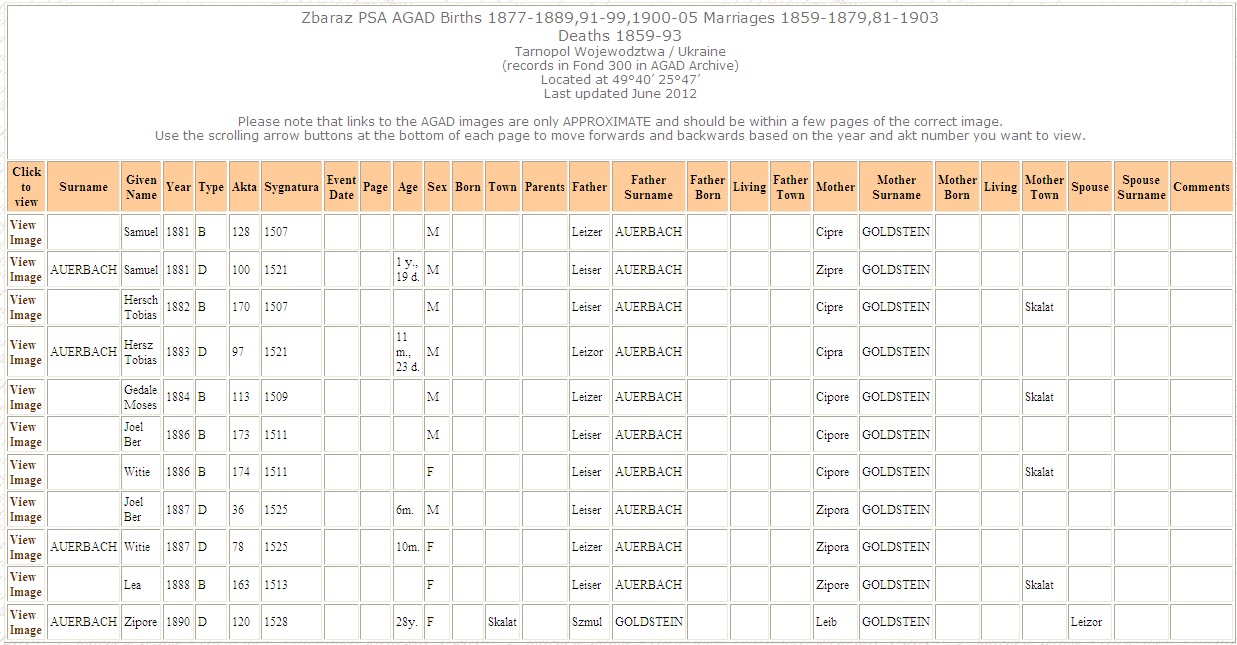
The other is Leiser Auerbach and his wife Zipore Goldstein. They had six children 1881-1888 in Zbarazh. In several of the records, Zipore (aka Cipre) is identified as being from Skalat. Zipore died in 1890 at age twenty-eight having buried four of her children at between six and thirteen months of age.

Here is the thing. Zipore Goldstein, the wife of Leiser Auerbach is the sister of Rifka Kaczor, the wife of Rachmiel from the passenger manifest.

I would not be surprised to find the widower Leiser Auerbach in the United States in the 1890s or early 1900s, but I have not really looked for him there.

I have no idea if Leiser is closely related to Aron from the passenger manifest, but if he is, it would not surprise me one bit.

I saw no connections between Aberbuch and either Pikholz or Bernstein.

The Kaczors of Skalat are a much bigger project. In fact, I know several people who are working on parts of that family - including a client of mine - but to my knowledge no one is looking at all the Skalat Kaczors in a single project.

Probably 340 out of these 357 search results are in Skalat itself. A large family.
I started with a search for "surname sounds like Kaczor" and "given name sounds like Rachmiel." There were thirty-six records in the Tarnopol area - twenty-nine in Skalat and one family of seven in Podwoloczysk. ("Sounds like Katcher" produced those same results.) There is nothing there that tells us anything about Rachmiel's parents, so unless someone dives into this on the American end - death or cemetery records, for instance - there is not much to do on that.

Searches for records which include both Kaczor and Bernstein come up empty and, of course, had there been and Kaczor-Pikholz connections, I would have been all over them long ago. (That said, I have a low priority interest, considering the possibilty that Kaczor, Kaczka and Kwoczka all come from a single source.)

So why is this any more than several families from the same place travelling together? Maybe it isn't. But still, let's see what else we have.

First of all, in discussions a few years ago, Lee Katcher, the late Norman Kotcher and Steve Pickholtz concluded that one of the Kaczors lived with Steve's grandfather while in school. I don't know the specifics - not even if he was from the family on the passenger list - but they felt thatthis was an indication of a family connection. Maybe. Or maybe it was just good friends from the old country.

Then there is a mortgage document in the names of "Berisz Pickholz and Sarah his wife, Rachmiel Katcher and Rochil his wife, [Heren?] Katcher and Catherine his wife and Bluma Barenstein." (Note that Rachmiel's wife was Rifka on all previous documents.) A second document is similar but does not include Bluma. They are identified as being from New York City. The documents are dated June and July 1890 and refer to land purchases in Pittsgrove New Jersey. Pittsgrove is just a couple of miles from alliance where Sarah was buried eighteen months later, so at least Berisch and Sarah must have actually lived there.

Here again, this joint mot\rtgage may be a sign that we are talking about family. Or maybe it was several Skalat families participating in the experiment that tried to make New Jersey farmers out of east European Jews. This plan is probably what put them on the same voyage. How long they remained farmers, who knows. Local Pittsgrove records probably can shed light on that period.

This is Steve's project, but perhaps someone reading this might have something to suggest. I for one have no experience with US land records. Nor do I have the time or inclination to acquire that experience at this time.

BERNSTEIN
This is a good time to make some additional Bernstein comments.
I did an "exactly" search rather than "sounds like" so as not to get all the Braunsteins. Another large family.
There are three researchers listed in the JewishGen family Finder doing this large family. Two of them seem to be active and I am in contact with one of them. Many of these Bernsteins - may all of them - are kohanim.

We have at least one other Pikholz connection in that Bernstein family.

In 1955, a woman named Haya Henkin in Rehovoth submitted a Page of Testimony to Yad Vashem in memory of her sister Betka / Boncia Bernstein of Skalat, who was married to Berl Pikholz. They had three sons - Josef, Moshe and Aharon, all of whom were killed.

I spoke to Haya's daughter Malka on Kibbutz Saad, who also filed a Page of Testimony for Betka. She confirmed that this is the Bernstein family who are kohanim. She did not know anything about her Uncle Berl, so I do not know where he fits into our families.

Neither Haya nor the daughter knew the ages of the children.

Betka was born in 1902, so her husband could be one of several Berls we have who were born in that period. Perhaps we will know later on.

Sunday, June 23, 2013

PICKHOLTZ, BERNSTEIN and FRIENDS (or maybe relatives)

Part one of two

(Parts of this appeared in The Galizianer - published by Gesher Galicia - in February 2006. We have learned a bit since, but not nearly as much as we would have liked.)

It must have been early 1999 - soon after the inception of the Pikholz Project - when Steve Pickholtz and I came into contact with one another by email and now, fourteen years later, it seems that his family and mine are the only ones we haven't been able to take beyond the names on our great-grandfathers' graves.  We know now that both our families came from Skalat, where the mother lode of Pikholz families resided, so we assume we are both part of what we have come to call "the eastern branch."  (The smaller, "western branch" was centered in Rozdol.)  
                                                                                                                             
Steve's grandfather Harry, with his
wife, daughters and son-in-law
Steve has become the most active of the Pikholz researchers among those family members in the US, while I continue to coordinate the project from here in Israel.  But I get ahead of myself. 
                                                                                              
Steve was born in Philadelphia in 1945, to Morris Pickholtz (1903-1970) who was also born in Philadelphia.  Steve "knew" that his grandfather was Harry and that he had been an orphan who came to the US alone, but in census records we found Harry living with his parents into young adulthood.  So much for that particular oral tradition.  
                                                                  
After a round of basic inquiry, it started out looking pretty straightforward.  Bernard (Berl/Berisch) Pickholtz and his wife Bluma (Bernstein) lived in Philadelphia, as did their children Olga Mandelkern, Harry Pickholtz, Anna Tersuhow and Fanny Pickholtz (who had no children and returned informally to her maiden name after divorce).  They were born in the 1870's-early 1880's, according to various later testimonies.  In the 1900 census, we have Bernard and Bluma with children Harry, Annie and Fanny.  Olga was married by then.
                                                                                        
Steve collected the six death certificates and visited the graves and here is a summary.
The bit about Fannie's mother's being Sarah Bernstein was odd, but we chalked it up to a double name, even though Bluma's grave didn't indicate any such thing.  However the informant was her sister Anna, who surely knew what she was talking about.   

The informants for Olga, Harry and Anna were their US-born sons who clearly did not know all the family history.  

Bernard's father Moshe Zvi was interesting, but it didn't tell us much as we have this combination in a number of families where the name does not appear to have a common source.  (My own father's brother is Moshe Zvi, named for his two grandfathers.)  
         
Based on the birthplace on Fannie's death certificate, Steve ordered a search of Odessa birth records for Pikholz and two turned up -  Fannie born in 1881 and Vodolya in 1883, both to Austrian citizens Bor and Sara Pikholz.  We never see a trace of Vodolya again (not as Vladimir, William, Wolf, Zeev etc), but neither do we find a matching child's death record or grave.  Clearly none of the other children of this family were born in Odessa, as the search request included them by names and ages.  

Soon after, Steve came up with a passenger list, from 1890, which included the following consecutive listings (names and ages), all travelling from the east Galician town Skalat. And right after them, two other families from Skalat. The ship was bound for Baltimore.

The passenger manifest raises some obvious questions.

Sara and Blume are obviously two different people. How did both come to be married to Berisch?

Blume - who has two sons - is going by Bernstein, which we thought was her maiden name. There is a Bernstein family in Skalat who are kohanim, so perhaps Bernstein is Blume's maiden name. In which case, who is the father of her children?

One of Blume children is Hersch, who would be Steve's grandfather. And who is this baby David, who appears nowhere else.

It is of some note that Berisch and Sara are listed as coming from Skalat, not Odessa, so they must have returned there, at least briefly.

And is there a connection to the Kaczor and Aberbuch families? There are a few Awerbachs in Skalat, but no couple named either Aron or Gittel. There are a few hundred Kaczors in Skalat, including one Rachmiel married to a Rifka Goldstein. They indeed had sons Getzel and Gabriel, so those are probably the family that travelled with Berisch and family.

The scenario we began to see went something like this:
  • Sara and Blume are Bernstein sisters.  Berisch and Sara decide to leave Odessa and go to America, but before they do, they return to Skalat and take Sara's recenty widowed younger sister Blume and her two sons, with them to America.
  • Soon after arriving in the US, Sara dies and Berisch marries his sister-in-law, a common solution for a widower with young children.  This also had the benefit of giving Berisch a son (Hersch), which he didn't have from Sara, after Vodolya died.
  • Somewhere in the Philadelphia area are graves for Sara and young David, who died in the period 1890-1900 - probably earlier than later. 
  • Harry's father is named as Bernard/Berisch, because his uncle/step-father adopted him, either formally or informally.  Anna's mother is listed as Bluma rather than Sara because there was no one left who knew the story, aside from Olga who was elderly and unwell.
  • The oral tradition that Harry came to the US as an orphan is not as far-fetched as we had thought. That's a reminder to never discount family tradition.
Some time later, Steve found Sara's grave. In Alliance New Jersey, where an attempt had been made to establish communities of Jewish immigrant farmers.

 Sara died 1 January 1892, less than two years after arriving from Europe. She is clearly identified on the stone as the wife of Dov (=Berisch) Pickholtz and the daughter of Mordecai HaKohen. So she is indeed Blume's sister.

Then we considered who might be Harry's father.  I examined the JRI-Poland birth index for Skalat and found two births to Bluhme Bernstein.  One is Moses-Hersch born 1878, with no father listed.  (There were many births with no father's name in Skalat during that period, probably due to some mistaken policy of the registrar.)   The other is Zalman Hillel (1876) and the father is Judel Mendil Werfel.  Eight months later is a death record for Salomon Hillel Werfel, son of Juda Mendel.  In both of these birth records, Bluhme's father is Markus (=Mordecai) Bernstein and in the case of Moses Hersch, Bluhme's mother is called Rachel.  We find no record of either David's birth or Juda Mendel's death, but the family may have lived elsewhere at the time.

There is no one listed as the father of Moshe Hersch Bernstein, but that was often the case in Skalat birth records.
If all this is true, then Harry Pickholtz was Moses-Hersch Werfel - Moses-Hersch being the same name as the father of Harry's uncle/step-father, a fact which I am not assuming to be significant.

We have yet to find a trace of David, not in New Jersey and not in Philadelphia. Not as Bernstein, not as Pickholtz, not even as Werfel. Considering that David is a dozen years younger that Hersch, he may be from some other family entirely and just raveelled with Blume for some unknown reason. (Steve is more concerned about finding him than I am, which is quite understandable.)

There is one other open question regarding Berisch's children - where were Olga and Anna born? There are no records either in Odessa or in Skalat. Perhaps they spent some time in Podolia before arriving in Odessa.

There is also the matter of the Kaczors and the Aberbachs. I hope to address that next week.

- - - - - - - - - - - - - - - - - - - - - - - - - - - - - - - - - - - - - - - - - - - - - -
Misc
Some time ago, a woman in Baltimore asked me to order records for her from the AGAD archives in Warsaw. When they arrived (paper copies), she claimed that she didn't know she had to pay for them - and in any case, she didn't gve me a mailing address. Last week, after three years, I threw them out.
- - - - - - - - - - - - - - - - - - - - - - - - - - - - - - - - - - - - - - - - - - - - - -

Housekeeping notes:

Last week, without fanfare - except a Facebook post - I marked the anniversary of my aliyah. I have now been living in Israel for forty years.

The National Library on the Giv'at Ram campus of the Hebrew University is trying to learn more about genealogy, so as better to serve the general research community. As part of that effort, they have invited several genealogists - myself included - to make presentations to library staff, explaining what we do and what resources we use. Following that, they will show us some of the lesser-known resources that they can offer us.
This program, in Hebrew, will be held Wednesday 26 June and is open to the public.

Sunday, June 16, 2013

OIL IN KIBBUTZ HULDA - The first Israeli Pikholz

Dr. Eliezer Pikholz Haniel was the first Pikholz descendant we know of to make aliyah, to immigrate to Eretz Israel. He died fifty-three years ago this week - 13 Tammuz 5720* - and is buried in the journalists section of Kiryat Shaul in Tel-Aviv.

My father's third cousin, he was born in Kopicienice (east Galicia) 20* May 1880 to Avraham Grunfeld and Gittel* Riwke Pikholz, the daughter of Eliezer and Chana-Chaya Pikholz of Skalat. His mother died when he was four and it is not clear whether he was raised by his father and step-mother or if perhaps he went to his mother's family in Skalat.
There are other births on this page, but I edited them out, for convenience.
He studied agronomy in Vienna with the intention of using his skills and education to further the cause of Jewish settlement in Eretz Israel and in 1910 was invited by Dr. Arthur Ruppin and the Keren Kayemet (Jewish National Fund) to serve as the agronomist for the Hulda and Ben Shemen forests. During that period, he lived in Ben Shemen.

As a well was being dug in Kibbutz Hulda in 1911, some unusal samples of earth turned up about fifty meters underground and after performing some experiments, Dr. Pikholz concluded that they had found oil. The Austrian Geological Institute confirmed his findings.

Dr. Ruppin was approached about developing this resource and he supposedly denied any possibility of oil in Hulda, saying that if the Turks thought there was oil, they would never leave.

He soon left the KKL and moved to Petah Tikva, where he ran an agricultural school. The school was closed down during the war years, partly because the foreign students were no longer able to receive support from their parents in Europe. It reopened in 1920.

Eliezer and Yonah Haniel
In the interim, Dr. Pikholz served on the steering committee for the war against the locust invasion of 1914 and he was arrested several times by the Turks for contact with the underground,  anti-Turkish organization Nili. (His daughter was not sure if he in fact had been involved with Nili.) In 1918 he married Yonah Soroker of Petah Tikva, with whom he had two daughters. In 1923, he changed his surname to Haniel, perhaps in memory of his maternal grandparents Chana and Eliezer - but he continued to be known as Pikholz.

But foremost in his mind was the school and his students, even during the war years when the school itself was closed. His great-grandson Or wrote the following for a school project. (He refers to his great-grandfather as "grandfather.") Translation from Hebrew is mine.

Background for "the initiative"
While he was principal of the agricultural school during WWI, Grandfather took an unforgettable initiative, which was later recounted in the memoirs of two of his students who married and lived on Kibbutz Ein Harod. This is the background for "the initiative."  In 1911 Grandfather had set up an agricultural high school.  This school was in the Jewish moshava Petah Tiqva and brought an agricultural high school education to the children of farmers, age fourteen and up. 
                                                                                           
This school had some important advantages.  The students were able to continue living in the moshava and could help their families with the workload without having to travel to school at the distant Tel-Aviv Gymnasium or in Mikve Israel.  In addition to the students from the moshava, there were some twenty students who had been sent by their wealthy parents abroad to live and study in Eretz Israel. There was much hope for the future of the school but suddenly WWI broke out in 1914.  The first to suffer were the students from abroad who were no longer able to maintain contact with their parents and were left without means of support.              
                                
The war between Turkey and Britain became fiercer.  Many people  were deported because they were Russian citizens.  Those who remained were required to take Ottoman citizenship and to be drafted into the Turkish army.  Many went by sea to Egypt were they waited out the war as refugees.  One of the farmers gathered the foreign students and urged them to leave for Egypt where perhaps the Jewish and Zionist institutions would care for them.  The students accepted the farmer's advice, collected their belongings and headed for Jaffa Port.             
                    
"The Initiative"
As the students were walking towards Jaffa Port, a carriage came in the opposite directon carrying their teacher and principal, Dr. Pikholz, on his way to Petah Tiqva.  He stopped and asked the students what was going on and when they told him he said," No one is going anywhere."  He ordered them to return and said," Don't worry, we will take care of you.  If we have to suffer, we shall suffer together and whatever happens will happen to all of us."

                                   
Upon their return to the moshava, Grandfather had to find ways to support these students who had lost contact with their parents.  Since the students were young and inexperienced, it was difficult to find work for them.  Grandfather convinced some farmers to give work to the boys in exchange for food - food that was no more than oranges.  Grandfather also found temporary work for some of the boys at the JNF farms at Ben-Shemen and Hulda.                                      
In addition, in order to contribute to their own nutrition - during the famine - the students began planting rows of their own vegetables, such as tomatoes and cucumbers.                         
                                                                         
Grandfather, who was very concerned for the students, was a man of initiative and began collecting small donations from the farmers and set up a restaurant-like "kitchen" for his unfortunate students.  As a result of Grandfather's works, the students survived the war, the hardships and the disease that were the lot of everyone here in Eretz Israel.

I met with one of Dr. Pikholz' daughters a few years before she died and she told me that he suffered greatly from the discrimination of the socialist Bolshevik domination of the various Zionist enterprises. His refusal to toe the political line of the "ruling class" cost him in employment and promotion, in housing, in access to health care and more. He knew that would happen, but he had his principles. This was apparently typical of the stories of many of the east Galicianers.

In 1968, Zeev Salat, one of Eliezer Pikholz Haniel's three grandsons, was killed at the Suez Canal when his patrol jeep went over a mine. He too is buried in Kiryat Shaul.

* There seems to be conflicting documentation on several points. I have used 13 Tammuz as the date of death, based on the death certificate. His gravestone and other documents say 15 Tammuz. My guess is that he died Friday and was buried Sunday and that the gravestone and other documents reflect the date of burial.
There are also alternate birth dates and even a variation on his mother's name, but since I am the genealogist and have the birth record, I am using what I have determined to be correct.

Some of the information above is from the Encyclopedia of the Founders and Builders of Israel by David Tidhar. My thanks to the Touro College Libraries for permission to use the photograph of Eliezer and Yonah Haniel.
- - - - - - - - - - - - - - - - - - - - - - - - - - - - - - - - - - - - - - - - - - - - - -
Housekeeping notes:

The National Library on the Giv'at Ram campus of the Hebrew University is trying to learn more about genealogy, so as better to serve the general research community. As part of that effort, they have invited several genealogists - myself included - to make presentations to library staff, explaining what we do and what resources we use. Following that, they will show us some of the lesser-known resources that they can offer us.
This program, in Hebrew, will be held Wednesday 26 June and is open to the public.

Sunday, June 9, 2013

SO WHY NOT WRITE A LETTER TO THE NEWSPAPER?

Thirteen years ago, a genealogy researcher named Hilary Henkin posted the following on JewishGen:

The Texas link is now elsewhere and the California birth index soon fell victim to privacy concerns, but they both worked back then, and the link to the California death index works to this day, up to 1997.

This is the way the search form looks today, essentially unchanged from thirteen years ago.

You can search by three different surnames - the deceased and both of the deceased's parents - so I immediately checked all three with different versions of Pikholz.

The search produced results for two people totally unknown to me, people born in places where I had not seen any Pikholz before.


The story of the Kaplans in Omaha sounded interesting, if fairly conventional, but the telling is for another time. A Pikholz descendant named Henrietta Rochester Evans from someplace in Missouri (St. Louis seemed likely) was completely off the charts and that's where my attention was drawn.

As I recall, at that time the 1900 and 1920 censuses were fully indexed, but not online. (1910 was indexed for only a few states.) So I asked my friend Carole Feinberg to see if Henrietta showed up in 1920 - either in California or in Missouri.

Carole came back to me with this:
Reuben ROCHESTER, Missouri, 1920, 55, Russia, immigrated 1903, naturalized 1914, 2220 Charlotte St., Kansas City, Jackson County. Wife: Nellie, 50, Russia, naturalized. Children: Lena, 21, Russia. All others born Missouri: Mary, 14; Jacob, 12; Ida, 10; Henrietta, 8.
Nellie Pickholtz, huh. Well, I certainly didn't have anyone by that name.

I did find a daughter for Henrietta in the death index and there seems to be a granddaughter, based on the no-longer-available birth index, but I have not succeeded in making contact.

I found Jacob Rochester, born 1907 in Missouri, in the California death index - no mother's name listed. But he matched the 1920 census. I found no children.

So Jacob and Henrietta were in California, but I saw no evidence of anyone else in the family. Of course, some of them - particularly Reuben and Nellie could have died before the death index begins in 1940.

So I went back to Kansas City and started by writing to the funeral home that handles most of the Jewish burials. Unfortunately nothing like Feldman's in Denver - I wrote and faxed several times but never received an answer. Meantime, I learned on JewishGen that a book with all the Jewish burials in Kansas City had been published and Maurine found me the single Rochester in the book - eight year old Abraham, who died in 1909. The others - particularly Reuben and Nellie were conspicuously missing.

Maurine checked the city directories and they disappear after 1923.

This was not a high-priority project and I worked on it sporadically. So much else to do. Such progress that there was came in fits and spurts.

In early 2002, someone suggested I put an ad in the Kansas City Jewish Chronicle, or perhaps write a letter to the editor. Well, that seemed pretty desperate. It had begun to look like they had all left town long enough ago that no one would remember them. But as my Aunt Betty says - if you don't ask, the answer is always "no." The 1930 census was not yet available, much less indexed, so I had no other good ideas.
I don't seem to have a copy of my letter to the editor, but here is the response I received from Jeff on 9 March 2002:
I read your letter to the editor of the Kansas City Jewish Chronicle seeking information about descendants of Jacob and Nellie/Nettie Rochester. My wife's paternal grandmother was Frances Rochester; my wife's father was [name redactcted]. Frances lived in Kansas City with her family until her death in the mid 1950's. I am not sure Frances was related to Jacob and Nellie but I will investigate this. I assume you or a family member or friend is somehow related to the Rochester family. I'd be interested in knowing more.
Suddenly I had a lead.  Two days later, Jeff had more to report.
Here's what I found out about Frances Anita Rochester ...:
Born: Jan 11, 1896 in Russia
Father: Reuben Rochester, Mother: Not listed
Moved to Kansas City in 1898
Lived at ...
Sisters: Ida Knapp - San Bernadino, CA
Henrietta Evans, Pomona, CA
Mary Silverstein, Pomona, CA
Lina Rochester, Pomona, CA
Brother: Jack Rochester, Pomona, CA
Frances died December 9, 1957 at age 61

So the whole family went off to California in 1923 or 1924, but there was a married daughter who remained in Kansas City.

So back to California it was. I tried Lena, Mary and Ida using their given names and "Father's surname = Rochester." Mary showed up like this:
She had translated Pickholtz to Peckwood.

There was a death entry for an Ida born 1909, but nothing showing the parents. I also found that Ida had a daughter who died in 1982 and a son, whom I did not find. (Note to self - Have another go at that. And Henrietta's granddaughter, as well.)

I found nothing for Lina (or Lena), but Hilary checked a brides' index and found that Lina had married a second time - a man named Worthington. She too had no parents' names in the death index.

Eventually I found the deaths of Reuben and Nellie - in 1927 and 1931. Neither has a stone. But I did get to a proper death certificate for Nellie, with Mary Rose as the informant. Daughter Mary must have been married at least twice.

I took the 1868 birth year as an approximation. I wasn't sure about Russia, since the Pikholz families were all from Galicia. Father's name "? Pickholtz" - OK. Mother's name "Mary Elsie," obviously a back-translation. ("Mary, you are named after my mother...")

I found the graves for both Nellie and Reuben. Neither has parents' names or other identifying information on the stones. Neither has a stone.

In July 2003, I came up with a passenger manifest showing Nellie (called "Nese") and four children sailing from Southampton (UK) to New York in 1904, to meet husband/father Reufin Rochester in Kansas City. The four children were Morris, Fanny, Leah and Abraham. The two girls are obviously Frances and Lina and we have Abraham's Kansas City grave. Morris was a new one. He was not in the 1920 census, not in the grave book and not on Jeff's list. Nor did I see him in California. He was with the family in the 1910 census.

Soon after that, we received the1914 naturalization papers, which showed that he had been born in Bratslav in 1864 and she in Nemirow - both in Podolia. So Russia is correct. We had record of a Moshe Pickholz from Nemirow who sailed to England on his way to New York, but we never found him in either the US or UK. He may well be a brother of Nellie. Morris, Fannie and Lena were listed as having been born in Odessa.

The naturalization petition did not give Reuben's original surname or the name of the ship he travelled on, but he had said it sailed from Antwerp to Philadelphia in 1903, so that limited the possibilities.

His name in the passenger list was Rackister (which we learned later was actually Rechister) and his last address was not England - where his wife and children were - but Odessa. There was a Pickholtz family in Philadelphia who had previously lived in Odessa, but that not whom he said he was going to. Reuben Rochester was going to a "cousin" Jankel Goldberg on Tasker Street, as was the next person on the passenger list - Jankel Braverman. I didn't find any significance to either of those names.

We have no idea what brought him to Kansas City.

I also found two other births - a son Chaim Gedalya was born in Odessa and apparently died there (we don't see him later) and a stillborn while the family was in London. The Odessa birth records had Nellie's name "Neche."

Recently we found Morris. He never married and died as Morris Davis at age fifty-nine in Kansas City.

So that's about where we are holding. We don't know who Nellie's parents are. We don't know why they went to Kansas City. Reuven and Nellie had seven children who grew to adulthood and apparently only five grandchildren. We have no graves for the four sisters in California.

But I have had the pleasure of making the email acquaintance of most of those six great-grandchildren in Kansas City, one of whom is participating in our DNA project.

And the key was finding the family who stayed behind in Kansas City - with the help of my letter to the editor.

- - - - - - - - - - - - - - - - - - - - - - - - - - - - - - - - - - - - - - - - - - - - - -
Housekeeping notes:

The National Library on the Giv'at Ram campus of the Hebrew University is trying to learn more about genealogy, so as better to serve the general research community. As part of that effort, they have invited several genealogists - myself included - to make presentations to library staff, explaining what we do and what resources we use. Following that, they will show us some of the lesser-known resources that they can offer us.