Showing posts with label Husiatyn. Show all posts

Thursday, February 26, 2026

Another Pikholz-Zellermayer Marriage

About a dozen years ago, I wrote a piece about the multiple marriages between the Pikholz and Zellermayer families from the Skalat/Husiatyn area. We can see three marriages between the two families on this chart that I made back then. Those named Pikholz are shaded blue and the Zellermayers are shaded yellow.  I am not sure exactly how the Zellermayers on the right connect to those on the left, but there are clear indications that they do, including the fact that one on each side (in red) was born in Liczkowce. 

   
We also have a Gabriel Pikholz who died in a house which is clearly associated with the Zellermayers and I speculated that Gabriel's wife Sara may have been a Zellermayer. If so, that would be the fourth. But Gabriel is a son of Nachman Pikholz (b. ~1795) so not closely related to the Pikholz descendants in the above chart.
 
Now we have another.
  
My half-third cousin Erika Herzberg Fraga is part of the Riss family. We share a second-great-grandmother (Rivka Feige Pikholz) from her two husbands. I met Erika about ten years ago in Los Angeles, with the assistance of her cousin George Gutman. She had done DNA - including MtDNA - for George and she is part of our Pikholz DNA group.
 
Recently, while looking for something else, I noticed this bit of information on the MtDNA Results Classic page of my project. Erika's most distant female-line ancestor is her great-grandmother Rosa Zellermayer, born 1835, died 1913. I don't know if I simply never noticed this before or if FamilyTreeDNA made a change in the layout of the page.

I wrote to George. He did not recall what was from Erika herself and what was from his research, but he had been able to add Rosa's parents Josef Zellermayer and his wife Fryma. Rosa and both parents were born in Husiatyn. I found the record in JRI-Poland but nothing further.
 
I see nothing that specifically connects Rosa to the other Zellermayers, but they are all from the Husiatyn area and the name is unusual, so it is reasonable to assume they are the same family. Erika's family is closer to the three couples in the chart above than she is to Gabriel, but they are not part of that bit of the family. On the other hand, four other Riss cousins were born in the small town of Liczkowce, where two of the Zellermayers were born. (Liczkowce is only 13 miles north of Husiatyn.)

I have long felt that there is a deeper connection between the Pikholzes and the Zellermayers. This Rosa strengthens this conviction without adding and more proof. There is a lot of that.

Thursday, February 21, 2019

The Gabriels, The Breines And The Etie Goldes

The Budapest records
Last week, the incomparable Lara Diamond had a blog post abut Hungarian Civil Records on FamilySearch and I figured I should have a look. Before I got to it, she sent me links to nineteen records which mention people named Pikholz, with one spelling or another. There were two births, seven deaths and ten marriages. (Elizabeth Long helped out with deciphering some of these records.)

Two births, two deaths and seven marriages are people I already knew from one particular Pikholz family that lived on Nyar Street - Mozes and his wife Lifsche Kornberg and their children. They are part of a family that I call the IF3 family from Rozdol, where Mozes was born. (Lifsche was from Tarnopol and I have long wondered how they met.) I am in touch with one descendant of that family group and she has even done a DNA test for my project.

Two other records are the marriage (1907) and death (1922) of Matel Lam, whose mother is a Rozdol Pikholz of unclear lineage. The marriage was recorded when Matel and her husband Feiwel Bohrer were in their forties.

Four death records and one marriage appeared to be from the non-Jewish Pikolcz family and I passed them on to Ron McComb who confirmed that they belong to his wife's family..

That leaves one.

Etie Golde Gottlieb
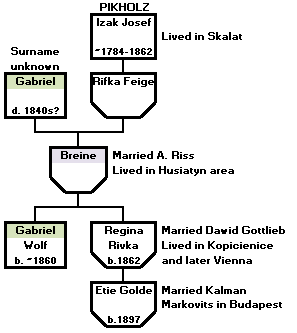
I had never heard of Etie Golde Gottlieb, but I knew her parents Dawid Gottlieb and Regina (Rivka) Riss, my grandfather's half first cousin. Some of the Riss family were recorded as Pikholz and that is why the record showed up in Lara's search.

Dawid Gottlieb was born in Kopicienice and Regina in Kolaharowka (near Husiatyn). Three of the five children I already knew about had been born in Kopicienice and my guess was that the other two were as well. Of the five, two died in childhood, two went to Vienna where one survived WWII. The fifth ended up in Sweden and no one knows what happened to her. Dawid and Regina also lived in Vienna where they died before the War.

So now we have a sixth, this Etie Golde who was born in Kopicienice in 1897 and married in Budapest in 1919, four months after her mother died. Etie Golde's husband Kalman Markovits was from Budapest. I am in touch with several of the Riss cousins and no one ever mentioned this couple. Nor am I aware of any other connections between our Riss family and Budapest.

But the name Etie Golde was familiar to me in another context connected to Husiatyn. Some time ago, I found an 1896 marriage record in Podwoloczysk for Wolf Feldman of Tarnopol and Etie Golde Pikholz, age 32, the daughter of Gabriel and Breine of Husiatyn. It was not at all obvious whether Etie Golde's Pikholz parent was her father Gabriel or her mother Breine, but the record appeared to me to be in error.

I had no couple named Gabriel and Breine, but I did have father-daughter and grandfather-granddaughter pairings, both connected to Husiatyn. And one of them lived in Podwoloczysk. So although this marriage record appeared in some way wrong, I recorded it as is.

The Gabriels and the Breines
So these (on the right) are all the people we know in the Pikholz family represented in the 1896 Podwoloczysk marriage record. Gabriel and Breine, one of whom is a Pikholz, and their daughter Etie Golde, born about 1864.

We have seven Pikholz named Gabriel from the Skalat area. Etie Golde's father is the second one in the following Gabriel Chart. I cannot attribute the third and fifth in the Chart to specific families and in any case, they both died as infants.


Nachman Pikholz (1795-1865) had a son Gabriel who had a granddaughter Brana. What's makes this family interesting here is that Brana's mother Chana (Gabriel's daughter) was born in Husiatyn and, after her marriage, lived in Podwoloczysk.

This is the first line in the Gabriel Chart above. The Gabriel on the last line is a grandson of this Gabriel, the son of Gabriel's son Moshe.

We might consider that if Gabriel's wife Sara died and he later married a Breine, he could have been the father of Etie Golde. But that is quite impossible as Gabriel died at age thirty in 1852, a dozen years before Etie Golde was born in about 1864. But the Husiatyn/Podwoloczysk angle remains intriguing.

Now we have this new Etie Golde Gottlieb, who has a grandmother named Breine and an uncle and great-grandfather named Gabriel. (That Gabriel is married to a Pikholz, so does not appear on the Gabriel Chart himself.) Etie Golde's uncle is the fourth line of the Chart and another cousin is the sixth line.

Obviously Gabriel Wolf Riss, the uncle, cannot be the father of Etie Golde who married Wolf Feldman, because he would have been only abut four years old when she was born.

We run into many coincidences in genealogy, particularly with repeated naming patterns within a family. But this triple Gabriel-Breine occurrence has me flummoxed, even before we find the name Etie Golde in two of those cases. Yes, I know that the two Etie Goldes are thirty-three years apart, but that too may be one named for the other or both named for the same person. Or maybe it's just a coincidence.

In the meantime, I shall send this blog post to the surviving members of the Riss family. Perhaps they can shed some light.


Housekeeping notes 
Order here.
European Jews have always married mainly within the tribe. Whether our numbers five hundred years ago in Europe were four hundred or four hundred thousand, the pool was limited. As a result, the members of the tribe today are all related to one another, multiple times.  This phenomenon, known as endogamy, makes Jewish genetic genealogy very difficult, often impossible. There is a similar phenomenon in some other population groups.

I was convinced that this brick wall is not as impenetrable as it seems, at least in some circumstances.

I believe that this book demonstrates that I was correct.

When I decided I wanted to write a book, I was not sure if I wanted to write a “How to” book or a “How I did it” book. The decision was dictated by the facts in the field. Different family structures, widely different numbers of living family members, and other similar factors dictated that writing “How to” would be irrelevant for most researchers.

“How I did it” is more likely to be helpful to the research community and more likely to instill the confidence necessary for such a project.

It is my hope that this book will encourage and inspire other researchers of their European Jewish families and other endogamous populations to say “I can do this!”


Thursday, February 9, 2017

Beyond A Doubt - Another Resolution


Presented most recently to JGS Toronto,
JGS Maryland and IAJGS Seattle
I have a lecture about dealing with things we are quite sure about but do not have the supporting proof. It may not even be available.

In that presentation, I break the general question into seven considerations and give an example of each. For each example I decide to accept the conclusion into my family database or to reject it for lack of sufficient evidence.

Example #5 deals with the family of Gabriel and Sara Pikholz of Husiatyn. They had a son Moses in 1851 and I have been quite convinced that this is the same Moshe who married Chana Muhlrad in Skalat and together they had eight children in the period 1874-1894.

I also believed that this Gabriel is the son of Nachman Pikholz who was born about 1795.

I discussed this family in some detail three years ago.

This is the family of Moshe who I would like to think is the Moses born in 1851.


Moshe's granddaughter Miriam Reiner told me that her grandfather had "died young," well before she was born in 1913, but could not be more specific. In fact, I found an 1894 death record for a Moshe Pikholz in Skalat, which seemed to make everything fit - but for one little problem. The Moshe in that death certificate was fifty-seven years old so could not have been born in 1851.

On the other hand, we had no unaccounted-for Moshe born around 1837, so the death record may have simply had the age wrong.

But I could not justify a decision to say that Moses from Husiatyn was indeed the father of the Skalat family and in the conclusion to my presentation, I left the matter unsettled.

A couple of weeks ago, Mark Halpern of JRI-Poland sent me a spreadsheet with 695 Skalat deaths during 1908-1915. That list includes twelve people named Pikholz and at least two other Pikholz family members with a different surname. Most of the twelve are listed without names of parents or spouses, so it is not always clear who the deceased is. For instance, there is a Josef Pikholz who died in 1909 and I am not sure if this is the one born 1862 or the one born in 1863.

The index also does not include towns of origin, at least not for our entries, but those may appear on the actual records.

The entries have ages, of course, and also house numbers. The actual records have always had house numbers, but they were usually not included in the index.


Moses Pickholz who died in 1908 at age 57, so would have been born 1851. This is a perfect fit for Moses from Husiatyn. So perhaps he is not the father of the Skalat family and there are two separate Moshes.

But the house number is 23. Six children of Tobias - Moshe's son - and two of his grandchildren were born in that house. Surely this must be Tobias' father.

Furthermore, the new spreadsheet has a four month old daughter of Tobias dying in that house in 1912.

So I can now say without reservation that the Moshe who had the family in Skalat was indeed the son of Gabriel and Sara and was born in Husiatyn in 1851. That leaves me with an 1894 death record for a different fifty-seven year old Moshe Pikholz in Skalat - who on earth is that?

I'll write about some of the others in that spreadsheet in a subsequent post.

Housekeeping notes
My daughter-in-law in New Jersey had a baby boy a few hours ago. I am not going to chance a flight home after a Thursday berit, so I am in the NJ area a few more days. If anyone in NJ/NY wants a program Wednesday 15 February, Thursday 16 February or Sunday 19 February, please let me know and we'll see what we can put together.

Sunday, July 27, 2014

We're Not From Galicia - We're from Vienna

Vienna
One of my favorite ancedotes when talking about my Pikholz research is about a fellow who lives across the road from where we lived until six years ago. His surname is Pickholz and he is about eighteen months older than I. He turned me down flat when I asked him years ago about his Pickholz ancestry. His excuse was "We are not from Galicia, we are from Vienna." Fancy people.

I got no further with his two sisters, who live in the Jerusalem area. We have crossed paths with the families of a couple of his kids as well, and no one has any interest in contact.

Fourteen years ago, I had some correspondence with Mrs. Heidrun Weiss of the Israelitischen Kultusgemeinde Wien (the Vienna Jewish community aka IKG) and she wrote, regarding the father of my neighbor:
"...Pickholz was born in 1919, June 1 in [Vienna] (2nd district, Taborstr.96). Mother Brane, father not [identified]. The birth is not official, that means it never was reported by mother or father, just by the nursing home."
I tried to follow up, but no information was available. So for nearly fourteen years I carried around this Brane Pickholz, probably born in the 1890s and nothing else.

I don't remember how many Pikholz descendants we had named Brane or Breine at the time, but even now we have only a dozen - ten from Skalat families and two from Rozdol. The only family where this name had any prominence is the Riss family, which I wrote about just two weeks ago.

Husiatyn - again
Logo for "The G" was designed by Assoc. Ed. Leo Albert
Lately I seem to be coming back to the small Pikholz family from Husiatyn again and again. In March, I wrote a blog post called "The Dead Man in the Zellermayer House" and I decided to expand it into an article for The Galizianer, the quarterly publication of Gesher Galicia. As it happens, the issue with that article came out a few days ago.

That article includes the following family diagram:

(A smaller version of this diagram appeared here when I discussed the Husiatyn Pikholz family back in January.)

As I reviewed the draft of the article, once again bemoaning the fact that we have no decendants of the two married children of Chancie and Joel Halpern, it occurred to me that perhaps their daughter Brane, born 13 January 1893 in Podwolocysk, just might be our mystery woman who gave birth in Vienna. in 1919.

Back to Vienna
I went back to IKG, asking if perhaps they had anything else on this birth or on the mother of the newborn. I mentioned the possibility that she might be the woman born in Podwoloczysk in 1893, and they came back to me with assorted forms to fill out - who I am, why do I want this information, where will I publish it, etc etc.

The actual birth record arrived some weeks later, and the mother is indeed identified as being born in Podwoloczysk on 14 January 1893. We won't quibble over the one day's difference.

There was no charge, but I sent a donation.

In my database, I added Brane's son, three grandchildren, twelve great-grandchildren and the two great-great-grandchildren that I know of. Surely there are more.

I wrote to my former neighbor and his two sisters on 12 June. None of them has replied thusfar. Wait until they find out I want some DNA.

Housekeeping notes
GRIPitt was wonderful. I had car and phone issues which detracted from the total experience, but that was not the fault of the program.

I gave a talk Wednesday evening on Special Challenges of Jewish Genealogy, which was very well received. Maybe thirty-forty people attended.
Earlier in the day, the rental car broke down while I was at the cemetery. Alamo was terrible about service and the only way I was able to get to my lecture was with the help of the eighty-nine year old woman who lived next door to the cemetery. At seven-thirty she drove me back to the college.

With Debbie Parker Wayne


Sunday, June 15, 2014

DID UNCLE JOE EVER LAUGH?

We join all the Jewish People in praying for the safe return of the high school boys
 Ya'akov Naftali ben Rachel Devora
Gilad Michael ben Bat Galim
Eyal ben Iris Teshura


This week we will mark the yahrzeits of Uncle Joe and Aunt Helen - she on Tuesday 19 Sivan, he on Wednesday 20 Sivan.  Fourteen years apart.

Uncle Joe and Aunt Helen are the older brother and sister of my father's parents. They lived in the neighborhood, on Morrowfield Avenue, or as my father used to say, above the Squirrel Hill tunnel. They were married fifty-two years, from Lag BaOmer the week before her seventeenth birthday. Aunt Helen loved saying that she was married when she was sixteen.

There was a big party for their fiftieth anniversary. We, of the younger generation were not invited. I was old enough to think I should have been there.

Uncle Joe was born Izak Josef Pickholz in Zalosce, east Galicia at the end of Pesach 1890, but like all our family's Isak Josefs of that period, was called Josef. His father's parents were Isak Fischel and Rivka Feige,  almost certainly both Pikholz. Rivka Feige's father was probably the "original" Isak Josef who died in 1862 at age seventy-eight.

He went to the US in 1903 with his father. Uncle Max had gone first, then Aunt Becky and Aunt Mary. His mother and the three youngest went about a year later. They landed in Baltimore on a ship called the Cassel and joined the older children in Pittsburgh, passing through countryside which looked remarkably like where they had come from.

When I began asking around a few months ago if anyone had ever seen Uncle Joe laugh, or even smile, Aunt Betty said "He must have." Well yes, he surely must have.

Aunt Helen was born in Budapest in 1896 and named after her mother's eldest sister Ilona Bauer, who had died in 1893 at  age thirty. She had been married to Lipot Weisel and I have no idea if they had children. Aunt Helen's Jewish name was Dobrisch and she hated it, even going so far as to instruct us that if we ever wanted to name a child after her, we should find some other way to do so.

The Rosenzweigs were fairly well off in Europe. My great-grandfather went to the US in 1901 and my great-grandmother and the children went together sixteen months later.

 Aunt Helen pretty much always smiled including here on the far left, probably aged nine.

Aunt Helen and Uncle Joe were blessed with their only child in their twentieth year of marriage. Margie too always smiled.

My younger cousin Linda writes

There are pictures of him [Uncle Joe] smiling (from the 50th anniversary party, at least). I can only remember being at 6315 [Morrowfield Avenue] a couple of times, and they were "festive" occasions. I honestly don't recall anyone being unhappy, but I can't specifically recall looking at Uncle Joe and seeing him laugh. There were always opportunities, though, as Cousin Harry was there, too, and everyone laughed because of him.

That party was apparently not a terribly formal event, as the following pages will show.  (remember, I wasn't invited.) Thanks to Amy and Larry Kritzman for finding me a copy on short notice.


 Uncle Joe was in the wholesale grocery business with his two younger brothers, Uncle Dave and my grandfather Morris. Uncle Dave was a wry and sardonic sort and I'm told that my grandfather - who died when I was nine - was the happy one, so it makes some sense that Uncle Joe, the eldest of the three, would have been the serious one. 

I always knew him as very thin, almost scrawny. But that was not always the case. Before his heart attack, Uncle Joe was significantly heavier, as in this 1941 picture. 

They closed the business when Uncle Joe turned sixty-five.

I asked Cousin Herb - Aunt Mary's son and by far the oldest surviving cousin - how he remembered the brothers. He wrote:

I have the same recall as Betty.  He was a sourpuss.  Now, My uncle Morris a jolly one, like a happy Irishman;

Uncle Dave a gentle sweet person with a backbone to stand up for his convictions. All three melded together so well in the business, but you should have heard the arguments at the weekly Bridge or Pinochle game.
They were card players, the lot of them. Not just bridge and pinocle but also canasta. The women too.

Aunt Helen was a character. During the war she was very active in war bonds and was honored by christening some kind of warship.

Aunt Helen was never bound by what other people thought. She would tell us jokes that she knew our parents would not have approved of ("What's the difference between mashed potatoes and pea soup?")  

She would bring some cooked dish when invited, but would never say in advance. Aunt Betty would say "If you'd tell me, I'd know how to plan the meal." And there would be feigned insults all around.

The one thing which was totally predictable was birthday and Hanukkah presents. It would always be a silver dollar.

Uncle Joe  always - in my day - gave the impression that he was not completely well and my mother was always very solicitous of him. My mother also worried about how he saw us. Once he stayed with us for a couple of days and dinner one evening was left-over turkey. We were not allowed to eat the bones. Uncle Joe might think we were poor.


 Amy suggested that perhaps because Aunt Helen "took up all the air in the room" - and she surely did - Uncle Joe was content to sit quietly and watch.

I supposed he must have smiled and laughed. But no one seems ever to have seen it.

The two couples, they and my grandparents, were close. All the way to the end.
With my grandson Avrohom, the week of his bar mitzvah


Housekeeping notes 
I have positively identified living descendants of Gabriel and Sara Pikholz of Husiatyn. Now I have to get them to talk to me. Not a simple matter. (Wait till they find out I want some DNA!)

My talk at the IAJGS Conference in Salt Lake City is one of those planned for their "LIVE!" program, so it can be seen by people who cannot attend. The panel I am participating in is also planned for "LIVE!" - the panel on Monday and my talk on Wednesday. As of now, I do not see any option to register for a single presentation. The cost for the program is $149 for the full week or $49 per day. They tell me, however, that speakers will receive free copies of their own sessions, which can be shown to family members.

In the last two weeks, six seven eight nine! family members have ordered DNA tests, including second cousins of three of my four sides.

Sunday, June 8, 2014

Differently Every Year - Remembering Skalat

The memorial for Skalat
I was not planning on writing about the annual Skalat memorial this year, except perhaps a brief passage at the end. I have written about this previously on this blog - here and here and here. The meeting is important, but not what you would call "interesting." Pretty much the same from year to year.

We met at five o'clock Thursday afternoon, the seventh of Sivan - which outside of Israel is the second day of the Shavuot holiday.

There is a whole row of town monuments along that stretch. Maybe thirty or so. At the other end is Husiatyn, a town near Skalat which I have written about here and specifically about the Zellermayer-Pikholz connections here.  Near that is a monument to Vileika, where many of my mother's Gordons lived in the early and mid 1800s, probably earlier too. There is Pleshchenitsy where my Gordon grandfather's mother, Anna Kugel, came from. And Zbarazh, not far from Skalat, where we had other Pikholz families.

We were about twenty-five or so. Zvika Sarid led us. We lost his mother's brother Mottel Weissman a few months ago, so again we all said kaddish together. We did that last year when Mottel was too ill to attend. Zvika pointed out that there were only four people in attendance who had actually lived in Skalat. The rest were children and grandchildren, plus a few spouses. I wondered about some of the missing. I knew that Tonia Winter was not well, but her daughter always came. And Giza - she is young for a Holocaust survivor. Giza came a few minutes later.

Zvika's daughter Chava took a picture of their mother Yocheved standing next to the monument and I made a comment about the monument's being the same as it was last year. But of course, that is not the point. The point is that while Skalat is frozen in time, Judenrein for seventy-one years, Yocheved is not. She left, made aliyah, married had children and grandchildren. That is what Chava was recording. Her mother growing older.

Some of the topics of discussion at the last few memorials were not mentioned. Nothing about the monuments in Skalat itself or the money to maintain them. No one spoke of plans to go back to visit. Skalat had been planning to make itself a five-hundredth birthday party last August. No one mentioned that either.

Mottel's daughter Chanaleh had written something years ago - perhaps a school project - about the yearly visit of the Rebbe of Husiatyn, who used to spend several weeks in Skalat on his way from his home in Vienna to his father's grave in Husiatyn. This was along the same lines as Tonka Pikholz had written in one of the Skalat memorial books. Tonka herself is buried in Holon and her sister's son and daughter visited her grave, as they always do. Tonka would be a hundred this year.

Zvika read from what Chanaleh had  written, which included something about the Rebbe's friend Yosef Milgrom, on whose property there was a small house in which the Rebbe stayed in Skalat. People came from all around to seek his advice and blessings, including the non-Jews.

Bronia said that no one was left from Yosef Milgrom's family.

So I spoke up. And told this story. Three years ago, I spoke at the IAJGS Conference on Jewish Genealogy in Washington DC, and in the course of my talk mentioned the Husiatyner Rebbe and his visits to Skalat. I spent the following Shabbes in Lakewood NJ, where my son and daughter-in-law and family were spending two weeks at the yeshiva. Someone asked me who I am etc and I said I am a genealogist, so he said that one of the rabbis who was there at the time had just written a book about his family.

I had a look at the book and saw a chapter about the Husiatyner Rebbe. So I went over to the writer, introduced myself and told him that I had just referred to the same subject in my conference talk. Across the table from him, and quite unrelated to him, sat an older woman who said "My husband's uncle Yosef Milgrom, built the hoiuse where the Rebbe used to stay when he was in Skalat."

"Small world" is a cliche, but cliches generally come from some truth. And Bronia was pleased that Yosef Milgrom has living family.

Zvika announced that he wanted to introduce something new for the memorial program. He read from the Hebrew version of the Weisbard memorial book, a personal testimony by Yoel Ben-Porath (Julek  Weinraub), as transmitted in 1995 to Lusia Milch. Zvika wants to "feature" a Skalater each year at the memorial meeting. He already told Zvi Segal that he wants him to prepare something about his father Shammai for next year.

No one wants to be the first to leave. We all hope that everyone will be there next year.

Other cemeteries
I usually use the day in the Tel Aviv area for other cemetery matters.

Gil Mordecai Scharf is a third cousin of my wife's, buried in the military section of the Holon cemetery.

He was a gunner in a tank and was killed during Operation Shelom HaGalil in 1985. He was nearly nineteen.

I went to the Kiryat Shaul cemetery to visit the two Zellermayer graves that I wrote about not long ago. Avraham's grave has his full birth name "Avraham Isak ben Zalman Yehudah." I wasn't sure it would, as his children's graves just have "Avraham." His yahrzeit was the day after my visit.

Also in Kiryat Shaul, I visited the grave of Zvi (Stanislav) Domnivsky. I mentioned him three weeks ago when I discussed the family of my Uncle Jachiel. Stanislav had submitted Pages of Testimony for two of Uncle Jachiel's Tunis grandsons and had defined himself as a relative. I was hoping the gravestone would give me a clue exactly how he was related. But it did not.

From there I went to the Yarkon cemetery to the grave of Stanislav's daughter Lydia.

That did give me some information. It says "My dear mother."

I will have to contact the burial society to see what they can tell me about the son or daughter - who probably has no idea who the Tunis family is.


Housekeeping notes
Occasionally I order records from Polish State Archives other than AGAD, when I need something for myself or for a client.  I made an exception recently when I placed an order with the Przemysl Archives - my sixth time ordering from them.

They are awkward to work with. They require statements explaining how the person placing the order is related to the person in the record, they send poor-quality paper copies by mail rather than scans, they cover up the other records on the page lest someone learn something that hasn't been paid for - and they take a very long time to process the orders even after they have been paid.

But in this case, a family member wanted  ten records on his other side, so I gathered up a few other people and placed an order on 11 September. The records came this week. Finally. One person received the single record he ordered. One got nothing. Another received part of an order. The original fellow who wanted ten got three of the ten, but also a handful of others that he hadn't ordered.

I think I am finished with Przemysl. (As my father would say "Famous last words?")


Sunday, March 16, 2014

The Dead Man In The Zellermayer House

Last week, I wrote about the new acquisitions from the AGAD archives, including the 1909 marriage record for Abraham Eisig Zellermayer and Basie Pudles and the 1910 birth record for their son Jonas.
For convenience, I placed the record higher on the page, adjacent to the headings


According to this record, Abraham Zellermayer was born 27 February 1883 in a town called Liczkowce, near Husiatyn, to Zelman Juda Zellermayer and Ettel Pikholz.

This index entry from JRI-Poland appears to be the birth of his father. The actual record is just below but it is very difficult to read. (Thanks to Mark Halpern for his help with that.)


The second line is the birth of Selman Cellermayer. I was hoping for a house number. No such luck.
There are several connections between the Pikholz and Zellermayer families, as shown below, with the Pikholz shaded blue and the Zellermayers shaded yellow.  I am not sure exactly how the Zellermayers on the right connect to those on the left, but there are clear indications that they do, including the fact that one on each side (in red) was born in Liczkowce.


I have been particularly interested in Chaje Cirl Pikholz in the top right corner. I haven't a clue who she is.1 We have no other children for her.

It had been my impression that Abraham Zellermayer and his wife had come to Israel in the 1930s, but I had never found any
Adolf & Julius in the Citizenship index of the Mandatory Government.
Adolf is shown here as born 1883 in Liczkowce.
trace of them here and the two granddaughters I know have never been particularly communicative. But once I learned from the marriage record that he had been born in Liczkowce in 1883, I realized that I did have evidence of his arrival. I just hadn't realized that on his Mandatory Citizenship file, he had gone by Adolf. I already had the file for his son Jonas, aka Julius, and it was easy enough to copy Abraham's as well. Basie went by Berta. They had lived previously in Vienna.

When I sent the marriage record to the granddaughters, one of them told me that Abraham and Batya, as she was known here, were buried in Tel-Aviv's Kiryat Shaul Cemetery, which is online and where I had not seen them before. This time I searched by given names and fathers' names and found them.
Deller Meyer Batya and Fellermayer Avraham in the database of the Greater Tel-Aviv Burial Society


I shouldn't have been surprised. I already knew that their younger son was listed as Max Zeller Meyer. Next time I am in the area, I'll photograph their graves and add them to our Virtual Cemetery.

So that should have wrapped up this inquiry, at least for now. Except for the matter of Gabriel.

I  have mentioned the family of Gabriel and Sara Pikholz from Husiatyn several times, including in connection with some of the new records last week. In fact, I wrote at some length about their family only two months ago. Gabriel Pikholz died in Husiatyn in 1852 at age thirty. I believed (and still do) that Gabriel was the son of Nachman Pikholz (b. ~1795) and the father of Moshe Pikholz, whose family appears here.

What I did not mention before is precisely where in Husiatyn Gabriel Pikholz died.

House number 70 in Husiatyn is where one of the Zellermayers lived. We see that Feige Zellermejer died in house number 70 just four weeks before Gabriel, identified as being "from Skalat," died in that same house.

My impression has been that this is where Gabriel stayed when he went to Husiatyn, very likely for some reason to do with his Hassidic rebbe.

I do not know exactly who this fourteen year old Feige is. I have not tried to piece together the Zellermayer clan and we do not have access to the full set of records.

But I do have a full copy of the Husiatyn death records for the period 1816-1876. I started looking through them in reverse order and saw that none of the later ones had house numbers.

Except one. From 1869.

Down at the bottom of the page, in house number 70 is the death of Abraham Eisig Zellermayer, age 73.

Well, we have a birth of Selman (=Zalman) to Abraham in 1859 and he is very likely the father of the Abraham Eisig born 1883. If this Abraham Eisig who died at 73 in 1869 is Selman's father, it would mean Selman was born when his father was past sixty. Maybe. Or maybe not.

We have a thirty-one year old Malka Zellermayer who died in house 70. That's the name of Selman's mother. But this Malka died in 1851, so she wasn't the mother of the Selman born 1859. (No "maybe" about that.)

There was a Juda Zellermayer who died in that same house in 1850 at age twenty-eight and a Nisin(?)2 age ten in 1836 and a baby named Baszie in 1830. There is also a Chanzie Mariem Celler in 1837 and I am assuming that she is also Cellermayer.

The only non-Zellermayer who died in this house was Gabriel Pikholz. But it would be a leap of faith to cite a family connection between Gabriel and these particular Zellermayers - who may or may not be the family of "our" Abraham Eisig.

Or maybe there is one more Pikholz-Zellermayer marriage we hadn't known about. After all, we have no idea what Gabriel's wife Sara's maiden name was. Perhaps Gabriel's presence in Husiatyn (and the birth of his son Moshe there in 1851) had nothing to do with the Rebbe and everything to do with his wife's family.

Now if I could only get some DNA from a couple of Gabriel's putative descendants and from the Zellermayer granddaughters, I could perhaps muddle the picture further.

A happy Purim to everyone.

1 After considering that Gabriel is probably the son of Nachman Pikholz, it is tempting to think that Chaje Cirl (top right corner of the tree chart) might be his sister. But we are pretty sure that Nachman had a year old daughter Cirl who died in 1840. That pretty much rules out his having a daughter Chaje Cirl who had a child in 1848.

2 The handwriting on the 1836 death record is not clear, so I crowd-sourced it on JewishGen. The results were Nisin-32, Ruven-10, Bevin, Nevin and Besin five each, and a handful of names with one "vote" each. In fact, we know that there were Zellermayers in Husiatyn named Rubin. We do not know of any Nisin (Nathan, Nisan, etc.)

Sunday, March 9, 2014

Nine New Records from AGAD

Until about a year ago, east Galician records were available from the AGAD archives in Warsaw, based on the indexing done for JRI-Poland. During the previous five years, I had placed about two dozen orders for these records - for my own research, for other people and occasionally for research clients.

Then last year, AGAD put those records online and there was no longer a need for these cumbersome orders.

But in the meantime, new records have become available, some listed at JRI-Poland and some in the All Galicia Database of Gesher Galicia and among them were a few records I wanted. This order took a long time to put together because I kept hoping that additional indexed records would be posted, but finally I decided to go with what I had.

Seven records in this order were for other genealogy researchers, six of them for people in Israel. One wanted his record to help him acquire Polish citizenship. Two others were for a man in my shul, whose family comes from Rozdol. The other nine were Pikholz records.

All told, there were a dozen births, five marriages and one death. Seven were from Podwoloczysk, four from Rozdol, three from Lwow, and one each from Drohobycz, Rohatyn, Skalat and Zbarazh.

The records arrived a few days ago via an online link. The total of eighteen were actually seventeen, as two of the Rozdol records were on the same page. In one case, they sent the wrong page and I have requested a replacement.

So here are the nine new Pikholz records.

Nachman, born to Abraham Pickholz and Lea Gelbling in Drohobycz
We already had a death record for this child. He died after only sixteen days. The birth  record shows that he was born 21 September 1911.

We do not know for certain who this Abraham Pickholz is, but I would guess he is part of the family we call IF2, where the name Nachman is prominent..

We know of two sisters before born Nachman, Hinde Feige and Sara Rivka.

Sara Lea, born to Markus Pickholz and Blime Jubjener in Rozdol
Here too, we cannot identify the father's place in the Pikholz structure, as the name is common and there is no identifying information on the birth record. The mother's name also appears as Jupiener.

The birth date is 19 July 1904. The couple had older children Matias and Gittel and a younger son Michal.

Gittel Rappaport, born to Josel Rappaport and Ryfka Luftschein Pickholz in Rozdol
We know this family, although the living descendants have not been willing to speak to us.

The family went to the US in the late 1920s. Gittel was the second of four children. She married Mayer Heilweil and died at age thirty-two.

Gittel's mother is the daughter of Fischel Pickholz and they lived in Bialkes, near Skole - which is where her older brother's birth was recorded.

Josel Rappaport  was from Zurawno - so Gittel must have been born when they were visiting some part of her mother's family in Rozdol. The birth was 1 January 1905.

Izrael Pikholz, son of Moses Hersch of Kaczanowka, recorded in Zbarazh
This is a death record. Izrael is thirty-five, died of cancer and was married. He died 20 April 1909 and was buried the following day in Zbarazh.

We know this family. The deceased had five younger brothers and sisters that we know of.

The best fit I see for Izrael is a man who married Ester Lyncyz. They had a daughter in 1901 who died at birth. But maybe not.

Etie Golde Pikholz, daughter of Gabriel and Breine, marries in Podwoloczysk
This is an odd one. The marriage took place in 1896. The bride is identified as being thirty-two years old and her parents are from Husiatyn. But Gabriel Pikholz of Husiatyn died in 1852, a dozen years before Etie Golde was born. And in any case, the wife of that Gabriel was Sara, not Breine.

The groom is Wolf, the son of Hersch and Male Feldman of Tarnopol.

There is a four-part note which appears to be just technical matters, but we are trying to determine if there might be some interesting information there.

And perhaps there is a Feldman descendant out there somewhere.

Abraham Eisig Pikholz (Zellermayer) marries Basie Pudles in Podwoloczysk
This is a record that I have wanted for years but had my doubts about ever finding.

We knew that Abraham was a grandson of Eliezer and Chane Chaje Pikholz, but had no idea what his mother's name was. Abraham and Basie had three children who all lived in Israel. One granddaughter is a well-known (if you are old enough) radio personality who in recent years has been writing Hebrew subtitles on Sponge Bob and other cartoon shows. Another granddaughter is the wife of an old boss of mine.

So now we have the record showing that Abraham's parents were Zalmen Hillel Zellermayer and Ettel Pikholz, that he had a second name Eisig, that he was born in 1883 and that the marriage took place 29 June 1909.

There is also a lengthy note which we are working on. After we get that figured out, I'll send the record to the granddaughters, as best we can tell, my fourth cousins..

And they had a son in Podwoloczysk
In May 1910, Abraham and Basie have a son. We knew this, of course, but now we have the birth record.

Jente Halpern (Pickholz) marries Schamschon David Sirki in Podwoloczysk
We know this family - or at least we know the bride's parents. She was born in 1884 to Joel Halpern and Chana Pickholz of Husiatyn. Chana is the daughter of Gabriel and Sara whom I mentioned above.

The marriage took place in 1911. One of the witnesses, Salomon Lynczycz was also a witness at the marriage of Etie Golde above. We have two Pikholz men married to Lynczycz women, but I don't see a connection between either of them and a Salomon.

I have not seen the surname Sirki anywhere else. I'd really like to find a descendant.

Ester Reizie, born to Basie Pickholz and Schaje Wolf Jorysz in Podwoloczysk
This is the fourth child we have for this couple. The birth was in August 1909. Ester Reizie was married in Grzmaylow in 1939 to Ojzer Swartz. (We also have a marriage for her older sister.)  We have nothing further.

Basie - or more properly Chaya Basie - is the daughter of Josef and Fradel Taube of Tarnoruda. This should be the RITA family. We do not know if Josef or Fradel Taube is the Pikholz.

I am told that there has been a new transfer from the Civil Records Office to AGAD, but we do not yet know which towns' records those would be.


Sunday, January 19, 2014

H is for HELLENBERG, HALPERN, HUSIATYN

Wednesday at Yad Vashem - The visit was not meant to be
A couple of weeks ago, I went to Yad Vashem to do some work in the International Tracing Service (Arolsen) database for a client.

When I got there I found that the database was down. Obviously it was not meant to be, at least not that day.

Hellenberg
In the days that followed, I learned a few things about one of my Pikholz puzzles.

In earlier visits to the ITS database, some years ago, I found these two cards.


Mendel and Frieda Pickholz, a married couple, he born 1883 in Podwoloczysk, died in 1941, she born 1893 in Czernovitz, released from the ghetto there in 1944. A handwritten note with a 1965 date seems to indicate she survived the war. Maybe she is a Hellenberg. It's not clear what the Halpern is doing here.

I ordered the files from Germany. Aside from the fact that Mendel died in the Czernovitz ghetto, my German-speaking friends could not add much.

Then came two breakthroughs, two weeks ago. First I received the 1923 Czernovitz marriage record for Mendel and Frieda, thanks to Daniel Horowitz of My Heritage. The next day, I heard from Batya Unterschatz that she had located Freida living in Tel Aviv until her death in 1971. In the same apartment was Bella Hellenberg, about the same age, perhaps a sister-in-law. Batya was not able to identify family members of either woman.

Defining Mendel
Here is the marriage record - the second one on the page.

Groom: Mendel Pickholz, son of Joel Halpern and Chana Pickholz; Bride Freida Hellenberg - with a note
Well, I certainly recognize the family of Joel Halpern and his wife Chana (sometimes Chancie) of Husiatyn. Here they are, with Mendel and his wife Freida at the bottom left.


I believe that Gabriel is the son of Nachman Pikholz (b.1795) though I have no actual evidence.

I also believe that the son Moses, born 1851, is the same man who heads the family we call TONKA. Here we have a bit of indirect evidence. Tonka is Moses' granddaughter and lived in Skalat. She wrote a piece in the Skalat memorial book about the Rebbe of Husiatyn, who used to spend several weeks a year in Skalat. Tonka's father Tuvia was a Husiatyner hassid and that fact may be connected to the fact that Gabriel - a Skalater - lived in Husiatyn.

If the two Moses are the same, we have living descendants of Gabriel and Sara. Of Chancie's children, we have not found any descendants beyond the above chart, but perhaps the newly-found marriage of Mendel and Freida gives us something to work with.

I found what the note on the marriage record says. Mendel and Freida were divorced in Czernovitz in 1936. That  explains why Freida was using her maiden name Hellenberg in Tel-Aviv.

 I did some searching in the yizkor books listed on JewishGen and found a listing in Husiatyn for "Yoel, wife, daughter Chanchia, Sons Moshe, Berl and Fishel." Close, but not quite what I wanted. But since I'd be going back to Yad Vashem in a few days to do that client work that I hadn't done a few days earlier, I figured I should have a look at the actual Hebrew version of the Husiatyn book as well as seeing if the ITS database had anything on the putative sister-in-law Bella Hellenberg.

I also decided to go to Kiryat Shaul Cemetery in Tel-Aviv, to visit the graves of the two Hellenberg women. I wanted to see if the stones said "our mother" or "our sister" or what and if there was any additional memorial to family killed in the Shoah, as is often done here.

The following Wednesday - Yad Vashem and Kiryat Shaul
Wednesday morning, I went to Yad Vashem, set myself up for a look at the ITS database and asked my friend Zvi, who was on duty in the library, for the yizkor book for Husiatyn.

First I did the work for the client.

I found ITS references to a Bella Hellenberg, but not the right woman.  I found the Joel Halpern family in the Husiatyn book but there was nothing beyond what I had already seen in the JewishGen translation.

I did find ITS references to the wrong Joel Halpern and figured I may as well order those files. The file numbers didn't make sense and I went to discuss it with Zvi, returning the Husiatyn book at the same time.

As I waited for Zvi to get off the phone, I saw a man in hassidic-dress looking at the Husiatyn book that I had just placed on the counter. I asked him not to take it until Zvi has written that I had returned it. Turns out he works at Yad Vashem and has some Husiatyn interests as well. But the person who REALLY knows Husiatyn, he told me, was out in the lobby.

David Margaliot came in a few minutes later and we introduced ourselves. Also a man in hassidic dress, he runs an organization called Maagarim in Ashdod. Something about international archival services and a Husiatyner hassid. We exchanged cards and will speak later, but now I see why the visit the week before had not worked out. It was this week that I was meant to come to the Yad Vashem research library.

I proceeded to Tel Aviv. and found the two graves in Kiryat Shaul.

Freida Hellenberg, sister and aunt. No possessive pronoun - "my" or "our. "

Bat Mordecai and Chani from Chernovitz.

And her date of death.

So there are no children, but at least one brother or sister, living at the time of her death in 1971, probably here in Israel.

I submitted a request (it carries a fee of NIS 50) to the burial society for information on next of kin or other family information and I hope to hear from them soon.

There are niece(s) and/or nephew(s) - whom I can probably find - but whether they know anything about the family of the aunt's ex-husband is another matter.
Bella Hellenberg is called Betti. "My dear mother, my dear sister." Nothing else I didn't know.  She died in 1957 at age sixty.

Neither of the women's stones mentioned family lost in the Shoah.

The possibility that Betti/Bella's son or (more likely) daughter knows anything is pretty remote, but if nothing turns up with Freida's people, I'll check Betti's.

I am not optimistic, but progress often comes as a surprise.

Housekeeping notes
1. I am to be interviewed this week by Marian Pierre-Louis who does a weekly podcast with genealogy professionals. It should play next week

2. We have a set of matches between Pikholz and Kwoczka family members and my eighth grade math teacher and her daughters.

Sunday, September 22, 2013

A FEW NEW RECORDS

About a month ago, the following announcement showed up on several of the JewishGen discussion lists.
This is just the beginning. It continues on for several more paragraphs.
Note the reference to the All Galician Database as AGD, not to be confused with AGAD, the Warsaw archives which holds most of the available vital records for east Galicia in the late 1800s.

Having interests in most of the towns with the new records, I decided to have a look. Their drop-down menu did not include Skalat and Podwoloczysk (or for that matter Brzezany) among its choices, so I did a search for Pikholz records from Grzymalow, which is quite near Skalat.
The actual search. (I added the red arrow for the readers' convenience.)
The search produced thirty-two results, six of them from Grzymalow, the rest from elsewhere in east Galicia. Thirty-one showed the name Pikholz  - one was Pekules, which is reasonable as a sound-alike. I already had most of these records and I have actually met some of those mentioned in the Grzymalow school records. And it turns out I get the same thirty-two records regardless of which town I ask the system to search.

I would like to tell you about the four which I  am planning to order, all from the Podwoloczysk.records in the AGAD archives.
  
Prof. Jonas Zellermayer came to Israel form Vienna when he was twenty-four and lived here 
for nearly seventy years. His son-in-law was my boss thirty-five years ago.

Everything we have here lists his father as Avraham, without the second name, so we now know that his father was actually Avraham Yitzhak. One odd thing with this family - we know much  about Avraham's family, but not his parents' names. We know the names of the grandparents and his Pikholz great-grandparents, his mother's three brothers and two sisters, but we know neither the name of his Pikholz mother nor that of his Zellermayer father.

But now we know, as their marriage record was the great surprise of this new set of indexed
records. Jonas'  father Abraham Eisig was the son of Zalmen Juda Zellermayer and Ettel Pickholz.

The fact that he came from Liczkowce may also prove useful as we have several Zellermayer-Pikholz connections and it is not at all clear if there is a larger family story to be told.

In fact, at least three of the four  records I cite here are in some way connected to Zellermayers. 

In the meantime, I sent the marriage entry to the two granddaughters of Abraham and Basie and as a result had my most significant interaction with either of them in some years. Those two granddaughters are, by the way, named after Basie's parents Don and Rifke.

We have a Pikholz couple named Gabriel and Sara who lived in Husiatyn. They had a son Moshe in 1851 and a daughter Chanzie. Gabriel, who was described as "from Skalat" died in
1852 at age thirty in a house associated with a Zellermayer family. Our only knowledge of Chanzie is that she was married to Joel Halpern and lived in Podwoloczysk, which we learn from the 1887 death record of their young son Isaak and the 1893 birth record for their daughter Breine. We know nothing further of Breine.

The new records include the 1911 marriage of their previously unknown daughter Jente to Schamschon Duwid Sirki, son of Mechel and Ester. Thusfar, I have not found other references to the surname Sirki, but it would be great if we can find some descendants.

And this one must be related too. In 1896, we have the Podwoloczysk marriage of Wolf Feldman, age 29, son of Hirsch and Male of Tarnopol to Etie Golde Pikholz, the thirty-two year
old daughter of Gabriel and Breine of Husiatyn.

This cannot be the same Gabriel above - that one died 1852 and this one had a daughter in 1864. Nor can it be any other Gabriel we know. And although we do not have any ther couple named Gabriel and Breine, we do have the one Gabriel with a granddaughter Breine and another whose mother is Brane. It all seems to revolve around Husiatyn.

I haven't a clue how this couple fits in, but the existence of the marriage record opens the possibility of finding some Feldman descendant.

So I must see if I can find anything else of the Sirki and Feldman couples - nothing so far. I will also order the four records themselves from AGAD, as these are not online.

I plan to see if others want to order anything, so that I can put together a larger order, so I asked if any other new records will be added to the All Galicia Database in the coming weeks. (No sense in placing an order and finding out two weeks later that it could have been bigger.) The answer I received was "Nothing that would be from AGAD."

One other odd one. A couple of weeks ago, Jurek, a research colleague in Sweden was
looking at a 1938 telephone directory that Logan Kleinwaks had just uploaded to his wonderful site. There was a listing - apparently a business - for "Pickholz i Wachs" in Skalat. The telephone number is 8. Nothing else but the street name.

This is very strange, as there are no other Wachs in Skalat, at least during the earlier period for which we have records.

But we do have some sort of undefined relationship between the Wachs family of Zalosce-Podkamen and my own Pikholz family  who lived in that same area. So I cannot just ignore this.

I have asked one of the surviving Skalaters here if she knows anything about this business or the families involved and I plan to ask others as well.


- - - - - - - - - - - - - - - - - - - - - -
If you missed my piece about Uncle Kenny last year, you might want to have a look. His yahrzeit is Monday.