Showing posts with label Gesher Galicia. Show all posts

Sunday, July 4, 2021

Wolf Pickholz

ANNOUNCEMENT TO SUBSCRIBERS

Blogger - the host of this blog - has announced that "the email subscription service will be discontinued in July 2021," meaning that subscribers will no longer received notices of new blog posts. Those who follow me on Facebook (or Tracing the Tribe or Jewish Genealogy Portal) will see announcements there. I will put together an email list, as well. Let me know if you wish to be included on that list.


Wolf and Ryfka Pickholz: Voters for the Polish Senate

The name "Pikholz" in its various forms, is both uncommon and unusual, so when people see it, they notice. Since I have been in contact with so many researchers over the years, I hear from people from time to time that they have run across a Pikholz reference that I had not previously seen. I received one of these about two weeks ago from a fellow named Oded Vardi, with whom I had a brief correspondence eighteen months ago.

1928 Polish Senate Elections
Oded has Skalat and Grzmaylow interests and was looking at records of voters in the 1928 Polish Senate elections, for people registered in Skalat. He passed on this listing for Wolf and Ryfka Pickholz, both age 52. Wolf is not a common Pikholz name. It appears in my Given Name Analysis only thirty-two times, seventeen in Skalat families and fifteen in Rozdol families. One of the seventeen from Skalat is married to Rivka Reisel with known children born 1896-1907 - so the age fits. I do not consider it jumping to conclusions to say that the couple in the elections list is the one we already know.

Wolf and Rifka Reisel's first child married a man named Izak Bergman in 1923 and we know nothing further about her. The second died at seven months. The third was killed in the Holocaust, with a wife and children. The fourth died in Israel, just short of her fortieth birthday, leaving a young son and a fifteen-month old daughter. I have been in contact with the daughter over the years. She is always polite, always answers my letters, knows nothing about her mother's family and has no real interest in the family history. She has declined my suggestions to do DNA.

The issue with this family is that we have no parents for Wolf, though we do for his wife Rifka Reisel. Wolf, who was born about 1875-6 could be a descendant of any of the Skalat Pikholz ancestors from the period 1780-1805.

From my Given Name Analysis

Horodnica

But this new document has one bit of new information. The voters are Skalaters, but did not necessarily live there at the time. The towns of residence are listed in the left-hand column and Wolf and Ryfka are listed as living in Horodnica.

Horodnica, on the road from Skalat to Husiatyn
Horodnica is 18 miles (29 km) SSE of Skalat towards Husiatyn, in the Kopicienice District and according to the JewishGen Communities Database had 21 Jews in 1920. I have discussed our connection to Husiatyn several times, including here and here but I have not mentioned Horodnica until now - yet it is a town I have seen in our records.

David Samuel Pikholz, who lived in Skalat and died 30 October 1920 at age 68 was married to Freude Linczycz of Horodnica. Freude died 12 November 1930 at age 75. They had three children that we know of - Golde (1878), Marjem (1879) and Chanzie (1880). I am thinking that Wolf may be a child of this couple and wonder if perhaps he and his wife moved to Horodnica after David Samuel died, to help look after his widow Freude.

Keep in mind that in 1877, there was a major change in record-keeping in Galicia and it doesn't surprise me that we find no record for Wolf in 1875-6. Wolf's missing birth record is a problem regardless of who his parents are, not specific to the David Samuel - Freude hypothesis.

I am not yet recording Wolf as the son of David Samuel and Freude. My own rule says that absent clear documentation, even once I am certain, I must find at least one more piece of supporting evidence. But it feels like I am on the right track.

David Samuel  

Even if this hypothesis is correct, I remain stuck at David Samuel, whose parents are unknown, or at least not identified. (As a side note, David Samuel is a name which appears multiple times in the Rozdol Pikholz branch, but only twice in Skalat. You can see a brief summary of those here.)

Gesher Galicia has recently made available some new birth indecies, including Skalat for 1827-1858. They are available to members only and are very difficult to work with, though the writing is clear. And since they are only indecies, they do not show parents' names or other critical information. I see no David Samuel (or David or Samuel) on any of the "P" pages, though I would expect to see this one in about 1852.

Perhaps he is listed under a different name (his mother's, for instance) but I would have to comb through the forty-six pages of scans to find even a candidate for ours. It is now on my to-do list.

Linczycz

Let me mention that David Samuel and Freude are not the only Pikholz-Linczycz couple. Ester Linczycz (also from Horodnica) and Israel Pikholz had a daughter who died at birth in 1901. I have no idea how these two couple are related, on either the Linczycz side or the Pikholz side.

My friend Jill Chozen is a Linczycz descendant from Horodnica and I have begun a bit of inquiry into that rabbit hole, in case there is more than meets the eye. Ester is definitely a sister of one of Jill's ancestors.

Sunday, September 23, 2018

The Murder of the First Pikholz Family in Tarnopol

Early Pikholz families in Tarnopol
We know that there were Pikholz families in Skalat - about 19 miles or 30 km ESE of the provincial capital Tarnopol - just before 1800. Later in the 1800s we find Pikholz families and individuals in nearby Mikulince, Grzmaylow, Kacanowka, Zbarazh, Klimkowce, Husiatyn and Tarnopol and its suburbs. Later we find Pikholz families in Kozivka, Buczacz, Terembowla, Podwoloczysk and elsewhere. Most of these individuals and families are traceable to known Skalat families.

But some are not. Almost certainly they come from our known families but the records don't give enough information to work with. For that matter, we have fifteen-twenty Pikholz deaths in Skalat itself whom we cannot identify.

In the case of Tarnopol, we have a few like this. Pikholz infants named Samuel, Perl, Gabriel, Moses and another young Samuel died during the period 1848-1852. Do they all have the same parents? Maybe, but we don't know.

Menie Beyle Pikholz died in Tarnopol in 1867 at age twenty-six, but she may have been a Pikholz spouse.

Jankel Pikholz was born in Tarnopol in 1854 to Marcus and Ruchel.

The 1910 Tarnopol census shows a Herman Pikholz, age 66, "born in Tarnopol."

These are the earliest records of Pikholz descendants living in Tarnopol. That would have been about 1844.

The murdered family
That changed last week when Gesher Galicia announced the availability of several new record sets including
Tarnopol (Ternopil). TsDIAL, Fond 701/1/328, 331, 332 and 334
 - Jewish deaths, May 1845-December 1869 (10,662 records).
I went to Gesher Galicia's All Galicia Database and searched "Pikholz" using the "Records added in the past month" filter


Among the search results were these:
A whole family - Abram Pikholz, his wife Welle, daughters Esther and Sara - all died on 22 March 1855 and son David died three days later. (I was not familiar with the female name "Welle" but others tell me that it indeed occurs in their families. Perhaps it is a female version of Welwel.)

And it's spelled in the German way, with a "c" - perhaps it was the custom in the provincial capital.

Tony Kahane provided the actual record and wrote:
I found the page from the Tarnopol D 1854-1857 records listing the deaths of the five members of the Pikholz family in March 1855, in Borki Wielkie, near Tarnopol. These deaths were not from cholera (unlike many others in that year). The part of the note that it is easier to decipher (attached screenshot) is line 3 and  the beginning of line 4:
"… in der Nacht v[on] 19. auf 20. d[ieses] M[onat] ermordet …".
These people were murdered in the night of 19-20 March 1855.

Roger Lustig had a look at the German-language note on the right and wrote:
was, at the Sbrutin (?) Inn in Borki wielkie, on the night of the 19th-20th of the month, murdered, and, as a result of Imperial and Royal [something] order of 20 March 1855 No. 4363, 
So the family were murdered at the inn in Borki Wielkie (currently known as Velikiye Borki) six miles ESE of Tarnopol. Were they passing through? Did they live in Borki? Were Abram and Welle the innkeepers? How is this family connected to the deaths of children in Tarnopol whom we had already seen?

Well, they seem to have lived in Borki. An additional record in the new set is this:
One-month old Chajem Moses lived in Borki and died 22 December 1854, three months before the murder. This seems to be the same family, living in Borki. So they were at the inn but lived locally. 
The actual death record of Chajem Moses
 Who is Abram?
The father, Abram, was thirty-two when he died. That seems to make him the first Pikholz in Tarnopol, though there I doubt that he was born there. Who is he? Who are his parents? How does he connect to the known Pikholz families from Skalat? 

The only other Avraham from the Skalat area, born before the 1870s is a son of Nachman Pikholz and he was born about 1841, so there is a good chance he is a son of my third-great-grandfather Izak Josef. In fact, we have no children for Izak Josef between Berl (1816) and Selig (1830) so it is reasonable that there are missing children born in the 1820s. I think I shall record Abram as a probable son of Isak Josef, though he might be a son of Berl (1789).

On the other hand, as far as I know, no Pikholz from the Skalat area named a child Avraham in the years following the murder.

I have contacted Alex Denisenko to see what might be found about the murder and the family. 

UPDATE: Traude Triebel provided a link to a newspaper report. It confirms what we already have and provides no additional information.

Sunday, March 5, 2017

Mendel (Morris) Pickholtz, 5657-5717 (1896-1957)

Twenty-fifth anniversary, 1946
My grandfather died on the ninth of First Adar - that's Monday evening - sixty years ago. He has been dead almost as long as he lived.

Everyone thought I was too young to go to the funeral, or even the unveiling - something I resented until, well forever. He had had a serious heart attack just before I was born and there was some concern that I would bear his name, but happily he recovered. He kept the extra name "Chaim" that was added during the illness.

In the end, it was a "cerebral vascular accident." Twelve hours from onset until death. I knew without anyone's telling me.

They lived in this house since sometime in the 1930s until I think 1952.
From the 1940 federal census
 
Sometime in the 1940s, my grandmother's mother moved in with them, until her death in 1950.

My father and Aunt Betty both went to their weddings from that house.
The family lived in Zalosce, east Galicia, and my grandfather's first seven siblings (four of whom survived childhood) were born there. Maybe the next two as well, but Zalosce birth records are available only through 1890, so we are not sure. My grandfather, the youngest was born in Bogdanowka, in house 95, on the holiday of Hoshanna Rabba, during Sukkot.

This Jezierna birth record is from the All Galicia Database of Gesher Galicia


Within a few years, the family began it's multi-stage migration to the Pittsburgh, where his father's sister had settled in the 1880s. My great-grandmother came last with the three youngest children, not through Baltimore or Ellis Island like the others, but through Montreal and the St. Albans Vermont border crossing.


With U. Dave (center) and U. Joe (right)
My grandfather was in the wholesale grocery business on Miller Street with two of his brothers, Uncle Joe and Uncle Dave, a business which closed when Uncle Joe turned sixty-five. I remember being there.

The children of the three brothers (the eldest, Uncle Max, had no children) were close in age and that and the business connection made my father's generation and mine closer with them then with the three sisters' children, who were older. (Not to mention that my grandfather and Uncle Joe married sisters!)

My grandfather had first cousins in Pittsburgh on both sides of his family, but the family connection didn't survive much after that first generation - until I began doing genealogy.

1953. Getting ready for the first seder on Northumberland Street, after leaving the house on Phillips Avenue.
I share the head of the table with my grandfather. Six people in this picture are still with us.


The Pittsburgh Jewish Criterion (thanks to The Pittsburgh Jewish Newspapers Project) recorded many of the key events in his life, including his regular listing as Vice-President of the Poale Zedeck Men's Club (and my grandmother's as President of the Sisterhood). Here are a few.


And finally...

Not mentioned are Aunt Becky and Aunt Bessie who predeceased him.
May his soul be bound in life. תהא נפשו צרורה בצרור החיים.

Housekeeping notes
I am speaking here in Israel in English - 16 March 2017, 7:30 – IGRA, Beit Fisher, 5 Klausner Street, Raanana
Lessons in Jewish DNA: One Man’s Successes and What He Learned on the Journey

I have had four proposals accepted for the IAJGS Conference in Orlando 23-28 July. No times or dates yet. But if anyone wants me to speak in the US before the Conference, now is the time to speak up.

And for the attention of any program chairs (or anyone who knows program chairs), I'll be available in the US late April-early May of 2018. Another bar mitzvah in Chicago.

Sunday, September 27, 2015

Pamela Weisberger - חבל דאבדין ולא משתכחין

The Aramaic phrase in the title is from the Talmud, Tractate Sanhedrin, page 111a. Rashi explains that it means that it is a tragic loss when a great person dies and there is no one to replace him.

All the talk in the world of Jewish genealogy today is of the passing Friday of Pamela Weisberger. We say that the cemeteries are full of people whom we once thought couldn't be replaced. Pamela is probably as close to such a person as anyone most of us will ever know.

Barely thirty days ago in Los Angeles
There is no need for me to weigh in on the acute loss to her husband Ken and to her three children. Nor is there any need for me to speak to Pamela's many job descriptions and accomplishments in the world of genealogy.

I also need not speak about what the so-premature death of a friend and colleague does to all of us in our sixties who think we have all the time in the world. Especially so close on the heels of the high holidays.

But I shall say a few things about my own relationship with Pamela.

Mea Shearim
Our first contact was maybe fifteen years ago. She sent me a photograph of a building in the Mea Shearim neighborhood of Jerusalem which she said that some relative of hers had donated to a synagogue or a yeshiva seventy or eighty years earlier. There were two signs attesting to this in the photograph. She wanted me to find the building and make some general inquiries about the family.

I found the building easily enough, in a prominent place on Mea Shearim Street itself. One of the signs was still there. (It isn't any more and no one seems to know where it is.) The building was being used as a yeshiva and there was also a store of some sort using part of the ground floor. I made some inquiries and passed them on.

Eventually, Pamela made contact with these Krishevsky and Eisner relatives and on two or three occasions I went with her to visit them. I was there to translate. Some of them understood the connection, others didn't really. They were all very pleasant visits. Pamela - classy that she always was - would change into a long skirt, shawl and hat, so as not to make anyone uncomfortable.

We were going to go to see them just before the Conference here in Jerusalem in July. We had it pretty much set up, but we had some miscommunication (strictly my fault!) and it didn't happen. We figured it would keep until next time.

I don't know if there is anyone in Pamela's family who will tell the Mea Shearim relatives. I called one of them. She will tell the others. She asked for Pamela's Jewish name and her father's. They will light a candle for her soul. I said I'd try to find out. They don't really know her, but she cared about them and they reciprocated.

Gesher Galicia
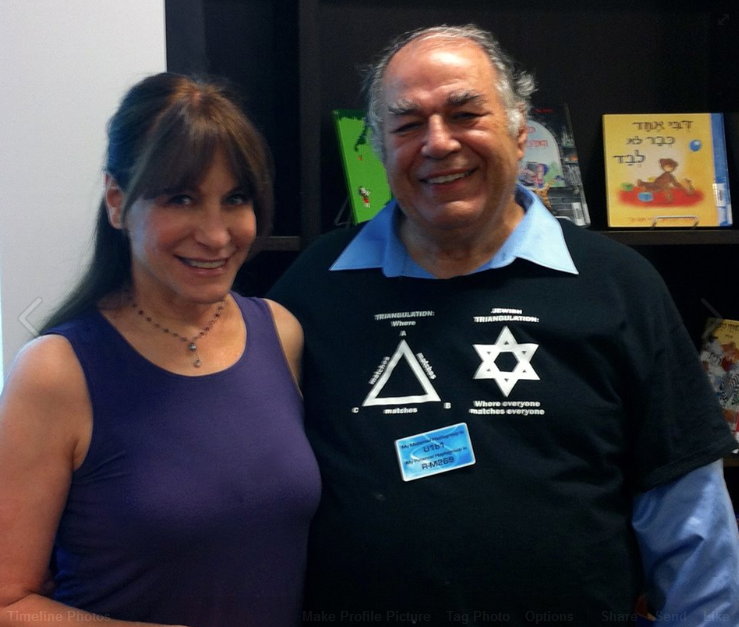
I was not a joiner back then, but Pamela decided I should be a member of Gesher Galicia. I  am not sure who else was involved in the decision but one day Pamela informed me that I (a non-member) had been co-opted to the Gesher Galicia Steering Committee. And what size T-shirt did I want.

When Gesher Galicia was incorporated in 2009, I served as Secretary and as such was a member of the Board, with Pamela as President.

Gesher Galicia had become Pamela's show and most of us were happy to be role players. It worked well, but now it will all be very different. Not just a change in titles.

We had some common research interests - mostly in Skalat and nearby Grzmaylow, but also apparently in our Hungarian families. Every couple of months, Pamela would feed me some Pikholz reference that she'd run across while doing something else. We were friends that way.

On her first visit to Israel, I took her to the Cave of the Patriarchs in Hevron and we visited the Hevron cemetery together.

ENDOGAMY
In the "Acknowledgements" section of my recently published book "ENDOGAMY: One Family, One People" under the heading "Encouragement," the second item is
I spoke of my plans for a DNA testing project to Pamela Weisberger while she was visiting Israel in 2012. She encouraged me to submit a presentation for [the IAJGS Conference planned for the following summer in] Boston. I did and it was well-received, though even when I presented my talk, I had very few results to report. From there it has been a runaway train.
Pamela and her daughter Lily appear in Chapters Eleven and Eighteen, where I looked at some people who have many DNA matches with Pikholz descendants. We surely have multiple common ancestors - probably within the last three hundred years.

Pamela welcomed my suggestion to speak to JGSLA in August despite the fact that they had  already done an August program, and was instrumental in setting up a Phoenix talk the next day. She posted about it on Facebook here. The photo at the top of this page is from that post. She was always classy.

Sunday, March 9, 2014

Nine New Records from AGAD

Until about a year ago, east Galician records were available from the AGAD archives in Warsaw, based on the indexing done for JRI-Poland. During the previous five years, I had placed about two dozen orders for these records - for my own research, for other people and occasionally for research clients.

Then last year, AGAD put those records online and there was no longer a need for these cumbersome orders.

But in the meantime, new records have become available, some listed at JRI-Poland and some in the All Galicia Database of Gesher Galicia and among them were a few records I wanted. This order took a long time to put together because I kept hoping that additional indexed records would be posted, but finally I decided to go with what I had.

Seven records in this order were for other genealogy researchers, six of them for people in Israel. One wanted his record to help him acquire Polish citizenship. Two others were for a man in my shul, whose family comes from Rozdol. The other nine were Pikholz records.

All told, there were a dozen births, five marriages and one death. Seven were from Podwoloczysk, four from Rozdol, three from Lwow, and one each from Drohobycz, Rohatyn, Skalat and Zbarazh.

The records arrived a few days ago via an online link. The total of eighteen were actually seventeen, as two of the Rozdol records were on the same page. In one case, they sent the wrong page and I have requested a replacement.

So here are the nine new Pikholz records.

Nachman, born to Abraham Pickholz and Lea Gelbling in Drohobycz
We already had a death record for this child. He died after only sixteen days. The birth  record shows that he was born 21 September 1911.

We do not know for certain who this Abraham Pickholz is, but I would guess he is part of the family we call IF2, where the name Nachman is prominent..

We know of two sisters before born Nachman, Hinde Feige and Sara Rivka.

Sara Lea, born to Markus Pickholz and Blime Jubjener in Rozdol
Here too, we cannot identify the father's place in the Pikholz structure, as the name is common and there is no identifying information on the birth record. The mother's name also appears as Jupiener.

The birth date is 19 July 1904. The couple had older children Matias and Gittel and a younger son Michal.

Gittel Rappaport, born to Josel Rappaport and Ryfka Luftschein Pickholz in Rozdol
We know this family, although the living descendants have not been willing to speak to us.

The family went to the US in the late 1920s. Gittel was the second of four children. She married Mayer Heilweil and died at age thirty-two.

Gittel's mother is the daughter of Fischel Pickholz and they lived in Bialkes, near Skole - which is where her older brother's birth was recorded.

Josel Rappaport  was from Zurawno - so Gittel must have been born when they were visiting some part of her mother's family in Rozdol. The birth was 1 January 1905.

Izrael Pikholz, son of Moses Hersch of Kaczanowka, recorded in Zbarazh
This is a death record. Izrael is thirty-five, died of cancer and was married. He died 20 April 1909 and was buried the following day in Zbarazh.

We know this family. The deceased had five younger brothers and sisters that we know of.

The best fit I see for Izrael is a man who married Ester Lyncyz. They had a daughter in 1901 who died at birth. But maybe not.

Etie Golde Pikholz, daughter of Gabriel and Breine, marries in Podwoloczysk
This is an odd one. The marriage took place in 1896. The bride is identified as being thirty-two years old and her parents are from Husiatyn. But Gabriel Pikholz of Husiatyn died in 1852, a dozen years before Etie Golde was born. And in any case, the wife of that Gabriel was Sara, not Breine.

The groom is Wolf, the son of Hersch and Male Feldman of Tarnopol.

There is a four-part note which appears to be just technical matters, but we are trying to determine if there might be some interesting information there.

And perhaps there is a Feldman descendant out there somewhere.

Abraham Eisig Pikholz (Zellermayer) marries Basie Pudles in Podwoloczysk
This is a record that I have wanted for years but had my doubts about ever finding.

We knew that Abraham was a grandson of Eliezer and Chane Chaje Pikholz, but had no idea what his mother's name was. Abraham and Basie had three children who all lived in Israel. One granddaughter is a well-known (if you are old enough) radio personality who in recent years has been writing Hebrew subtitles on Sponge Bob and other cartoon shows. Another granddaughter is the wife of an old boss of mine.

So now we have the record showing that Abraham's parents were Zalmen Hillel Zellermayer and Ettel Pikholz, that he had a second name Eisig, that he was born in 1883 and that the marriage took place 29 June 1909.

There is also a lengthy note which we are working on. After we get that figured out, I'll send the record to the granddaughters, as best we can tell, my fourth cousins..

And they had a son in Podwoloczysk
In May 1910, Abraham and Basie have a son. We knew this, of course, but now we have the birth record.

Jente Halpern (Pickholz) marries Schamschon David Sirki in Podwoloczysk
We know this family - or at least we know the bride's parents. She was born in 1884 to Joel Halpern and Chana Pickholz of Husiatyn. Chana is the daughter of Gabriel and Sara whom I mentioned above.

The marriage took place in 1911. One of the witnesses, Salomon Lynczycz was also a witness at the marriage of Etie Golde above. We have two Pikholz men married to Lynczycz women, but I don't see a connection between either of them and a Salomon.

I have not seen the surname Sirki anywhere else. I'd really like to find a descendant.

Ester Reizie, born to Basie Pickholz and Schaje Wolf Jorysz in Podwoloczysk
This is the fourth child we have for this couple. The birth was in August 1909. Ester Reizie was married in Grzmaylow in 1939 to Ojzer Swartz. (We also have a marriage for her older sister.)  We have nothing further.

Basie - or more properly Chaya Basie - is the daughter of Josef and Fradel Taube of Tarnoruda. This should be the RITA family. We do not know if Josef or Fradel Taube is the Pikholz.

I am told that there has been a new transfer from the Civil Records Office to AGAD, but we do not yet know which towns' records those would be.


Sunday, January 5, 2014

FILING


A few weeks ago, my friend Marla Raucher Osborn posted on Facebook about a birth record for her grandmother's sister Sime Horn, who died in Rohatyn in childhood. Some discussion ensued about notes of death being recorded on birth records and about the importance of reviewing documents, letters and other papers from time to time because what looked unimportant when we first saw them, may be significant now.

Here is the Facebook discussion.
Sandy Malek, the legal counsel of Gesher Galicia, mentioned that she "always seem[s] to find something new and enlightening" when having a second look at documents. Veteran researcher Sylvia Furshman Nusinov said that she "DOES look them over from time to time - finding clues which lead to new sources."

My contribution to the discussion was to explain that this is in fact the way my three-step filing system is designed, at least regarding genealogy-related paper.

Step one
                There is way too much stuff in this box
When I have a document, whether it is a vital record or some of my own correspondence or something else, I read it, record whatever seems relevant and put it into a box.

In the case of vital records from Warsaw, I usually make a note of the family on the back.

They stay there for months. At least.

(Non-genealogy-related is another matter, which I'll mention below. Things like utility bills get filed in binders, immediately. Other receipts, insurance and bank documents etc should as well. Sometimes I fall behind. A lot.)

Client papers go in a pile in a drawer and are filed from to time - usually when I need something and can't find it.

Step two
From time to time, I go through the box and put the papers into sectioned cardboard files
(There must be a name for these - in Hebrew, it's a "sadran.") like those pictured here. The one on the left is my Pikholz filing, the one on the right is everything else.

In the Pikholz file, each section represents a group of families. In the other one, each section is an ancestral line, either one of mine or one of my wife's.

For the most part, this is not just a matter of putting the paper into the right place. In order to file them properly, I generally have to reread the documents. Often in doing so, I will see something I missed months earlier. Or there will be some piece of information which was meaningless at the time, but has since become a point of interest. The name of a witness, a town or street address, some event that suddenly takes on significance, something else I could not have known when I first touched the particular paper.

A paper like that goes through the recording process, almost as though it were entirely new.

Step three
Every once in a while, I will take the papers from one or more of these sections and and put
them into the appropriate binders.

The purple binders on the shelves on the right are all Pikholz Project families. The yellow binders are my other families and the green binders are my wife's families.

As in  step two, moving each piece of paper involves rereading it and  re-evaluating its contents. But there is more because putting the papers into the binders brings me into contact with older papers which are already filed. Sometimes it is those older papers which produces new insights.

Paperless office?
Of course all of this requires paper.  Online-genealogy guru Dick Eastman has been on a "paperless office" crusade for some time. A post last week opened as follows:
On January 1 of this year, I wrote a short article entitled A New Year's Resolution: Going Paperless in which I promised I would stop wasting paper and not file all sorts of paper in piles, nor in binders or filing cabinets. I am happy to report that I have achieved nearly 100% success during 2013.

I now print almost nothing on my computer. Most everything is saved in Evernote or in an appropriate folder in Dropbox. Of course, the same items can be retrieved quickly and viewed not only on my desktop or laptop computers, but also with my iPhone or iPad, wherever I am. (An Android phone or tablet will do the same.) The few pieces of paper that need to be given to others are usually sent by email, never printed and mailed.
He goes on to discuss different types of paper - bills, bank records and of course genealogy. (He also discusses back-ups and is partial to "the cloud" for that.) He concludes his recent piece::
I can report 99% success at being paperless during all of 2013. I no longer have mounds of paper lying around. I can find anything quickly and easily, thanks to the capability of quickly searching the computer's entire hard drive for any words. I can retrieve any item quickly when I need it. 
I can see this with utility bills and other expense records and will even give that part of paperless a try in 2014, though the eight-page monthly cell phone invoice is a challenge. . Bank and other type records are a bit more complicated because it means I have to deal with them before they pile up. But genealogy paper? 

If I were to go paperless, it would kill my entire filing system as I would never see those documents again unless I went looking for them specifically. I certainly wouldn't leaf through them, as I do with paper files..

Online genealogy
Although it was not my intention in discussing filing, I come back around to online genealogy of the Geni-type, which I discussed at length three weeks ago. But it comes up on its own.

In private correspondence, one of the Geni advocates wrote:
I make a discovery, I enter a branch into Geni, I upload all my photographs and documentation, and phew!, I can rest easy that I have put everything in its place and move on to my next interest.  And when I am looking for it again, I know where it is.
For me that's a negative. I don't want to simply "rest easy...and move on" I want to see old documents and correspondence even when I am not looking for them.  I want to have to review each document and letter in each of the three steps. It doesn't have to be how other people work, but it's my system. My research heir - if I will be fortunate enough to have one - can do it differently if he wants, when the time comes.

- - - - - - - - - - - - - - - - - - - - - - - - - - - - - - - - - - - -
Housekeeping notes

1. Today, 4 Shevat is yahrzeit for my grandfather and begins a string of family memorial days during the month, a few of my wife's ancestors (including her father, her maternal grandfather, her paternal grandmother and others), my mother (here and here) and my sister - all in Shevat.


2. I have submitted two proposals for the 34th IAJGS Conference on Jewish Genealogy, to
be held in Salt Lake City next summer. And I made a reservation for the conference hotel. None of this means a commitment, just yet.


3. The following was written to me by a possible non-Jewish DNA match. The last sentence is hilarious. (Emphasis mine.)
Anyway, it's more than a little difficult to find the common thread between everyone in my search for a place of origin, but it seems *very* safe to assume that my "epicenter" for this would be the Pale of Settlement/Congress Poland... basically the [east] Galicia region you mentioned. And judging by the tiny sliver of it involved, I'm also guessing a birth from around 1700. But how/when/why they got to America is a complete mystery to me.