Showing posts with label Tarnopol. Show all posts

Tuesday, July 13, 2021

Erzsebet Kornberg(er) in Budapest

The inimitable Lara Diamond gave me a heads-up just before her most recent blogpost, telling me that she had seen some of my Pikholz (assorted spellings) in a Hungarian archival database she was writing about. She also sent me a Budapest death record which she had happened across.

The 9 December 1938 report of the death three days previous of Erzsebet Kornberger, wife of Jozsef Pikholz. She was seventy-two and her parents were Abraham Kornberger and Roza Korberg.

This looked familiar, but not quite as I remembered this person.

I have a Budapest birth record for Sara Rebekka Stefania born 24 August 1898 to Mozes Pikholz (mentioned in the notes on the record) and Erzsebet Kornberg, age 31 of Tarnopol Galicia. Close but no cigar.


We have additional information on this couple from their 1908 (late) Budapest marriage registration. We see Mozes' mother and birthdate, both of which we know from the Rozdol birth records. Erzsebet is called by a Jewish name "Lifsche" and she was born 30 May 1867 to Chaim Kornberg and Sara Rivka Stein.


Lifsche's birthdate and parents' names (plus her maternal grandfather Eisig) appear in the Tarnopol birth records.

So are these two women the same person?

The ages look right. The surname Kornberg vs. Kornberger are within the norm of clerical error. (Mozes is dead by then, and he would have been the best source of information when his wife died.)

On the other hand, the husbands - Mozes and Jozsef - are different. We have no evidence of any Jozsef either in that part of the family or in any other Pikholz Budapest family. And the parents of Erzsebet/Lifsche are completely different - Chaim vs Abraham and Sara Rivka vs. Roza.

(I suppose it is possible that after Mozes Pikholz died, Erzsebet married Jozsef Pikholz, but I find that highly unlikely. And it only solves part of the contradiction.)

I really find it hard to believe that these are two different women, but the errors look too great to be clerical.

There is one other bit of information which seems to seal the deal. The address 36 Nyar Street appears for both. It appears on the 1938 death record, on the 1908 marriage record and on several birth records for the children.

As it happens, Mozes and Lifsche have a granddaughter living in Belgium. She has done DNA for our project and I am Facebook friends with her daughter. I do not assume that the granddaughter - who was born after the Holocaust - will be able to clarify this, but we shall ask.

In the meantime, I shall hold off on recording Erzsebet's death record in my database. And hope for the best.

Sunday, September 23, 2018

The Murder of the First Pikholz Family in Tarnopol

Early Pikholz families in Tarnopol
We know that there were Pikholz families in Skalat - about 19 miles or 30 km ESE of the provincial capital Tarnopol - just before 1800. Later in the 1800s we find Pikholz families and individuals in nearby Mikulince, Grzmaylow, Kacanowka, Zbarazh, Klimkowce, Husiatyn and Tarnopol and its suburbs. Later we find Pikholz families in Kozivka, Buczacz, Terembowla, Podwoloczysk and elsewhere. Most of these individuals and families are traceable to known Skalat families.

But some are not. Almost certainly they come from our known families but the records don't give enough information to work with. For that matter, we have fifteen-twenty Pikholz deaths in Skalat itself whom we cannot identify.

In the case of Tarnopol, we have a few like this. Pikholz infants named Samuel, Perl, Gabriel, Moses and another young Samuel died during the period 1848-1852. Do they all have the same parents? Maybe, but we don't know.

Menie Beyle Pikholz died in Tarnopol in 1867 at age twenty-six, but she may have been a Pikholz spouse.

Jankel Pikholz was born in Tarnopol in 1854 to Marcus and Ruchel.

The 1910 Tarnopol census shows a Herman Pikholz, age 66, "born in Tarnopol."

These are the earliest records of Pikholz descendants living in Tarnopol. That would have been about 1844.

The murdered family
That changed last week when Gesher Galicia announced the availability of several new record sets including
Tarnopol (Ternopil). TsDIAL, Fond 701/1/328, 331, 332 and 334
 - Jewish deaths, May 1845-December 1869 (10,662 records).
I went to Gesher Galicia's All Galicia Database and searched "Pikholz" using the "Records added in the past month" filter


Among the search results were these:
A whole family - Abram Pikholz, his wife Welle, daughters Esther and Sara - all died on 22 March 1855 and son David died three days later. (I was not familiar with the female name "Welle" but others tell me that it indeed occurs in their families. Perhaps it is a female version of Welwel.)

And it's spelled in the German way, with a "c" - perhaps it was the custom in the provincial capital.

Tony Kahane provided the actual record and wrote:
I found the page from the Tarnopol D 1854-1857 records listing the deaths of the five members of the Pikholz family in March 1855, in Borki Wielkie, near Tarnopol. These deaths were not from cholera (unlike many others in that year). The part of the note that it is easier to decipher (attached screenshot) is line 3 and  the beginning of line 4:
"… in der Nacht v[on] 19. auf 20. d[ieses] M[onat] ermordet …".
These people were murdered in the night of 19-20 March 1855.

Roger Lustig had a look at the German-language note on the right and wrote:
was, at the Sbrutin (?) Inn in Borki wielkie, on the night of the 19th-20th of the month, murdered, and, as a result of Imperial and Royal [something] order of 20 March 1855 No. 4363, 
So the family were murdered at the inn in Borki Wielkie (currently known as Velikiye Borki) six miles ESE of Tarnopol. Were they passing through? Did they live in Borki? Were Abram and Welle the innkeepers? How is this family connected to the deaths of children in Tarnopol whom we had already seen?

Well, they seem to have lived in Borki. An additional record in the new set is this:
One-month old Chajem Moses lived in Borki and died 22 December 1854, three months before the murder. This seems to be the same family, living in Borki. So they were at the inn but lived locally. 
The actual death record of Chajem Moses
 Who is Abram?
The father, Abram, was thirty-two when he died. That seems to make him the first Pikholz in Tarnopol, though there I doubt that he was born there. Who is he? Who are his parents? How does he connect to the known Pikholz families from Skalat? 

The only other Avraham from the Skalat area, born before the 1870s is a son of Nachman Pikholz and he was born about 1841, so there is a good chance he is a son of my third-great-grandfather Izak Josef. In fact, we have no children for Izak Josef between Berl (1816) and Selig (1830) so it is reasonable that there are missing children born in the 1820s. I think I shall record Abram as a probable son of Isak Josef, though he might be a son of Berl (1789).

On the other hand, as far as I know, no Pikholz from the Skalat area named a child Avraham in the years following the murder.

I have contacted Alex Denisenko to see what might be found about the murder and the family. 

UPDATE: Traude Triebel provided a link to a newspaper report. It confirms what we already have and provides no additional information.

Sunday, October 22, 2017

Mazal Tov - Uncle Selig Gets Married

The find
From the JewishGen SIG announcements from Friday.
Gesher Galicia is pleased to announce the addition of new sets of
Jewish records on the All Galicia Database
<https://search.geshergalicia.org>.

            <snip>
Tarnopol (Ternopil)
- Jewish marriages, 1859-1876. State Archive of Ternopil Oblast
(DATO), Fond 33/1/716. (379 records)
 I went in and used the new "Records Added in the Past Month" function and this came up.
I am assuming that the wife's name is Rachel.


The only Selig Pikholz we have is the brother of my great-great-grandmother Rivka Feige Pikholz. I have written about him in this space numerous times, most recently here. I even have a presentation called "Why Did My Father Know that His Grandfather Had an Uncle Selig," which I gave at JGS Maryland last winter and at the IAJGS conference in Orlando.

This find - and it is not a full document, only an simple index record - answers and documents several open points and opens the door to a possible significant new development.

Identifying Uncle Selig
This is definitely Uncle Selig, not only because there is no one else, but because the age (43) in January 1874 fits his 1830 birth year (based on the age in his death record.)

Many years ago, I concluded that Uncle Selig's (and therefore Rivka Feige's) father is Izak Josef Pikholz (~1874-1862), who was known as Josef. This was based on the fact that Uncle Selig named his son Itzig Joseph right after Old Izak Josef died and the fact that Rifka Feige had a grandson called Joseph Yitzhak but who was actually born Isak Josel.
I also have DNA evidence, as I discuss in Chapter Seven of my book "ENDOGAMY: One Family, One People."

But I never had an actual document. Now I do, for the marriage index calls him "son of Josel Pikholz."

Of course that also verifies the identity of my own third-great-grandfather, even though that has been settled in my mind for probably eighteen years. I can now totally ignore the fact that Selig was born when his father was at the relatively advanced age of forty-six. We finally have a document.

Uncle Selig in Tarnopol
Uncle Selig and his wife Chana lived in Skalat, where most of the Pikholz families lived. Chana died 11 September 1873 at age forty-five of cancer (raka).

But later in life, Uncle Selig lived in Tarnopol. And his youngest son Meir, who was born about 1872 or maybe 1874, is listed as being from Tarnopol, not Skalat where Selig and Chana lived. After visiting Meir's grave in Vienna a few months ago, I suggested:
The thing is Uncle Selig's wife Chana died of cancer in September 1873 at age forty five, so she could have had a son in 1872 but not 1874. Of course Meier could be from a second wife, but we have no evidence that Uncle Selig remarried and certainly none that he remarried so quickly after Chana died.
Except that Meir was born in Tarnopol and Chana died in Skalat, where the family lived. Maybe Uncle Selig married a second time, this time to a woman from Tarnopol. And they lived in her hometown. Where Meir was born.
So do we reopen the question if Meir was born to Chana in 1872 or the twenty-four year old second wife in 1874? That marriage was 21 January, so birth the same calendar year was certainly possible.

But we do know that Uncle Selig married a woman from Tarnopol and that is likely why he lived there from the time of that marriage.

And speaking of the second wife...
This young woman is Rachel Nagler (b. ~1849) and he married her barely four months after his first wife died.That sounds like the standard practice when a widow or widower is left with young children. (For this reason I believe that Meir is the son of Chana. We know of no other "young children.")

The new spouse is often from within one of the families.

So who might Rachel Nagler be? Peretz Pikholz (~1820-1873) is the son of Berl Pikholz (~1789-1877). We do not know how he is related to my Pikholz families. Perhaps Berl is the brother of Old Izak Josef - or a cousin or a nephew. Peretz was married to Perl Nagler (~1823-1904). Selig's wife Rachel is surely related to Peretz' wife Perl, a niece or cousin, perhaps.

Perhaps this points to a Pikholz-Nagler connection that is more substantial than the Peretz-Perl marriage. Perhaps the actual record will tell us something. Thus far, the folks at Gesher Galicia are not encouraging regarding getting an actual record from the Tarnopol archives.

Housekeeping notes
I have three talks coming up, all here in Israel. All are in Hebrew.

19 November 2017, 7:00 – Israel Genealogical Society, Bet Sapir, Sderot Yerushalayim 2 (second floor), Kefar Sava.
Lessons in Jewish DNA – One Man’s Successes and What He Learned On the Journey

8 January 2018 as part of the Yad Vashem / Central Zionist Archives series “From Roots to Trees” at Yad Vashem in Jerusalem. 
5:30-6:15 – The Importance to Genealogy of Understanding Jewish Culture and Customs
6:16-7:00 – Using Genetics for Genealogy Research

Sunday, December 8, 2013

LEWINTER = KWOCZKA ?

Kwoczka
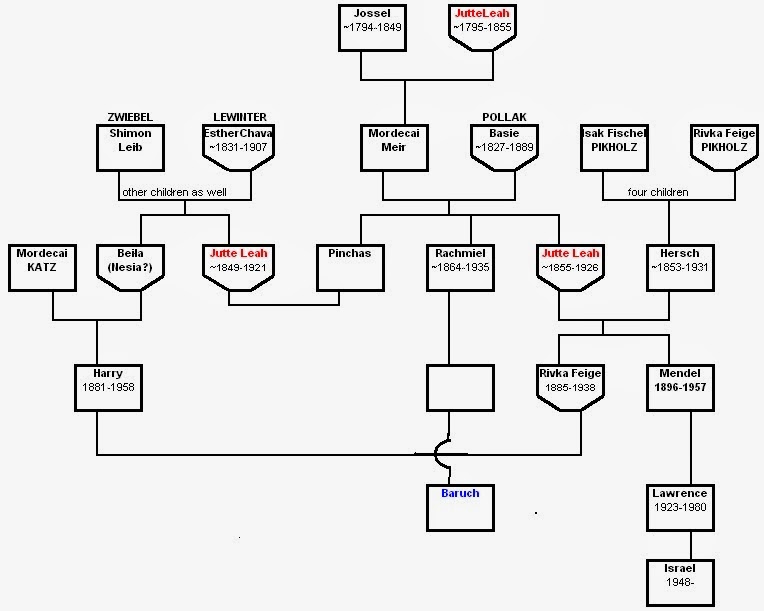
My father's second cousin, whom I'll refer to as Baruch, is the great-great-grandson, in an all male line, of Jossel Kwoczka (~1794-1849) and his wife Jutte Lea. Baruch's surname should be Kwoczka, but his father changed it.

Jossel and Jutte Leah were called Kwoczka on their death records, but we do not know how far back the name goes. All the Kwoczkas lived in Zalosce and it appears that they are all descended from this couple or perhaps a couple who lived a generation or two earlier. I discussed this family about a year ago.

Baruch's grandfather Rachmiel Kwoczka had an older sister named Jutte Leah, my great-grandmother. Rachmiel and Jutte Leah had a brother Pinchas, who was also married to a Jutte Leah. Her father was a Zwiebel and her mother a Lewinter, but I have always had a strong feeling that the two Jutte Leahs could be traced back to a single namesake.


The question of the two Jutte Leahs is very much a back burner issue, mostly because there is so little documentation available for Zalosce.
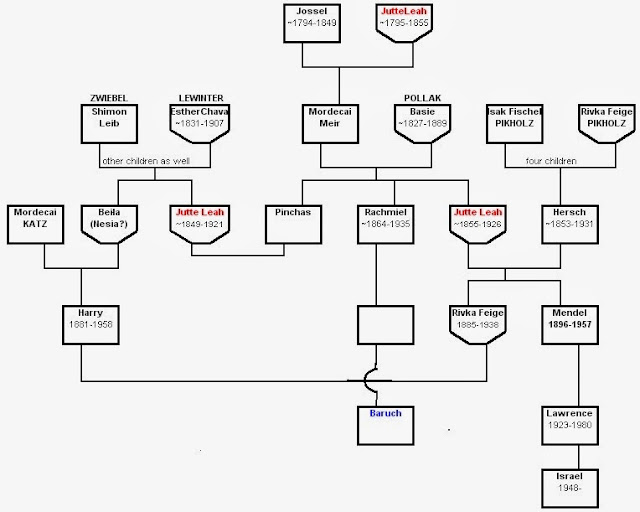
There are additional children in all these families
So about eighteen months ago, I asked Baruch to do some DNA testing. I wanted an autosomal test to nail down the fact that my Jutte Leah is in fact the sister of his Rachmiel, which is now clear. And I asked him to do a Y-DNA because of his male line. I was not specific enough and he only did the very basic twelve-marker test, which does not lead us very far. It is sufficiently vague that he has 313 perfect matches, but of course that number would shrink drastically if he had tested for 25 or 37 or 67 or 111 markers. (The standard is 37 and I myself did 67.)

Lewinter
Nonetheless, every once in awhile, I'll have a look at Baruch's matches to see if anyone interesting shows up. A month ago, one did – a man named LeWinter in the US. I saw from his information on the match page that he had done a Y test with 111 markers, but had not done an autosomal test. There was an email address. I wrote.

He listed his most distant male-line ancestor as a Lewinter from Tarnopol, the provincial capital not from Zalosce.

I started putting together the scenario in my head. If Baruch and this LeWinter are in fact a good Y match, it means they have a common male-line ancestor. Without an autosomal test for LeWinter or at least a higher level Y test for Baruch, we could not tell how far back the common ancestor might be, but Tarnopol and Zalosce are so close that it would be reasonable to think that two hundred years ago is quite possible. That is about when the Jews of Galicia adopted surnames and we could have two brothers, one became Kwoczka and one Lewinter. Or maybe one took a surname from his wife. This looked like it might lead to a huge breakthrough.

I wrote and got a response, from the mother. He himself isn't very interested and this is all her doing. She sent me the grandfather's SS-5 form, where he applied in his own hand for a Social Security number. His parents, writes the grandfather Louis Lewinter, are Berel Lewinter and Yetty Lewinter. Yetty. There is Jutte again. Maybe even Jutte Leah. This could be really close family. Born 23 July 1895 in Tarnopol.

Nothing from my side was familiar to her. I was hoping she would know of our Zwiebel-Lewinter couple, whose descendants lived in Pittsburgh. But no. But also not necessarily important.

I went to JRI-Poland and looked up births of Lewinters anywhere near 1895, anyplace in Tarnopol province. After all, Louis may not have meant Tarnopol the city, just the general area.

There was one good match. Nachman Leib – Leib becomes Louis easily enough. Born 29 July 1895 – off by six days. Born in Tarnopol itself. So far so good. The mother is Jutte Dyne, the father is Berl.  It's certainly the right man. 
One problem. Jutte Dyne is the daughter of Nachman and Menie LEWINTER and Berl's surname is MANDEL. Louis – Nachman Leib – got his Lewinter surname from his mother. That happened often in east Galicia as the Jews did not always record their marriages with the civil authorities. That means my cousin Baruch's Kwoczka male line is a match with a family named Mandel. He may be related to the Lewinters, but not in that male line.

Too bad. Maybe the next DNA match will pan out.

The youngest Jutte Leah
Sometimes things work out right without being planned. I am writing this on Wednesday evening, the last night of Hanukkah. The second of Teveth. That is the fifth birthday of the youngest Jutte Leah. Her family calls her Lakie. She is the great-great-great-granddaughter of Jutte Leah Zwiebel and Pinchas Kwoczka, which makes her my third cousin twice removed.

Her mother made the decision to choose that ancestral name while sitting in my office about a month before Lakie was born. And it just happened to work out that I am sitting in my office writing this on her birthday.

- - - - - - - - - - - - - - - - - - - - - - - - - - - - - - - -
Housekeeping notes
1. The Fall AVOTAYNU is out. Next week I plan to write about my response to the two articles from the Summer issue on collaborative online genealogy, including a few outtakes from my earlier drafts.

2. The call for papers for the Salt Lake City conference came out this week.

While the program committee will consider all submissions, we have
identified some focus areas in which we are especially interested.
These include Genealogy and Jewish History related to World War I,
Jews of the Western United States, Technology in support of
genealogical research, Immigration and migration over the ages and
Ethical considerations in genealogy.

The conference will kick off one day shy of the 100th anniversary of
the start of World War I (Austria-Hungary declared war on Serbia on
July 28, 1914, one month after the assassination in Sarajevo of
Archduke Franz Ferdinand of Austria). Many of us have ancestors who
served in the armies of the various nations engaged in this conflict.
The War and subsequent fighting for control of Eastern Europe
devastated much of Europe including the Jewish heartland in the Pale.
It stimulated a wave of Jewish migration and resulted in the Balfour
declaration, calling for "the establishment in Palestine of a national
home for the Jewish people". If you would like to submit a speaking
proposal related to the "War to End all Wars" please do so.

I'm not sure I have anything to say on those topics, but I have until 15 January to come up with something. 

Sunday, August 4, 2013

THE MATTER OF ROSA PIKHOLZ FROM TARNOPOL AND VIENNA

Next week in Florida, I'll be meeting with a number of Pikholz descendants, including the two granddaughters of Rosa. This ought to be a fairly simple story of a woman who escaped Europe with her daughter in the months before the War and settled in the United States. But there are complications, so I thought I'd lay out the story here as a way of organizing my thoughts before we meet.

Blime's Children

Blime Pikholz and Abraham Brandes had the following children: SON (1886), Nissen (1887), Ruchel (1889), SON (1890), Peter (1891), SON (1895) and Chaje (1896).  F.or most of these we have birth records; for the  son born in 1890 we have only a death record with an age.

Peter was born in Lwow, the others in Tarnopol or in Zagrobela, which is on the western outskirts of Tarnopol. I have no idea why they were in Lwow during that particular period.

In addition to the three unnamed sons, the youngest daughter Chaje died when she was a few days old and we have the death record..

Peter died in 1916 during his military service and is buried in an unmarked grave in Vienna.

Nissen married his cousin Bassie Ruchel and was deported from Vienna in 1942 with his wife and six children. They were killed in Maly Trostinez, near Minsk.

Daughter Ruchel goes to America - twice

We have a  passenger list is from 27 March 1923 (sailing date) which includes Ruchla Brandes, age 33, single, a tailor of East Galician nationality, last residence Vienna.  Nearest relative in Europe is her mother, Blime Pickholz of Vienna.  Final destination is her cousin Mr. & Mrs. Jak. Spanier, in New York.  (I  looked a bit for this man and his family a few years ago, but with no success.)

Click to see a larger version of this passenger manifest.
According to the manifest, Ruchla Brandes was born in Tarnopol and had previously visited the US in July 1911 and 1921, or more likely FROM July 1911 UNTIL 1921.  She intended to stay permanently in the US.  Her age is the same  as Ruchel Brandes, born in 1889 - and everything else fits nicely.

We also have the manifest for the earlier trip to the US - a July 1911 passenger manifest which includes a Rosa Pickholz, age 21 or 23, from Vienna, travelling with her cousin Bertha Silberman.  Rosa lists her nearest relative in her home country as her mother "Lime" who appears to be Blime. I have not been able to learn more about Bertha Silberman.

On the other hand...

According to the records of the Vienna Jewish community (IKG), on 16 October 1921, Leon Laufer (b. 1897, Lachowice) married Rosa Pickholz, daughter of Blime Pickholz and Abraham Brandes, born Tarnopol, 21 March 1892. We do not have a copy of the actual marriage record.

We have no birth record for this Rosa, but since there is a gap between Peter (1891) and the next birth (1895), an undocumented birth in that period is not unreasonable. But Peter was born 29 December 1891, so the 21 March 1892 birth date cannot possibly be correct..
Click the image to enlarge
This Rosa Laufer went to the United States with her daughter Edith in February 1939.  According to the passenger list, she was an American citizen due to her marriage 16 December 1921 to a citizen, but I have not found any immigration or citizenship record for her husband, Leon Laufer. (It is this daughter Edith whose two daughters I'll be meeting.)

According to the passenger list, Rosa is forty-five years old, which means she was born in 1894, which makes more sense than 1892. (Note that Leon was born in 1897, so it would make more sense that his wife would have wanted to appear younger at the time of their marriage - not older.)

Once in New York, Rosa made an attempt to secure passage for her mother Blime and Nissen's eldest daughter Suzanne, but was unsuccessful. Blime died in Theresienstadt.

Finding Edith

Nearly five years ago, the same month that I found living descendants of two of Blime's sisters, I found a series of Pages of Testimony that Edith (known as Dita) had submitted to Yad Vashem.

Those Pages included her grandmother Bime, her father Leon Laufer who was killed in France while on a business trip of some sort, her uncle Nissen (listed as Nathan) with his wife and five of their six children and an aunt Charlotte Rosenbaum of Vienna, with her husband and two sons. Also a few other of her father's Laufer family.

According to the Page, Charlotte was about fifty, so she would have been born about 1892. As I wrote earlier, there was a gap between the children so 1893-4 would have been reasonable.
We have no Charlotte among the birth records and the only daughter other that Ruchel and Rosa is Chaje, for whom we have a childhood death record.

I spoke with Dita on the phone and she could not tell me anything to help straighten out the apparent contradictions. She had no knowledge of any other brothers and sisters that her mother might have had, aside from Nathan, Charlotte and Peter the young Austrian soldier.

Rosa lived in New York and died in October 1955.  According to her tombstone in Mt Hebron Cemetery, she was sixty-one years old, which is consistent with the 1894 birth year.

The tombstone lists Rosa's name as Rachel bat Avraham, which is a problem considering that she has a sister Ruchel who is several years older and who was last seen entering the US in 1923, and identified as "single" at a time that Rosa was already married. Edith told me that it is "not possible" that her mother had been in the US prior to 1939.
 

Dita herself died less than six months after we spoke so we were not able to really discuss this as I wanted to show her the documents first. I plan to visit her grave in Florida next week.

I have not ruled out the possibility that someone in this story was using an assumed identity, but I have no idea how to test that theory. 

Yet another Rosa from Tarnopol born in 1892


So we have these two sisters, Rosa (Rachel) born 1892-1894 and Ruchel born 1889.

But there appears to be another. The US Holocaust Memorial Museum has a 1943 record of a Pickholz family from Szolvya (near Munkacz) who apparently tried to make aliyah.  The family consists of Felix (b. 1888, Krasovka), Rosa (b. 1892, Tarnopol) and Mila and Eszter (both born 1926, Szolvya). My guess is that Rosa is the Pickholz, not Felix, and she looks very much like she could be part of Blime's family, as we do not have other Pikholz births in Tarnopol during those years. Of course, that could not possibly be the case, but I am recording the story of this family here due to the similarities.

The Central Zionist Archives has this same record, but neither institution was able to provide further information, nor was ITS or anyone else.

The USHMM says to ask the CZA and the CZA says to ask the USHMM, as each claims it received the information from the other.. One would think that if there were forms for aliyah, the CZA would have them, but apparently not.

The death of Rosa's father Abraham Brandes

We know nothing about the death of Blime's husband Abraham Brandes and no one seems to mention him anywhere. It must have been before the War, as Blime appears as a widow. He could have died in Tarnopol during the period for which we have no records. I have no idea when the family moved to Vienna, but there does not appear to be a relevant death record there.

There is a 27 September 1894 death records for a Mendl Abraham Brandes in Vienna, but he cannot be Blime's husband - certainly not with a daughter Chaje born in December 1896.