Showing posts with label Lewinter. Show all posts

Monday, February 15, 2021

Narrowing It Down Using The X

As I have mentioned before, every few months I review the newest autosomal matches on my many Family Tree DNA kits to see which are the best candidates to investigate further with GEDmatch. Maybe a third of those respond to my inquiries and of those perhaps one or two, maybe three, will show anything useful. On this last round, I sent out about eighty-five inquiries and was surprised how many people got back to me in the first forty-eight hours. This is the story of one of these.

The match is a woman named Donna who was adopted and is looking for information that might lead her to her birth parents. One of her two matches with my families was this, a quite ordinary segment of 16 cM with seven Pikholz descendants.

Jean, Sarajoy, Judith and Amy are my sisters. Uncle Bob is my father's brother. Roz is my second cousin on my grandfather's side. Marshal is my double second cousin - our grandfathers are brothers and our grandmothers are sisters. The seven matches triangulate; they all match one another. So this looks to be pretty straightforward. This segment comes from either my great-grandfather Hersch Pikholz or my great-grandmother Jutte Lea Kwoczka.

But this segment is from chromosome 23, the X.The chromosome that never passes from father to son.

Roz gets to our great-grandparents through her mother and grandmother, so both Kwoczka and Pikholz are viable sources for her segment. But the others are all from sons of our great-grandparents, so they would have no X from Hersch Pikholz. Which means this is a Kwoczka segment.

But that cannot be right either. Uncle Bob would have to have received the segment from his father, which is clearly impossible. Uncle Bob received this segment from his mother. That option works for my sisters and for Marshal, but Roz has nothing to do with my grandmother's Hungarians and Slovakians. The Pikholz and Kwoczka families lived in the Tarnopol area of east Galicia.

If this sounds familiar, it should. Three and a half years ago, I discovered a segment shared by two supposedly unconnected parts of my families, one being my grandmother's Hungarians and the other the Galicianers on the non-Pikholz/Kwoczka side of the family of my cousins Rhoda, Roz and Pinchas. 

I have since found about forty strangers who share this segment with matches of anywhere between twelve and twenty centiMorgans. I wrote all of them, but have not gotten any firm leads on how, when and where my two families connect. It is a good ways back, as the families have been in the same places since the mid or late 1700s, but it's recent enough to preserve this 20+ cM segment intact.

Wendy and Carolyn, at JGS Maryland, 2016,

my earliest cousins on this segment


I have also written about this segment of chromosome 21 here, here and most recently here.

My guess is that the same ancestor who gave us the segment on chromosome 21, gave us the newfound X segment, though I cannot prove it. Until now, I have had seven surnames to work with, five from the Hungarians and two from the Galicianers. Of course there was no reason to assume that the common ancestor actually used one of those seven names - if he (or she) used any at all. But they were starting points. 

Now, we know that two of those lines are completely irrelevant. The X cannot be from my third-great-grandfather Lasar Bauer or his wife Rosa Lowinger, because it could not have been passed to Cousin Shabtai Bauer. One of the forty "strangers" has a Bauer ancestor, so that was a candidate for chromosome 21. But it cannot be for the X.

The others are still possibilities simply because we do not have other known descendants of those families who might share the segments in question. We can neither confirm nor eliminate them. Here are the earliest known ancestors in each family.

On the Hungarian side:

Salomon/Yehoshua Selig STERN ~ 1805-1862, son of Izak Leib of Paks could have received this segment from his unknown mother.

Jakob GRUNWALD of Perkata whose daughter was born about 1806 could have received the segment from his unknown mother.

Fani/Feige HERCZ, Jakob Grunwald's wife, could have received the segment from either parent.

On the east Galician side:

Shimon Leib ZWIEBEL, ~1825-1910, son of Isak, from the Tarnopol area, could have received the segment from his unknown mother.

Ester Chava LEWINTER, ~1831-1907, from the Tarnopol area, could have received the segment from either parent. She is Shimon Leib Zwiebel's wife.

I would love to see some tests from any of these families. Zwiebel is probably the easiest place to start.

It feels like progress. I'll certainly notify the forty-odd strangers.

Wednesday, November 20, 2019

Developments in Chromosome 21

Some months ago, Jessica Feinstein, the editor of the Jewish Genealogical Society of Great Britain quarterly Shemot, asked me to write a brief piece for their winter DNA issue. That publication came out recently and my article is reproduced below.

There is, however, something new which came in after Shemot was already closed. I have added that here in red.


Chromosome 21 – Perhaps My Favorite Brick Wall
Israel Pickholtz

Background  - The Bauers and the Sterns
I manage DNA kits of over 120 people – about two-thirds of them Pikholz descendants and most of the rest known members of my other families. Those include two grandchildren and nine great-grandchildren of my father’s maternal grandmother Regina Bauer Rosenzweig and one grandson (Shabtai) of her brother. Regina Bauer was born in 1870, one of five daughters and two sons of Simon (Shemaya) Bauer (1833-1902) and Fani (Feige) Stern (1842-1911).

The Bauers were a large family in Kunszentmiklos Hungary, about an hour south of Budapest;  in the 1700s they had lived in Apostag, about half an hour further south. We have many Bauer records from both places.  Fani Stern was born in Kalocsa, another half hour further south, and her father Salomon (Selig) Stern (~1805-1862) was from nearby Paks. Fani’s mother was a Grunwald from Perkata, which is across the Danube from Kunszentmiklos.

Regina’s paternal grandmother was probably a Lowinger and Fani Stern’s maternal grandmother was a Hercz, so I have five of Regina’s ancestral surnames to work with. Jewish research being what it is, I have no other great-grandparent with that many ancestral surnames.

When I first learned of DNAPainter.com nearly two years ago, I mapped out twelve segments where Shabtai matches multiple descendants of Regina with at least 18 cM. The largest of these are 61, 57, 47, 38 and 35 cM.  Using the “Segment Search” tool on GEDmatch Tier1 (this was previously known as “Matching Segments Search”), I was able to see other people who match those specific segments. Most of my larger segments of interest had few outside matches, but I wrote to the matches where I could and none of them knew anything helpful.

Robbie
While reviewing my Family Tree DNA match alerts, I found Robbie from Chattanooga Tennessee. Robbie showed matches with my father’s sister, my second cousin Susan, my brother, one of my sisters and me – and Shabtai. The match was 19-21 cM on chromosome 21 (where our segment with Shabtai is only 23 cM) and clearly showed that Robbie had a common ancestor with Regina Bauer. It is his only match with us. I asked Robbie about his ancestry, but he is adopted, so could not tell me anything.

But this is only half the story.  Here is Robbie’s full match with us on chromosome 21.
In addition to the six Bauer descendants, he matches three of my cousins on my father’s paternal side – Pinchas, Rhoda and Roz. Rhoda and Roz are my second cousins, first cousins to one another. Pinchas is our third cousin.  But it’s more complicated than that. Pinchas is a third cousin of Roz and Rhoda on a second path that has nothing to do with the Pikholz family. That second path is almost certainly what is in play here.

The great-grandmothers of Pinchas, Rhoda and Roz are the sisters Beile and Jutte Zwiebel and their mother is Ester Chava Lewinter. The Zwiebels and the Lewinters are from the Tarnopol area of east Galicia and have nothing to do with anything Hungarian, since 1800. Nonetheless, the three of them triangulate with the six Bauers – everyone matches everyone else on this segment.
This is a classic case of Jewish endogamy, where my Hungarian family and my Galician cousins have some sort of common ancestor. Maybe on the Bauer side, maybe on the Stern side. Maybe on the Zwiebel side, maybe on the Lewinter side. Who knows! But a common ancestor there is – recent enough that the match between the groups survives yet far enough in the past that it predates the known geography of the families. The fact that Robbie has only this one segment with us sounds like it is further back than the 20 cM segment might otherwise indicate.

We have no cousins of either Regina Bauer or Beile and Jutte Zwiebel, so we cannot determine whether our segment 21 comes from their fathers’ sides or their mothers’ sides.

The Other Matches
Recently I went back to the Segment Search tool on GEDmatch Tier1 to see who else matches on that segment. There are about three dozen who match our chromosome 21 with more than 12 cM. Five of those have a match of 18.0-18.2 cM and another’s match is 16.8 cM. The rest are 12.0-15.1 cM. Robbie’s match of 19.3 cM is still the largest. A few of them are managed by people I know as researchers – or even know personally. A few are related to one another. By and large, these are kits that – like Robbie’s – don’t have significant matches with us outside of chromosome 21.

I wrote to all of them. Fifteen responded.

One – Andrew – has a Bauer grandmother. He writes:

My line of the Bauer family, and most likely yours too, originated from Moravia, and from there Northern Hungary (what is now Slovakia), particularly in Hluboka, Nyitra County. In the early 19th century, there was a great movement of Jews (and also Slovaks, or Tóts) to south-eastern Hungary, where more opportunities opened up at that time. Your Bauers were not that far there from  my Bauers, they may have visited each other, but how they were related, I don’t know; perhaps you can find out. I have looked at your Kunszentmiklos Bauer database, many names are similar to my list, but they are clearly not the same people.

Regina Bauer spoke German, in addition to Hungarian, so there may be something to this. And if it is real, it may or may not include chromosome 21.

 Andrew has no Bauer candidate for a Y-DNA test, so we cannot compare his line to mine.

Another match is the daughter of a woman named Zendel and suggests a similarity to Zwiebel. I don’t think so.

Another dozen said they did not have any of the seven surnames on my side or any geography of real interest. The rest of the matches never replied.

Nava
Last week, I received a note from a woman named Nava, with whom I had corresponded earlier about chromosome 21. Nava's match to us on chromosome 21 is small, about 10 cM with Robbie and a bit smaller with my six Bauers. It does not match Pinchas, Rhoda and Roz who start a bit further to the right on this segment, but that does not bother me.

Nava writes:

I've built out much more of my family tree since we communicated last, at which point I was just beginning the research. I took a look again at the info you shared in your email and have noticed a possible connection. 

I've followed my mother's line back to my great-great-grandmother. Her name was Szara Hercz, born 1830 in Berczalja, Saros, Kingdom of Hungary (current-day Slovakia). I wonder if that could be the link we share on your Hungarian branch as you mentioned the name Hercz? She married Saja Czigler (born 1829) and their daughter, Anna (b. 1859) emigrated to the states in 1892. One of her daughters was my great-grandmother, Blanche Zuckerman, who died in New York when I was a child.
So perhaps this segment come from a common Hercz family. Or not. Our relevant towns are 156 miles apart which proves nothing one way or another. (Actually, her Hercz family lived quite near my great-grandFATHER's family.)

Nava has no one with an MtDNA line to her second great-grandmother so the fact that I have one to my fourth great-grandmother (H10a1b). 

Nava has no matches with our six Bauers (or Robbie) over 10 cM on any other segment, though she does have a small match with my brother and my cousin Susan on the same segment.Of course, that needn't be from the same ancestor as the one on Chromosome 21.

This brick wall will fall
How, I don’t know. More testers, more patience by me, more DNA analysis tools – for the DNA itself and for the test results – more older records, more traditional genealogy research to find additional descendants of these families, even cleaning up the Kunszentmiklos cemetery.

When, I don’t know that either. I’d like to think it will be in my lifetime.

For now I need to keep shining a light on this corner of my family genome. We never know what will prompt a breakthrough.

But this brick wall will give up its secrets.

Israel Pickholtz is a US-born professional genealogist who has been living in Israel for forty-six years. His flagship work is The Pikholz Project, which means to identify and reconnect all Pikholz descendants. He blogs at http://allmyforeparents.blogspot.com, writes and speaks on genealogy in Israel and abroad as the opportunities arise and is a member of the Israel Genealogical Society, Gesher Galicia, the Guild of One-Name Studies and a number of SIGs and research groups and a two-time alumnus of the Genealogy Research Institute of Pittsburgh. In 2015 he published his book "ENDOGAMY: One Family, One People" about his successes with DNA and lessons that are relevant to all genetic research. He has recently relocated from Jerusalem to Ashkelon and can be contacted at IsraelP@pikholz.org .

Sunday, January 28, 2018

Hillel Academy Reunion, With A New Genealogy Contact

My eighth grade class
Top: Fred, Bonnie, VeraG, Bayla, VeraB, Faygie, Beverly, Miryam, Mrs Belle
Middle: R' Rottenberg, R' Shapiro, Mr. Schoenbrun, R' Poupko, R' Teitelbaum
Bottom: Marc, Jack, your humble blogger, Rich
I attended Hillel Academy of Pittsburgh for grades seven through ten. Those years were significant and they made an important contribution to who I am today.

The week before last, the school sponsored an evening reunion for alumni in Israel. (Their definition of "alumni" is, shall we say, liberal - not limited to graduates of eighth or twelfth grades.) The reunion was in Modiin, about a forty-five minute drive, and I actually attended, together with my cousin Bobbi and her sister Tamar.

There were probably sixty people or so there, including some spouses of alumni. I counted six who are older than I and a few others who are old enough that I knew them back then. I think I am the only person from my eighth grade class here in Israel, though I know of one who left after sixth grade. Quite a few alumni from my age cohort were no-shows. I wore my bright yellow "DNA My Kind of Acid" shirt, which attracted a bit of attention.

We arrived just as the microphone circulated for introductions. Dov Bloom mc'd, new immigrant Rachelee Brog Sacks (Hillel's first female graduate) spoke, as did Barnea Selavan.

I also met Gary Coleman, who was seated at the next table. I have known his name for years but I don't think we ever met. I knew that he was in kindergarten with my sister Amy, but he didn't remember that. He mentioned that he is a cousin of Yaacov Temes, who is related to my cousins Rhoda, Roz and Marty, grandchildren of my grandfather's sister Aunt Becky and her husband Harry Katz. It turns out that Gary's mother is an Elinoff and I know her mother Chaje/Clara Katz to be Uncle Harry's sister.

So why does this matter? I mean it's the family of my grandfather's sister's husband. Not part of my gene pool. And I don't have any particular interest is other similarly tangential families. What's special here?

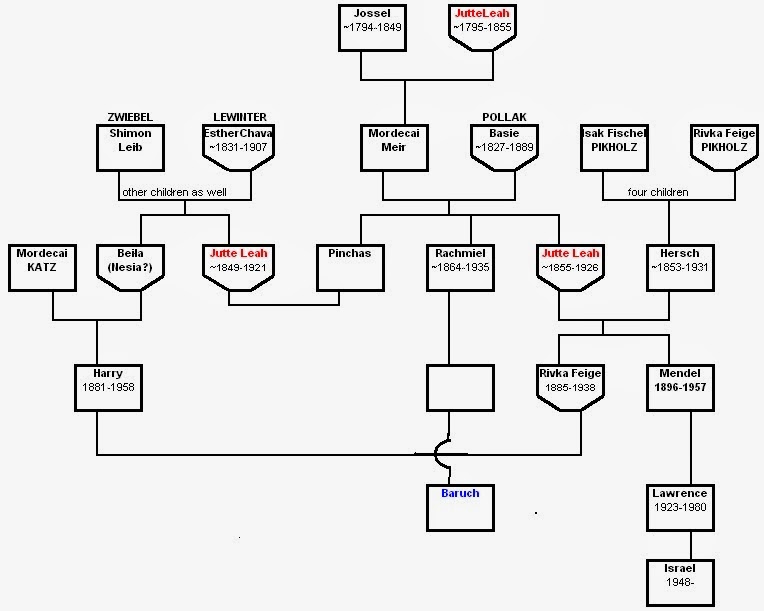
Well, there are two things. First of all, Uncle Harry, Gary's grandmother Chaje and Yaacov's grandmother Feige Malka are three of the ten children of Mordecai Katz and Beile (maybe Beile Nesia) Zwiebel. Beile's sister Jutte (maybe Jutte Leah) Zwiebel was married to Pinchas Kwoczka the brother of my great-grandmother. Their great-grandsons Pinchas and Aaron are my third cousins. They are third cousins of Rhoda, Roz and Marty the same way I am. But Rhoda, Roz and Marty are also third cousins of Pinchas and Aaron via Beila and Jutte Zwiebel's parents Shimon Leib Zwiebel and Ester Chava Lewinter.
Gary and Yaacov are the only living people in this chart who have not done DNA tests.


I have referred to this double relationship in my Lazarus presentation.

All these families - Kwoczka, Zwiebel, Lewinter, Katz and Pikholz - were from the Tarnopol area of east Galicia and undoubtedly have additional relationships further back, that we don't know about.

But it gets better. As I wrote nearly seven months ago, Rhoda, Roz and Pinchas share a segment of chromosome 21 with the descendants of my great-great-grandparents Shemaya Bauer and Feige Stern who - like several generations of their ancestors - lived in Hungary. So somewhere back in genealogy time, some Bauer or Stern ancestor of mine is also an ancestor of an unidentified Zwiebel or Lewinter. Back in time but recent enough that a segment of at least 13 cM has been preserved from each side.

I have found a number of strangers who share that segment of chromosome 21, but thus far none of them has had any useful information to contribute.

I found it interesting that Gary did not know of his Fleischman cousins and the others descended from Sarah Chana Kwoczka but he does know the family of Aaron, whose grandmother is Sarah Chana's sister.

Neither Gary nor Yaacov has done DNA testing (yet!) and we have no known cousins who are unambiguously Lewinters or Zwiebels on one hand or Bauers or Sterns on the other, so we have no clue where we might find the common ancestor. Yet!

Housekeeping notes
I plan to be in Chicago for my grandson Mordechai's bar mitzvah the first weekend in May. If any program directors are interested in having me speak in the days immediately before or after that weekend, please drop me a note.

I made a kiddush in shul this past week to mark my mother's seventh yahrzeit and while I was at it, my granddaughter's engagement.

Sunday, April 16, 2017

Jutte Leah Kwoczka's Lazarus Kit

Last summer at the IAJGS Conference in Seattle, I gave a new presentation called GEDmatch.com’s Lazarus Tool As It Applies to Two Kinds of Endogamy. It was well-received but I felt it needed some changes. I also received a few more kits that I had to add. I am beginning to work on those for the Orlando Conference in July. This is the summary I submitted with my proposal.
Lazarus is a tool offered by GEDmatch.com, which can create a partial genome of a person based on autosomal test results of descendants on one hand and non-descendant relatives on the other. This recreated kit can be compared to other kits in order to help determine and clarify relationships. 
But for endogamous families, this is more complicated, especially when you consider that there are two distinct types of endogamy. 
This presentation will address the two types of endogamy and the way to best use Lazarus while reducing "contaminated" input inadvertently introduced due to multiple relationships. It will also address the use of Lazarus as a tool for DNA analysis. 
The presentation – much of which is based on the speaker's recently published book "ENDOGAMY: One Family, One People" – will use examples from the single-surname Pikholz Project.
The talk will take place on Tuesday 25 July at 2 PM in a room called "Osprey 2" and will be introduced by Mindie Kaplan. The handouts are mostly tree charts so people will be able to follow the family structure.

The kit I am most interested in recreating in this presentation is my great-grandfather Hersch Pikholz (~1853-1931), but along the way, I shall recreate kits for my father, my great-grandmother and Hersch's mother Rivka Feige, with a nod to my grandfather as well.

People who have done Family Finder tests are shaded in green.
It is the kit of my great-grandmother, Jutte Leah Kwoczka (~1855-1926), Hersch Pikholz' wife, which I wish to comment upon here. We have Family Finder tests for fifteen of her descendants - three grandchildren and twelve great-grandchildren. 

Those fifteen descendants should be fine as Group 1*. (Actually we have two more great-grandchildren, but I am not using their tests as their parents are already included.)


For Group 2*, I used the grandson of one of Jutte Leah's brothers and a great-grandson of the other. That gave me a Lazarus kit for Jutte Leah of 1490 cM, not quite enough for GEDmatch to make it useful for one-to-many comparisons to other people.


I figured I should be able to make up the missing 10 cM and then some by testing a great-great-grandson of Jutte Leah's brother Pinchas.

The "and then some" turned out to be more than one hundred cM and the new kit was 1816 cM, more than enough for batching.

Finally - well not quite finally - this week I received Family Finder results for a sister of the great-great-grandson that I had added previously, giving me a fourth person in Group 2. The total cM went up by another 16 cM, for a total of 1833 cM. Not very much gained there.

But there are definitely false matches in that total. Aunt Becky's husband, Uncle Harry, is the son of Pinchas Kwoczka's wife's sister. 

That means that Aunt Becky's two granddaughters share Zwiebel/Lewinter DNA with the three descendants of Pinchas - DNA which has nothing at all to do with Jutte Leah Kwoczka and should not (MUST NOT) be included in her Lazarus kit.

So I had no choice but to remove the granddaughters of Aunt Becky and Uncle Harry, leaving thirteen members of Group 1*. This reduced the size of Jutte Leah's kit to 1644 cM. The irrelevant Zwiebel/Lewinter DNA was 189 cM, a very significant amount.

Please note that the last day of Passover begins this evening (Sunday) - the last two days if you are still in exile. I'll not be reacting to comments made during the holiday until my Wednesday morning.

* In fact, GEDmatch gives you only slots for ten kits in Group 1. But I have more than that in this case, so I had to reverse Group1 1 and Group 2. That doesn't matter to the computation.

Tuesday, July 12, 2016

Wendy and Carolyn

About a week ago, I received an inquiry about a week ago from a woman named Wendy who begins:
Hi Israel,

I am trying through a process of elimination to figure out my mom’s fathers side. Through Gedmatch, there are 3 relatives that you tested who have matches with my mom. She doesn’t know who her father is but she is 20+% Ashkenazi.
She gave me her mother Carolyn's GEDmatch kit number and the three of my kits that she matches and the chromosomes where the matches occur. I didn't pay much attention to the three people she mentioned but went straight to Carolyn's match list where I saw that she actually matches thirty of my kits.

In looking at the list of thirty, I saw that one was a match of nearly 12.5 cM with my father's second cousin Shabtai. This would be on my grandmother's mother's Hungarian side. I did a chromosome browser for that part of my family and quickly saw that all the action is on chromosome 21, at the far right end.


To remind everyone, Susan is my second cousin, Aunt Betty is my father's sister and Sarajoy is one of my sisters. So this is a nice family group. Not a large segment and probably not much use for someone looking for a birth father, but it does hint at geography as we know our Bauers were in the same area since the 1700s.

So I reported to Wendy:
This group points to my pgm's mother's family. her father is a Bauer from Apostag and Kunszentmiklos in Hungary and her mother is a Stern from Kalocsa.

I don't have more but that will give you some direction.
I also saw in the match list that Carolyn has matches with two second cousins on my father's father's (Galician) side, Rhoda and Roz who are first cousins to each other. But there were no matches with other of my Pikholz second cousins. There is, however, a match with my third cousin Pinchas. Pinchas is a third cousin to Rhoda and Roz as I am but is also a third cousin to them in a direction having nothing to do with me - their Zwiebel and Lewinter families, also from the same area of east Galicia. (It could be a Kwoczka match, but no other second cousins of mine appear.)

So I did a chromosome browser for just those three. And got this:


OK. So Carolyn has a match with the Zwiebels or the Lewinters.

Then I realized that this too is chromosome 21 and that a chromosome browser for both groups gives me this:


This really looks like one group, especially when I note that my start point (41,302,925) is the same as Shabtai while my end point (45,746,864) is the same as Pinchas.

I triangulated the two groups just in case one matchs Carolyn of her mother's side and one on her father's side. (This was unlikely as Carolyn's mother has no known Jewish ancestry.) The two groups triangulated perfectly.

So it appears clear that someplace back in genealogical time there is common ancestry between Shabtai's Hungarian Bauers or Sterns and the east Galician Zwiebels or the Lewinters. Back in time, but recent enough that segments in the 11-13 cM range were preserved in both groups.

Here's to endogamy. Even if it doesn't help Carolyn very much.

Carolyn and Wendy live in Maryland and both plan to attend my presentation at JGS Maryland at 1:30 on the twenty-fourth. That's at Hadassah, 3723 Old Court Road, Suite 205. Come join us. It's my one non-DNA talk other than Seattle. Maybe they'll meet their cousin Pinchas, if he comes.

Beyond A Reasonable Doubt:
What We Know
vs
 What We Can Prove

Housekeeping notes
I'm off to the US for the next four weeks. GRIP, the IAJGS Conference, programs in half-a-dozen places, some private mentoring on Y-DNA and meeting with a few relatives I haven't seen in forever.

Perhaps the most exciting thing will be meeting a male-line descendant of the Pikkel family from Vajnag, which is across the river from Vyshkovo. If you have forgotten the significance of that, review this blog from six weeks ago. I'll have a DNA test kit with me.

I'll blog as I can.

Sunday, March 2, 2014

Fiftieth Reunion, Genealogy, Young Cousin Matt, Geni - and More About Marla's family

My Class Reunion
The fiftieth reunion of my high school class (Taylor Allderdice, in Pittsburgh) is planned for the
No, I do not plan to attend
end of the summer. I never had much to do with my 462 fellow graduates during the two years I was there, but it's amazing what happens when you fill in your profile on the reunion website and write "Occupation: Genealogist."

This one writes to me and tells me what his family name was in Europe and throws in some Hebrew ("Shalom Chaver") for good measure. That one remarks on how interesting it must be for me. Others had questions about their families or how to do this or that.

There are also a few whom I approached, because their unusual surnames had some family connections with me. Or with my wife. In one case, a classmate has the same rare name as my wife's late husband. In another, the surname is almost surely from my ancestral town Skalat. (Actually, I think the family of my wonderful fourth grade arithmetic teacher at Linden School may also have been from Skalat.)

The truth is there may be some meaningful communal genealogy to be done among my classmates and others in my home community, based on their towns of emigration.

Zalosce and Podkamen
My great-grandfather, Hersch Pickholz, was probably born in Podkamen, though his family had been from Skalat. Other Pittsburgh families that I knew were also from Podkamen - the Klahrs and the Steins, for a start. But there are no Podkamen records, so I could not do anything on that front.

Hersch Pickholz married Jutte Lea Kwoczka from neighboring Zalosce and their older children were born there. His brother and one of his sisters also raised their families in Zalosce. When JRI-Poland came out with indexed birth from Zalosce for 1877-1890, I was eager to see them. I went through the lists and saw so many names that I knew from Pittsburgh, including from school and the neighborhood. Kweller, Lewinter, Papernik, Chotiner, our own Braun and Kwoczka, Charap, Schwadron, Wachs and others.

There must have been a lot of chain migration from the Zalosce area to Pittsburgh in the 1890s. I don't know if the chain was mostly intra-family or just people who knew each other. There is at least one person is my class whose (great-)grandparents were from two families on the list above.

After WWI, Rabbi Wolf Leiter, the son of the rabbi of Zalosce, came to Pittsburgh where he served until his death in 1974. His memoirs helped me solve a major family relationship in a different town. A story for another time.

Enter Matt
One of the girls in my class (I am allowed to say "girls" in this context even though the next big birthday will be 70, right? Nana always called her friends "The Girls.") tells me that her grandfather came from a town called Nasielsk, not far from Warsaw. The grandfather died here in Israel and is buried in Petah Tikva. She has never been here.

I am not sure how much effort I am interested in putting here, but I figure I can do a bit of poking around to see what comes up.

The grandfather is listed in the cemetery website and appears on JOWBR, with a photo.

His grave is the next section over from my parents, so it's easy enough to visit, next time I am there.

Anyway, just as she and I are corresponding, I meet Matt. Matthew Saunders is newly married to Jessica Gordon, whose late father David is my first cousin. Jessie and Matt were visiting from New York and spent Shabbes here, together with her brother and sister-in-law Ari and Bobbi, who live here in town with their baby daughter Devorah. We had a lovely time, full of Torah and genealogy, as Matt is very much into both of these.

So Friday afternoon we are sitting at the computer talking and Matt says something about his grandfather's having come from Nasielsk. I had him write a note to the girl from my class right there on the spot. We'll see if that leads anywhere.

Matt and I also discussed Geni.com, which he uses. Some of my thoughts on that appear here. It turns out that despite what Geni says, Matt and my mother-in-law are NOT related. There is a chain leading from one to the other, but as soon as I saw that it depends on a "brother-in-law relationship" in the middle, I knew they could not be truly related.

Speaking of Geni
Which reminds me, I received a note from an experienced genealogy researcher in the US purporting to show how we are related. I removed the names aside from my own, leaving the initials of the fellow who sent me this.
As you can see, there are twenty-one steps here from him to me, including half a dozen in-law relationships, which jump bloodlines It misspells my name and includes a photograph of me that I don't think I have ever seen before; I certainly didn't authorize its use on Geni.

It's hard to take this stuff seriously. But we have to, if only to protect ourselves. And laughter can be oh so effective.


Leftovers from last week
After posting last week, I added a comment, which I revisit here with some illustrations and further explanation.

If Marla and her brother match nineteen Pikholz descendants between them, but their mother matches only seventeen, we must consider that there are some who would match on Marla's father's side. (There are also two that only the mother matches, but that is not a problem.)

The four that the mother doesn't match are Bonnie, Gene, Gadi and Micha. Bonnie and Gene are third cousins from Skalat and Gadi and Micha are from Rozdol. The only interesting overlap involving those four is on chromosome 19, where Bonnie has a 5.97 cM match with Marla and Gadi has a 6.33 cM match, with a large overlap between them.

Marla as background, from top to bottom:
Marla's brother, mother, uncle, Bonnie, Gadi
In fact all four of Marla's group match the entire length of chromosome 19, so I thought that perhaps there was some kind of testing anomaly such that Marla's mother did not match Gadi and Bonnie.

But I ran them against Marla's uncle - who as I say matches them with Marla as a background. But he in fact does not match them on chromosome 19 at all, even though FTDNA calls them remote matches.

Here with Marla's uncle as background,
Bonnie and Gadi disappear entirely.

So it is clear to me that at least Bonnie and Gadi match Marla on her father's side.

Marla's father is deceased so we have to see if she has anyone else on his side who can test.

Her brother did a Y-37 test last week. It was always a longshot, but their surname has a meaning that is related to wood and maybe around 1800 two brothers chose different wood-related names, perhaps as a reflection of their family occupation..There was no match. Too bad. I liked the theory.

Oh, and one other thing for the consideration of the professional explainers. Since both Bonnie and Gadi have an overlapping match on chromosome 19 on Marla's father's side, a chromosome check of either Gadi or Bonnie that includes the other should show that both match Marla and her brother.

Gadi matches Marla and her brother,
on their father's side, but not Bonnie
Bonnie matches Marla and her brother
on their father's side, but not Gadi
So does this mean that Bonnie and Gadi are on different sides of Marla's father?

So much to learn.

Housekeeping notes
1. As a result of what I consider a nearly-confirmed relationship with Marla's family, I had a look at how her family connects DNA-wise with some of the other non-Pikholz families who also match with many of us. We have had an ongoing discussion among half a dozen such families the last few days and I would like to think that we will eventually nail something down. As I write this, several others of the non-Pikholz have joined our surname project at FTDNA, making it easier to do these comparisons.

2. I ordered four books from Amazon to help prepare for the GRIPitt.org course on Practical Genetic Genealogy in July. Matt brought one of them. My cousin Linda will be here next month and already has the other three. I am really placing alot of faith in this course.


GRIPitt has spaces available in some of the other courses.

3. PIT-ORD flight booked. ORD-SLC-ORD flights booked. International flights will wait until I am more certain of when I want to travel. Prices are way higher than last year.- more than 50% higher.

Sunday, December 8, 2013

LEWINTER = KWOCZKA ?

Kwoczka
My father's second cousin, whom I'll refer to as Baruch, is the great-great-grandson, in an all male line, of Jossel Kwoczka (~1794-1849) and his wife Jutte Lea. Baruch's surname should be Kwoczka, but his father changed it.

Jossel and Jutte Leah were called Kwoczka on their death records, but we do not know how far back the name goes. All the Kwoczkas lived in Zalosce and it appears that they are all descended from this couple or perhaps a couple who lived a generation or two earlier. I discussed this family about a year ago.

Baruch's grandfather Rachmiel Kwoczka had an older sister named Jutte Leah, my great-grandmother. Rachmiel and Jutte Leah had a brother Pinchas, who was also married to a Jutte Leah. Her father was a Zwiebel and her mother a Lewinter, but I have always had a strong feeling that the two Jutte Leahs could be traced back to a single namesake.


The question of the two Jutte Leahs is very much a back burner issue, mostly because there is so little documentation available for Zalosce.

There are additional children in all these families
So about eighteen months ago, I asked Baruch to do some DNA testing. I wanted an autosomal test to nail down the fact that my Jutte Leah is in fact the sister of his Rachmiel, which is now clear. And I asked him to do a Y-DNA because of his male line. I was not specific enough and he only did the very basic twelve-marker test, which does not lead us very far. It is sufficiently vague that he has 313 perfect matches, but of course that number would shrink drastically if he had tested for 25 or 37 or 67 or 111 markers. (The standard is 37 and I myself did 67.)

Lewinter
Nonetheless, every once in awhile, I'll have a look at Baruch's matches to see if anyone interesting shows up. A month ago, one did – a man named LeWinter in the US. I saw from his information on the match page that he had done a Y test with 111 markers, but had not done an autosomal test. There was an email address. I wrote.

He listed his most distant male-line ancestor as a Lewinter from Tarnopol, the provincial capital not from Zalosce.

I started putting together the scenario in my head. If Baruch and this LeWinter are in fact a good Y match, it means they have a common male-line ancestor. Without an autosomal test for LeWinter or at least a higher level Y test for Baruch, we could not tell how far back the common ancestor might be, but Tarnopol and Zalosce are so close that it would be reasonable to think that two hundred years ago is quite possible. That is about when the Jews of Galicia adopted surnames and we could have two brothers, one became Kwoczka and one Lewinter. Or maybe one took a surname from his wife. This looked like it might lead to a huge breakthrough.

I wrote and got a response, from the mother. He himself isn't very interested and this is all her doing. She sent me the grandfather's SS-5 form, where he applied in his own hand for a Social Security number. His parents, writes the grandfather Louis Lewinter, are Berel Lewinter and Yetty Lewinter. Yetty. There is Jutte again. Maybe even Jutte Leah. This could be really close family. Born 23 July 1895 in Tarnopol.

Nothing from my side was familiar to her. I was hoping she would know of our Zwiebel-Lewinter couple, whose descendants lived in Pittsburgh. But no. But also not necessarily important.

I went to JRI-Poland and looked up births of Lewinters anywhere near 1895, anyplace in Tarnopol province. After all, Louis may not have meant Tarnopol the city, just the general area.

There was one good match. Nachman Leib – Leib becomes Louis easily enough. Born 29 July 1895 – off by six days. Born in Tarnopol itself. So far so good. The mother is Jutte Dyne, the father is Berl.  It's certainly the right man. 
One problem. Jutte Dyne is the daughter of Nachman and Menie LEWINTER and Berl's surname is MANDEL. Louis – Nachman Leib – got his Lewinter surname from his mother. That happened often in east Galicia as the Jews did not always record their marriages with the civil authorities. That means my cousin Baruch's Kwoczka male line is a match with a family named Mandel. He may be related to the Lewinters, but not in that male line.

Too bad. Maybe the next DNA match will pan out.

The youngest Jutte Leah
Sometimes things work out right without being planned. I am writing this on Wednesday evening, the last night of Hanukkah. The second of Teveth. That is the fifth birthday of the youngest Jutte Leah. Her family calls her Lakie. She is the great-great-great-granddaughter of Jutte Leah Zwiebel and Pinchas Kwoczka, which makes her my third cousin twice removed.

Her mother made the decision to choose that ancestral name while sitting in my office about a month before Lakie was born. And it just happened to work out that I am sitting in my office writing this on her birthday.

- - - - - - - - - - - - - - - - - - - - - - - - - - - - - - - -
Housekeeping notes
1. The Fall AVOTAYNU is out. Next week I plan to write about my response to the two articles from the Summer issue on collaborative online genealogy, including a few outtakes from my earlier drafts.

2. The call for papers for the Salt Lake City conference came out this week.

While the program committee will consider all submissions, we have
identified some focus areas in which we are especially interested.
These include Genealogy and Jewish History related to World War I,
Jews of the Western United States, Technology in support of
genealogical research, Immigration and migration over the ages and
Ethical considerations in genealogy.

The conference will kick off one day shy of the 100th anniversary of
the start of World War I (Austria-Hungary declared war on Serbia on
July 28, 1914, one month after the assassination in Sarajevo of
Archduke Franz Ferdinand of Austria). Many of us have ancestors who
served in the armies of the various nations engaged in this conflict.
The War and subsequent fighting for control of Eastern Europe
devastated much of Europe including the Jewish heartland in the Pale.
It stimulated a wave of Jewish migration and resulted in the Balfour
declaration, calling for "the establishment in Palestine of a national
home for the Jewish people". If you would like to submit a speaking
proposal related to the "War to End all Wars" please do so.

I'm not sure I have anything to say on those topics, but I have until 15 January to come up with something.