Showing posts with label Blaine Bettinger. Show all posts

Sunday, December 23, 2018

The Rosenbloom Envelopes From Penza


Testing artifacts
The age of genetic genealogy has featured two basic verbs - "spit" and "swab." It's how we submit our DNA samples to the testing companies. The two have one thing in common. The subject must be alive, or at least dead-but-not-yet-buried.

We would like to know the DNA of our dead ancestors and several analytical tools have helped with that. I have had success with GEDmatch's Lazarus based on a combination of descendants and non-descendant relatives. Others have phased a missing parent, using children and the available parent. Visual Phasing works out grandparents based on grandchildren. But these are indirect methods that don't produce the full set of chromosomes for the missing ancestor.

The genetic genealogy community has been talking and asking about artifacts almost from the beginning. Grampa's hat has a bit of hair. Can we do anything with that? Only if there are follicles - and it would be a special, expensive project.

But what about that same spit that we already use, if applied to an envelope flap or a stamp. On one hand, this DNA is protected from the elements. On the other hand, how do we even know that the envelope was sealed and stamped by the actual letter writer. More than five years ago, Roberta Estes wrote about her attempts to get DNA from her long-deceased father and serendipitously acquired letters mailed by her grandfather. Roberta writes:
At the time my grandfather mailed those letters to my father, in the 1960s, my grandfather was living alone, so he should have licked the envelope and the stamp himself.
I called Bennett Greenspan at Family Tree DNA.  He referred me to a private lab that “does things like this,” called Trace Genetics.  Before you start googling, the company was subsequently sold and has now been defunct for years.  However, at that time they were doing custom processing of private forensic samples.
Yes, anything like that is considered forensic.  Anything you have to extract DNA from before you can have it processed in a regular lab is forensic work.
So, I got an estimate, took out a loan, and told them to go ahead.  You think I’m kidding, but I’m not.  The cost was in the $2000 range FOR EACH ATTEMPT.  So, we tried the envelope first.  No DNA.  Then we tried the stamp.  We got DNA, but it was female, so we knew it was contaminant DNA.  Think of how many people handle an envelope in the processing and delivery of mail, not to mention all the people who had handled it since.
Then we tried a second envelope.  No dice.
TWO THOUSAND DOLLARS! With less than 50% chance of success! Even if it's the person we think it is. For most of us, that is off the table.

Letters from Penza 
We actually have nine envelopes sent from Penza (Russia) where my great-grandfather lived his last years. Sometime during or (more likely) after the First World War, my great-grandfather and namesake Israel David Rosenbloom left - or was exiled from - Borisov (Barysaw) in today's Belarus and ended up in Penza, 680 miles away. With him were his second wife Yenta and her daughter Sonia (Sousha Chana) Resnikov and her family. The daughter they had together, Mera, was probably with them at first but by 1929, she was a physician living in Moscow. Also in Moscow was Israel David's daughter Alta Kaplan, from his late first wife Etta Bryna.

Israel David and Etta Bryna had two other children in the United States - my grandmother Sarah in Vandergrift Pennsylvania and Chaim Benzion (Uncle Hymen) who lived in Brooklyn. There was correspondence between the family in Russia and the family in the US during the 1920s, but only Uncle Hymen's copies survive.

I have nine envelopes and five letters addressed to Uncle Hymen. Fortunately he opened most of them with a letter opener, so the sealed flaps are largely intact. I scanned the nine envelopes and sent them to a company who offers this service and between three and seven were considered suitable for DNA extraction. The ones I list here as "maybe" were the result of comments like "if this was your only sample for this person we would attempt extraction on it."
Three are considered suitable for DNA extraction. Maybe four others. The identity of Mendel Wolfson is unknown.


There are five letters. I have copies of the Yiddish originals and translations into English of all five. I think that they are numbered in the order they were translated. Translations were done by various people, all arranged and paid for by Uncle Hymen's daughter, Cousin Ethel Klavan.

Letter #1
A six-page letter dated 30 September 1930 and opens "Dear Brother Yankev," so it would have been
Lieber Bruder Yankev
written by the step-daughter Sonia Resnikov. She mentions writing to their mother - whom we know to have been in Penza - so she was elsewhere. We knew that her brother had come to the US but never had much success looking for him. She mentions his wife and children, whom we know nothing about. In any event, this doesn't appear to be from one of the nine envelopes. It is an interesting snapshot of life in Stalin's USSR and perhaps I shall post the translation separately.

I don't know why Uncle Hymen had this letter. Perhaps his step-brother lived with him for a time, though they are not together in the 1930 census. The same census has a Jacob Bandes family living on Eastern Parkway, about two miles away, who may or may not be the step-brother.

Letter #2
"Israel David Rosenbloom" in his own hand?
A two-page letter from Israel David Rosenbloom to his son Uncle Hymen ("Chaim Bentshe"). He mentions that his grandson "Alta's Jakov" visited, met a girl and married her and that they have a daughter, making him a great-grandfather. The implication is that this is the first great-grandchild. This daughter died in childhood, and we do not know exactly when she was born.

The family knows that Jakov's wife Fania Pinskaya was from Penza and this confirms my assumption on how that came about.

Letter #3
A letter that is less than a page and a half in the same handwriting as letter #2. The letter is undated but the translation is stapled to a copy of the December 1928 envelope. I am not sure if that attribution is correct. The letter thanks Uncle Hymen for the $10 that he sent for Passover, eight months earlier than the date on that envelope.

The letter concludes "Regards from Alte and her children. She already has 2 grandchildren from her two sons, both girls." The second granddaughter is still living (in Moscow) and she says that she was born 23 August 1928.
I think the handwriting is the same on all three of these letters.
Letter #4
Lieber Kinder - Dear Children
This two-page letter opens "Dear Children" is specifically signed "Your mother, Yente." It is confusing and that may be the fault of the translator. The date "27th" appears at the top. The handwriting is the same as in letters 2 and 3, so it appears that one of the couple did the writing for both of them.

Letter #5
This two-page letter is definitely from daughter Mera to Uncle Hyman and it is dated 13 October 1929. The translation does not cover the entire letter. Mera thanks him for sending regards with someone named Mendel and that may be the man whose name appears on the last envelope. Mera lived in Moscow, so perhaps none of the envelopes are hers.

The card
There is also a card which records the receipt in Penza of seventy-eight francs on 23 April 1929 by Israel David Rosenbloom. My cousin Katya translated the card and added "due to his illiteracy in accordance to his personal request it is signed by (signature)." The reverse side says that it was sent to my great-grandfather in Penza.

I assume that he may have been illiterate in Russian but surely he read and wrote Yiddish. Katya suggests that perhaps "he decided that in 1929 it was safer to pretend being illiterate." I mention this because it may be relevant to the question who addressed and sealed the Rosenbloom Penza envelopes


totheletter DNA
Recently there have been new developments. Blaine Bettinger blogged about this a few weeks ago and has since revised it with updates. Blaine himself has sent envelopes to an Australian testing company called totheletter DNA. This is the company to whom I showed my nine scans. Their testing process has multiple stages:
  • You send them scans of the front and back of the envelope and they tell you if it appears to be suitable for DNA extraction. That part of the service is free.
  • You place the order for A$781.50 (=US$559.90) and send them the envelope.
  • They attempt to extract DNA, which costs A$140 (=~US$100). That part of the cost is non-refundable, regardless of the results.
  • If the extraction is successful, the actual genotyping costs A$621.50 (~US$445). That is refunded if the extraction is unsuccessful.
  • The last A$20 is for the cost of returning the envelope to the customer.
The company will upload the autosomal results to GEDmatch (Genesis) as part of the service.

(MyHeritage has announced that they will be offering a similar service, but they have not yet said what their prices will be and what exactly they will be offering. Nor are they willing to give a timetable for providing these details.)

The Mission
I would love to try this extraction and genotyping on at least one of the envelopes, but US$560 each is beyond my budget. Perhaps some of my family members would like to step up and help out. I think I would send the three envelopes which they deem "suitable" and let the company itself choose the one that looks the best for a start. If that one shows matches with us - the fifteen tested great-grandchildren - of 600-1000 cM, we would know it is Israel David's DNA. If not, we could consider whether to try another. We have the advantage here of knowing that none of the other of the Penza Rosenblooms (except Mera who lived in Moscow) has any of our Rosenbloom DNA.

The three "suitable" envelopes. One even has a bit of a stamp.
Housekeeping notes
I shall be speaking, in Hebrew, for the Rishon LeZion branch of the Israel Genealogical Society on Monday, 14 January at 7 PM at the Rishon LeZion Museum, 2 Ahad Haam Street. This is not a DNA presentation, though there are a few DNA references. The topic is


מֵעֵבֶר לְסָפֵק סָבִיר
מה שיודעים, לעומת מה שאפשר להוכיח
BEYOND A REASONABLE DOUBT
What We Know vs. What We Can Prove

Friday, May 4, 2018

Sometimes We Rethink

For several years now, I have been giving a presentation which includes the statement
Because once I, the family expert,
write it down, will it ever
be seriously re-examined?
If I say something is so, will my research heirs question my decision - if indeed they ever see it as a decision? Will even I myself reconsider it without some new overwhelming piece of evidence?

The theories
One of the first things I decided to check out when I began working with this new-fangled DNA thingee was the matter of the four Pikholz descendants who lived in Podolia, outside our usual east Galicia. The four - Necha, Moses, Chaim and Yakov - all appeared to have been born 1868-1878 and I had the feeling they might be siblings.

Moses, from Nemerow, boarded a ship in Hamburg bound for New York via Liverpool. That is the last we see of him. We never even see him arriving in either port. Or any other.

Necha, also from Nemerow, married Ruben Rechister of nearby Braclav and they emigrated to the US where she was known as Nellie Rochester. The Rochesters lived for about twenty years in Kansas City then most of the family moved on to California.

Chaim lived in nearby Tetiev where he and his family were killed in a pogrom in 1919.

Yakov was born in 1878 in Tulcin and has a living grandson who immigrated to Israel from Russia after the fall of the Soviet Union. We actually have Yakov's birth record which shows his father as Mikhail the son of Mordecai.

I had two non-competinng theories about who these people were. First the obvious possibility that the four are siblings. Second, we have a known Mordecai Pikholz born about 1805 in Skalat and it appeared to me that Yakov's grandfather is likely this same Mordecai.

Testing the theories
So after my "Immediate and Stunning Success" as outlined in Charper One of my book "ENDOGAMY: One Family, One People", I decided that I could test both theories using DNA. I could not test any descendants of Moses or Chaim, but I was in contact with Yakov's grandson and some of the great-grandchildren of Necha, whom I suspected were second cousins once removed to Yakov's grandson.

Second cousin once removed is eminently testable using autosomal DNA. And of course since we already had Y-DNA for Mordecai from Skalat, Yakov's line would be easy enough to compare.

Yakov's grandson did both tests, the autosomal Family Finder and the male line Y-37.

I was in touch with the families of two of Necha's grandsons - brothers. The elder has two children and the younger, four. The elder brother's daughter promptly agreed to test and I figured we were on the way to proof. They were the sixth and seventh Pikholz descendants  to test for our project.

The end of the theories
When the results came in, what looked like a simple confirmation, turned out quite the other way. The Y-DNA of Yakov's grandson did not match Mordecai of Skalat. It was not even close.

Both Family Finder tests showed some matches with the other Pikholz family members, but they did not match each other at all. Whatever they were, it was not second cousins once removed.

I did not get what I had hoped for but I got the truth. "No" is also an answer and this was a DNA success.

In the meantime...
The number of Pikholz descendants who tested increased from seven to about eighty and with it, the number of Pikholz matches for both Yakov's grandson and Necha's great-granddaughter..

We began using GEDmatch as our standard for analysis, rather than the less useful tools that Family Tree DNA provides. For instance, a one-to-one comparison of Yakov's grandson and the Rochester great-granddaughter is not exacty non-existent.
There are twenty-two segments totalling some 60 cM with the three largest segments only 6.1, 5.8 and 4.6 cM. Certainly not much more than nothing.

Sheva
We found a woman named Sheva Pikholz Weinstein from Nemerow, about the same age as Necha Rochester, with a living granddaughter in North Carolina. If Sheva and Necha are sisters, then we can test possible second cousins once removed. In fact, Family Tree DNA shows Sheva's granddaughter and Necha's great-granddaughter as suggested third-fifth cousins with a longest segment of 27 cM and a total of 80 cM.Blaine Bettinger's Shared cM Project says that second cousins once removed share on average 123 cM, with a high of 316 cM and a low of zero. Our match looks low but not outrageously so.

Lara Diamond has some preliminary data for an Ashkenazic Shared DNA Survey which shows second cousins once removed sharing an average of 170 cM, with a high of 446 cM and a low of zero. In this context our match is certainly to small to qualify.

GEDmatch shows Sheva's granddaughter and Yakov's grandson with a longest segment of 14.8 cM with a total of 50.6 cM. This is well below second cousin territory.

A second Rochester test
I have been saying ever since those first tests that perhaps the Rochester great-granddaughter is an outlier and that her cousins might give us better resuts. Eventually one of those cousins tested, a male, with MyHeritage.

He uploaded to GEDmatch and his match with Sheva's granddaughter are even weaker than his cousin's. A total of 65.2 cM with a longest of 15.5 cM. And only one segment that he shares with both his cousin and Sheva's grandaughter, and that shared segment is only 8.3 cM.

So it looks definitive that Sheva and Necha are not sisters. They are likely cousins but could be aunt and niece. The matches we see are reasonable for second cousins twice removed.

An unexpected conclusion
This throws a monkey wrench into one of the more obvious conclusions, one I hadn't even been looking at. I have assumed all along - though I never wrote it as such - that whatever the status of Chaim and Yakov, Necha was the older sister of Moses, both being from Nemerow. That is the kind of conclusion that many researchers would record as fact and never given it another thought.

If however, as it seems, that Sheva and Necha, both from Nemerow, are NOT sisters, then perhaps Moses is Sheva's brother, not Necha's. Or perhaps Moses is the brother of neither Sheva nor Necha. This is an unexpected result of the rethink and another good example of why we must proceed with caution before drawing concusions. Because if I write it down, will anyone ever question it? Will even I revisit it?

And what of Yakov?
When Yakov's grandson tested, we had almost no experience with Pikholz Y-DNA. We have since determined that three known Skalat male lines are precise matches in the "R" haplogroup and that four known Rozdol male lines are also precise matches in a different part of the "R" haplogroup.

Only one other person with the Pikholz surname has done a Y-DNA test and he is also "R." We don't know how he connects to any other Pikholz family.

Yakov's grandson is J-M172. The records call his male line ancestors "Pikholz" (or Pikgolts), so it does not appear that the name Pikholz came from a maternal ancestor, in the Galician way. Yakov's mother's surname is known so it is pretty clearly that there is no such scenario.

I think it is time to bite the bullet and label Yakov's grandson as the product of a non-paternal event - an adoption or some other event that broke the Pikholz male line. Label in my own mind. Label as a "maybe" in the comments. Certainly not to label a certain NPE. But I think that;s what we have.

I still think that Yakov's grandfather Mordecai is likely the Mordecai (b.1805) whom we know and Yakov may well be the brother of Necha. Or Sheva. But I haven't a clue how we might demonstrate that. (Come to think it, I have an idea. We'll see if it goes anywhere.)

Wednesday, November 22, 2017

My First "False Father" Event

The False Father
What do you call a situation where the father isn't who he was expected to be? On the few occasions when I needed to refer to such cases, I would call it a "false father" situation. Then I got into genetic genealogy and learned that the experienced folks call it a Non-Paternity Event, so I went with that. Until I began writing this post, when I looked it up on the ISOGG wiki. They define it thus:
Non-paternity event is a term used in genetic genealogy to describe any event which has caused a break in the link between an hereditary surname and the Y-chromosome resulting in a son using a different surname from that of his biological father.[1] The definition excludes minor changes in the spelling of the surname, and is implicitly limited to events after the relevant branch of the surname became hereditary. 

They cite more than a score of synonyms and more than a dozen scenarios, including such innocuous instances like "Surname switch."

So I am going back to "false father" and changed the title of this post accordingly. It's much less cumbersome than "misattributed parentage event."

Anyway I am here to tell you about my first false father case. I have helped out on a few, but it's not anything I have run across in my own research or my own families. I am writing this with the permission of the people involved, after changing or omitting all identifying information. For the purpose of this post, it doesn't matter whether I have a connection to this family or how they came to approach me.

This is the basic family structure.

The Problem
Fred Goldfeld's daughter Bonnie took an autosomal DNA test some time ago. A few months ago, Harvey's daughter Elaine took an autosomal test with the encouragement of her husband Rick. My impression is that Rick is the one who is interested in genealogy - Elaine, not so much.

Elaine and Bonnie are, ostensibly, first cousins. Here is how GEDmatch sees them. (All the comparisons in this case are based on GEDmatch kits.)


They have no common segments of 7 cM or more and six segments in the 3-7 cM range.

According to the most recent iteration of Blaine Bettinger's Shared cM Project, first cousins share an average of 884 cM and 95% of first cousins share between 619 and 1159 cM. Clearly Bonnie and Elaine are nowhere near those numbers. In fact the segments they share are likely Identical By State (IBS) and do not represent any common ancestry whatsoever. (Bonnie's mother Peggy is not Jewish, so there is no intrusion of endogamy from her side.)

One of the two women is not the daughter of the Goldfeld brothers, Fred and Harvey. At least one of them, perhaps even both. Which?

Fred and Harvey are long dead, as is Harvey's wife Phyllis. All the children here are in their fifties and sixties. The entire family lives in a large US city which has probably never had as many as 30,000 Jews.

Another test, by George
The obvious way to proceed was to ask Bonnie's brother or Elaine's siblings to test. Elaine's older brother George took an autosomal DNA test - here too, I am not sure he is particularly interested in genealogy and my contact was his wife Cheryl.


George's top match is his sister Elaine, as expected, followed by his first cousin Bonnie. But let's look at the numbers.

The Shared cM Project tells us that the average pair of full siblings share 2629 cM and that 95% of full sibling pairs share 2342-2917 cM. Elaine and George share 1929.5 cM which is below full sibling territory but well within half-sibling territory which is on average 1760 cM.

Since this is sensitive and I am new at this analysis, I asked CeCe Moore and Lara Diamond to review my logic. Both agreed that we are looking at half-siblings.

We see on the right the one-to-one comparison between George and Elaine. There are no significant green areas making it clear that they do not share two parents. (The yellow areas are segments where we see one common parent.)

Elaine and George share 118.9 cM on the X chromosome which must indicate that they have the same mother, since George gets no X from his father. Elaine and George have different fathers.That explains why Elaine and Bonnie are not related.

Fred and Harvey
George's second match is his first cousin Bonnie; they share 636.1 cM. As I wrote above, first cousins share an average of 884 cM and 95% of first cousins share between 619 and 1159 cM, so George and Bonnie are at the lower end of that range. Half first cousins, on the other hand, share an average of 440 cM and 95% of first cousins share between 235 and  665 cM. George and Bonnie are at the high end of that range.

So are George and Bonnie full first cousins or half first cousins? If the former, it's because their fathers, Fred and Harvey are full brothers. If the latter, Fred and Harvey are half brothers -  another false father case. CeCe and Lara differed on this question.

I decided to attempt to solve this question by looking at George's other matches and seeing what they share. Beforehand, I had to have a look at the geography. I knew from the documents that I had seen, that Fred and Harvey's mother Rivka was born in eastern Russia as were both her parents. Their father, Irving, was born in the US and all I could see was that his parents were from "Russia." I went into the JewishGen Family Finder and looked up their surname Goldfeld. There is one Goldfeld researcher and he said they were from Vilna. Since the name is rare, I figured that Irving Goldfeld's father Abraham was also from the western part of Russia, what is now Lithuania and Belarus.

I manage over 110 GEDmatch kits for my own families and it has become something of a joke on the Jewish genealogy groups on Facebook that most European Jews match several dozen of my kits. George matches over forty of my family kits. But seven segments stand out.

He has three segments on three different chromosomes which match my Jaffe cousins, from Borisov in Belarus. These matches appear to come from Irving's Goldfeld side. Neither Bonnie nor Elaine share these matches.

My three Jaffe cousins, two first cousins to one another and the daughter of a third


George has two segments which match my Kwoczka cousins who lived in Zalosce, near Tarnopol. These appear to come from Rivka's family, who lived a bit further east. Neither Bonnie nor Elaine shares these matches.
The lower chromosome has a segment of about 9.5 cM, so I decided to include it.


George has a match with nine of my family members on chromosome 21, about which I have written before. This group consists of two apparently unrelated parts of my family, one from the Tarnopol area, the other from Hungary. This also appears to be from Rivka's family. Neither Elaine nor Bonnie shares this match.


Finally, George matches a segment which appears to come from the other side of two of my second cousins. That family lived in Schedrin, in today's Belarus so is probably a Goldfeld match. Elaine does not share it, but Bonnie does. 

The yellow match here is Bonnie, the two greens are my Schedrin cousins..


If Bonnie and George both match a segment that comes from the Goldfeld side, I can conclude that Fred and Harvey are full brothers. This is far from 100% convincing.

A better way to check this out is to get Bonnie's brother Michael and George and Elaine's younger brother Norman and younger sister Karen to take autosomal tests. They would likely have less ambiguous results than the George-Bonnie match.

Elaine's father
After preparing my analysis and conclusions, I met with Elaine, her husband Rick, George and his wife Cheryl using GoToMeeting, which allowed me to show them the imges above and more. I asked them in advance, as I had during earlier emails with Rick, if they are prepared for whatever we might find. Rick assured me that all they wanted was the truth and that whatever it is, they could handle it.

So I explained to them that Elaine's father was not Harvey and showed them the proofs. Rick said that Elaine is still the same Elaine, no matter who her father was.

I suggested again that testing Norman and Karen might clarify the status of Fred and Harvey, but they were not sure if they wanted to tell the younger siblings anything at all.

And Rick asked me if I could tell them anything about the man who fathered Elaine.

I went back to GEDmatch and used their tool "People who match one or both of two kits" to find Elaine's matches which George does not share.  There were, of course, many - Most of them have Jewish-sounding surnames, so there is that. About fifteen of them matched on segments greater than 25 centiMorgans. The longest was just over 50 cM and there was another over 40 cM.


The one over 50 cM came with another of over 20 cM and they triangulated. I wrote to both. The smaller one answered, but she knows nothing that can help. The person with the 50+ cM has not yet responded. Perhaps she will later.

I suggested to Rick that he might want to contact the remainder of the fifteen.

Housekeeping notes
I had a nice turnout Sunday evening for the Israel Genealogical Society meeting in Kefar Sava. It was a lively, Hebrew-speaking crowd and with the questions we went well over the allotted time.

Next up, the genealogy series at Yad Vashem, in partnership with the Central Zionist Archives.

Sunday, May 28, 2017

Lazarus and Half-Siblings


Most of  my readers know by now that the Lazarus tool on GEDmatch (a Tier 1 tool which requires a small donation) enables you to recreate a partial genome of a person based on DNA of his descendants and other relatives.

If your Lazarus kit has 1500 cM or more, it will be batched by GEDmatch and you can use it in one-to-many searches. With that, you can see who else that kit matches and how.

Lazarus works with two groups of relatives. Group 1 is descendants of the target, children, grandchildren even great-grandchildren - though the further away you get, the less useful. Group 2 is non-descendant relatives of the target - siblings, aunts and uncles, cousins etc. The idea is that in a non-endogamous population, any segment that appears in both Group 1 and Group 2, must be shared by the target.

In endogamous populations, that's a bit more complicated as it is easy to mistakenly introduce segments that do not belong, as I discussed about six weeks ago regarding the Lazarus kit of my great-grandmother Jutte Leah Kwoczka.

The Facebook group "GEDmatch Lazarus Tool" gives users a place to discuss their experiences and problems and to get advice from others. That groups was founded by the indispensible Blaine Bettinger and he also provides a link to his blog with a detailed explaination on how to use Lazarus. Blaine's blog includes the following:


Later he repeats for emphasis:
The most important rule is to
NEVER EVER PUT A DESCENDANT IN GROUP 2!!

Why is that? Because if you are doing a Lazarus for your grandmother, her descendants will likely also be descendants of your grandfather as well and if you have descendants of both of them in both Group 1 and Group 2, the Lazarus kit - which accepts all the matching segments without differentiation - will give your grandmother's kit segments that are not hers, but her husband's.

Nearly two years ago, I challenged that blanket statement in this space. I wrote:
There is, however, an exception. When the target has children from multiple spouses who are not related to one another.
I explained this using a fictional discussion within a well-known historical family, which is worth a reread.

The subject keeps coming up, so I thought it worth a review.

The idea is that since the target's multiple unrelated spouses are, well, unrelated, if you put the descandants of one spouse in Group 1 and descendants of another in Group 2, you do not run into the problem of misattribution that I described above.

This subject comes up from time to time in the Facebook group because despite the fact that GEDmatch adjusted its instructions to permit half-siblings in Group 2, Blaine's linked blog still has the old instructions which warns sternly against doing so.

This is not a trivial matter. In my Jutte Leah Kwoczka blog cited above, I described how I struggled to reach the 1500 cM minimum, even though I had fifteen descendants in Group 1.

David matches Anna. Click to enlarge.
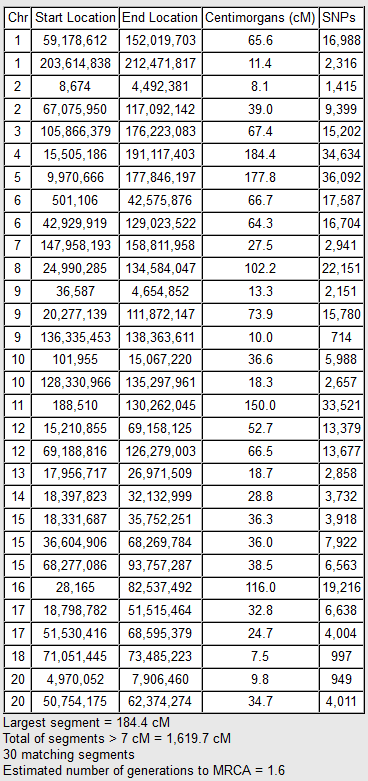
But let's look what happens when we use two half siblings - one each in Group 1 and Group 2. For this I return to my favorite fourth cousins, David and Anna, great-great-grandchildren of Uncle Selig. They have the same father but their mothers are not related to one another. Both mothers are Polish so there is no issue of Jewish endogamy in play.

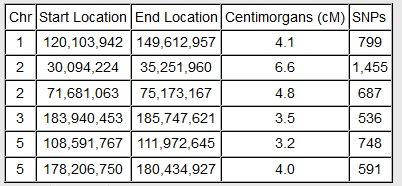
Using a one-to-one, we get 1619.7 cM right off the bat, more than the 1500 cM we need for batching. (This does not include the X, but we don't need it because obviously David has no X from his father. If we were talking about two sisters, we would add the results of the separate "X 'One-to-one' " tool.)

Blaine's very important Shared CcM Project shows the average half-sibling match to be 1731.05 cM, but the diffrence between that  and David and Anna's shared 1617.7 cM probably includes the X which they don't have at all. In any case, 1617.7 cM is a reasonable result.

But we can do better.

The 1617.7 cM is based on a threshhold of 7 cM. That is, it excludes anything below 7 cM. In fact, if two half-siblings have smaller matches, they surely come from the shared parent. Their father also has those small segments, even if they came to him as IBS (Identical By State).

I ran the "One-to-one" again using a threshhold of 4 cM (the lowest permitted by Lazarus) and added these six segments. That brings the total match between David and Anna to 1649.8 cM.

This is what they share from their father.


I created a Lazarus kit (shown on the left), using the 4 cM threshhold, with only David in Group 1 and only Anna in Group 2. I fully expected to get a kit with that same 1649.8 cM. The result is 1642 cM - close but not perfect. I'll let GEDmatch figure out what the difference is and why.

The results are good enough for batching.

Of course, if David's full brothers would test, we could add them to Group 1 which would improve the results. Probably significantly.

If Anna also had full siblings, even better.

And if we could add their one known second cousin (whom I hope to meet at my presentation in Rishon Lezion in three weeks) to Group 2, we could also improve the results. I'm not sure by how much.

But the point is, this works.


Housekeeping Notes

Skalat memorial
The annual Skalat memorial at the Holon Cemetery outside Tel-Aviv is the day after Shavuot - this year Thursday the first of June at five thirty, next to the Skalat monument along the eastern wall of the cemetery. Those of you saying Yizkor that day may wish to keep us in mind.

Coming presentations in Israel
I am giving two presentations here in Israel in the coming weeks.

4 June 2017, 7:00 PM – IGS “Shorashim BaGalil” Kiryat Tivon, Library and Memorial Center, Migdal 2
and
19 June 2017, 6:30 PM – IGS Rishon Lezion, Museum of Rishon Lezion, Ahad Ha’am 2.
Both are the Hebrew version of
Lessons in Jewish DNA – One Man’s Successes and What He Learned On the Journey
   
Moscow
I have my ticket in hand for my trip to the US for the Orlando conference, with a stop in Moscow for a day and a half. I'll be meeting there with two more of my newfound Kaplan-Rosenbloom second cousins. I am very excited about this. (I introduced you to this family here, here and here.)

Presentations in Orlando
I have now signed up introducers for all four of my presentations at the IAJGS Conference in Orlando 23-28 July. Two of them are people I have never met - but they are Pikholz descendants, one from Skalat and one from Rozdol.
   
Unveiling
On my way back from Orlando, I'll be in Chicago for a couple of days.  I understand that my sisters there plan to have my brother's unveiling then.

Sunday, August 14, 2016

A Month Abroad - Part Two - GRIP

This is the second in my series of blogs on my recent four weeks in the US. Part One is here.

Genealogical Research Institute of Pittsburgh
Two years ago, I participated in the inaugural course in Practical Genetic Genealogy at the Genealogical Research Institute of Pittsburgh (GRIP). The knowledge and the friendships from that week helped propel me along the path I have chosen in genetic genealogy.

This year, they offered Advanced Genetic Genealogy in their July session. This is the way GRIP describes the course:
If you believe that you are ready to graduate from the basics of genetic genealogy and take the next step in genetic genealogy education, then this is the course for you. Be prepared for a fast-paced learning experience intended for the genealogist who has experience applying DNA testing to family history research and has a strong foundational understanding of genetic genealogy concepts.We will demonstrate and discuss methods used by expert genetic genealogists to get the most out of DNA results, utilizing all four types of DNA, in conjunction with documentary evidence to advance knowledge of an individual’s family tree. Genetic genealogy’s application to unknown parentage search will also be examined and resources explored for when unexpected results are encountered.  We will end each day with a discussion session to enhance and reinforce the day’s coursework.Upon completion of this course, students will have gained insight into how to take their own genetic genealogy research to the next level and what it takes to assist others in this pursuit.
Nearly all the instruction was from CeCe Moore and Blaine Bettinger, who also taught two years ago. This is the curriculum.
One hundred forty pages of syllabus for this rich program
As I did two years ago, I stayed with Aunt Betty and Uncle Ken in Squirrel Hill rather than in the LaRoche College dormitory and rented a car for the twenty minute morning drive and the thirty minute afternoon return trip. Each day after morning services, I picked up a donut and a bagel at the kosher Dunkin Donuts to get me through the day.

The audio visual equipment in the room we were assigned was excellent, with everything shown on two large screens in the front of the room and a screen in the back to enable the  instructor to see it while facing the class. We were in four rows of stadium seating, with plugs for our computers on the table and adequate WiFi. The ratio of women to men was less overwhelming than last time. There were several people I knew, from the earlier course and from other places. The class list had forty-nine names, but it didn't feel like an overly large group. Only one or two aside from me expressed any special interest in Jewish DNA.

As before, I helped myself to a front row seat.

The course itself was outstanding and after more than one session, I (and others) said "this session was worth the entire price of admission." Of course this was helped by the fact that I am better equipped to handle the more advanced material than I was two years ago.

Among the stand-out sessions were Blaine on "Advanced Applications foir Third Party Tools" and CeCe on Ethnicity and Admixture, Unknown Parentage and Triangulation. The former included a really nice presentation of Kathy Johnston's Visual Phasing which identifies grandparents' segments based on three sibling-grandchildren. I had never seen this before. It is really very clever.

Both the unknown parentage session and those on admixture led to Jewish issues and CeCe showed herself to be much more knowledgeable and much more comfortable with the Jewish DNA than she had been two years ago. I told her that I was proud of her for her progress. She thanked me publicly for not giving her a hard time and for staying awake. (The latter was a problem last time.)

There was alot of emphasis on things specific to Ancestry and 23 & Me, and since I work with neither (though I tested with 23 & Me) I was quite unfamiliar with the material. I made a decision then that when in Seattle I would go to the Ancestry booth, give them some spit.- then put up the bare bones of a tree. I am pleased to report that I followed through on that. Even if I do not need it for my own research, I really need to know how this works as part of being a professional.

I still have to do something about 23 & Me which I have been ignoring because I find it user-unfriendly to say the least.

Although I am still skeptical about the whole notion of the companies' ethnicity analyses, I saw how CeCe uses them to help identify unknown parents. I was intrigued by the 23 & Me ethnicity results which are by chromosome, rather than just an aggregate blob. I would like to see FTDNA do something like that. I seem to have picked up on what CeCe was doing, as I was quite on the ball in the session on case studies. Of course, I do not use this much in real life, so I am not sure how to keep sharp on that analysis.

The attitude of Ancestry's "we'll do the work for you so you don't need to see the data" policy was analyzed under the harshest of lights. Good things were said about triangulation in that and other contexts.

There was a lot of discussion during Blaine's session on "Ethical and Legal Considerations." Judy Russell was a participant in the course so she had what to say on the subject. (Judy and I crossed swords more than a few times, but it was all in a friendly way. I think.)

Debbie Parker Wayne did one session - on "Reporting and Citing DNA results." It started off very dry with alot of reading from the slides, but it picked up and  ended up being quite useful.

Two students who are geneticists - Brianne Kirkpatrick and Beth Balkite - gave a session on "The Intersection of Genetic Genealogy and Genetic Counseling"  which gave us a different perspective on the whole topic.

Many of the participants in the course already work at a high level so student participation in the discussions was both interesting and useful. I think I held my own in that department.

If I had to boil it down to one sentence, I'd say that the course was way beyond my expectations, which were high to begin with.

I also enjoyed the general GRIP experience even though I was not a visitor to the cafeteria and did not stay for the evening programs. I wish I could say I look forward to doing this again as Elissa Scalise Powell and Debbie Deal put together a fine week of programming, but the non-DNA topics are pretty irrelevant for me and I don't see another DNA course in the near future.

There was one evening program in which I participated - the one on Wednesday when I gave a presentation "Lessons in Jewish DNA - One Man's Successes and What He Learned on the Journey." It was well attended and well received. A few people bought my book and a few others who had bought it online gave it to me to sign.

Triangulation: Jim Bartlett
While we are are on the subject of triangulation, which I mentioned a few paragraphs ago, let me mention that during the week after GRIP I spent a wonderful day with Jim Bartlett the segmentologist.

What got the ball rolling on that was a bloggers party at the home of Pat Richley-Erickson (aka Dear Myrtle) after RootsTech. Lara Diamond introduced me to Carol Petranek, the Co-Director of the Washington DC Family History Center. Carol said that it would be nice if I could speak at one of their Saturday programs, which of course I cannot. But since I knew then that I'd be in Baltimore on the twenty-fourth of July, I offered her the twenty-fifth. One thing led to another and I ended up with an invitation to speak that evening at the Fairfax (Virginia) Genealogical Society, with Jim Bartlett as my host.

I already knew that he liked my book and I have had a tremendous respect for his engineer's approach to DNA analysis, particularly triangulation. We went on for many hours and he showed me exactly how he does his analysis. It is still difficult for me to dive into this at that level both because of the Jewish issues and because I am doing a single-surname project, not just my own personal genealogy. This means I'd have to build an Excel analysis with additional dimensions.

I felt as though I had known Jim well, perhaps in a previous life. He and his wife Olivia were gracious hosts - as were all the people I stayed with during my trip. Actually, Jim and I met at the home of one of my wife's cousins and the three of us had a pleasant time together.

Jim is also known by the email address "gedmatch3" so I decided to run the Lazarus-Endogamy talk I had prepared for Seattle by him to see what he thought. He was the only person to see it before the actual presentation.

Jim and I on TV
Tuesday, after my Fairfax presentation, Jim and I were back in Fairfax for two interviews on Sidney Sacks' local TV show, Tracing Your Family Roots. In one Jim and Sidney's wife Arline interviewed me about my book and the other was more of a three way discussion, though officially Arline was interviewing both of us. I was not at my smoothest.

After they are shown locally, they will be available on line. I'll post links when I have them.

Part Three is here. Part Four is here. And finally, Part Five is here.

Wednesday, April 6, 2016

Diamond Endogamy

A Joint Post with Lara Diamond of Lara's Jewnealogy

Dorit and Evelyne
Last week, Dorit sat in my office learning about DNA match analysis. Dorit has tested her mother Evelyne (nee Berger), her mother's sister and a few other relatives and has the benefit of another of her mother's family (Jason) who manages a few kits on his own. (Dorit's father's family is Moroccan and of less interest, at least for now.)

Dorit's tests were done with Family Tree DNA (FTDNA) as were some of Jason's and some of them have been uploaded to GEDmatch.

We went over the basic tools offered by FTDNA for autosomal analysis and looked at some GEDmatch tools as well. In the course of looking at Evelyne's matches in the GEDmatch Tier1 "Matching Segment Search" tool, I saw some segments that match any number of friends of mine in the world of DNA. And, of course, since all European Jews are related to one another multiple times, it cannot be otherwise.

(GEDmatch is free except for a few items in Tier1 which require a donation.)

Among those matches were several with the family of my friend and colleague Lara Diamond, who shows up on GEDmatch as less than four generations away from Evelyne.

I cannot keep track of all of Lara's family, but I did have a look the list of Evelyne's nine matches with people named Diamond. You can see them here on the right, edited to eliminate the personal names.

Five are Lara's family, marked in red. In addition to Lara herself, we see her father, paternal grandmother and uncle. And also her mother, who is not known to be related to Lara's father..

So Evelyne is related to Lara through both of Lara's parents.

But Lara's uncle is a suggested "2nd cousin - 4th cousin" while his mother, Lara's grandmother, is only a suggested "4th cousin - remote cousin." So in addition to Lara's paternal grandMOTHER, Evelyne is also related to Lara's paternal grandFATHER.

Five matches is just what a FTDNA chromosome browser can handle so I opened one for Evelyne and lined up Lara's five matches: grandmother, uncle, father, Lara herself and her mother.

I left the threshold at the default 5 cM and the results look like this. (I am displaying only those six chromosomes where there are two or more of Lara's family on the same segments.) I added to the display the sizes of the segments in cM.


The two matches on chromosome 5 show segments from both paternal grandparents. On the left, Lara's father and grandmother have similar segments - clearly her father received this segment from his mother. On the centromere Lara and her father have an identical segment which is not from the grandmother, so it must be from the grandfather.

On the right ends of chromosomes 7 and 15, Lara has segments which are clearly from her mother.

Chromosome 8 shows a large segment (18.57 cM) where Evelyne matches Lara's uncle, but less than half of that matches the grandmother. In fact, the grandmother, the uncle and Lara herself all have the same starting point (64,372,741) and the uncle, Lara's father and Lara's second segment all have the same end point (85,095,990). The grandmother's segment ends at the same point where Lara's second segment begins (70,702,700). So clearly, the uncle has two adjacent - or nearly so - segments, one that he received from his mother and one from his father.

But it's not so simple
But this raises another question. How did Lara inherit her segment on the left from her grandmother if her father doesn't have it as well?

The same question comes up on the left side of chromosome 15 where Lara and her grandmother have identical segments of 5.1 cM, but her father does not. I ran that question on the ISOGG Facebook group and Blaine Bettinger made the (obvious!) suggestion to lower the threshold. Here is what came up:


Lara's father has a match on chromosome 15 which is slightly smaller than those of his mother and daughter and the excess bits appear to be Identical By State (IBS) rather than properly hereditary. So far, so good.

The eight of Diamonds
But that does not resolve the anomaly on chromosome 8, where Lara still has a segment in common with her grandmother, but not with her father. (There is a school of thought to simply discard all the small segments of this sort, under the IBS banner, but I am not comfortable with that until it proves unavoidable.)

I did triangulation for the segments on chromosome 8. These are the segments pictured above.
Lara's match with her grandmother on chromosome 8 goes from 119,665.558 to 146,255,887. Lara's match with her mother begins at 154,984 and goes on to 146,255,887.

Lara's match with Evelyne is not from her paternal grandmother but from her mother.

Let's drop the threshold from 3 cM to 1 cM and see what happens.
Here we see that Lara's mother has three very small segments that did not appear before. The third of the three is 2.73 cM and it seems clear that Lara received those two right-most segments from her mother, with a bit of IBS detritus in between.

If we look at the same set of matches for Lara's family with Evelyne's sister,
the segments in question are very similar to the matches with Evelyne, but Lara's mother's match appears more complete.

My purpose here was to illustrate for Dorit the complexities of endogamous DNA, which the matches between these five members of Lara's family and Evelyne (and her sister)  show nicely. It is not my purpose here to figure out the multiple common ancestors shared by these two families. Perhaps we can do that later.

But let me give the floor to Lara, who will introduce her other family members into this analysis.

Thursday, November 19, 2015

Second Cousins and Siblings

In the course of the lecture that I have been giving about DNA analysis and endogamy, I make the point that it is important to test as many family members as possible and particularly first and second cousins.

I show a slide based on Wiki of the International Society of Genetic Genealogy which shows estimates of shared DNA for various relationships.


I emphasize that second cousins share on average only about 212.5 cM or 3% of their DNA, which means that they do NOT share nearly 97%. Second cousins are people that many of us know and have grown up with. Sometimes we even resemble one another. So by not testing second cousins, we lose alot of information.

Some months ago, Blaine Bettinger did a non-scientific (self-selected) survey of peoples' known relationships and showed that second cousins share about 246 cM on average. That's more like four percent, still not very much.

I was curious to see how endogamous families were different from non-endogamous families. (I am talking about general populations, not cases where close cousins married one another in the last few generations.)

So I did my own mini-non-scientific study. No cherry-picking. (Note, the comparisons below are for segments of five or more cM.)

Here I compare four second cousins to my own results.

The two numbers for each person are number of matching segments and total matching cM.

Sam is on my mother's mother's side. Ruth is on my mother's father's side. My mother's parents are from Belarus/Lithuania, but apparently Ruth's father is a Galizianer, hence the much larger match with her.

Marty, Terry and I are mutual second cousins on the Pikholz side.

We see that Sam, Marty and Terry match me in the general range suggested by ISOGG and Blaine's study. Ruth, as I explained above, has a greater level of matching.

For purposes of comparison, I asked Roberta Estes if she would share some of her second cousin data and she readily agreed.

Roberta was comparing her mother Barbara and two of her mother's first cousins, Donald and Cheryl, to a second cousin named Rex. The closest of her three matches - Donald with 10 segments and 191 cM - is lower than the weakest of my matches - Marty, eleven segments and 223 cM.

So, at least in this bit of anecdotal evidence, my endogamous family has much better matches than Roberta's - which makes it much more difficult to make sense of it all. I added a slide into the newest version of my presentation, in order to make that point.

Roberta's data shows something else. Cheryl is Donald's sister and her matches - both number of segments and total cM - are a third less than her brother's. So we see another demonstration of the importance of testing siblings.

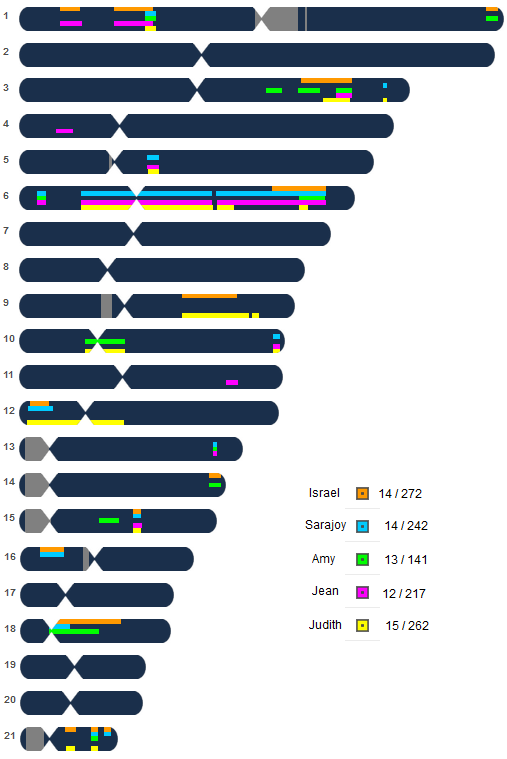
I have made this point before, most dramatically at the end of this. But for sport, I ran another Pikholz second cousin Rhoda (who is also a second cousin of Terry and Marty) against my sisters and me.
Here the number of segments that we match Rhoda is in a small range - 12-15. But Jean's total cM is 217, significantly less that Sarajoy, Judith and me. Amy has only 141 cM. Imagine if we didn't know that Rhoda is a second cousin and we had only Amy's results to compare to her. We would have seen 35-49% less matching DNA.

So please folks, test your second cousins. Test your first cousins. Test your siblings. As many as you can and as many as your budget allows. Oldest first.

And while FTDNA and Ancestry are having sales is a good time.

Housekeeping notes
The Genealogical Research Institute of Pittsburgh (GRIP) has announced a course in Advanced Genetic Genealogy to be held 17-22 July in Pittsburgh. Registration is 2 March and I shall be on tenterhooks until then.

(Last time they let me give an evening presentation about Jewish genealogy. Perhaps they'll let me give one this time on Jewish DNA.)

If that works out and if my speaking proposals for the IAJGS Conference in Seattle are accepted, I'll have two weeks in between - 24 July-5 August - when I'll be in the US and available.

But before all that, I have registered for RootsTech in Salt Lake City (3-6 February) as an exhibitor, with books and genetic genealogy T-shirts and tote bags for sale. Needless to say that my booth will only be open only until mid-afternoon Friday. (The local Extended Stay is about twenty minutes walk from Chabad's synagogue.)

I am also putting together a lecture tour for about ten days before and after RootsTech. Three of the four Sundays are taken, but most of the weekdays are available. Anyone looking for a presentation on genetic genealogy - Jewish societies, non-Jewish societies and groups that are not genealogy-based - please contact me by email. Tell your friends.
Finally, I have an article in the newest issue of the Association of Professional Genealogists Quarterly. I told much of that story here, a couple of years ago.

Monday, September 21, 2015

Another Option for GEDmatch's Lazarus Tool

I have written about the Lazarus tool on GEDmatch as have Blaine Bettinger and others. In fact, there is a Facebook group dedicated to the subject.

Lazarus is a tool which helps you recreate - in full or in part - the genome of someone who cannot himself be tested. Usually because he is long dead.

Lazarus is one of the "Tier 1" tools  which require a contribution to GEDmatch. (They do very important work and the contribution is definitely warranted, even if all you use are the standard tools.)

The idea behind Lazarus is that you look at the target's descendants and see what segments match other known relatives who are not descendants. For instance, if I have segments that match my father's sister or brother, then those segments must have come to me from my father. For a Lazarus of my father, I would be in what they call Group 1 and my aunt and uncle would be in what they call Group 2. My sisters would also be in Group 1 and they would allow us to recreate additional bits of our father's genome.

Adding other relatives of my father to Group 2 - his first and second cousins, for instance - allows us to enlarge his Lazarus kit even more. Unfortunately we do not always have enough kits of these cousins to give us a significant number of matches with Group 1.

Furthermore, in the case of endogamous families, where people are related fairly closely in mutiple directions, this must be done very carefully. I discuss this issue in detail in Chapters Fifteen and Sixteen of my book "ENDOGAMY: One Family, One People" and I after that I show practical uses of several Lazarus kits.

The form at GEDmatch tells us:
Group two is a list of kit numbers for available remaining relatives of the target Lazarus person we wish to deduce the atDNA. That will be brother/sisters, parents and cousins.
The implication here is that Group 2 must not include descendants of the target. This is stated specifically on Facebook and in other discussion groups.

The reason for this exclusion is that the members of Group 1 carry the DNA of both the target and the target's spouse (the other parent of the descendants). You want to be sure, therefore, that no one in Group 2 might share DNA with the target's spouse, DNA which would be mistakenly attributed to the target's genome.

There is, however, an exception. When the target has children from multiple spouses who are not related to one another.

Let us take as an example our forefather, the Biblical Jacob, who had thirteen children from four women. Leah gave Jacob seven children: Reuven, Shimon, Levi, Judah, Issachar, Zevulun and Dinah. Jacob had two children - Joseph and Benjamin - with Leah's sister Rachel. Jacob had four additional sons with his two concubines, Bilhah (Dan and Naftali) and Zilpah (Gad and Asher).

For the purposes of this analysis, I shall ignore the fact that Jacob was a first cousin of Leah and Rachel, in addition to other family connections. I shall also ignore the Rabbinic tradition that Bilhah and Zilpah were sisters of Rachel and Leah.
So let's say that Jacob's family has just returned to Egypt after burying him in his family plot in Hevron and Reuven says "Too bad we didn't do a Family Finder test on Dad while he was alive."

Levi, who was always particuarly conscious of his lineage, says "Well, half the DNA of each of us comes from Dad. We should be able to work with that."

Judah wasn't so sure. "We'd have to figure out a way to see what came to each of us from Dad and what came from our Moms. But we would probably need to phase our DNA using some other relatives."

Joseph, the worldly, practical one, said that he heard that GEDmatch had a new tool called Lazarus (whoever he is) which allows recreation of a dead person's genome based on matches between descendants and other known relatives. The descendants go in Group 1 and the other known relatives go in Group 2.

Dan, whose deaf son Hushim had whacked off the head of Jacob's only brother Esau when he misunderstood all the wild gesturing over the ownership of the burial plot, pointed out that they were not likely to enjoy any cooperation from Esau's kids.

"So," Reuven sighed, "We have only ourselves to work with. And we are all candidates for Group 1. It says that right here in the instructions."

"No so," said the learned, analytical Issacher. "Group 2 have to be people who are not related to the other parent of the descendants in Group 1. Generally that means not descendants of Dad. How about if we put the nine children of Leah and Rachel (who are sisters) in Group 1 and the four sons of the concubines in Group 2. Joseph and Benjamin cannot be in Group 2, because Rachel and Leah share DNA that would then be misattributed to Dad."

Dan, Naftali, Gad and Asher hated being reminded that they were the sons of concubines. When they were young, some of the others teased them by calling them "porcupines." But they couldn't argue with Issachar's logic.

"In fact," Issachar pointed out, "the DNA of the four half-brothers would be even better than the DNA of Esau's disgusting sons or even Uncle Esau himself, because the half-brothers are a full 50% from Dad." The porcupines were proud of that designation.

"Let it be written so" said Judah and Joseph in a rare moment of agreement.

Housekeeping notes
My next two speaking appearances are in Hebrew - 27 October at the IGS Jerusalem branch and 28 October in Carmiel. "ENDOGAMY: One Family, One People" will be available for purchase and signing. After those two events, the Israeli price will go up from NIS 120 to NIS 140 (plus shipping from Israel).

Outside Israel, books and genetic genealogy T shirts and tote bags are available at www.endogamy-one-family.com .