Showing posts with label Shared cM Project. Show all posts

Sunday, October 28, 2018

Reviewing Endogamy - What Does it Mean?

But First Things First
 
This is Pittsburgh. 

Yet, evenso, somehow we always come back to the yellow Star of David.

(When my parents brought me home from the hospital, we lived half a block down Shady Avenue. Later, from when I entered second grade, we lived fifteen years about two minutes walk away from the Tree of Life.)
                                                                                                                                              

- - - - - - - - - - - - - - - - - - - - - - - - - - - - - - - - - - - - - -
Why endogamy is different
We have been throwing around the word "endogamy" for some years now. Most people understand in a general sense that it means all Jews (as well as members of similar populations) are related to each other multiple ways and that we have tons of "matches" that are virtually meaningless, but not everyone understands how that translates to individual DNA matches.

A few days ago, someone asked me what I thought of this match, which comes from the GEDmatch on-to-one search.


The total of 118.3 cM looks nice. The typical non-Jew looks at Blaine Bettinger's Shared cM Project, sees:


...and says "This looks like Cluster #6 and the match is probably a half second cousin or a second cousin once removed." I have heard lecturers and read bloggers who say exactly that.

And I sit in the audience or at my desk and laugh at the simplicity of DNA in the non-Jewish world. This kind of thing is meaningless to Jews and Jews who use the Shared cM Project in this way, miss the point of the match.

We are related to each other in multiple ways. The matching 27.4 cM segment on chromosome 3 and the matching 39.6 cM segment on chromosome 18 may be from different ancestors. Perhaps one on the father's side and one on the mother's. Perhaps both from the same parent and grandparent but from different great-grandparents. Maybe even further back.

If the first three segments all come from one ancestor and the last three all come from another, Shared cM would say the two testers are third cousins twice removed (or 2C2R, etc) as in Cluster #7.

But, of course, the six matching segments could come from four or five or six different ancestors, none as close as third cousins and most much further.

Matching Ed
Michelle's father and Ed
Case in point, fresh in my memory. A couple of weeks ago, I received an inquiry from a woman named Michelle whose father matches my cousin Ed on four segments. She was asking me for information about his family.

GEDmatch said that they have 84.3 cM in common and that the estimated number of generations to the Most Recent Common Ancestor is 3.7. But that includes segments as small as 5 cM. Using segments over 7 cM produces only 58.9 cM and an estimated MRCA at 4.0 generations.

Ed's mother has tested and Michelle didn't mention matches with her, so it appeared that at least some of this match would have to be from Ed's father - who has no interest in any of this genealogy stuff.

Michelle's father and Ed's mother
It turns out that Michelle's father matches Ed's mother on only one of those four segments - the one on chromosome 9 - but she also has a nice segment of 15.3 cM on chromosome 1 with Ed's mother.

So about sixty-eight percent of Michelle's father with Ed is through his father. And since we have no testing for Ed's father's family, we cannot know how many ancestors are represented by the three segments with an (unimpressive!) total of 41 cM.

When I looked more deeply into the segments that Michelle's father has with Ed's mother on chromosomes 1 and 9, I see that both segments show multiple matches with descendants of my great-grandparents.

On chromosome 1, there are three matches of 12-16 cM and on chromosome 9 there are five matches of 14-19 cM. In each case there is also one descendant of my great-grandmother's two brothers - one from her brother Pinchas on chromosome 1 (~11 cM) and one from her brother Rachmiel on chromosome 9 (20 cM). In addition there is are small segments (<6 cM) with descendants of the opposite brother on each of the two segments.

So both these segments came from one or the other of the parents of my great-grandmother Jute Leah Kwoczka of Zalosce. Are they from the same Kwoczka/Pollak ancestor? Who knows!

(The segment on chromosome 15 has several cousins, including one with >12 cM - but there are no descendants of the Kwoczka brothers, so this may be a Pikholz segment. Or it may be Kwoczka.)

In short, what appears to the non-endogamous eye to have been a third cousin match between Michelle's father and Ed is no such thing. It is composed of multiple common ancestors, more distant than four generations, one both his father's and mother's sides.

This is endogamy and this is its challenge.

While we are remembering
This evening, 20 Heshvan, is the twenty-sixth yahrzeit for my mother's sister, Aunt Sadie Gordon. This was her letter home, published in Pittsburgh's Jewish Criterion in 1943.


Tuesday, July 3, 2018

64.2 centiMorgans

A few weeks ago, Beth Long - Hungarian researcher extraordinaire - asked me to join a project she was working on regarding a woman born during the Holocaust but has no idea who her parents are. More on this another time, perhaps with a guest blog by Beth herself.

But there is one corner of this project which warrants a spotlight now. One of my favorite soapboxes.

The woman - we'll call her the Holocaust Baby - did a DNA test at Ancestry and uploaded her results to GEDmatch where she found a number of matches of interest. Two of those - male first cousins to one another - match her in the 220-260 cM range. (All the DNA information cited here is based on GEDmatch on-to-one searches with the standard threshold of 7 cM. These do not include the X chromosome.) That is second cousin territory.

A third first cousin tested and his match is 336 cM.

There are several segments where these three cousins match the Holocaust Baby, particularly on chromosomes 7 and 8.

The first question was which side of these cousin is relevant, their grandmother's side or their grandfather's side. Beth tested two second cousins on their grandfather's side (orange) and their matches with the Holocaust Baby are less than 50 cM.

Wrong direction.

The connection with the Holocaust Baby must be on their grandmother's side. Beth built trees and went after the relatives.

The grandmother had a brother (green) and two of his grandchildren tested. One matches with 323 cM, also second cousin territory.

The other, with only 64.2 cM - well, who knows!

A second cousin once removed of the original three testers (in blue) is in the testing process.


The grandmother had a sister (pink) with a living grandson from her first husband and two great-grandchildren from her second. They would be second cousins and second cousins once removed to the original blue testers.

Here too, the sizes of the matches point to an as-yet-unidentified sibling of the blue grandmother, though 423 cM is high for a second cousin. But of course these Jewish families are subject to the vagaries of endogamy, where people are related multiple ways.

We have proceded beyond this and results there are not in, but that is not the point of this article. The green second cousin with the 64.2 cM match is way out of line with everyone else. I expected that he is not really a second cousin. The genetic father (or grandfather) is not who he is supposed to be.

But that is simple enough to confirm. We compared the 64.2 cM cousin to the rest of his known cousins, his green close cousins and the blue and pink second cousins..


At 64.2 cM he may not look like a second cousin to the Holocaust Baby, but he matches everyone else quite well. He has a particularly large match with his first cousin, at 1158.6 cM. So there is no misattributed paternity here. This man is a second cousin to the Holocaust Baby - at least as much of one as the the others with the "normal" matches..

Here is what Blaine Bettinger's Shared cM Project says about second cousins.

64.2 cM is way below the expected 213 cM for second cousins. It is below the 95th percentile which goes as low as 99 cM. Note that the pink cousin who matches the Holocaust Baby with 423 cM is also outside the 95th percentile, but in the other direction. And these two match each other within the norm.

So the lesson here is that norms are just that - norms. The ninety-fifth percentile still excludes five percent and five percent of the matches will be out there on the fringes. It is easy to say "This doesn't look like a good match." Easy - even lazy.

For this project it doesn't matter, but I would be curious to see what kind of match the Holocaust Baby would have with Mr 64.2's siblings, if he has any.

I have said this before. You have to test everyone. I expect I will find opportunities to say it again.

Friday, May 4, 2018

Sometimes We Rethink

For several years now, I have been giving a presentation which includes the statement
Because once I, the family expert,
write it down, will it ever
be seriously re-examined?
If I say something is so, will my research heirs question my decision - if indeed they ever see it as a decision? Will even I myself reconsider it without some new overwhelming piece of evidence?

The theories
One of the first things I decided to check out when I began working with this new-fangled DNA thingee was the matter of the four Pikholz descendants who lived in Podolia, outside our usual east Galicia. The four - Necha, Moses, Chaim and Yakov - all appeared to have been born 1868-1878 and I had the feeling they might be siblings.

Moses, from Nemerow, boarded a ship in Hamburg bound for New York via Liverpool. That is the last we see of him. We never even see him arriving in either port. Or any other.

Necha, also from Nemerow, married Ruben Rechister of nearby Braclav and they emigrated to the US where she was known as Nellie Rochester. The Rochesters lived for about twenty years in Kansas City then most of the family moved on to California.

Chaim lived in nearby Tetiev where he and his family were killed in a pogrom in 1919.

Yakov was born in 1878 in Tulcin and has a living grandson who immigrated to Israel from Russia after the fall of the Soviet Union. We actually have Yakov's birth record which shows his father as Mikhail the son of Mordecai.

I had two non-competinng theories about who these people were. First the obvious possibility that the four are siblings. Second, we have a known Mordecai Pikholz born about 1805 in Skalat and it appeared to me that Yakov's grandfather is likely this same Mordecai.

Testing the theories
So after my "Immediate and Stunning Success" as outlined in Charper One of my book "ENDOGAMY: One Family, One People", I decided that I could test both theories using DNA. I could not test any descendants of Moses or Chaim, but I was in contact with Yakov's grandson and some of the great-grandchildren of Necha, whom I suspected were second cousins once removed to Yakov's grandson.

Second cousin once removed is eminently testable using autosomal DNA. And of course since we already had Y-DNA for Mordecai from Skalat, Yakov's line would be easy enough to compare.

Yakov's grandson did both tests, the autosomal Family Finder and the male line Y-37.

I was in touch with the families of two of Necha's grandsons - brothers. The elder has two children and the younger, four. The elder brother's daughter promptly agreed to test and I figured we were on the way to proof. They were the sixth and seventh Pikholz descendants  to test for our project.

The end of the theories
When the results came in, what looked like a simple confirmation, turned out quite the other way. The Y-DNA of Yakov's grandson did not match Mordecai of Skalat. It was not even close.

Both Family Finder tests showed some matches with the other Pikholz family members, but they did not match each other at all. Whatever they were, it was not second cousins once removed.

I did not get what I had hoped for but I got the truth. "No" is also an answer and this was a DNA success.

In the meantime...
The number of Pikholz descendants who tested increased from seven to about eighty and with it, the number of Pikholz matches for both Yakov's grandson and Necha's great-granddaughter..

We began using GEDmatch as our standard for analysis, rather than the less useful tools that Family Tree DNA provides. For instance, a one-to-one comparison of Yakov's grandson and the Rochester great-granddaughter is not exacty non-existent.
There are twenty-two segments totalling some 60 cM with the three largest segments only 6.1, 5.8 and 4.6 cM. Certainly not much more than nothing.

Sheva
We found a woman named Sheva Pikholz Weinstein from Nemerow, about the same age as Necha Rochester, with a living granddaughter in North Carolina. If Sheva and Necha are sisters, then we can test possible second cousins once removed. In fact, Family Tree DNA shows Sheva's granddaughter and Necha's great-granddaughter as suggested third-fifth cousins with a longest segment of 27 cM and a total of 80 cM.Blaine Bettinger's Shared cM Project says that second cousins once removed share on average 123 cM, with a high of 316 cM and a low of zero. Our match looks low but not outrageously so.

Lara Diamond has some preliminary data for an Ashkenazic Shared DNA Survey which shows second cousins once removed sharing an average of 170 cM, with a high of 446 cM and a low of zero. In this context our match is certainly to small to qualify.

GEDmatch shows Sheva's granddaughter and Yakov's grandson with a longest segment of 14.8 cM with a total of 50.6 cM. This is well below second cousin territory.

A second Rochester test
I have been saying ever since those first tests that perhaps the Rochester great-granddaughter is an outlier and that her cousins might give us better resuts. Eventually one of those cousins tested, a male, with MyHeritage.

He uploaded to GEDmatch and his match with Sheva's granddaughter are even weaker than his cousin's. A total of 65.2 cM with a longest of 15.5 cM. And only one segment that he shares with both his cousin and Sheva's grandaughter, and that shared segment is only 8.3 cM.

So it looks definitive that Sheva and Necha are not sisters. They are likely cousins but could be aunt and niece. The matches we see are reasonable for second cousins twice removed.

An unexpected conclusion
This throws a monkey wrench into one of the more obvious conclusions, one I hadn't even been looking at. I have assumed all along - though I never wrote it as such - that whatever the status of Chaim and Yakov, Necha was the older sister of Moses, both being from Nemerow. That is the kind of conclusion that many researchers would record as fact and never given it another thought.

If however, as it seems, that Sheva and Necha, both from Nemerow, are NOT sisters, then perhaps Moses is Sheva's brother, not Necha's. Or perhaps Moses is the brother of neither Sheva nor Necha. This is an unexpected result of the rethink and another good example of why we must proceed with caution before drawing concusions. Because if I write it down, will anyone ever question it? Will even I revisit it?

And what of Yakov?
When Yakov's grandson tested, we had almost no experience with Pikholz Y-DNA. We have since determined that three known Skalat male lines are precise matches in the "R" haplogroup and that four known Rozdol male lines are also precise matches in a different part of the "R" haplogroup.

Only one other person with the Pikholz surname has done a Y-DNA test and he is also "R." We don't know how he connects to any other Pikholz family.

Yakov's grandson is J-M172. The records call his male line ancestors "Pikholz" (or Pikgolts), so it does not appear that the name Pikholz came from a maternal ancestor, in the Galician way. Yakov's mother's surname is known so it is pretty clearly that there is no such scenario.

I think it is time to bite the bullet and label Yakov's grandson as the product of a non-paternal event - an adoption or some other event that broke the Pikholz male line. Label in my own mind. Label as a "maybe" in the comments. Certainly not to label a certain NPE. But I think that;s what we have.

I still think that Yakov's grandfather Mordecai is likely the Mordecai (b.1805) whom we know and Yakov may well be the brother of Necha. Or Sheva. But I haven't a clue how we might demonstrate that. (Come to think it, I have an idea. We'll see if it goes anywhere.)

Wednesday, November 22, 2017

My First "False Father" Event

The False Father
What do you call a situation where the father isn't who he was expected to be? On the few occasions when I needed to refer to such cases, I would call it a "false father" situation. Then I got into genetic genealogy and learned that the experienced folks call it a Non-Paternity Event, so I went with that. Until I began writing this post, when I looked it up on the ISOGG wiki. They define it thus:
Non-paternity event is a term used in genetic genealogy to describe any event which has caused a break in the link between an hereditary surname and the Y-chromosome resulting in a son using a different surname from that of his biological father.[1] The definition excludes minor changes in the spelling of the surname, and is implicitly limited to events after the relevant branch of the surname became hereditary. 

They cite more than a score of synonyms and more than a dozen scenarios, including such innocuous instances like "Surname switch."

So I am going back to "false father" and changed the title of this post accordingly. It's much less cumbersome than "misattributed parentage event."

Anyway I am here to tell you about my first false father case. I have helped out on a few, but it's not anything I have run across in my own research or my own families. I am writing this with the permission of the people involved, after changing or omitting all identifying information. For the purpose of this post, it doesn't matter whether I have a connection to this family or how they came to approach me.

This is the basic family structure.

The Problem
Fred Goldfeld's daughter Bonnie took an autosomal DNA test some time ago. A few months ago, Harvey's daughter Elaine took an autosomal test with the encouragement of her husband Rick. My impression is that Rick is the one who is interested in genealogy - Elaine, not so much.

Elaine and Bonnie are, ostensibly, first cousins. Here is how GEDmatch sees them. (All the comparisons in this case are based on GEDmatch kits.)


They have no common segments of 7 cM or more and six segments in the 3-7 cM range.

According to the most recent iteration of Blaine Bettinger's Shared cM Project, first cousins share an average of 884 cM and 95% of first cousins share between 619 and 1159 cM. Clearly Bonnie and Elaine are nowhere near those numbers. In fact the segments they share are likely Identical By State (IBS) and do not represent any common ancestry whatsoever. (Bonnie's mother Peggy is not Jewish, so there is no intrusion of endogamy from her side.)

One of the two women is not the daughter of the Goldfeld brothers, Fred and Harvey. At least one of them, perhaps even both. Which?

Fred and Harvey are long dead, as is Harvey's wife Phyllis. All the children here are in their fifties and sixties. The entire family lives in a large US city which has probably never had as many as 30,000 Jews.

Another test, by George
The obvious way to proceed was to ask Bonnie's brother or Elaine's siblings to test. Elaine's older brother George took an autosomal DNA test - here too, I am not sure he is particularly interested in genealogy and my contact was his wife Cheryl.


George's top match is his sister Elaine, as expected, followed by his first cousin Bonnie. But let's look at the numbers.

The Shared cM Project tells us that the average pair of full siblings share 2629 cM and that 95% of full sibling pairs share 2342-2917 cM. Elaine and George share 1929.5 cM which is below full sibling territory but well within half-sibling territory which is on average 1760 cM.

Since this is sensitive and I am new at this analysis, I asked CeCe Moore and Lara Diamond to review my logic. Both agreed that we are looking at half-siblings.

We see on the right the one-to-one comparison between George and Elaine. There are no significant green areas making it clear that they do not share two parents. (The yellow areas are segments where we see one common parent.)

Elaine and George share 118.9 cM on the X chromosome which must indicate that they have the same mother, since George gets no X from his father. Elaine and George have different fathers.That explains why Elaine and Bonnie are not related.

Fred and Harvey
George's second match is his first cousin Bonnie; they share 636.1 cM. As I wrote above, first cousins share an average of 884 cM and 95% of first cousins share between 619 and 1159 cM, so George and Bonnie are at the lower end of that range. Half first cousins, on the other hand, share an average of 440 cM and 95% of first cousins share between 235 and  665 cM. George and Bonnie are at the high end of that range.

So are George and Bonnie full first cousins or half first cousins? If the former, it's because their fathers, Fred and Harvey are full brothers. If the latter, Fred and Harvey are half brothers -  another false father case. CeCe and Lara differed on this question.

I decided to attempt to solve this question by looking at George's other matches and seeing what they share. Beforehand, I had to have a look at the geography. I knew from the documents that I had seen, that Fred and Harvey's mother Rivka was born in eastern Russia as were both her parents. Their father, Irving, was born in the US and all I could see was that his parents were from "Russia." I went into the JewishGen Family Finder and looked up their surname Goldfeld. There is one Goldfeld researcher and he said they were from Vilna. Since the name is rare, I figured that Irving Goldfeld's father Abraham was also from the western part of Russia, what is now Lithuania and Belarus.

I manage over 110 GEDmatch kits for my own families and it has become something of a joke on the Jewish genealogy groups on Facebook that most European Jews match several dozen of my kits. George matches over forty of my family kits. But seven segments stand out.

He has three segments on three different chromosomes which match my Jaffe cousins, from Borisov in Belarus. These matches appear to come from Irving's Goldfeld side. Neither Bonnie nor Elaine share these matches.

My three Jaffe cousins, two first cousins to one another and the daughter of a third


George has two segments which match my Kwoczka cousins who lived in Zalosce, near Tarnopol. These appear to come from Rivka's family, who lived a bit further east. Neither Bonnie nor Elaine shares these matches.
The lower chromosome has a segment of about 9.5 cM, so I decided to include it.


George has a match with nine of my family members on chromosome 21, about which I have written before. This group consists of two apparently unrelated parts of my family, one from the Tarnopol area, the other from Hungary. This also appears to be from Rivka's family. Neither Elaine nor Bonnie shares this match.


Finally, George matches a segment which appears to come from the other side of two of my second cousins. That family lived in Schedrin, in today's Belarus so is probably a Goldfeld match. Elaine does not share it, but Bonnie does. 

The yellow match here is Bonnie, the two greens are my Schedrin cousins..


If Bonnie and George both match a segment that comes from the Goldfeld side, I can conclude that Fred and Harvey are full brothers. This is far from 100% convincing.

A better way to check this out is to get Bonnie's brother Michael and George and Elaine's younger brother Norman and younger sister Karen to take autosomal tests. They would likely have less ambiguous results than the George-Bonnie match.

Elaine's father
After preparing my analysis and conclusions, I met with Elaine, her husband Rick, George and his wife Cheryl using GoToMeeting, which allowed me to show them the imges above and more. I asked them in advance, as I had during earlier emails with Rick, if they are prepared for whatever we might find. Rick assured me that all they wanted was the truth and that whatever it is, they could handle it.

So I explained to them that Elaine's father was not Harvey and showed them the proofs. Rick said that Elaine is still the same Elaine, no matter who her father was.

I suggested again that testing Norman and Karen might clarify the status of Fred and Harvey, but they were not sure if they wanted to tell the younger siblings anything at all.

And Rick asked me if I could tell them anything about the man who fathered Elaine.

I went back to GEDmatch and used their tool "People who match one or both of two kits" to find Elaine's matches which George does not share.  There were, of course, many - Most of them have Jewish-sounding surnames, so there is that. About fifteen of them matched on segments greater than 25 centiMorgans. The longest was just over 50 cM and there was another over 40 cM.


The one over 50 cM came with another of over 20 cM and they triangulated. I wrote to both. The smaller one answered, but she knows nothing that can help. The person with the 50+ cM has not yet responded. Perhaps she will later.

I suggested to Rick that he might want to contact the remainder of the fifteen.

Housekeeping notes
I had a nice turnout Sunday evening for the Israel Genealogical Society meeting in Kefar Sava. It was a lively, Hebrew-speaking crowd and with the questions we went well over the allotted time.

Next up, the genealogy series at Yad Vashem, in partnership with the Central Zionist Archives.

Sunday, May 28, 2017

Lazarus and Half-Siblings


Most of  my readers know by now that the Lazarus tool on GEDmatch (a Tier 1 tool which requires a small donation) enables you to recreate a partial genome of a person based on DNA of his descendants and other relatives.

If your Lazarus kit has 1500 cM or more, it will be batched by GEDmatch and you can use it in one-to-many searches. With that, you can see who else that kit matches and how.

Lazarus works with two groups of relatives. Group 1 is descendants of the target, children, grandchildren even great-grandchildren - though the further away you get, the less useful. Group 2 is non-descendant relatives of the target - siblings, aunts and uncles, cousins etc. The idea is that in a non-endogamous population, any segment that appears in both Group 1 and Group 2, must be shared by the target.

In endogamous populations, that's a bit more complicated as it is easy to mistakenly introduce segments that do not belong, as I discussed about six weeks ago regarding the Lazarus kit of my great-grandmother Jutte Leah Kwoczka.

The Facebook group "GEDmatch Lazarus Tool" gives users a place to discuss their experiences and problems and to get advice from others. That groups was founded by the indispensible Blaine Bettinger and he also provides a link to his blog with a detailed explaination on how to use Lazarus. Blaine's blog includes the following:


Later he repeats for emphasis:
The most important rule is to
NEVER EVER PUT A DESCENDANT IN GROUP 2!!

Why is that? Because if you are doing a Lazarus for your grandmother, her descendants will likely also be descendants of your grandfather as well and if you have descendants of both of them in both Group 1 and Group 2, the Lazarus kit - which accepts all the matching segments without differentiation - will give your grandmother's kit segments that are not hers, but her husband's.

Nearly two years ago, I challenged that blanket statement in this space. I wrote:
There is, however, an exception. When the target has children from multiple spouses who are not related to one another.
I explained this using a fictional discussion within a well-known historical family, which is worth a reread.

The subject keeps coming up, so I thought it worth a review.

The idea is that since the target's multiple unrelated spouses are, well, unrelated, if you put the descandants of one spouse in Group 1 and descendants of another in Group 2, you do not run into the problem of misattribution that I described above.

This subject comes up from time to time in the Facebook group because despite the fact that GEDmatch adjusted its instructions to permit half-siblings in Group 2, Blaine's linked blog still has the old instructions which warns sternly against doing so.

This is not a trivial matter. In my Jutte Leah Kwoczka blog cited above, I described how I struggled to reach the 1500 cM minimum, even though I had fifteen descendants in Group 1.

David matches Anna. Click to enlarge.
But let's look what happens when we use two half siblings - one each in Group 1 and Group 2. For this I return to my favorite fourth cousins, David and Anna, great-great-grandchildren of Uncle Selig. They have the same father but their mothers are not related to one another. Both mothers are Polish so there is no issue of Jewish endogamy in play.

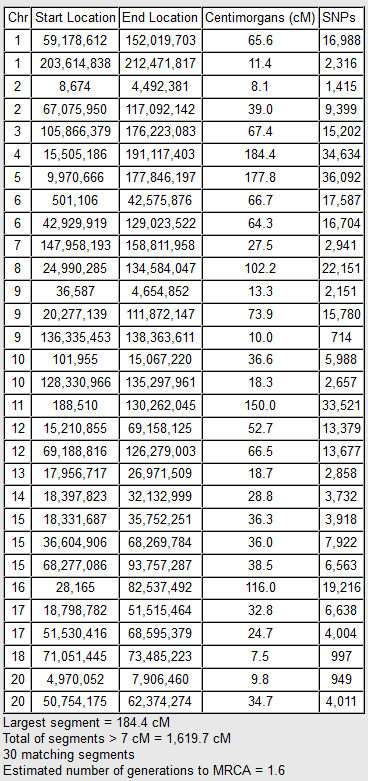
Using a one-to-one, we get 1619.7 cM right off the bat, more than the 1500 cM we need for batching. (This does not include the X, but we don't need it because obviously David has no X from his father. If we were talking about two sisters, we would add the results of the separate "X 'One-to-one' " tool.)

Blaine's very important Shared CcM Project shows the average half-sibling match to be 1731.05 cM, but the diffrence between that  and David and Anna's shared 1617.7 cM probably includes the X which they don't have at all. In any case, 1617.7 cM is a reasonable result.

But we can do better.

The 1617.7 cM is based on a threshhold of 7 cM. That is, it excludes anything below 7 cM. In fact, if two half-siblings have smaller matches, they surely come from the shared parent. Their father also has those small segments, even if they came to him as IBS (Identical By State).

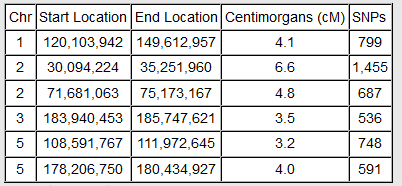
I ran the "One-to-one" again using a threshhold of 4 cM (the lowest permitted by Lazarus) and added these six segments. That brings the total match between David and Anna to 1649.8 cM.

This is what they share from their father.


I created a Lazarus kit (shown on the left), using the 4 cM threshhold, with only David in Group 1 and only Anna in Group 2. I fully expected to get a kit with that same 1649.8 cM. The result is 1642 cM - close but not perfect. I'll let GEDmatch figure out what the difference is and why.

The results are good enough for batching.

Of course, if David's full brothers would test, we could add them to Group 1 which would improve the results. Probably significantly.

If Anna also had full siblings, even better.

And if we could add their one known second cousin (whom I hope to meet at my presentation in Rishon Lezion in three weeks) to Group 2, we could also improve the results. I'm not sure by how much.

But the point is, this works.


Housekeeping Notes

Skalat memorial
The annual Skalat memorial at the Holon Cemetery outside Tel-Aviv is the day after Shavuot - this year Thursday the first of June at five thirty, next to the Skalat monument along the eastern wall of the cemetery. Those of you saying Yizkor that day may wish to keep us in mind.

Coming presentations in Israel
I am giving two presentations here in Israel in the coming weeks.

4 June 2017, 7:00 PM – IGS “Shorashim BaGalil” Kiryat Tivon, Library and Memorial Center, Migdal 2
and
19 June 2017, 6:30 PM – IGS Rishon Lezion, Museum of Rishon Lezion, Ahad Ha’am 2.
Both are the Hebrew version of
Lessons in Jewish DNA – One Man’s Successes and What He Learned On the Journey
   
Moscow
I have my ticket in hand for my trip to the US for the Orlando conference, with a stop in Moscow for a day and a half. I'll be meeting there with two more of my newfound Kaplan-Rosenbloom second cousins. I am very excited about this. (I introduced you to this family here, here and here.)

Presentations in Orlando
I have now signed up introducers for all four of my presentations at the IAJGS Conference in Orlando 23-28 July. Two of them are people I have never met - but they are Pikholz descendants, one from Skalat and one from Rozdol.
   
Unveiling
On my way back from Orlando, I'll be in Chicago for a couple of days.  I understand that my sisters there plan to have my brother's unveiling then.