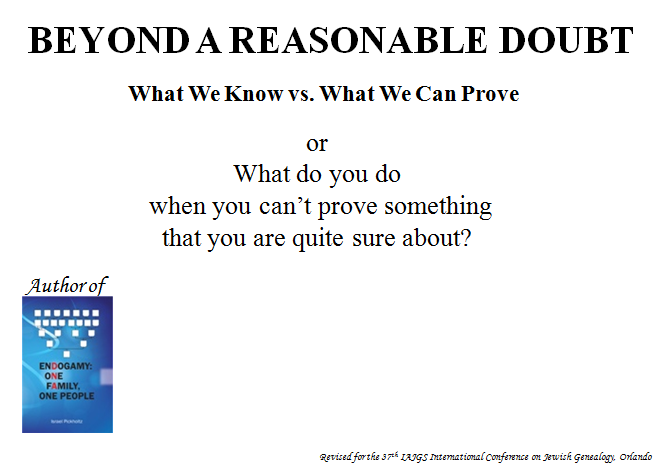
For several years now, I have been giving a presentation which includes the statement
If I say something is so, will my research heirs question my decision - if indeed they ever see it as a decision? Will even I myself reconsider it without some new overwhelming piece of evidence?
The theories
One of the first things I decided to check out when I began working with this new-fangled DNA thingee was the matter of the four Pikholz descendants who lived in Podolia, outside our usual east Galicia. The four - Necha, Moses, Chaim and Yakov - all appeared to have been born 1868-1878 and I had the feeling they might be siblings.
Moses, from Nemerow, boarded a ship in Hamburg bound for New York via Liverpool. That is the last we see of him. We never even see him arriving in either port. Or any other.
Necha, also from Nemerow, married Ruben Rechister of nearby Braclav and they emigrated to the US where she was known as Nellie Rochester. The Rochesters lived for about twenty years in Kansas City then most of the family moved on to California.
Chaim lived in nearby Tetiev where he and his family were killed in a pogrom in 1919.
Yakov was born in 1878 in Tulcin and has a living grandson who immigrated to Israel from Russia after the fall of the Soviet Union. We actually have Yakov's birth record which shows his father as Mikhail the son of Mordecai.
I had two non-competinng theories about who these people were. First the obvious possibility that the four are siblings. Second, we have a known Mordecai Pikholz born about 1805 in Skalat and it appeared to me that Yakov's grandfather is likely this same Mordecai.
Testing the theories
So after my "Immediate and Stunning Success" as outlined in Charper One of my book "ENDOGAMY: One Family, One People", I decided that I could test both theories using DNA. I could not test any descendants of Moses or Chaim, but I was in contact with Yakov's grandson and some of the great-grandchildren of Necha, whom I suspected were second cousins once removed to Yakov's grandson.
Second cousin once removed is eminently testable using autosomal DNA. And of course since we already had Y-DNA for Mordecai from Skalat, Yakov's line would be easy enough to compare.
Yakov's grandson did both tests, the autosomal Family Finder and the male line Y-37.
I was in touch with the families of two of Necha's grandsons - brothers. The elder has two children and the younger, four. The elder brother's daughter promptly agreed to test and I figured we were on the way to proof. They were the sixth and seventh Pikholz descendants to test for our project.
The end of the theories
When the results came in, what looked like a simple confirmation, turned out quite the other way. The Y-DNA of Yakov's grandson did not match Mordecai of Skalat. It was not even close.
Both Family Finder tests showed some matches with the other Pikholz family members, but they did not match each other at all. Whatever they were, it was not second cousins once removed.
I did not get what I had hoped for but I got the truth. "No" is also an answer and this was a DNA success.
In the meantime...
The number of Pikholz descendants who tested increased from seven to about eighty and with it, the number of Pikholz matches for both Yakov's grandson and Necha's great-granddaughter..
We began using GEDmatch as our standard for analysis, rather than the less useful tools that Family Tree DNA provides. For instance, a one-to-one comparison of Yakov's grandson and the Rochester great-granddaughter is not exacty non-existent.
There are twenty-two segments totalling some 60 cM with the three largest segments only 6.1, 5.8 and 4.6 cM. Certainly not much more than nothing.
Sheva
We found a woman named Sheva Pikholz Weinstein from Nemerow, about the same age as Necha Rochester, with a living granddaughter in North Carolina. If Sheva and Necha are sisters, then we can test possible second cousins once removed. In fact, Family Tree DNA shows Sheva's granddaughter and Necha's great-granddaughter as suggested third-fifth cousins with a longest segment of 27 cM and a total of 80 cM.Blaine Bettinger's Shared cM Project says that second cousins once removed share on average 123 cM, with a high of 316 cM and a low of zero. Our match looks low but not outrageously so.
Lara Diamond has some preliminary data for an Ashkenazic Shared DNA Survey which shows second cousins once removed sharing an average of 170 cM, with a high of 446 cM and a low of zero. In this context our match is certainly to small to qualify.
GEDmatch shows Sheva's granddaughter and Yakov's grandson with a longest segment of 14.8 cM with a total of 50.6 cM. This is well below second cousin territory.
A second Rochester test
I have been saying ever since those first tests that perhaps the Rochester great-granddaughter is an outlier and that her cousins might give us better resuts. Eventually one of those cousins tested, a male, with MyHeritage.
He uploaded to GEDmatch and his match with Sheva's granddaughter are even weaker than his cousin's. A total of 65.2 cM with a longest of 15.5 cM. And only one segment that he shares with both his cousin and Sheva's grandaughter, and that shared segment is only 8.3 cM.
So it looks definitive that Sheva and Necha are not sisters. They are likely cousins but could be aunt and niece. The matches we see are reasonable for second cousins twice removed.
An unexpected conclusion
This throws a monkey wrench into one of the more obvious conclusions, one I hadn't even been looking at.
I have assumed all along - though I never wrote it as such - that
whatever the status of Chaim and Yakov, Necha was the older sister of
Moses, both being from Nemerow. That is the kind of conclusion that many researchers would record as fact and never given it another thought.
If however, as it seems, that Sheva and Necha, both from Nemerow, are NOT sisters, then perhaps Moses is Sheva's brother, not Necha's. Or perhaps Moses is the brother of neither Sheva nor Necha. This is an unexpected result of the rethink and another good example of why we must proceed with caution before drawing concusions. Because if I write it down, will anyone ever question it? Will even I revisit it?
And what of Yakov?
When Yakov's grandson tested, we had almost no experience with Pikholz Y-DNA. We have since determined that three known Skalat male lines are precise matches in the "R" haplogroup and that four known Rozdol male lines are also precise matches in a different part of the "R" haplogroup.
Only one other person with the Pikholz surname has done a Y-DNA test and he is also "R." We don't know how he connects to any other Pikholz family.
Yakov's grandson is J-M172. The records call his male line ancestors "Pikholz" (or Pikgolts), so it does not appear that the name Pikholz came from a maternal ancestor, in the Galician way. Yakov's mother's surname is known so it is pretty clearly that there is no such scenario.
I think it is time to bite the bullet and label Yakov's grandson as the product of a non-paternal event - an adoption or some other event that broke the Pikholz male line. Label in my own mind. Label as a "maybe" in the comments. Certainly not to label a certain NPE. But I think that;s what we have.
I still think that Yakov's grandfather Mordecai is likely the Mordecai (b.1805) whom we know and Yakov may well be the brother of Necha. Or Sheva. But I haven't a clue how we might demonstrate that. (Come to think it, I have an idea. We'll see if it goes anywhere.)
Showing posts with label Lara Diamond. Show all posts
Friday, May 4, 2018
Monday, August 4, 2014
Salt Lake City
I posted Thursday about my week in Pittsburgh, neglecting to mention that this was probably my best ever visit with Aunt Betty and Uncle Ken.
This has been a different kind of conference for me than in years past.
I was surprised to find that most of the people I talked to here had never heard of GRIP, so one day I skipped my new set of "I LOVE ENDOGAMY" T-shirts and wore the shirt we got from GRIP. The rest of the time was the new T-shirts except when I spoke, which was shirt and tie.
I spent very little time with my Galizianer friends, spending more time with the blogger crowd. There were a few meetings that I was invited to - bloggers, media etc - and I saw alot of the same people at each. I also attended the talks of several of them. These included people I have known somewhat over the years but also some younger ones who have become Facebook friends in the past months, including two with Pittsburgh-area ancestors.
At one point in one of those meetings, I was exchanging Facebook direct messages with someone who was sitting three seats away from me, like the modern version of passing notes.It was like I was seeing for the first time how the younger generation works.
I am not going to review all the lectures I attended. The lectures are availble for purchase and enough people blogged talks in real time - here, here, here and here, for instance.
There was one prominent blogger from the general genealogy community who was here for the whole conference, typing away all day. James Tanner is said to be the most prodigious of the genealogy bloggers and some of his children have followed him into the field. I had not been familiar with his work until now.
Wednesday evening, I had the privilege of spending two and a half hours with Kitty Munson Cooper and Gaye Tannenbaum, talking tools for DNA analysis. Kitty has written a few tools herself and is well thought of in the general DNA genetics world. Kitty will speak to the folks at GEDmatch about creating a tool which would have specific relevance to my own work.
I know Gaye's name because she co-authored one of several articles by Dr. Jeff Paull, for which I served as a pre-publication reviewer. Another in that series is due out in the Fall Avotaynu.
And I spoke with Alex Denysenko about some record sets in Podolia, particularly Nemirow. Unfortunately, those end in 1852, while I want 1865-1880. He will check about census records, which should serve a similar purpose in my Pikholz research.
I was involved in two presentations - a panel and a lecture.
The panel was on Monday afternoon and was called "Internet Collaboration: How Do We Share Our Family Trees Online?" The concept began as a pro or con debate on Geni.com and programs like it and took off from a presentation at the conference last year. I discussed this at some length a few months ago. The panel ended up a bit more generic with each of three debaters explaining how he brings his family tree to the attention of the general public.
We were told to write up a full text of a fifteen minute opening, then ask each other questons. I wrote up my fifteen minutes a few weeks ago, but when I looked it over, it seemed more like an article than a talk. Although I speak reasonably well from notes, I have never actually written a speech and this did not sound like one.
I took advantage of being with Uncle Ken in Pittsburgh and we went over it in quite a bit of detail - until 11:30 at night, way past his usual bedtime. I made some changes in the text, but most of the change was in the way I spoke and the way I listened to myself - both thanks to him. Uncle Ken has been mentoring graduate students art Pitt since his retirement twenty-five years ago, so he knows whereof he speaks.
I also spoke Wednesday morning on "Beyond a Doubt: What We Know vs. What We Can Prove," the same title I used for a similar talk at the DC conference three years ago. I was once again introduced by my good friend and colleague Renee Steinig and the talk went well. Turnout was not what I had in the much smaller room in DC, but you can only control so much.
The handout for that talk can be found here.
Following that talk was a bit of unpleasantness. I was scheduled for 9:00-10:15, with the last fifteen minutes for questions. But there were few questions, so we ended ten minutes early. I was still at the podium with ten minutes left on the clock, when the speaker scheduled to follow came up and ordered(!) me off the podium so she could set up. There may be ramifications to this going forward.
I attended three talks on publishing. Tammy Hepps presented her Treelines program, which serves as an online tree, but with a story-telling capability. Very impressive, but it looks like a lot of work. Perhaps If I had an assistant, I'd have a go at it. Treelines is not a finished product and we should expect it to become a pay site when it is further along, though Tammy says that those who join now will be grandfathered in free. It is an impressive piece of work, even if it may not be right for me.
Mike Karsen spoke about publishing actual books, but in small bites. One part of the family at a time. He has an actual Pledge Card where people promise him that they will publish something within twelve months, in exchange for various goodies from Mike himself.
Part of the idea here is that once you have done one, it becomes much easier to do others.
This is an excellent idea and a very good way to approach publishing, but here too, I don't think my schedule is up to it.
Finally, Marlis Humphrey, the President of IAJGS, gave a talk about publishing online. Clearly the wave of the future, but just as clearly, too much for me, at least right now.
I attended Martin Fischer's lecture "Finding Living Relatives: Techniques for Discovering Previously Unknown Mishpoche." One of the questioners afterward said that he has overcome reluctant relatives by sending them incorrect data about themselves, which almost forces them to set the record straight. (making a woman older than she is, for instance.) This got lots of laughs and applause as it is clearly one of the more efficient ways to address this phenomenon.
However, I have seen more than one discussion - I don't recall if on JewishGen or on non-Jewish sites - where everyone agreed that this is unethical.
I posted about this on Facebook and got quite a few comments, mosty objectng to the questioner's suggestion. My son, who studies Jewish law on such things, says that is definitely improper.
At the last lecture I attended before leaving the conference, I found myself sitting next to my MtDNA match that I wrote about four months ago.
I am pleased to say that there was a minyan three times a day while I was at the conference. The food, on the other hand, did not give us the idea that there is a vibrant Jewish community in Salt Lake City.
Housekeeping notes
* The photo from the panel debate was taken by Lara Diamond and graced her blog post here.
On either end of the Conference, I got to spend Shabbes with my son and his family in Chicago. (Number two son is away at camp.)
Monday the eighth of Av and we are going into the Tisha beAv day of mourning. May everyone have an easy and meaningful day and may this be the year that this day of national mourning becomes one of rejoicing.
This has been a different kind of conference for me than in years past.
I spent very little time with my Galizianer friends, spending more time with the blogger crowd. There were a few meetings that I was invited to - bloggers, media etc - and I saw alot of the same people at each. I also attended the talks of several of them. These included people I have known somewhat over the years but also some younger ones who have become Facebook friends in the past months, including two with Pittsburgh-area ancestors.
At one point in one of those meetings, I was exchanging Facebook direct messages with someone who was sitting three seats away from me, like the modern version of passing notes.It was like I was seeing for the first time how the younger generation works.
I am not going to review all the lectures I attended. The lectures are availble for purchase and enough people blogged talks in real time - here, here, here and here, for instance.
| Jim Tanner, not in his usual bent-over-the-laptop pose |
Wednesday evening, I had the privilege of spending two and a half hours with Kitty Munson Cooper and Gaye Tannenbaum, talking tools for DNA analysis. Kitty has written a few tools herself and is well thought of in the general DNA genetics world. Kitty will speak to the folks at GEDmatch about creating a tool which would have specific relevance to my own work.
I know Gaye's name because she co-authored one of several articles by Dr. Jeff Paull, for which I served as a pre-publication reviewer. Another in that series is due out in the Fall Avotaynu.
And I spoke with Alex Denysenko about some record sets in Podolia, particularly Nemirow. Unfortunately, those end in 1852, while I want 1865-1880. He will check about census records, which should serve a similar purpose in my Pikholz research.
I was involved in two presentations - a panel and a lecture.
![]() |
| Gary at the podium while the rest of the panel looks on.* |
We were told to write up a full text of a fifteen minute opening, then ask each other questons. I wrote up my fifteen minutes a few weeks ago, but when I looked it over, it seemed more like an article than a talk. Although I speak reasonably well from notes, I have never actually written a speech and this did not sound like one.
I took advantage of being with Uncle Ken in Pittsburgh and we went over it in quite a bit of detail - until 11:30 at night, way past his usual bedtime. I made some changes in the text, but most of the change was in the way I spoke and the way I listened to myself - both thanks to him. Uncle Ken has been mentoring graduate students art Pitt since his retirement twenty-five years ago, so he knows whereof he speaks.
| Thanks to Preeva Tramiel for this one |
I also spoke Wednesday morning on "Beyond a Doubt: What We Know vs. What We Can Prove," the same title I used for a similar talk at the DC conference three years ago. I was once again introduced by my good friend and colleague Renee Steinig and the talk went well. Turnout was not what I had in the much smaller room in DC, but you can only control so much.
The handout for that talk can be found here.
Following that talk was a bit of unpleasantness. I was scheduled for 9:00-10:15, with the last fifteen minutes for questions. But there were few questions, so we ended ten minutes early. I was still at the podium with ten minutes left on the clock, when the speaker scheduled to follow came up and ordered(!) me off the podium so she could set up. There may be ramifications to this going forward.
I attended three talks on publishing. Tammy Hepps presented her Treelines program, which serves as an online tree, but with a story-telling capability. Very impressive, but it looks like a lot of work. Perhaps If I had an assistant, I'd have a go at it. Treelines is not a finished product and we should expect it to become a pay site when it is further along, though Tammy says that those who join now will be grandfathered in free. It is an impressive piece of work, even if it may not be right for me.
Mike Karsen spoke about publishing actual books, but in small bites. One part of the family at a time. He has an actual Pledge Card where people promise him that they will publish something within twelve months, in exchange for various goodies from Mike himself.
Part of the idea here is that once you have done one, it becomes much easier to do others.
This is an excellent idea and a very good way to approach publishing, but here too, I don't think my schedule is up to it.
Finally, Marlis Humphrey, the President of IAJGS, gave a talk about publishing online. Clearly the wave of the future, but just as clearly, too much for me, at least right now.
I attended Martin Fischer's lecture "Finding Living Relatives: Techniques for Discovering Previously Unknown Mishpoche." One of the questioners afterward said that he has overcome reluctant relatives by sending them incorrect data about themselves, which almost forces them to set the record straight. (making a woman older than she is, for instance.) This got lots of laughs and applause as it is clearly one of the more efficient ways to address this phenomenon.
However, I have seen more than one discussion - I don't recall if on JewishGen or on non-Jewish sites - where everyone agreed that this is unethical.
I posted about this on Facebook and got quite a few comments, mosty objectng to the questioner's suggestion. My son, who studies Jewish law on such things, says that is definitely improper.
At the last lecture I attended before leaving the conference, I found myself sitting next to my MtDNA match that I wrote about four months ago.
I am pleased to say that there was a minyan three times a day while I was at the conference. The food, on the other hand, did not give us the idea that there is a vibrant Jewish community in Salt Lake City.
* The photo from the panel debate was taken by Lara Diamond and graced her blog post here.
On either end of the Conference, I got to spend Shabbes with my son and his family in Chicago. (Number two son is away at camp.)
Monday the eighth of Av and we are going into the Tisha beAv day of mourning. May everyone have an easy and meaningful day and may this be the year that this day of national mourning becomes one of rejoicing.
Subscribe to:
Posts (Atom)


