Sunday, June 30, 2013

PICKHOLTZ, BERNSTEIN and FRIENDS (or maybe relatives)

(Part two of two - see part one here)

Last week, I looked at the Pickholtz-Bernstein family who came to the United States from Skalat in 1890. We do not have all the details of their first years in the US, but the main gap in the story is what happened to David Bernstein, who was eleven months old when the ship sailed.

This week, I want to have a closer look at the other two Skalat families who followed the Pickholtz-Bernstein family on the passenger manifest, almost consecutively.
Lines 206 and 212-214 are people who seem
to be unconnected to the Skalat families.
You can see the actual manifest, but it is easier to work from the transcribed information presented here on the right.

I spent a morning looking at the JRI-Poland vital records for both the Kaczors and the Aberbuchs. (This was complicated by the fact that their "sounds-like" algorithm does not think that Aberbuch sounds like Auerbach, even though the same people are listed both ways.)

I'll spare you the details, but I did find two connections between Aberbuch and Kaczor. The more obvious (but perhaps less useful) is Nuchim Kaczor who married Lea Auerbach. They had six children in the period 1891-1901 in Podwoloczysk and in one of the birth records, Lea is identified as being from Skalat.  I don't see anything connecting them to anyone else in our story.

The other is Leiser Auerbach and his wife Zipore Goldstein. They had six children 1881-1888 in Zbarazh. In several of the records, Zipore (aka Cipre) is identified as being from Skalat. Zipore died in 1890 at age twenty-eight having buried four of her children at between six and thirteen months of age.
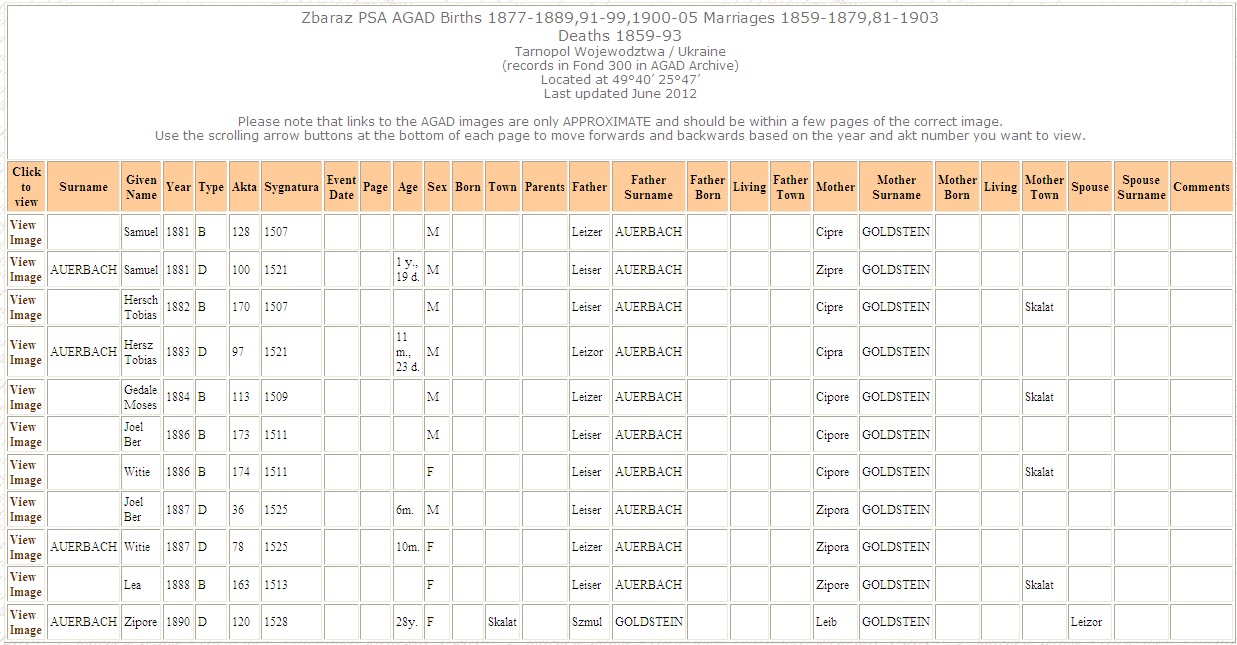
Here is the thing. Zipore Goldstein, the wife of Leiser Auerbach is the sister of Rifka Kaczor, the wife of Rachmiel from the passenger manifest.

I would not be surprised to find the widower Leiser Auerbach in the United States in the 1890s or early 1900s, but I have not really looked for him there.

I have no idea if Leiser is closely related to Aron from the passenger manifest, but if he is, it would not surprise me one bit.

I saw no connections between Aberbuch and either Pikholz or Bernstein.

The Kaczors of Skalat are a much bigger project. In fact, I know several people who are working on parts of that family - including a client of mine - but to my knowledge no one is looking at all the Skalat Kaczors in a single project.

Probably 340 out of these 357 search results are in Skalat itself. A large family.
I started with a search for "surname sounds like Kaczor" and "given name sounds like Rachmiel." There were thirty-six records in the Tarnopol area - twenty-nine in Skalat and one family of seven in Podwoloczysk. ("Sounds like Katcher" produced those same results.) There is nothing there that tells us anything about Rachmiel's parents, so unless someone dives into this on the American end - death or cemetery records, for instance - there is not much to do on that.

Searches for records which include both Kaczor and Bernstein come up empty and, of course, had there been and Kaczor-Pikholz connections, I would have been all over them long ago. (That said, I have a low priority interest, considering the possibilty that Kaczor, Kaczka and Kwoczka all come from a single source.)

So why is this any more than several families from the same place travelling together? Maybe it isn't. But still, let's see what else we have.

First of all, in discussions a few years ago, Lee Katcher, the late Norman Kotcher and Steve Pickholtz concluded that one of the Kaczors lived with Steve's grandfather while in school. I don't know the specifics - not even if he was from the family on the passenger list - but they felt thatthis was an indication of a family connection. Maybe. Or maybe it was just good friends from the old country.

Then there is a mortgage document in the names of "Berisz Pickholz and Sarah his wife, Rachmiel Katcher and Rochil his wife, [Heren?] Katcher and Catherine his wife and Bluma Barenstein." (Note that Rachmiel's wife was Rifka on all previous documents.) A second document is similar but does not include Bluma. They are identified as being from New York City. The documents are dated June and July 1890 and refer to land purchases in Pittsgrove New Jersey. Pittsgrove is just a couple of miles from alliance where Sarah was buried eighteen months later, so at least Berisch and Sarah must have actually lived there.

Here again, this joint mot\rtgage may be a sign that we are talking about family. Or maybe it was several Skalat families participating in the experiment that tried to make New Jersey farmers out of east European Jews. This plan is probably what put them on the same voyage. How long they remained farmers, who knows. Local Pittsgrove records probably can shed light on that period.

This is Steve's project, but perhaps someone reading this might have something to suggest. I for one have no experience with US land records. Nor do I have the time or inclination to acquire that experience at this time.

BERNSTEIN
This is a good time to make some additional Bernstein comments.
I did an "exactly" search rather than "sounds like" so as not to get all the Braunsteins. Another large family.
There are three researchers listed in the JewishGen family Finder doing this large family. Two of them seem to be active and I am in contact with one of them. Many of these Bernsteins - may all of them - are kohanim.

We have at least one other Pikholz connection in that Bernstein family.

In 1955, a woman named Haya Henkin in Rehovoth submitted a Page of Testimony to Yad Vashem in memory of her sister Betka / Boncia Bernstein of Skalat, who was married to Berl Pikholz. They had three sons - Josef, Moshe and Aharon, all of whom were killed.

I spoke to Haya's daughter Malka on Kibbutz Saad, who also filed a Page of Testimony for Betka. She confirmed that this is the Bernstein family who are kohanim. She did not know anything about her Uncle Berl, so I do not know where he fits into our families.

Neither Haya nor the daughter knew the ages of the children.

Betka was born in 1902, so her husband could be one of several Berls we have who were born in that period. Perhaps we will know later on.

Sunday, June 23, 2013

PICKHOLTZ, BERNSTEIN and FRIENDS (or maybe relatives)

Part one of two

(Parts of this appeared in The Galizianer - published by Gesher Galicia - in February 2006. We have learned a bit since, but not nearly as much as we would have liked.)

It must have been early 1999 - soon after the inception of the Pikholz Project - when Steve Pickholtz and I came into contact with one another by email and now, fourteen years later, it seems that his family and mine are the only ones we haven't been able to take beyond the names on our great-grandfathers' graves.  We know now that both our families came from Skalat, where the mother lode of Pikholz families resided, so we assume we are both part of what we have come to call "the eastern branch."  (The smaller, "western branch" was centered in Rozdol.)  
                                                                                                                             
Steve's grandfather Harry, with his
wife, daughters and son-in-law
Steve has become the most active of the Pikholz researchers among those family members in the US, while I continue to coordinate the project from here in Israel.  But I get ahead of myself. 
                                                                                              
Steve was born in Philadelphia in 1945, to Morris Pickholtz (1903-1970) who was also born in Philadelphia.  Steve "knew" that his grandfather was Harry and that he had been an orphan who came to the US alone, but in census records we found Harry living with his parents into young adulthood.  So much for that particular oral tradition.  
                                                                  
After a round of basic inquiry, it started out looking pretty straightforward.  Bernard (Berl/Berisch) Pickholtz and his wife Bluma (Bernstein) lived in Philadelphia, as did their children Olga Mandelkern, Harry Pickholtz, Anna Tersuhow and Fanny Pickholtz (who had no children and returned informally to her maiden name after divorce).  They were born in the 1870's-early 1880's, according to various later testimonies.  In the 1900 census, we have Bernard and Bluma with children Harry, Annie and Fanny.  Olga was married by then.
                                                                                        
Steve collected the six death certificates and visited the graves and here is a summary.
The bit about Fannie's mother's being Sarah Bernstein was odd, but we chalked it up to a double name, even though Bluma's grave didn't indicate any such thing.  However the informant was her sister Anna, who surely knew what she was talking about.   

The informants for Olga, Harry and Anna were their US-born sons who clearly did not know all the family history.  

Bernard's father Moshe Zvi was interesting, but it didn't tell us much as we have this combination in a number of families where the name does not appear to have a common source.  (My own father's brother is Moshe Zvi, named for his two grandfathers.)  
         
Based on the birthplace on Fannie's death certificate, Steve ordered a search of Odessa birth records for Pikholz and two turned up -  Fannie born in 1881 and Vodolya in 1883, both to Austrian citizens Bor and Sara Pikholz.  We never see a trace of Vodolya again (not as Vladimir, William, Wolf, Zeev etc), but neither do we find a matching child's death record or grave.  Clearly none of the other children of this family were born in Odessa, as the search request included them by names and ages.  

Soon after, Steve came up with a passenger list, from 1890, which included the following consecutive listings (names and ages), all travelling from the east Galician town Skalat. And right after them, two other families from Skalat. The ship was bound for Baltimore.

The passenger manifest raises some obvious questions.

Sara and Blume are obviously two different people. How did both come to be married to Berisch?

Blume - who has two sons - is going by Bernstein, which we thought was her maiden name. There is a Bernstein family in Skalat who are kohanim, so perhaps Bernstein is Blume's maiden name. In which case, who is the father of her children?

One of Blume children is Hersch, who would be Steve's grandfather. And who is this baby David, who appears nowhere else.

It is of some note that Berisch and Sara are listed as coming from Skalat, not Odessa, so they must have returned there, at least briefly.

And is there a connection to the Kaczor and Aberbuch families? There are a few Awerbachs in Skalat, but no couple named either Aron or Gittel. There are a few hundred Kaczors in Skalat, including one Rachmiel married to a Rifka Goldstein. They indeed had sons Getzel and Gabriel, so those are probably the family that travelled with Berisch and family.

The scenario we began to see went something like this:
  • Sara and Blume are Bernstein sisters.  Berisch and Sara decide to leave Odessa and go to America, but before they do, they return to Skalat and take Sara's recenty widowed younger sister Blume and her two sons, with them to America.
  • Soon after arriving in the US, Sara dies and Berisch marries his sister-in-law, a common solution for a widower with young children.  This also had the benefit of giving Berisch a son (Hersch), which he didn't have from Sara, after Vodolya died.
  • Somewhere in the Philadelphia area are graves for Sara and young David, who died in the period 1890-1900 - probably earlier than later. 
  • Harry's father is named as Bernard/Berisch, because his uncle/step-father adopted him, either formally or informally.  Anna's mother is listed as Bluma rather than Sara because there was no one left who knew the story, aside from Olga who was elderly and unwell.
  • The oral tradition that Harry came to the US as an orphan is not as far-fetched as we had thought. That's a reminder to never discount family tradition.
Some time later, Steve found Sara's grave. In Alliance New Jersey, where an attempt had been made to establish communities of Jewish immigrant farmers.

 Sara died 1 January 1892, less than two years after arriving from Europe. She is clearly identified on the stone as the wife of Dov (=Berisch) Pickholtz and the daughter of Mordecai HaKohen. So she is indeed Blume's sister.

Then we considered who might be Harry's father.  I examined the JRI-Poland birth index for Skalat and found two births to Bluhme Bernstein.  One is Moses-Hersch born 1878, with no father listed.  (There were many births with no father's name in Skalat during that period, probably due to some mistaken policy of the registrar.)   The other is Zalman Hillel (1876) and the father is Judel Mendil Werfel.  Eight months later is a death record for Salomon Hillel Werfel, son of Juda Mendel.  In both of these birth records, Bluhme's father is Markus (=Mordecai) Bernstein and in the case of Moses Hersch, Bluhme's mother is called Rachel.  We find no record of either David's birth or Juda Mendel's death, but the family may have lived elsewhere at the time.

There is no one listed as the father of Moshe Hersch Bernstein, but that was often the case in Skalat birth records.
If all this is true, then Harry Pickholtz was Moses-Hersch Werfel - Moses-Hersch being the same name as the father of Harry's uncle/step-father, a fact which I am not assuming to be significant.

We have yet to find a trace of David, not in New Jersey and not in Philadelphia. Not as Bernstein, not as Pickholtz, not even as Werfel. Considering that David is a dozen years younger that Hersch, he may be from some other family entirely and just raveelled with Blume for some unknown reason. (Steve is more concerned about finding him than I am, which is quite understandable.)

There is one other open question regarding Berisch's children - where were Olga and Anna born? There are no records either in Odessa or in Skalat. Perhaps they spent some time in Podolia before arriving in Odessa.

There is also the matter of the Kaczors and the Aberbachs. I hope to address that next week.

- - - - - - - - - - - - - - - - - - - - - - - - - - - - - - - - - - - - - - - - - - - - - -
Misc
Some time ago, a woman in Baltimore asked me to order records for her from the AGAD archives in Warsaw. When they arrived (paper copies), she claimed that she didn't know she had to pay for them - and in any case, she didn't gve me a mailing address. Last week, after three years, I threw them out.
- - - - - - - - - - - - - - - - - - - - - - - - - - - - - - - - - - - - - - - - - - - - - -

Housekeeping notes:

Last week, without fanfare - except a Facebook post - I marked the anniversary of my aliyah. I have now been living in Israel for forty years.

The National Library on the Giv'at Ram campus of the Hebrew University is trying to learn more about genealogy, so as better to serve the general research community. As part of that effort, they have invited several genealogists - myself included - to make presentations to library staff, explaining what we do and what resources we use. Following that, they will show us some of the lesser-known resources that they can offer us.
This program, in Hebrew, will be held Wednesday 26 June and is open to the public.

Sunday, June 16, 2013

OIL IN KIBBUTZ HULDA - The first Israeli Pikholz

Dr. Eliezer Pikholz Haniel was the first Pikholz descendant we know of to make aliyah, to immigrate to Eretz Israel. He died fifty-three years ago this week - 13 Tammuz 5720* - and is buried in the journalists section of Kiryat Shaul in Tel-Aviv.

My father's third cousin, he was born in Kopicienice (east Galicia) 20* May 1880 to Avraham Grunfeld and Gittel* Riwke Pikholz, the daughter of Eliezer and Chana-Chaya Pikholz of Skalat. His mother died when he was four and it is not clear whether he was raised by his father and step-mother or if perhaps he went to his mother's family in Skalat.
There are other births on this page, but I edited them out, for convenience.
He studied agronomy in Vienna with the intention of using his skills and education to further the cause of Jewish settlement in Eretz Israel and in 1910 was invited by Dr. Arthur Ruppin and the Keren Kayemet (Jewish National Fund) to serve as the agronomist for the Hulda and Ben Shemen forests. During that period, he lived in Ben Shemen.

As a well was being dug in Kibbutz Hulda in 1911, some unusal samples of earth turned up about fifty meters underground and after performing some experiments, Dr. Pikholz concluded that they had found oil. The Austrian Geological Institute confirmed his findings.

Dr. Ruppin was approached about developing this resource and he supposedly denied any possibility of oil in Hulda, saying that if the Turks thought there was oil, they would never leave.

He soon left the KKL and moved to Petah Tikva, where he ran an agricultural school. The school was closed down during the war years, partly because the foreign students were no longer able to receive support from their parents in Europe. It reopened in 1920.

Eliezer and Yonah Haniel
In the interim, Dr. Pikholz served on the steering committee for the war against the locust invasion of 1914 and he was arrested several times by the Turks for contact with the underground,  anti-Turkish organization Nili. (His daughter was not sure if he in fact had been involved with Nili.) In 1918 he married Yonah Soroker of Petah Tikva, with whom he had two daughters. In 1923, he changed his surname to Haniel, perhaps in memory of his maternal grandparents Chana and Eliezer - but he continued to be known as Pikholz.

But foremost in his mind was the school and his students, even during the war years when the school itself was closed. His great-grandson Or wrote the following for a school project. (He refers to his great-grandfather as "grandfather.") Translation from Hebrew is mine.

Background for "the initiative"
While he was principal of the agricultural school during WWI, Grandfather took an unforgettable initiative, which was later recounted in the memoirs of two of his students who married and lived on Kibbutz Ein Harod. This is the background for "the initiative."  In 1911 Grandfather had set up an agricultural high school.  This school was in the Jewish moshava Petah Tiqva and brought an agricultural high school education to the children of farmers, age fourteen and up. 
                                                                                           
This school had some important advantages.  The students were able to continue living in the moshava and could help their families with the workload without having to travel to school at the distant Tel-Aviv Gymnasium or in Mikve Israel.  In addition to the students from the moshava, there were some twenty students who had been sent by their wealthy parents abroad to live and study in Eretz Israel. There was much hope for the future of the school but suddenly WWI broke out in 1914.  The first to suffer were the students from abroad who were no longer able to maintain contact with their parents and were left without means of support.              
                                
The war between Turkey and Britain became fiercer.  Many people  were deported because they were Russian citizens.  Those who remained were required to take Ottoman citizenship and to be drafted into the Turkish army.  Many went by sea to Egypt were they waited out the war as refugees.  One of the farmers gathered the foreign students and urged them to leave for Egypt where perhaps the Jewish and Zionist institutions would care for them.  The students accepted the farmer's advice, collected their belongings and headed for Jaffa Port.             
                    
"The Initiative"
As the students were walking towards Jaffa Port, a carriage came in the opposite directon carrying their teacher and principal, Dr. Pikholz, on his way to Petah Tiqva.  He stopped and asked the students what was going on and when they told him he said," No one is going anywhere."  He ordered them to return and said," Don't worry, we will take care of you.  If we have to suffer, we shall suffer together and whatever happens will happen to all of us."

                                   
Upon their return to the moshava, Grandfather had to find ways to support these students who had lost contact with their parents.  Since the students were young and inexperienced, it was difficult to find work for them.  Grandfather convinced some farmers to give work to the boys in exchange for food - food that was no more than oranges.  Grandfather also found temporary work for some of the boys at the JNF farms at Ben-Shemen and Hulda.                                      
In addition, in order to contribute to their own nutrition - during the famine - the students began planting rows of their own vegetables, such as tomatoes and cucumbers.                         
                                                                         
Grandfather, who was very concerned for the students, was a man of initiative and began collecting small donations from the farmers and set up a restaurant-like "kitchen" for his unfortunate students.  As a result of Grandfather's works, the students survived the war, the hardships and the disease that were the lot of everyone here in Eretz Israel.

I met with one of Dr. Pikholz' daughters a few years before she died and she told me that he suffered greatly from the discrimination of the socialist Bolshevik domination of the various Zionist enterprises. His refusal to toe the political line of the "ruling class" cost him in employment and promotion, in housing, in access to health care and more. He knew that would happen, but he had his principles. This was apparently typical of the stories of many of the east Galicianers.

In 1968, Zeev Salat, one of Eliezer Pikholz Haniel's three grandsons, was killed at the Suez Canal when his patrol jeep went over a mine. He too is buried in Kiryat Shaul.

* There seems to be conflicting documentation on several points. I have used 13 Tammuz as the date of death, based on the death certificate. His gravestone and other documents say 15 Tammuz. My guess is that he died Friday and was buried Sunday and that the gravestone and other documents reflect the date of burial.
There are also alternate birth dates and even a variation on his mother's name, but since I am the genealogist and have the birth record, I am using what I have determined to be correct.

Some of the information above is from the Encyclopedia of the Founders and Builders of Israel by David Tidhar. My thanks to the Touro College Libraries for permission to use the photograph of Eliezer and Yonah Haniel.
- - - - - - - - - - - - - - - - - - - - - - - - - - - - - - - - - - - - - - - - - - - - - -
Housekeeping notes:

The National Library on the Giv'at Ram campus of the Hebrew University is trying to learn more about genealogy, so as better to serve the general research community. As part of that effort, they have invited several genealogists - myself included - to make presentations to library staff, explaining what we do and what resources we use. Following that, they will show us some of the lesser-known resources that they can offer us.
This program, in Hebrew, will be held Wednesday 26 June and is open to the public.

Sunday, June 9, 2013

SO WHY NOT WRITE A LETTER TO THE NEWSPAPER?

Thirteen years ago, a genealogy researcher named Hilary Henkin posted the following on JewishGen:

The Texas link is now elsewhere and the California birth index soon fell victim to privacy concerns, but they both worked back then, and the link to the California death index works to this day, up to 1997.

This is the way the search form looks today, essentially unchanged from thirteen years ago.

You can search by three different surnames - the deceased and both of the deceased's parents - so I immediately checked all three with different versions of Pikholz.

The search produced results for two people totally unknown to me, people born in places where I had not seen any Pikholz before.


The story of the Kaplans in Omaha sounded interesting, if fairly conventional, but the telling is for another time. A Pikholz descendant named Henrietta Rochester Evans from someplace in Missouri (St. Louis seemed likely) was completely off the charts and that's where my attention was drawn.

As I recall, at that time the 1900 and 1920 censuses were fully indexed, but not online. (1910 was indexed for only a few states.) So I asked my friend Carole Feinberg to see if Henrietta showed up in 1920 - either in California or in Missouri.

Carole came back to me with this:
Reuben ROCHESTER, Missouri, 1920, 55, Russia, immigrated 1903, naturalized 1914, 2220 Charlotte St., Kansas City, Jackson County. Wife: Nellie, 50, Russia, naturalized. Children: Lena, 21, Russia. All others born Missouri: Mary, 14; Jacob, 12; Ida, 10; Henrietta, 8.
Nellie Pickholtz, huh. Well, I certainly didn't have anyone by that name.

I did find a daughter for Henrietta in the death index and there seems to be a granddaughter, based on the no-longer-available birth index, but I have not succeeded in making contact.

I found Jacob Rochester, born 1907 in Missouri, in the California death index - no mother's name listed. But he matched the 1920 census. I found no children.

So Jacob and Henrietta were in California, but I saw no evidence of anyone else in the family. Of course, some of them - particularly Reuben and Nellie could have died before the death index begins in 1940.

So I went back to Kansas City and started by writing to the funeral home that handles most of the Jewish burials. Unfortunately nothing like Feldman's in Denver - I wrote and faxed several times but never received an answer. Meantime, I learned on JewishGen that a book with all the Jewish burials in Kansas City had been published and Maurine found me the single Rochester in the book - eight year old Abraham, who died in 1909. The others - particularly Reuben and Nellie were conspicuously missing.

Maurine checked the city directories and they disappear after 1923.

This was not a high-priority project and I worked on it sporadically. So much else to do. Such progress that there was came in fits and spurts.

In early 2002, someone suggested I put an ad in the Kansas City Jewish Chronicle, or perhaps write a letter to the editor. Well, that seemed pretty desperate. It had begun to look like they had all left town long enough ago that no one would remember them. But as my Aunt Betty says - if you don't ask, the answer is always "no." The 1930 census was not yet available, much less indexed, so I had no other good ideas.
I don't seem to have a copy of my letter to the editor, but here is the response I received from Jeff on 9 March 2002:
I read your letter to the editor of the Kansas City Jewish Chronicle seeking information about descendants of Jacob and Nellie/Nettie Rochester. My wife's paternal grandmother was Frances Rochester; my wife's father was [name redactcted]. Frances lived in Kansas City with her family until her death in the mid 1950's. I am not sure Frances was related to Jacob and Nellie but I will investigate this. I assume you or a family member or friend is somehow related to the Rochester family. I'd be interested in knowing more.
Suddenly I had a lead.  Two days later, Jeff had more to report.
Here's what I found out about Frances Anita Rochester ...:
Born: Jan 11, 1896 in Russia
Father: Reuben Rochester, Mother: Not listed
Moved to Kansas City in 1898
Lived at ...
Sisters: Ida Knapp - San Bernadino, CA
Henrietta Evans, Pomona, CA
Mary Silverstein, Pomona, CA
Lina Rochester, Pomona, CA
Brother: Jack Rochester, Pomona, CA
Frances died December 9, 1957 at age 61

So the whole family went off to California in 1923 or 1924, but there was a married daughter who remained in Kansas City.

So back to California it was. I tried Lena, Mary and Ida using their given names and "Father's surname = Rochester." Mary showed up like this:
She had translated Pickholtz to Peckwood.

There was a death entry for an Ida born 1909, but nothing showing the parents. I also found that Ida had a daughter who died in 1982 and a son, whom I did not find. (Note to self - Have another go at that. And Henrietta's granddaughter, as well.)

I found nothing for Lina (or Lena), but Hilary checked a brides' index and found that Lina had married a second time - a man named Worthington. She too had no parents' names in the death index.

Eventually I found the deaths of Reuben and Nellie - in 1927 and 1931. Neither has a stone. But I did get to a proper death certificate for Nellie, with Mary Rose as the informant. Daughter Mary must have been married at least twice.

I took the 1868 birth year as an approximation. I wasn't sure about Russia, since the Pikholz families were all from Galicia. Father's name "? Pickholtz" - OK. Mother's name "Mary Elsie," obviously a back-translation. ("Mary, you are named after my mother...")

I found the graves for both Nellie and Reuben. Neither has parents' names or other identifying information on the stones. Neither has a stone.

In July 2003, I came up with a passenger manifest showing Nellie (called "Nese") and four children sailing from Southampton (UK) to New York in 1904, to meet husband/father Reufin Rochester in Kansas City. The four children were Morris, Fanny, Leah and Abraham. The two girls are obviously Frances and Lina and we have Abraham's Kansas City grave. Morris was a new one. He was not in the 1920 census, not in the grave book and not on Jeff's list. Nor did I see him in California. He was with the family in the 1910 census.

Soon after that, we received the1914 naturalization papers, which showed that he had been born in Bratslav in 1864 and she in Nemirow - both in Podolia. So Russia is correct. We had record of a Moshe Pickholz from Nemirow who sailed to England on his way to New York, but we never found him in either the US or UK. He may well be a brother of Nellie. Morris, Fannie and Lena were listed as having been born in Odessa.

The naturalization petition did not give Reuben's original surname or the name of the ship he travelled on, but he had said it sailed from Antwerp to Philadelphia in 1903, so that limited the possibilities.

His name in the passenger list was Rackister (which we learned later was actually Rechister) and his last address was not England - where his wife and children were - but Odessa. There was a Pickholtz family in Philadelphia who had previously lived in Odessa, but that not whom he said he was going to. Reuben Rochester was going to a "cousin" Jankel Goldberg on Tasker Street, as was the next person on the passenger list - Jankel Braverman. I didn't find any significance to either of those names.

We have no idea what brought him to Kansas City.

I also found two other births - a son Chaim Gedalya was born in Odessa and apparently died there (we don't see him later) and a stillborn while the family was in London. The Odessa birth records had Nellie's name "Neche."

Recently we found Morris. He never married and died as Morris Davis at age fifty-nine in Kansas City.

So that's about where we are holding. We don't know who Nellie's parents are. We don't know why they went to Kansas City. Reuven and Nellie had seven children who grew to adulthood and apparently only five grandchildren. We have no graves for the four sisters in California.

But I have had the pleasure of making the email acquaintance of most of those six great-grandchildren in Kansas City, one of whom is participating in our DNA project.

And the key was finding the family who stayed behind in Kansas City - with the help of my letter to the editor.

- - - - - - - - - - - - - - - - - - - - - - - - - - - - - - - - - - - - - - - - - - - - - -
Housekeeping notes:

The National Library on the Giv'at Ram campus of the Hebrew University is trying to learn more about genealogy, so as better to serve the general research community. As part of that effort, they have invited several genealogists - myself included - to make presentations to library staff, explaining what we do and what resources we use. Following that, they will show us some of the lesser-known resources that they can offer us.

Sunday, June 2, 2013

EINSTEIN, ROTHSCHILD, BUZAGLO, MALMILIAN, PICKHOLZ

(or Names I Never Thought I'd Be Writing About in This Blog)

I suppose every language has a few surnames which become part of the local idiom, occasionally as a verb but usually as a noun or an adjective. Sometimes the name comes from a specific person, sometimes a family.

Einstein, for instance, is a synonym for "genius" and there is no need to explain why. Sometimes that would be used in a straight-forward sense, but often it's sarcastic, as in "Way to go, Einstein," which probably appears in some English-language literature, as well.


Rothschild, of course, refers to the banking family and means "filthy rich." "What am I, Rothschild?" is the Hebrew equivalent of "You think I am made of money?"

Both Einstein and Rothschild are easily understandable to a non-Israeli - even a non-Jew. No so Buzaglo and Malmilian.

Aharon Barak condescending

   Thirty-odd years ago, the State Prosecutor (and eventual Supreme Court President) Aharon Barak, was handling the high-profile case of Asher Yadlin, the candidate for Governor of the Bank of Israel, who had been caught in a financial scandal involving the ruling Labour Party. In making the point that the elites would not enjoy any favoritism that would place them above the hoi polloi, Barak said "The law for Yadlin is the law for Buzaglo," using a surname typical of Morroccan Jews.

Although the "Buzaglo principle" has undergone a few iterations over the years, the name remains the archtype for a regular guy who should have no aspirations to anything exceptional. (I always found the use of Buzaglo in that sense to be remarkably condescending, even before Barak became openly condescending to everyone. But that's me.)

Uri Malmilian played soccer for Betar Jerusalem years ago and later served as their coach. The team was good back then and Malmilian was much beloved, particularly among the Buzaglos of the Mahane Yehudah market.

I am not well-informed either about soccer nor about the goings-on in the Mahane Yehudah market, but my wife's son informs me that "Malmilian" means "very good quality" - as in "Every watermelon we have is a real Malmilian."

And then there is Pickholz.

A couple of weeks ago, I was at the National Library, where I do an occasional stint as a volunteer genealogy consultant for a program they are trying to put together. While I was there, Mrs. Elona Avinezer, the Head of the Judaica Reading Room at the National Library, showed me a website called JPress, which I had seen before, but never really worked with. JPress - or more properly Historical Jewish Press -  has interfaces in Hebrew, English and French. They have search capabilities for many Jewish newspapers in Israel and abroad, going back to the 1800s.

So I went to the Hebrew papers and looked up Pikholz. Among the results were three - from 1920, 1954 and 1960 - which used an expression which I had heard before but not for many years.
שוטה בן פיקהולץ
Literally that would be "Fool, son of Pickholz" but of course "son of" is not meant literally.


The search that produced the three references to "Shoteh ben Pickholz"

The 1920 reference is a cartoon in the long-defunct newspaper HaZefira. At the time, the only Pikholz here in the holy land was Dr. Eliezer Pikholz who ran an agricultural school in Petah Tikva (more on him in a few weeks) and it is highly unlikely that he would have been the model for this disparaging term. So my guess is that it was used in Europe. I am thinking that perhaps the trigger was the connotation of wood in the name Pikholz and that "ben Pikholz" meant something like "blockhead." Nothing personal or anything. I think.

Rough translation (assistance from Shira Gvir):
"And you are a fool-son-of-Pickholz, sitting over your notepads, counting and calculating your meagre profits. Isn't it better to see what is happening outside: everyone is grabbing the Persian oil debentures at an expensive bargain.  Getting rich in a world becoming upside-down and you, fool-son-of-Pickholz...
Oh, they will beat you!"
 In the note the man is holding, it says "4% [something] premium loan"

The second piece was in the Socialist paper Davar in 1960. It was a story about a gentle man named R' Tuvia who raised pigeons. When people would ask "what kind of way is that for a Jew to make a living?" He would say "Shoteh ben Pickholz, of course it's a proper way for a Jew to make a living."

The third reference is from a 1954 piece, also in Davar - perhaps a financial opinion column presented as a story. Two friends - Archi and Parchi (which would be like calling them Hoi and Polloi in English) - are  debating whether discovery of oil in Israel, as predicted by an American "expert," would be good for the country. At some point, Parchi calls Archi "Shoteh ben Pickholz." Everyone seemed to know what he meant.

"Blockhead" seems about right to me. But at least one Pickholz will tell you that he thinks Pickholz means "lumberjack" and the expression reflects a stereotype of a lumberjack as a person who is not very bright.

Sunday, May 26, 2013

ISRAELI VITAL RECORDS AND THE BUREAUCRACY THAT KEEPS THEM FROM US

THE NATURE OF THE ADVENTURE (It is after all a government office)
The average Israeli knows Misrad Hapenim as the place to go for birth and death certificates, passports, name changes, identity cards and citizenship issues. These are all handled by the Population Registry. This same Misrad Hapenim deals with elections, urban and rural planning, firearms licenses, local emergency planning, foreign workers, financial oversight of municipal government  and more. Years ago, it was called "the Ministry of Internal Affairs" in English, but some years ago, they adopted the American-sounding name "Ministry of the Interior" which makes this US-born Israeli think of national parks, the Bureau of Mines, forests, Fish & Wildlife, water resources and the US Geological Survey.

First: Who are you?
Then: What do you want.
As a genealogist, I occasionally I turn to them for a death record - sometimes for my own work, sometimes for a client, sometimes for an attorney who is helping a court abroad deal with an inheritance. Current policy permits the Population Registry to provide death certificates to no one but a "first degree relative" or an authorized representative.

So let's say someone in Europe dies and leaves some money to someone in Israel. But the person in Israel is dead. If the Israeli died after the person in Europe, his descendants get the money. If not, the money goes back to the estate. The European court will typically require an Israeli death certificate and will not accept a photo of the grave or a dated obituary. The attorney in Europe sends me a copy of his own authorization and a letter of appointment authorizing me to act on his behalf. I send all that to the Population Registry, together with the appropriate forms, wait six weeks, send a reminder, make a few phone calls and eventually receive the certificate by mail. There is no charge for this service.

Lately, when I phone for follow-up, they have said "Why are you doing this by mail? Just come into any of our offices and they'll do it on the spot."

MY RECENT EXPERIENCE
So in a recent case, I tried that. A woman had died in New York and she had neither children nor siblings, so the executors began looking for cousins. Two first cousins (brothers) had lived in Tel-Aviv and the executors needed their death certificates. They sent me the proper authorizations and I decided to take the applications to the local Jerusalem office to watch them "do it on the spot."

Here in Jerusalem, the Population Registry has a very busy office downtown, as well as a small satellite office in Gilo and my neighborhood is one of those permitted to use the Gilo office. But just to be sure, I called the central information number to see if the Gilo office could handle applications of this nature. The person who answered my phone call was not sure, but he went to ask the higher-ups and eventually told me that yes, I could do this in Gilo.

He was wrong. I waited in line maybe forty minutes and the clerk took my papers to the manager of the office. A few minutes later, I was back on the street, with nothing to show for my lost time. (I could hardly bill the client for that time, could I.)

I phoned the information people to find out why they had misled me. I'll spare you the story of the hour I spent trying to get someone to even answer me, but eventually I found someone who speculated that the folks at the Gilo office probably couldn't read English, so did not understand the authorizations. Lovely.

I few days later, I went to the main office downtown, arriving at seven-thirty to get an early number when they opened at eight. At 8:10, I presented my applications to a clerk who had no idea what to do, so she sent me to the manager. The manager looked askance, shook her head and suggested I try another back-office clerk. It took less than five minutes to get the certificates in hand, once I got to someone who was willing to issue them. (As I left, the manager said to the clerk "You actually gave them to him?!")

At least I know exactly where to go next time.

DESCRIBING THE POLICY
Six years ago, I wrote an article for the Israel Genealogical Society's quarterly Sharsheret Hadorot, which I am please to reproduce here, in part.


As far as I know, nothing has changed in the last six years.

- - - - - - - - - - - - - - - - - - - - - - - - - - - - - - - - - - - - - - - - -
Housekeeping note
I am speaking (in Hebrew) at the Israel Genealogical Society's Petah Tikva branch on Wednesday evening 29 May.  The subject is
BEYOND A REASONABLE DOUBT: WHAT YOU KNOW vs WHAT YOU CAN PROVE
The meeting will be held at the Kefar Ganim Library, 44 Atzmaut Street. The meeting opens at 6:30.  At 7:00 Dani and Miri Gershuni will give a presentation about the Schifres Family and I am scheduled for 7:30.

Sunday, May 19, 2013

SEVENTY YEARS WITH NO JEWS.

Last week was the annual memorial meeting of Skalat survivors and descendants at the cemetery in Holon. See last year's posts here and here.

This year is seventy years since the murder of the last Jews of Skalat.

There was a larger group than in the last few years, mostly Shammai Segal's children and grandchildren and Yocheved Sarid with her children and grandchildren.

Shammai's family was to go on to Shammai's grave in Rehovot, for his yahrzeit was the day before.

Yocheved's brother Motel Weissman was missing for the first time as age has begun catching up to him. His closing kaddish was taken up by the whole group.

There were people who had never been there before, not just from the third generation. Henie Winter was not able to accompany her mother Tonia, but her brother came instead. He told me he wasn't sure what the point of the meeting was, but by the time we left, I think he had begun to understand.

Zvika Sarid spoke about two pieces of news. Their family project to locate the body of their brother and uncle Herschel Weissman is proceeding and they hope to go to Siberia this summer - at least to find his grave and perhaps to bring him to Israel.

The other news is that the town of Skalat is planning a celebration in August of five hundred years since the founding of the town. The mayor has said that they would be pleased to have Jewish former residents and their descendants as "honored guests." Zvika said that they were considering scheduling their Siberia trip to allow them to allend the celebration. Bronia objected to the idea that Jews should want to take part in a celebration of this sort. Everyone acknowledged that both attitudes were legitmate and that anyone who chose to attend would not be representating anyone but themselves.

A cousin of Bronia - whose name I didn't catch, but who is a Birnboim from Grzmalow - told of her own family's experience in the first two aktiot. The family had been in hiding and escaped the first aktzia, but her baby sister cried too much and the family that was hiding them on the roof, turned out the mother and two younger sisters, so only she and the father survived the second aktzia.

As we dispersed, I had a personal word with Zvika and some of his family. They live on Kevutzat Yavne, where I spent a year after the Six Day War. At the time I knew nothing of my own family history. The name Skalat meant nothing to me, nor did Zalosce, wher my grandfather was born. I do remember that Yitzhak Sarid, Zvika's father, spoke to us about his Holocaust experience and surely mentioned both those towns at that time. And I lamented the missed opportunity. There were people alive at the time who could have answered so many of the genealogy questions that I have today.

Sunday, May 12, 2013

BAUM NOTATIONS

Earlier discussions of my wife's grandfather Mendel Baum appear here and here.

A few months ago, I was visiting the office of my wife's first cousin Menachem Goldstein in his capacity as my dentist. Menachem is named for their grandfather Mendel Baum, as is my wife's eldest brother and another of the first cousins.

Menachem had just returned from a visit to his father in London (his mother died eleven years ago) and while he was there, he went through his father's library. While doing so, he found two books that had belonged to the grandfather, Mendel Baum, with handwritten notes inside the front and back covers. (One of them had only a back cover.) Both books were pretty much falling apart and Menachem brought them to me to see if I could learn anything new about the family.

The notes are in handwritten Hebrew, some in pen but some in badly-faded pencil. Some of it, I could make out pretty well. Other parts were not only difficult to read, but appeared to be riddles written in flowery language. I took them to Rav Dovid Shapiro, a document expert, to get them properly transcribed.

Almost all the genealogy notes were in the front of the first book (Kings and Chronicles, with commentaries, published in Vilna in 1874) and I want to present that here. I have not attempted to interpret the riddles but I will make those available when I have a chance. The remaining genealogy items will also have to wait.

The material I describe below is available online now.

I am presenting this now, a few days before the Shavuot holiday, for a reason which will become clear below.
The top image is the inside cover and the page opposite. Below is an enlargement of the center of the left-hand page, with R' Dovid's transcription. Other than the signature - Menahem Mendel Baum - I'm not sure what to make of it.

* * * * * * * * * * * * * * * * * * * * * * *

At the bottom right, he twice writes in Hebrew what appears to be "Naftali Yitzhak Fradmin" - the aleph is clearly emphasized in the first instance. The name is misspelled both times and the vertical lines in the second instance makes me wonder if there isn't some kind of wordplay here..

To the left of those, he writes (in Latin letters) "I. Freedman" three times, which I assume is a reference to the same person.
I have no idea who this Freedman or Fradmin is.
 
R' Dovid Shapiro writes:
It's common to find lots of names on old seforim. Usually former owners, or even someone who borrowed it. You will notice that Naftali is spelled wrong in the Hebrew, both times. The first time Freedman is written Fradmin in the Hebrew. It's looks like it was written by a child, or at least someone who doesn't know Hebrew well. In the "English", I think the first initial is a European 'J', not I. This suggests that it was written on the continent, before the seforim arrived in England, and may well have been a former owner.
 
* * * * * * * * * * * * * * * * * * * * * * *
 
My son Avraham was born to me Rosh Hodesh Nisan 5676, in their count [=Gregorian calendar] April 23, 1916 [actually 3 April]. We hope to merit to raise him to Torah, the marriage canopy and good deeds.  
The quality is really poor, I know.
And I don't know why Blogger
will not let me put this image on the right.

My son Yaakov Yehoshua was born to me on the Tuesday of the week we read Parashat Toledot 5680, 18 November 1919, 25 MarHeshvan. We hope to merit to raise him to Torah, the marriage canopy and good deeds.

My daughter, the girl Esther, was born to me Motzaei Shabbat Bereishit 5685, 28 Tishrei, in their count October 25.
My daughter, the girl Chaya Sarah, was born to me on the Sunday of week we read Parashat Yitro, 16 Shebat 5686, 31 January 1926.
We hope to merit to raise them to Torah, the marriage canopy and good deeds.
  
Shalom, the third son, who died, is not listed here.
* * * * * * * * * * * * * * * * * * * * * * *
 

My  father, my teacher, of blessed memory died in 5667 on the eighteenth of the


 month of Adar. May his soul be bound in life. 1998.

My mother, my teacher, of blessed memory died 5658 on erev Shavuot and was buried on the day of Shavuot, on Sunday. May her soul be bound in life. 1907

I was born 5626.


There are several problems with this death information. Let's assume he meant 1898, not 1998. That fits the Jewish year he lists for his mother, while 1907, which he wrotes for his mother, fits the Jewish year for his father. I am assuming the Gregorian years are correct because in 1898/5658 erev Shavuot was Shabbat which fits Sunday burial. In 1907/5667 erev Shavuot was a Thursday, so the Sunday burial would not be right. On the other hand,"Yom Rishon" may not mean Sunday, but rather the first day (of Shavuot). 

I  have inquired in Tarcal and they say they have no Baum deaths in either 1898 or 1907.
  
I am very disappointed that he does not record the names of his parents' parents. I really hope that if I find death certificates, the parents' names will appear.
According to the 1867 census, he was two years old, so 5626 may not be precise, though my guess is that it is.
* * * * * * * * * * * * * * * * * * * * * * *

Interesting here is the stamp at the top of the page:
BAUM SALAMON
TARCZAL
 
Salamon was the next younger brother, who went to New York sometime in the 1880 or early 1890s. I do not think they ever saw each other again, though Salamon's two elder daughters visited London in the 1930s.


I'll post something about the rest of the notes at a later date. I may do something about Blogger too!

* * * * * * * * * * * * * * * * * * * * * * *

HOUSEKEEPING NOTES:

I am speaking (in Hebrew) at the Israel Genealogical Society's Petah Tikva branch on Wednesday evening 29 May.  The subject is
BEYOND A REASONABLE DOUBT: WHAT YOU KNOW vs WHAT YOU CAN PROVE


The meeting is at the Kefar Ganim Library, 44 Atzmaut Street and I am to speak at seven-thirty.
This is the frontspiece for the book
in which all the above appears.