Sunday, February 26, 2012

SOMETHING OF A DISSENT

After a series of posts about death, I decided it was time for one about life, before this blog gets a reputation for a grey backdrop that I had not intended.
And no, I am not a Luddite. At least not in this context.
We learned about Drs. Watson and Crick and their four-colored ribbon back in high school and even then it seemed to be something special. Something like chemical fingerprinting, perhaps. And in time, it found all kinds of practical uses, including in criminal investigations, but this is quite different from testing for genealogy.

I think the first big use in genealogy was the study of kohanim, the descendants of Aaron the Priest, brother of Moses. It isn't anything I really got into, but from articles here and there, I understand that it seems to demonstrate that there is in fact a "kohen gene" passed down the Y-chromosome from father to son.

In fact, one of the most obvious challenges to the idea of an identifying kohen gene, may in fact support religious belief. The challenge says if a gene is passed from father to son, why wouldn't Aaron's brother Moses and his male descendants have it too? And Aaron's male cousins and their descendants - all the tribe of Levi. Then why not the descendants of the others of Jacob's sons?

In order to limit kehunnah to Aaron's descendants, to the excusion of the others, there would have to have been some kind of mutation affecting Aaron and his sons, but no one else. In fact, such a physical mutation fits with the idea that Aaron was not just a political appointment, but that some genetic transformation accompanied his becoming a priest, something that would forever genetically distinguish his line. I like that idea.

I don't suppose that if the Torah had come out and said that G-d altered Aaron's genes as part of the process described in the eighth chapter of Vayikra (Leviticus), it would have been understood, but I would not be surprised to find that the notion is hidden in the text in one way or another.

So what about DNA in our own practical genealogy? Well, when people began talking about that, it seemed to me like cheating, like looking at the answers in the back of the book. Real genealogy researchers look at books and records, they conduct interviews and visit cemeteries, libraries, courthouses and archives. And nowadays they use Internet sources. They don't do blood tests and cheek swabs. I knew, of course, that it wasn't that simple, but that became my response when people would ask me - especially non-genealogists who had read a puff piece in a magazine.

There was also the matter of cost effectiveness. When DNA testing for genealogy became a commercial reality, the costs were undeniably high.

And effectiveness? Well, first of all it was clear that only a very large database of DNA samples would make it likely to produce useful results. This would almost certainly take quite a few years to develop. And as multiple companies began to compete for this market, the potential very large database would inevitably be fragmented among those competing companies.

Second, it seemed to be limited to particular types of matches - the Y-chromosome which exists only in males with which you can make matches only in an all male line and the mitochondrial (Mt) sequence which can have a male only at the bottom of the line. But both of these issues can be solved with time, by increasing the size of the database and by technological progress.

But the most important problem for me was - and still is - one of principle. DNA testing deals in probabilities, not facts. Say they can prove that Steve Pickholtz and I are relatives. (Steve or Irene or Jacob or Rita or any of the other Skalat Pikholz families.) It cannot tell us that our great-great-grandfathers were brothers or uncle-and-nephew or first, second or even third cousins, with or without a degree or two of removal. But we are genealogists and we deal in facts, in documents, in evidence. DNA testing did not seem to be able to tell us anything with certainty about relationships five or more generations ago, which is what I would have wanted. After all, we can already trace most of the Skalat-Pikholz lines back about two hundred years, even without chemicals.

You look at the discussion list of the Association of Professional Genealogists and you see all this talk about precise documentation and citing sources. Nothing there about probability.  I have given a lecture called "BEYOND A REASONABLE DOUBT: What You Know vs. What You Can Prove" and I worry that if the "real pros" heard it, they'd throw me out of APG, because it isn't based on fully documented fact.

So in the mind of this ignorant layman I could not see much point in this whole business beyond perhaps giving a general sense of direction. Which I have anyway.

And of course the cost. Always the cost.

In fact, I did put my toe into the water. At the IAJGS Conference on Jewish Genealogy in Salt Lake City in 2007, I attended a lecture by a senior representative of one of the companies, but the email inquiries I made afterwards were never answered.

After my mother died last year, I began thinking more about our losing resources from previous generations and I thought it might be worthwhile to have a proper look at DNA testing as a genealogy tool. As it happens, the two lines about which I know the least are the two best suited for this kind of investigation.  My father's father's father got his Pikholz name from his mother, and we have no idea what his father's surname was. My mother's mother's mother's maiden name is also unknown, as she died when her children were young and her husband remarried soon after. So I began considering a Y-chromosome test for my father's paternal side and a Mt test for my mother's maternal side.

I also began considering who among the relatives would be the best candidates to test other lines of interest - either lines of my own family (or my wife's) or other lines in the Pikholz Project. Of course I could not even dream of approaching anyone else until I had gathered some experience from having myself tested. The relevant expression in Hebrew translates as "putting your money on the horns of a deer [as an investment]."

About that time, I saw an announcement of a free webinar on exactly that subject. The person giving the webinar is someone I had met, as is the president of the DNA-testing company she represents. So I signed up for the webinar.

I listened, I took notes, I asked some questions and received answers and assurances (remember, they didn't have their hands on my money yet) and a few days later I signed up for the Mitochondrial DNA Full Genomic Sequence tests, and the full Y-chromosome which checks 67 markers. I sent them my $470.20, which took into account a discount from my participation in the webinar. They called it a SuperDNA test.

After they analyzed my test results, they advised me that my Y-chromosome was R1b1a2 and my Mt showed I was in haplogroup U1. I figured that I should write those on my badge at the DC Conference, together with the family names I am researching.

In the weeks leading up to the Conference, I received a series of notifications about matches of 12 or 25 or 37 out of the 67 markers, always with numbers of variations. Each notification told me that they could not do more, because I had signed up (=paid for) only 67 markers. I learned how to use that part of the company's website that would allow me to contact those matches and I dutifully wrote to each. The results from those who replied were literally all over the map.  The closest DNA matches on my father's father's east Galician side were in Lithuania and Rumania and on my mother's Belarus side was in Slovakia.

I used the calculator on the company's site and found that the very best of the matches had something like a 14.5% chance of being related to me eight generations ago. Well.

At the Conference, I actually met a few of these folks, but couldn't hold an intelligent conversation with any of them, at least not about our 14.5%  chance of connections.

After the Conference, the notifications about matches stopped coming and I had more pressing matters to deal with and the DNA folder went to the bottom of the pile.

About a month ago, I received another notice - this one that someone with whom I had been matched last year for 25 markers with a distance of one and for 37 markers at a distance of four, I am now matched for 67 markers at a distance of six. You, patient reader, may not know what that means.  Don't feel bad, neither do I. So I wrote him and he replied:


It is not supposed to be relevant from my understanding but I'm starting to
wonder if these folks have all this right or they are just making educated
guesses. Also not relevant is that my father's paternal line from what we
know has absolutely NO ROMANIAN line because we are Belorussian originally
from Latvia. My mothers side is 50% Romanian and many matches from my
Y-DNA show people of Romanian descent. How can this be?
I received another 25-marker Y-chromosome match a few days later and when I went into the company's website, I saw that it had been redone. The last thing I wanted to do was to relearn that. (For this, call me Ludd.)

I don't think I am exactly trying to swim against the tide here.  It's more like the electric nature of my research - it follows the path of least resistance. For now that does not include DNA. I have laid out my results where future testees can find them, so maybe something will come of it. But it won't be documented research.  I don't think it can be.

Friday, February 17, 2012

HAS IT REALLY BEEN THAT LONG?

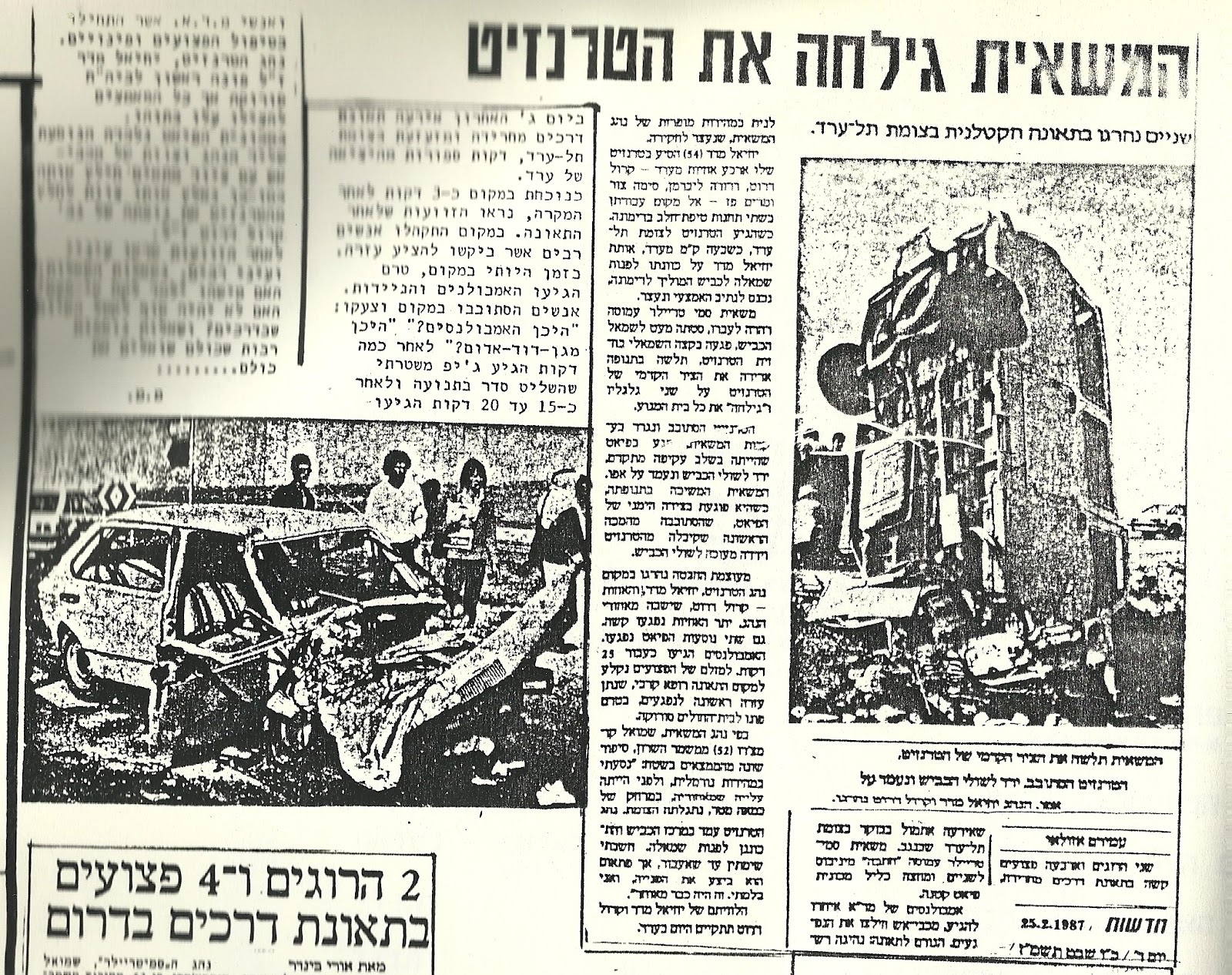
25 Shevat 5747. I received a phone call at work, just before noon. Carol had been killed in an accident. At the Tel Arad Junction, where you turn left to go from Arad to Dimona, which is what the driver of her van had been waiting to do.

Click to enlarge
I was in Oron, in the desert offices of Negev Phosphates where I was the mining economist. We got there by company bus, so I had to get someone to round up a car and drive me to Arad, where I too lived back then. I had no idea what the scene of the accident looked like, so I told the guy to take me around the other way, past our new plant.

I had no idea when the accident had occurred, though I should have realized that it would have been  several hours earlier, at the start of her work day. She worked as a nurse in a government well-baby clinic. Tipat Halav, it was called, "a drop of milk." Even the smallest town had at least one. Dimona, had three or four of these clinics and she had been working at one of them since returning to full-time work after her last child was born.

I was playing out scenarios in my head, but I didn't know what was happening.  Had her husband Yaakov come up from the Dead Sea already?  Were her four children still in school and day care? What about Mother? Who else knew? What all had to be done? Was Judith coming down already?

It was a Tuesday and I had last seen my sister three days earlier when she had come to shul specifically to hear me read my bar mitzvah. We had spoken only briefly. That was twenty-five years ago.

Carol and Judith are twins, my parents fourth and fifth children of seven. Carol was named Devorah after Father's Aunt Bessie Kraus who told Mother that she was carrying twins. Aunt Bessie died ten days before they were born.

Carol wore glasses for astigmatism from age three-and-a-half. The girls are identical, but even in the photographs without the glasses you can recognize her by the way she tilted her head. For a few years she wore an eye patch periodically to exercise her eye. Mother went through a stage where we all had to walk around with one eye covered, so we would understand how difficult that was. They were both well-behaved children, but Carol was extremely self-disciplined. Mother says it was the glasses. She never broke any and never lost any.

After their last year in high school - that one year in Williamsport - they planned a year on kibbutz on the Hachshara program of Bnei Akiva. Mother and Father decided that this was the time and they all went. After that first year - during which Carol had been on Kibbutz Saad and Judith on Kevutzat Yavne -  Carol enrolled at Bar Ilan University, a short bus ride from what had become home. A year later war came and she left the university for something more practical - nursing school.

One year later, Carol and Yaakov were married and they moved into a rented room in Jerusalem, where she attended Shaare Zedeck's nursing school.  The following summer Avi was born and they moved into an apartment quarters in an alley off Hayyei Adam Street, that words are inadequate to describe. (Father wondered out loud "This is what we left America for?")

See how traffic from the left has to
 adjust to the not-quite straight road
It was a few hours before I had a clear picture of what had happened that morning. The regular van took the nurses from Arad to work in Dimona.  As they waited at Tel Arad before turning left, an oncoming semi-trailer didn't keep to its lane and hit them head-on. The lane is not quite straight and you have to be aware of it. Leaving Kibbutz Mishmar Hasharon hours before daybreak is not conducive to that awareness. Neither is speeding. The van was stopped, so had no way to escape.

From the newspaper "Hadashot." The van is on the right,
the Fiat on the left. Click to enlarge

The van was driven back into the small Fiat waiting behind it and the woman driving that car was on crutches for many months. I think it turned out that she lived in Mother's building. Carol was sitting directly behind the van driver and both were killed immediately. The nurse in the front seat was injured after being suspended by the seat belt. The van landed on its nose, off the road to the right.

Medical people came out from Arad, so some of our neighbors knew long before any of the family. The injured and the dead were taken to Beer Sheva.
The children had been sent to friends after school and nursery. Yaakov was just getting home. I went to gather the children, if I recall correctly with Jay Shames in his large car.  As we brought them home, I said under my breath "Kids, life as you know it is over." It also fell to me to phone the family in the US, including Aunt Betty and Uncle Ken, who had to go over to tell Nana. Nana phoned back a bit later and asked if grandmothers sit shiva.

Avi was a year old when Carol received her certification as a registered nurse. She did one more year at Shaare Zedeck as part of a mandatory service program and for that year received the Schwester Selma Award for outstanding service. The next year they moved to Akko, where they bought a nice apartment at the far northern edge of town.

Carol worked at the government hospital in Nahariyya and the next summer Michal was born. During their five years in Akko, Carol was given additional responsibilities at the hospital and was doing very well professionally. Not quite two years later, Yossi was born and two years after that they moved to a house with a small yard, in Arad.

Carol worked at the hospital in Beer Sheva until Shmuel Mordecai was born two years after that. He was named for Father's two uncles - Uncle Max (Mordecai Shmuel) and Uncle Fred (Shmuel) who had lived long lives but had no children. I made a comment about her not naming him for Father and she said "next time." Shmuel was three and a half. The gan cancelled their Mothers' Day program that had been scheduled for the following Sunday. He - and the others too - hung around Judith alot during shiva.  They really did look alike.

There was the matter of the funeral, but first we had to get her released from the hospital morgue. The release had to be approved by the police. They weren't sure if they could release her that day - something about maybe an autopsy. The Hevra Kadisha (burial society) was not allowed to send their van unless it was certain she would be released, so Jay volunteered his car and he and I, together with Elisha (I think that is his name) from the Hevra Kadisha went to Beer Sheva to see what we could do. We set up a headquarters by Macky and Barbara Goldman, insurance clients of Jay's. (I had known Barbara years ago in Camp Moshava and had met Mackey in Netzer Hazani, when I had done reserve duty there seven years earlier.) We made calls to everyone we thought might be able to pull some strings.

Eventually we got the OK but by then it was evening. The local rav, Rav Benzion Lipsker, urged Yaakov to have the funeral right away, but Yaakov was adamant that the children would attend and he didn't want the dark of night to be part of their memories. We went to the hospital morgue. I had been a Hevra Kadisha volunteer in Chicago and occasionally in Arad, but when they told me I had to identify the body, I was not prepared.

We brought her back to Arad and put her on the floor of the shul - Hashahar - with her feet near the door. Someone had set up a rotation of people to sit with her and say Tehillim all night. There was no tahara (ritual washing) and no traditional linen garments and shroud. In the case of a violent death - even a fall - you leave the clothes as they are. The irony of no tahara.

Carol wasn't sure about working after Shmuel was born. It was certainly a financial necessity, but Beer Sheva was too far. Rav Lipsker phoned me and asked me what I thought about their offering her the job of mikva lady. He hadn't known her well and I had been in Arad two years longer. He wanted to know if she had the merit for the job. For the responsibility.

I am not sure that he liked what he got, not at first. She had demands. About the conditions there. I don't remember the details but there were some issues of lighting and perhaps sanitation. And the phone. The mikva had no phone. "What if someone drowns? How do I call someone?" she used to say.

Eventually they got used to her, as everyone always did. She took the job in Dimona and later the head of the station showed me how she recorded everything in the most orderly way. She made demands of others, but was always first up herself. Her notebooks were everything they could have wanted. Mother said it was the discipline from the glasses.

And she continued working at the mikva, even after starting in Dimona. Responsibility.

I knew the halacha of no tahara, but it didn't seem right.

The night before the funeral, Rav Mordecai Cohen sat with Avi to teach him the meaning of kaddish. He was eleven and a half. The first kaddish was in the yard outside the shul just after nine Wednesday morning. Afterwards we walked up the hill from the shul and from there a long line of cars down through the Rotem neighborhood to the cemetery.

Yaakov is a kohen, so the grave was on the edge of a wide pathway. There were many people. Our own crowd, of course. And the Ministry of Health people. And the Gerrer hassidim who interrupted their learning to attend. And many many women. Rav Lipsker spoke.  Rav Zvi Shemueli of the ulpana girls' high school spoke. And the town Sephardic rabbi, Rav Yosef Albo spoke. Some of the family were not pleased about some of what was said that day, but all I needed was to hear Rav Albo say "את טהורה, את טהורה" (You are pure, you are pure.)

Young nephews joined in filling the grave.

Before the unveiling, after thirty days according to local custom, one of Carol's friends decided to put together a booklet with letters, photographs, documents, clippings. Everyone was supposed to write something, adults and children alike. I was probably the only one who declined. I suppose I am ready now.

Friday, February 10, 2012

WHO IS THIS LEA PICKHOLZ?

Lea Pickholz Keller of Drohobycz
After the Second World War, the allies set up an organization called the International Tracing Service (ITS) with headquarters in Bad Arolsen Germany, to deal with all documentation regarding civilians during and after the war. This included deportations, camp records, refugees, people looking for other people, slave labor, etc. Over the years, ITS did lookups for people but did not make records or indecies available for general research, aside from some microfilms which have been available at Yad Vashem since the 1950s.

Attitudes began changing a few years ago and in early 2008, a much larger index was made available to the public at Yad Vashem. My first search of the new index showed files of a number of Pikholz descendants whose names I had not known before, among them Lea Pickholz Keller of Drohobycz. She was born in 1906 to Ben Zion and Rifka Rachel, but it was not clear which of her parents was the Pickholz. Lea was killed in Belzec in 1942.

I requested the file from Arolsen and learned that Lea's husband Pinchas had had some post-war correspondence wth the ITS from his Tel-Aviv address. I found two Pinchas Keller buried in Greater Tel-Aviv cemeteries, both of whom were age-appropriate for Lea and both of whom had died within the past fifteen years. I located the son of the right one.

The son was very surprised to receive my letter. He knew that his father had lost a family in Drohobycz, but didn't know any details.  He certainly didn't know anything about the first wife's lineage. But I did learn about the two children that Pinchas and Lea had together and who were killed. A son Shlomo and a daughter Rachel. I found an ITS card at Yad Vashem for Shlomo, but none for Rachel. Shlomo too had been killed in Belzec.

So this is where I was left, with a Lea Pickholz born 1906 in Drohobycz, to Ben Zion and Rifka Rachel. Another unidentified Pikholz descendant, at a time in my research when I'd have thought I'd be solving these questions, not finding new ones.

Identification
Birth, death and marriage records from east Galicia are held in the AGAD archives in Warsaw, but they may not be released from the Civil Records Office to the archives until the last record in the set is a hundred years old. Even then, we cannot order these records until they have been processed, fumigated, microfilmed and indexed. And there are no plans at the moment for additional indexing. AGAD's staff will not do searches, even if there is a precise date, which I didn't have in Lea's case. So the transfer in 2010 of Drohobycz birth records for 1906-09 was not much help.

In the course of some other inquiries, I found a man - I think he is a former AGAD employee - who is able to do searches in the newly transfered records based on surnames, and provide extracts of the records. He charges by the hour but can do several surnames at once. I got a quote from him for a number of record sets and contacted a few other researchers for each town, to spread the costs. (By the time of this writing, I have done this with three groups of record sets.) The extracts came quickly, but since there were dozens from the main Pikholz towns Rozdol and Skalat, Drohbycz took a back seat. (I had not done this project specifically to find Lea's birth.)

The five record sets I had ordered provided extracts of four births from Drohobycz, three from neighboring Boryslaw, thirty from Rozdol and thirteen from Skalat, as well as thirteen Skalat deaths. Lea was born to Ryfka Ruchel Pikholz and Benzion Flam/Kornhaus(l)er (it is not clear which surname comes from Benzion's mother and which came from his father) on 16 August 1909 in Boryslaw. That's 1909, not 1906 and Boryslaw, not Drohobycz. The record further tells us that Ryfka Ruchel's parents are Dawid Samuel and Sara Pikholz, a couple we know well.

We certainly know this couple. Dawid Samuel Pikholz was born in Rozdol in about 1838 to Aron and Chaje Pikholz. Aron was born about 1818 to the original Pikholz couple in Rozdol, Pinkas and Sara Rifka. Dawid Samuel and his wife Sara Thalenberg had four children that we knew of: Schaje, Chaja Lea (m. Samuel Glucksman), Abraham and Iszak. There are a few descendants of Schaja in the US and Canada, but they have no interest in contact. Chaja Lea and Abraham each had a number of children, but I have found no trace of anyone beyond their birth records. Iszak was known as Tallenberg and lived in Budapest and had three children. I am in touch with one of Iszak's two grandsons, who lives here in Jerusalem, and he was interested to hear of his mother's previously unknown first cousin.

I am pleased that Lea now has a place in the Pikholz tree.

Sunday, February 5, 2012

MOTHER'S FIRST YAHRZEIT

I suppose I should be writing at length about my mother - Beatrice (Batya) Pickholtz - but I am not up to that. At the funeral I wasn't either, speaking then mostly about Mother's death rather than about her life. But here is the basic bio.

Mother was not yet born when this was taken in 1924.
Mother was born on the second day of Elul, 5686 (12 August 1926) in Vandergrift Pennsylvania, the youngest of the five children of Raymond and Sarah (Rosenbloom) Gordon. There were two grandfathers living in Russia, but the family - on both sides - lived mostly in Washington DC, with one aunt in New York.

They visited the family in DC fairly frequently, considering the times, and Mother was quite close with her older cousins who lived there. Mother also got her first real work experience in DC, where she spent several summers as a teenager. (Her Social Security card was issued there.)

Mother was also permitted to attend a Jewish overnight camp, partly as compensation for her meagre Jewish education. She spoke of this experience - and other aspects of her childhood - in an interview with the investigative journalist David Bedein, while she was living in Beer Sheva. (That is not to say that there was no Jewish education whatever.  Mother attended Kiski Valley Religious School and was confirmed.)

Mother was accepted to the University of Pittsburgh and there met Betty Pickholtz, who introduced Mother to her brother,
 who had recently returned from the War. They married soon after, on 22 September 1946  at the Poale Zedeck Synagogue in Pittsburgh, where Father's parents were active members.

They moved into an apartment made out of someone's third floor on Shady Avenue and then into a small semi-detached house on Woodbine Street in Stanton Heights. And the children began coming.  There were five within their first seven years of marriage and by then they were in their third house, on Stanton Avenue.  We lived in that house nearly three-and-a-half years, a short time, but long enough for a major remodeling.

Mother did the bulk of the child-raising, as Father was on the road several days a week. And for those of you who have always admired her calm and patience,... well maybe I should just leave that alone. As the eldest, I was given alot of independence. (The kindergarten teacher was appalled that I was left to come home myself, from the very first day.) But under the circumstances, it couldn't have been much different.

After first grade, we moved one final time, to the house on Denniston in Squirrel Hill, where we spent sixteen years and where the two youngest girls were born. Schools, shul, one set of grandparents and other family were within walking distance. (Despite everything to do at home, Mother was very active in the school.)

They (I was out of the house by then and my brother remained in Pittsburgh) moved to Williamsport Pennsylvania and a year later - when the three older girls finished high school - to Israel. An absoption center in north Tel-Aviv, then a three-bedroom apartment in suburban Kiron. Father worked for Motorola. The three older girls were on programs that had them living away. And Mother was diagnosed with cancer. Surgery, treatments, I never needed to know the specifics.

After three years, they went back. With the two younger girls. They fully intended to return after Father's retirement and rented out the apartment. They rented and later bought in Skokie Illinois and Father went to work for Motorola, eventually securing a position which enabled him to visit the Israeli office (and the four children who remained here) several times a year. But Father had one heart attack too many and Mother was a widow at fifty-four.

But she had always intended to return to Israel and so she did, at age sixty, renting an apartment in Arad, where three of her children lived. One was killed in an accident two months later. (More on that sometime next week - I told you Shevat is a tough month around here.) After a year, Mother sold the Kiron apartment to the people who had been renting and bought the Arad apartment she had been renting and she lived there twenty years, as long as she had lived in her parents' house.

That third floor, three-bedroom apartment was her only home that most of the grandchildren ever knew. And they knew it well. As they got older, they would spend time there with Mother, without their parents, often several at a time. In their teen-age years, Mother had a full summer schedule of visitors, and as she got older, they were able to help her with whatever needed doing.  Mother had independent and individual relationships with each of her grandchildren, from eldest to youngest. And out-of-the-way Arad became part of the itineraries of family (and lots of non-family) visiting from abroad.

Eight years after Mother arrived in Arad, the cancer came back. It brought with it other health problems including a marked decrease in mobility.

Eventually, Mother decided she could no longer live alone and moved into a seniors facility in Beer Sheva, where she had her own 59 square meter apartment and an option to eat one meal a day in the dining hall. It worked for awhile, but after less than two years it became clear that she needed something with more personal attention. There was some discussion about going back to the United States, but - although Mother was prepared to do that if we all thought it best - she really wanted to be here. "Going back" would have been an admission of failure.

Mother's last twenty-seven months were in Jerusalem, first in a room for "independents" and later in a full care department at the same facility. The first ten months were very good, but after that things went downhill quickly and we thought that the end was close.  Then on Simhat Torah, from her fog, Mother said to me "I'm not ready yet" and a week or so later was sitting up having normal conversation. We had another fifteen months.  Some days better, some days worse, but she knew who everyone was and mostly she was clearly in control of her thoughts and her conversation.

Often during those last months, Mother would tell me that Uncle George was coming, with her father's truck, from the furniture store.  To take her home. She looked forward to that.

And so he did. On Tu BiShevat morning, at five past eleven (four years nearly to the hour after her good friend Miriam Goldberg), at Hadassah Hospital.

We buried her the next day, next to Father, in the Segullah Cemetery in Petah Tiqva. I plan to go to the grave Wednesday, the fifteenth of Shevat. First time since sheloshim. Then again Friday, when we are to go to Judith's afterwards for brunch.

Sunday, January 29, 2012

SHEVAT - My Wife's Ancestors

At least five of my wife's ancestors died in Shevat, all in the last seventy years. Four of those five have their yahrzeits this week. My wife's maternal grandfather, Mendel Baum, died seventy years ago and in reverse order my wife's father, HIS mother, HER mother and HER father - four generations.

MENDEL (Menahem) BAUM was born in Vidrany (Slovakia) in 1867. He went to England a few years before WWI as a widower with no children. His landlady brought her niece from Poland to marry him and they had five children - one of whom died in early childhood.

He was a very learned man and was the study partner of Rav Avraham Yitzhak HaKohen Kook, the Chief Rabbi of Eretz Yisrael during the Rav's WWI exile. (The Rav was the sandak for his eldest son.)

Mendel Baum died 7 Shevat 5702 (25 January 1942). Three of his four children named sons for him.

MORDECAI DIAMOND was in England in time for the 1901 census, where he appears with his wife Beile Gittel (Betsy) and younger daughter Tova. An older daughter was already married and her husband had preceded them. (The husband is the only one for we have documented immigration information.) I am working with a descendant of the older daughter to nail down as much information as we can about the Diamonds. The family came from somewhere near Warsaw, perhaps Plock, and their name was probably more like Diament.

Mordecai ben Pinchas was born about 1851 and died 24 Shevat 5703 (30 January 1943).

TOVA DIAMOND was nineteen in the 1901 census and soon afterwards married Moshe Avraham Schwartz (originally Scharf).  They had four daughters and two sons. Tova died 5 Shevat 5723 (30 January 1963).

Wedding of Jane Schwartz and Harry Silberstein

JANE/SCHEINDEL SCHWARTZ was Tova's eldest daughter, born 5 June 1903. She married Jacob Harry Silberstein and they had three sons, one of whom died just before his twenty-first birthday.

The family was in the restaurant business in London.

Jane died 7 Shevat 5746 (16/17 January 1986).


Wedding of Arthur Silberstein and Esther Baum.
Jane and Harry's eldest son ARTHUR AARON (Alter Aharon) SILBERSTEIN was born 4 Kislev 5684 (12 November 1923). He married Esther Baum on 23 December 1945 and they had three sons and a daughter. He worked with his father and grandfather in the family restaurant, eventually bringing his family and the restaurant on aliya in 1969.

He died in Jerusalem on 8 Shevat 5765 (17 January 2005) and is buried in Kefar Etzion. He was survived by six grandsons and nine granddaughters and was predeceased by one son and one granddaughter. At present there are six great-grandsons and fourteen great-granddaughters.

Wednesday, January 25, 2012

SHEVAT - Yahrzeit Month around here

Wednesday, Rosh Hodesh Shevat. Time to make sure we have yahrzeit candles. Let's review.

4 Shevat. Raymond Gordon. My mother's father. Forty years. Yerahmiel ben Zvi and Chana.
This will be my first time keeping this yahrzeit myself. The last few years, I have gone up to my mother's and lit the candle with her.
A few years ago, I learned of a custom whereby you keep the yahrzeits that your deceased parents would have kept. (Just their own, not the ones they inherited from their parents.)  It's a matter of kibbud av va'eim - honoring your parents.
That is not relevant for my father, who died thirty-one years ago.  My grandmother outlived him by fifteen years and asked me to keep my grandfather's and to say kaddish for her when the time came. So I am doing this without regard to that custom.
My mother never wanted me to say kaddish for her parents' yahrzeits while she was still living, so now I begin.
My gf on right. Also U. Frank, A. Rose &
A. Mary Jaffe who is buried in New York.

My grandfather was born in Dolginov, near Minsk. His mother died when he was a teenager, away at yeshiva. He became a Socialist and went to the US in 1906. In 1914 he married my grandmother, whom he had known in Russia, and they lived in Vandergrift Pennsylvania, where he owned a furniture store. My mother was the youngest of their five children.
My grandfather died in Pittsburgh and was buried in Washington DC. His is the only one of my grandparents' funerals that I attended. He and my grandmother are in adjacent graves.
His brother Frank and wife Mary are one row behind them. Next to U Frank are his sister Rose and her husband Max Shapiro. In front of them, adjacent but one to my grandmother is Celia Fritz, a first cousin of my grandfather's father. (Her granddaughter lives a fifteen minute walk from me in Jerusalem and I call her my closest living relative.)
I visited those graves this past summer for the first time since my grandfather's funeral.

I'll tell you about some of the other Shevat yahrzeits as the month progresses. The full month includes (ancestors - mine and my wife's - plus others whose yahrzeits I personally observe):
My mother - 15 Shevat, my sister Devorah (Carol) - 25 Shevat, my wife's father - 8 Shevat, my wife's maternal grandfather and paternal grandmother - 7 Shevat, my father's mother's father's mother - 7 Shevat, my father's father's mother's father's mother - 27 or 28 Shevat, my wife's father's mother's mother - 5 Shevat, my wife's father's mother's mother's father - 24 Shevat. (On the other hand, we also mark the birthdays of two three of my grandsons.)

Saturday, January 21, 2012

COMING APPEARANCES

First there is this one:

A presentation in Hebrew by Israel Pickholtz
and the Israel Genealogical Society Jerusalem Branch
(IGS charges NIS 20 for non-members.)

What do you do when the hard proofs just aren't there,
but you are as sure as you can be what they would say if you could find them?
If you fold your hands and wait, you may never get anywhere with your research, but if you
accept your suppositions as fact, they may never be questioned again.
Not by you nor by your research heirs.
This presentation will use examples from the east Galician single-surname
Pikholz Project to consider when what you know
is beyond a reasonable doubt and if that is indeed good enough.
This lecture was presented in English at the 31st IAJGS Conference on Jewish Genealogy in Washington DC

 
= = = = = = = = = = = = = = = = = = = = = = = = = = = = = = = =
 

Then on 21 February, I am speaking in English to a senior citizens group in Maale Adummim.  It's a general presentation, not for people with genealogy experience.  No idea who is allowed to come.  I am calling it
ADVENTURES IN GENEALOGY
and it will consist of anecdotes from my research. It is at 10:15 in the morning at the Pnai Shmuel Synagogue in Mitzpeh Nevo.
I did this kind of thing a year or so ago at AACI in Jerusalem.  It was well-received and quite a few people asked for my card, but I got no actual business.

Wednesday, January 18, 2012

Wachs-Braun-Pickholtz

I have decided to put this into a blog format so that everyone can see everyone else's comments. Please sign your name to comments, with something that indicates who you are. You can also write me privately by email if you wish to say something not for general consumption.

I have tried to bring this to the attention of most of the relevant Pickholtz descendants, to a number of the descendants of Schewach Wachs (of Podkamen), to the genealogy researchers who responded to a question I posted on jewishgen.org a few weeks ago and to some of my gen-friends whom I think might be interested.

BACKGROUND
There are two bits of background:

Isak-Fischel and Rivka-Feige
The earliest couple we have in our own Pickholtz family is Isak-Fischel and Rivka-Feige, who were probably born around 1820 and lived in Podkamen (49°56' N 25°19' E), a town in east Galicia for which there are no records. It is my firm belief that Rivka-Feige is the Pikholz and we haven't a clue what Isak-Fischel's surname was.  Rivka-Feige is occasionally referred to as Feige-Rivka. Her father was almost certainly Isak-Josef Pikholz (~1784-1862) of Skalat.

Isak-Fischel and Rivka-Feige had four children that we know of - Yechiel, Leah (married Yaakov-Hersch Brunn/Braun), Bassie (married David Lazel Frankel/Franzos/Francis) and Hersch (married Jutte-Leah Kwoczka), during the approximate period 1843-1855.
Diagram 1
Yechiel's family was lost in the Holocaust, Bassie's family was largely in Denver (though she and her husband were in the New York area) and Leah and Hersch lived in Pittsburgh, though Leah lived for a time in Denver as well.  Hersch is my great-grandfather.

David Lazel Frankel was from Skalat, where the Pikholz families (including Rivka-Feige) came from, but the spouses of the others were from Zalosce, the next town over from Podkamen.  We have access to birth records from Zalosce for 1877-1890 plus quite a few years of death records, though these have little actual information.

In the course of my genealogy work over the years, I have sought out records of anyone named Izak-Fischel or Fischel-Izak, particularly in the records from east Galicia, just to see if something might turn up. Of the six I found, two lived in Tarnopol and one lived near Skalat, but there wasn't much I could really do with any of them. (Fischel is usually found as a Yiddish form of the Hebrew names Ephraim or Yeroham.  We know that our Isak-Fischel is Yeroham, not Ephraim.) I suspect something may show up in nearby Brody, but I haven't found anything yet.

Where the Braun and Wachs connections fit in
My father's first cousin, Herb Braun - who lives in Florida - is named for Hersch Wachs, who died 20 March 1917 in Pittsburgh. Hersch Pickholtz, Herb's grandfather, was alive at the time, so Hersch Wachs must have been quite close to the family. (We don't name for living relatives, so using the name while the grandfather was alive would be unusual, even if it were after someone else. So I figure it has to be someone important.)

Diagram 2
When Herb told me this about a dozen years ago, I made contact with a number of Hersch Wachs' descendants.  Some of them were aware of a vague connection with the Pickholtz family, but aside from Herb, no living Pickholtz descendant had ever heard of such a connection.

Diagram 3
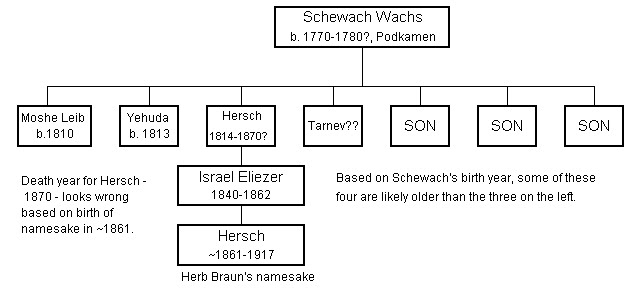
When I made some broader inquiries, I learned that the brothers Zale and Chatzkel Anis - whom I knew well during my brief Chicago period forty years ago - were descendants of one Schewach Wachs and Chatzkel had a tree that included the Hersch Wachs from Pittsburgh, as well as his namesake who was born about 1814. Chatzkel put me in touch with Lenny Schorr - a native Pgher living in Haifa, whose grandmother was Devorah Feige Shapiro, the sister of Hersch Wachs. Lenny told me back then that the Wachs were not related to the Pickholtz family, but to the Brauns - Herb's father's side.

Diagram 4-Note the twenty-year age difference between the groups of step-siblings.
That's where things stood until this past summer.

Feige Rifke Silbermann, daughter of Chana Wachs
Last summer, I was preparing a large order of east Galician records from the AGAD archives in Warsaw and while looking for something else, I happened to see a listing in the JRI-Poland index for Feige Rifke Silbermann, daughter of Chaskel Silbermann and Chana Wachs. This Feige Rifke was born in 1878 in Tarnopol, which is the provincial capital of an area which includes all the small towns I mentioned above. The juxtaposition of my great-great-grandmother's given name Feige Rifke and the surname Wachs was intriguing, so I ordered the birth record, without doing any further research in the index.

The record came in early December and much to my amazement, it showed that Chana Wachs' parents were Isaak and Feige Rifke Wachs. Those are the same given names as my great-great-grandparents', minus the "Fischel."  My first thought was that this was perhaps the same couple and that there was a fifth child, Chana, whom we had never heard of. Not to mention perhaps finally putting a surname on our Isak Fischel.

That euphoria didn't last long.  I went back to JRI-Poland and found the marriage record for Chaskel and Chana.  Chana was born about 1842, which - if she had been a sister to my great-grandfather - would have made her the oldest, but well within the normal range of birth years. But the marriage record also showed that her father was not Isak Fischel, but Isak Leib.  Still it was worth following up.

I also posted on several of Jewishgen's message boards as follows:


Does anyone have any Isaac WACHS references in the mid-late 1800s, particularly one with a daughter Chana who married Chaskel Silberman?
These would likely be in (or from) the Tarnopol area.
I also went to the JewishGen Family Finder (JGFF) to see who else was researching Wachs in the right area and sent those researchers a similar message.

I received a number of responses, none of which made specific contributions to my search. All those who responded have been invited to this conversation.

I then touched base with Chatzkel Anis and Lenny Schorr and had another look at the list of Schewach Wachs' descendants. Perhaps the most striking thing there is the total absence of anyone named Isak. Schewach Wachs (b. ~1770-1780) was known to have had seven children, but the chart has names for only four of them.  (See Diagram 3, above.)

One of those sons is connected to the town of Husiatyn, a town the other side of Skalat.  (The chart says "Rusiatyn," but that is surely an error.) The Husiatyner Rebbe had a large following in Skalat, so those towns were well connected to one another. One of the researchers in JGFF has Wachs in Husiatyn.

It is entirely possible that one of the less developed lines from Schewach Wachs has the Isaks. And it may or may not have anything to do with our Isak Fischel. But I can't just walk away from it.

I have been trying to make contact with the keeper of the Schewach Wachs chart to see what she might know and what her sources are.

So...

I'd like to get some thoughts and advice, particularly from the Schewach Wachs family and other Wachs researchers, as well as my gen-friends. How might we proceed to see if the several Isak Wachs who appear in JRI-Poland's database are somehow part of the Schewach Wachs family?

Incidentally, this index entry, which I just found now, is particularly interesting
and I will include it in my next order, in the spring. It is from Mosty Wielkie, which is about 55 miles NW of Podkamen and includes an Isak whose surname is both Schewach and Wachs and who has a specific connection to Podkamen and Brody.

That's it for now.  Thank you for your attention. (If you click on the images, you can see a larger version.)