Showing posts with label Vandergrift. Show all posts

Sunday, April 14, 2013

REDOING MY OFFICE

THE PROBLEM
The state of my home office is kind of getting to me.

It's two meters wide and four meters long, not counting the closet at the far end.

It has no window.

It's furnished with whatever I had at hand when we moved in, nearly five years ago. At the time, I had just left my drudge job and begun taking genealogy clients. I had no idea what I needed, so I set up based on what I had.

These two photos were taken from the doorway, leading from a closed-in porch which serves as a laundry room and spare bedroom.  It has a very large window overlooking a main street and generously lets in lots of noise.

The closet on the far wall came with the apartment. The cork-covered door in the middle leads to a bathroom, but I rarely use that doorway. I had the cork put on. Previously the door had been covered with a full-length mirror.
The only source of natural light and air, seen from my doorway. And much street noise.
The office chair faces my desktop computer which now uses a 24" screen. After I bought the tablet three years ago, I realized that it can serve as a bulletin board, as well as allowing me to have more things going on at once. When the 24" screen arrived, the older screen went to my son's room and his old clunky monitor came to me and the tablet is now attached to it. (When I have a chance to find a used flat-screen, I'll solve part of that problem.)

I really like the table that the tablet is on. I made it myself about a dozen years ago and it has some excellent storage. I also made the table that the 24" screen is on - it's not very good.

The wall I face when working has a couple of bulletin boards - one I hardly use anymore - and a small bookshelf for dictionaries, Bibles, a Hammond's World Atlas that I had been in print ten years when I got it for my bar mitzvah, and my Concordance. And a thesaurus that I also got for my bar mitzvah.

The second photograph shows four shelving units. The furthest one is something I made for Devir's toys when he was young and it fits here very well. The wooden cabinet is something I picked up at a second-hand store, seven or eight years ago. It has served it's purpose well, but it's really ugly and in very poor condition. The two sets of metal shelves have been with me for forty years, reassembled more times than I'd care to count as I moved from place to place. Despite their history, I think I am ready to part with them.

To the right of the door at the top of the wall is a heating / air-conditioning unit. It's definitely a necessity, though I'm usually too cheap to use it.

The two shelves of purple files in the top center are all Pikholz Project. The box of papers on the far end of the top white shelf are Pikholz Project papers waiting to be filed. Waiting is part of my system, but it's been too long.
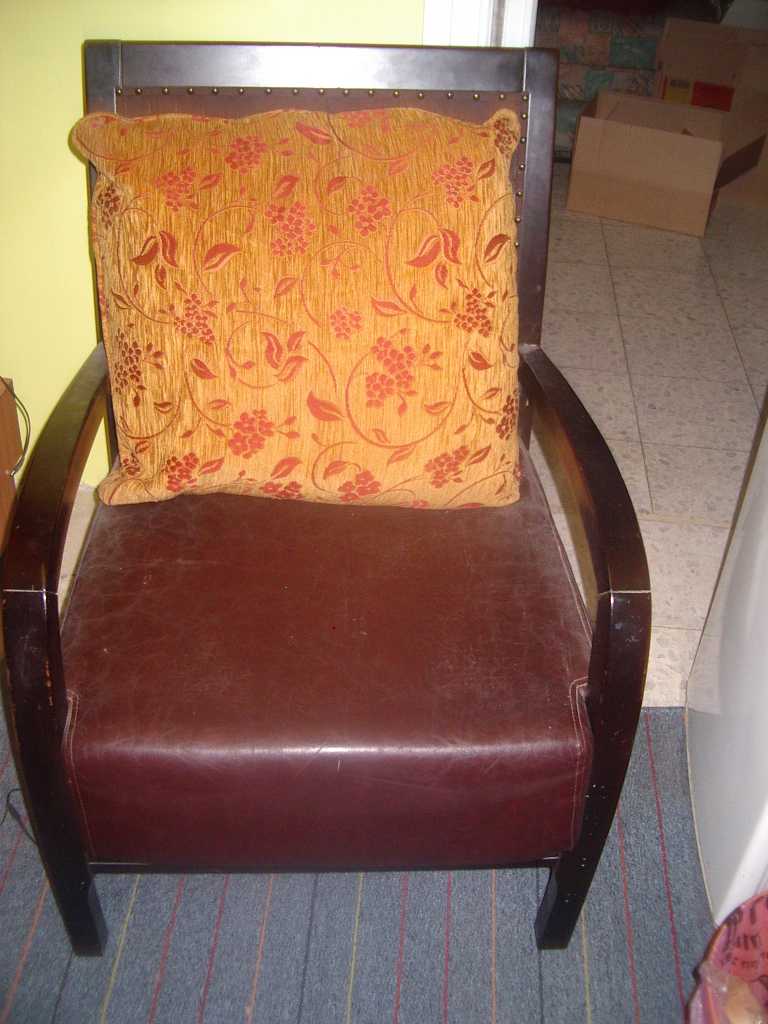
There is also a large arm chair on the right as you enter the room. It's just below what you can see in the second picture. It's too big for the space, but I really really like it and when we moved here it was probably less than a year old.

And if that was everything, it wouldn't be half bad. But soon after we moved, we realized we didn't have enough refrigerator space and I like to have a few bottles of cold water close at hand. So we bought this, used, of course, and it found a place between the white table and the far closet.
     
When Mother moved out of her independent apartment, I added her desk to my collection. Mother brought that desk with her from Skokie twenty-six years ago.

There was no place for that but between the white table and the closet - where I almost never use it - so the refrigerator moved over next to the door. Now it's really crowded.
It's crowded, inefficient, with "to do" piles scattered all around and it's making me a bit nuts. (The Hebrew expression is that it gives me "harara" - a skin rash.)

THE SOLUTION
So I asked Anat Gertner to come and have a look. Anat is an interior decorator whom I met back when I went to weekly meetings of a business networking group. I figured that an hour of her time was worth it to get me started on dealing with it.

Anat had a lot of questions, most beginning with "Do you really need..." Clearly the bulky screen had to go. She liked the big armchair, but it has to be placed better.
How about if I turn around and face the corner to the right of the door? I'm not sure I can handle that as it would disconnect me even more from the window on the porch. besides, facing a corner seems more confining. And then I'd have to rearrange all the electricity. And the phone line. But Anat likes the idea of shelving along the long left wall. She says that sitting in the middle of the room is inefficient.
Do I really need the refrigerator? I think so. I really like to have three bottles of cold water at hand.
Do I need the desk? Well, it's my mother's desk. And who will want it after me? One of my kids, I'd hope. They were all close with Mother.
Devir returned from a three-day class trip and saw I was doing things in my office. He asked what is going on and I told him I was making some changes, changing some furniture. He said "Not Savta's desk." So that settles that.
Anat took a look at a shelf full of odd items and pointed to a small plaster building. The conversation went something like this:
What is that?

That's the Casino Theater a landmark building in Vandergrift, where my mother grew up. It was across from my grandfather's store.
Why do you have it? Do you really need it?

Well, I bought it from the local historical society when I visited three years ago.

Where in Europe is Vandergrift?

Europe? It's about an hour from Pittsburgh.

Anat wants to get rid of all the shelves and tables. Things should be even and uniform. And she says I need real drawers, not just those plastic sets of four that I have all around. And I do have six real drawers - one with stamps, one with drivers and software manuals, one with computer cords, phone cords and such, one with pills and stuff. Plus the drawers in Mother's desk, which have mostly unsorted photographs.

She also wants me to move the scanner/printer further away from where I sit. She says it takes up prime real estate. (In the picture at the top, it's that black thing between the two computers, with the papers on top.)  I am sure she is right about that, but if I use that space for the tablet & screen, thus opening up space on my right for work, I may not be able to see that screen as easily.

Those really need some silver polish.
On top of the shelves to the right of the door are a couple of teapots and some plates from my wife's great-grandfather's restaurant in England. After her father finally shut it down, we ended up holding on to a vast quantity of plates, cutlery etc. Most of that is gone, but I insisted on holding onto a few pieces. Anat says they should go on a special glass shelf on the wall. That way maybe I'll polish them more than once a year.

Anat really doesn't like the small alarm clock but I want an analog clock with numbers, where I can see it. Not just the numbers on my computer or cell phone.
I need to find a way to keep the pictures from falling off the wall.
Jewish Law requires an unfinished patch in a home, as a zecher lemikdash - a reminder of the destruction of the Temple and the glory of Jerusalem. Mine is in my office, on the right wall above the white shelves. It stays where it is.

The center says "If I forget you, Jerusalem, may my right hand lose its cunning. The pictures are from an old Passover Haggaddah or the sort we used at my grandfather's seder.

What about all the files, Anat wants to know. Can't they be scanned? I'm sure they can. Dick Eastman goes on about that all the time. But the scanning is alot of work and I'm still from the older generation who feels more comfortable with paper. And I'm not sure I trust the computer to keep it all safe, back-ups or no. Well, Anat has a suggestion for that - a friend who helps people organize themselves. Basically another pair of hands, though my brain sometimes has trouble controlling the pair that I have. And if she is going to scan files, she needs access to the computer, right?

So I concluded our meeting having tentatively decided on a a three-step process. First I would get rid of or consolidate everything I can. That includes getting things into temporary storage boxes for the duration of the process as well as getting rid of some of the furniture.

Second, I should talk with Anat's organizer and determine what she can do for me. And do it.

Third, go back to Anat for more specific advice about replacement shelving etc and arranging the room.

PROGRESS
  • I learned how to work the feeder on the scanner, though for some reason some of the scans come out rotated ninety degrees.
  • I scanned 366 Pages of Testimony and thrown out the paper copies. I also scanned the first ninety-nine Skalat birth and death records, most of which have to be done in two parts and combined on the computer. Many more to go.
  • I did some rearranging of closets and opened up some storage space for these temporary boxes of which Anat speaks.
  • The old dot matrix printer is on the way out the door. My daughter Merav wants the paper.
  • A few miscellaneous items that are meant to go "someday" to the kids, will in fact go at the first opportunity.
  • I dug out Mother's musical clock which will go up above the doorway - probably without the batteries that make it play a different instrument every hour. The small alarm clock can go back in the bedroom.
  • My wife agreed to try to find a good folding table, which can repace the table on the porch, giving me a place to put Mother's desk. We are discussing the refrigerator.
  • The metal shelves to the right of the door are gone.
  • Nachum the painter is coming over to give me a price for a patch on the ceiling, caused by a leak in the upstairs neighbors shower. At the same time, I'll get a quote to refresh the office. (Maybe some other stuff too.)
  • The big ugly cabinet is more than half empty (some would say less than half full) and I hope to be able to get rid of it perhaps as soon as Sunday evening.
I am not going to keep you informed as I go along, but I'll probably give you a peek at the final results.
- - - - - - - - - - - - - - - - - - - - - - - - - - - - - - - - - -
Housekeeping notes
I am spending way to much of my blog time trying to get the photographs and the paragraph breaks to stay where I put them. And I save stuff one way and it comes back differently. Maybe I should be thinking about leaving Blogger. But it's another learning curve and who knows if it will be any better.

Friday, March 2, 2012

CANDLES OF ADAR

MORRIS PICKHOLTZ - Chaim Menahem ben Zvi and Itta Leah
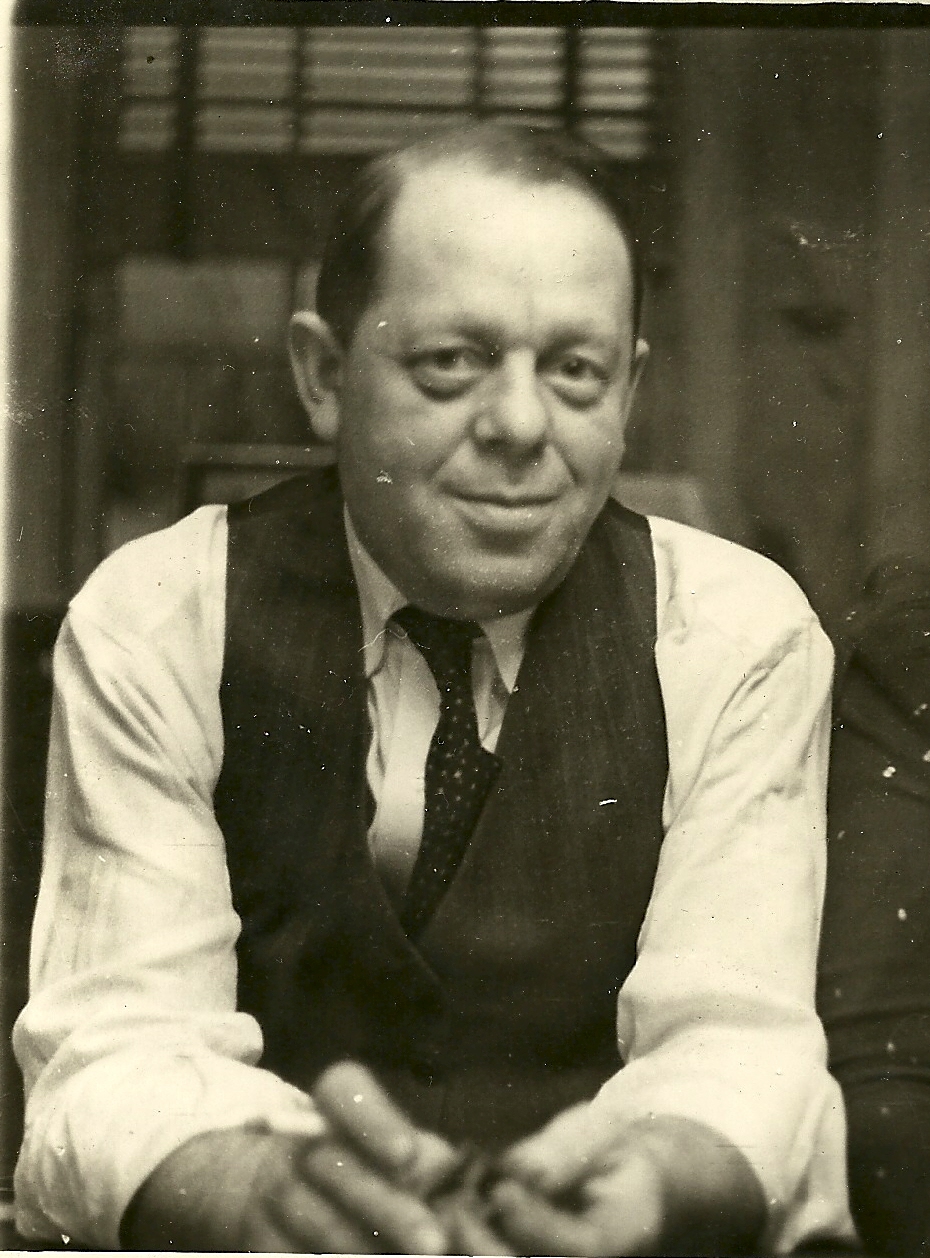
My father's father was fifty-one when I was born and was in the hospital with a heart attack. It was serious enough that my parents thought I might be named for him and he had already been given the additional name "Chaim." As it turned out, he lived another nine years and died of something else, on the ninth day of First Adar 5717, fifty-five years ago.

My grandfather was born in Zalosce, in east Galicia. He was named for his mother's uncle Mendel Kwoczka who had died seven months earlier. When he was six, his father and second brother went to America, following the eldest brother and the first two sisters who had gone earlier. The next year, his mother took the three youngest on a ship from Liverpool to Montreal and from there to join the others in Pittsburgh via St. Albans Vermont.

At age twenty-four, he married his brother's sister-in-law and they had three children. My grandfather was in the wholesale grocery business on Miller Street with two of his three brothers and much of that time the business was sufficient to support the three families. When Uncle Joe turned sixty-five, they closed down Pickholtz Brothers (which I remember visiting a few times) and my grandfather worked his last years selling for a company called Tak-A-Toy, that placed small toys on racks near checkout counters in grocery stores and supermarkets.

All those years, he was an active member of the Poale Zedeck synagogue, serving a number of years as vice-president of the men's club, while my grandmother was president of the sisterhood.


I have a replica of this gene
 He went into the hospital on a Shabbat morning, soon after my ninth birthday. No one had to tell me that evening that he had died - I knew on my own. They didn't let me go to the funeral. I was mad about that for probably thirty years.

My grandparents lived in Squirrel Hill - first on Phillips Avenue and later on Northumberland Street, across from the police and fire stations, not two blocks from our house. So we saw them often, but I cannot say that I had much of a one-on-one relationship with him. My loss. I'd like to think that I talk to my own grandchildren more than my grandfather spoke to me. But I always sat on his right at the seder table. And he was the one who noticed that my toes pointed out when I walked.

There is a Sunday when I was seven-and-a-half that I will always remember and appreciate. My father and grandfather, together with Uncle Bob, took me to Forbes Field. It was my first game and the last of the season. We sat in the bleachers in left field. Going to a game was a really big deal, as we didn't have much baseball on television and certainly none in color, with real green grass. The Pirates lost 4-0. Johnny Podres started for the Brooklyn Dodgers. The next week he pitched in the World Series and won two games.

I learned how to keep a scorecard that day.

And I learned the word "generations."

Four Other Ancestors
Simon (Shimshon ben Shelomo?) Rosenzweig, born Rajec Slovakia 1787-1790, died Puchov Slovakia 3/4 Adar 5620, 26 February 1860. He was my father's mother's father's father's father.

Golde Buchalter died in Obertyn east Galicia 2 Second Adar (11 March 1881) at age sixty. She was my wife's father's mother's paternal grandmother.

Betsy (Beile Gittel bat Moshe Aharon) Diamond, died in London, 8 Adar 5697 (19 February 1937) at age ninety-three. She was my wife's father's mother's maternal grandmother.

Binyamin Yitzhak ben Mordecai Aharon Mostek (aka Lindenberg), born 1866 probably in Prznasnyz Poland, died 24 First Adar 5708 (5 March 1948) in New York. He was my wife's mother's maternal grandfather.

Uncle George
My mother's brother, Gershon ben Yerahmiel and Sarah Gordon, born 5 April 1920 in Vandergrift Pennsylvania, died 15 Second Adar 5760 (22 March 2000) in Pittsburgh.

Uncle George and Mother
Uncle George was the younger of Mother's two older brothers and they were particularly close. They lived not far from us while we were growing up, though he went back to Vandergrift every day to work in his father's furniture store, "R. Gordon & Son.". Eventually it became his.

He served as a lieutenant in the US Army during WWII and together with his wife raised three children. He was a good man and a fine uncle.


One more that I want to mention, who is not a family member
The fifteenth of Adar is the yahrzeit of Uri Megidish, may G-d avenge his blood. In fact, I think He did, in rather spectacular fashion.

When I served in a reserve artillery unit, one of the two communications sergeants in our battery was Uri Megidish. He had big bright teeth and smiled all the time. I knew him in another context, as he was vice-principal of the religious high school in Yeroham when I lived there.

Our paths diverged and Uri moved to Gan Or, a moshav in Gush Katif, where he became a farmer. He worked in his own greenhouse and he enabled a few local Arabs to make a living as well. Until the day that one of them stabbed him to death. It was the fifteenth of Adar 5753, nineteen years ago.  Uri was thirty-nine and he left a wife and four children. His first son had celebrated his bar mitzvah two months earlier.

The years went by and one fine day - oh what a fine day it was - eleven summers later, Uri's daughter had given birth to his first grandson. The day of the brit, an IDF helicopter took out a car carrying two terrorists in Gaza, killing them both. One of them was Uri's murderer.

Thirteen months later, Gan Or and the rest of the Gush Katif communities were destroyed and turned over to the Gazans. Uri's was not one of the bodies that had to be disinterred, as he had been buried in his parents' moshav, Segullah, near Kiryat Gat.

Uri and I were not close friends or anything, but you know how sometimes something silly revives a particular memory of a particular person? This will always be linked in my mind to Uri Megidish. That and the big Hines Ward smile.

Sunday, February 5, 2012

MOTHER'S FIRST YAHRZEIT

I suppose I should be writing at length about my mother - Beatrice (Batya) Pickholtz - but I am not up to that. At the funeral I wasn't either, speaking then mostly about Mother's death rather than about her life. But here is the basic bio.

Mother was not yet born when this was taken in 1924.
Mother was born on the second day of Elul, 5686 (12 August 1926) in Vandergrift Pennsylvania, the youngest of the five children of Raymond and Sarah (Rosenbloom) Gordon. There were two grandfathers living in Russia, but the family - on both sides - lived mostly in Washington DC, with one aunt in New York.

They visited the family in DC fairly frequently, considering the times, and Mother was quite close with her older cousins who lived there. Mother also got her first real work experience in DC, where she spent several summers as a teenager. (Her Social Security card was issued there.)

Mother was also permitted to attend a Jewish overnight camp, partly as compensation for her meagre Jewish education. She spoke of this experience - and other aspects of her childhood - in an interview with the investigative journalist David Bedein, while she was living in Beer Sheva. (That is not to say that there was no Jewish education whatever.  Mother attended Kiski Valley Religious School and was confirmed.)

Mother was accepted to the University of Pittsburgh and there met Betty Pickholtz, who introduced Mother to her brother,
 who had recently returned from the War. They married soon after, on 22 September 1946  at the Poale Zedeck Synagogue in Pittsburgh, where Father's parents were active members.

They moved into an apartment made out of someone's third floor on Shady Avenue and then into a small semi-detached house on Woodbine Street in Stanton Heights. And the children began coming.  There were five within their first seven years of marriage and by then they were in their third house, on Stanton Avenue.  We lived in that house nearly three-and-a-half years, a short time, but long enough for a major remodeling.

Mother did the bulk of the child-raising, as Father was on the road several days a week. And for those of you who have always admired her calm and patience,... well maybe I should just leave that alone. As the eldest, I was given alot of independence. (The kindergarten teacher was appalled that I was left to come home myself, from the very first day.) But under the circumstances, it couldn't have been much different.

After first grade, we moved one final time, to the house on Denniston in Squirrel Hill, where we spent sixteen years and where the two youngest girls were born. Schools, shul, one set of grandparents and other family were within walking distance. (Despite everything to do at home, Mother was very active in the school.)

They (I was out of the house by then and my brother remained in Pittsburgh) moved to Williamsport Pennsylvania and a year later - when the three older girls finished high school - to Israel. An absoption center in north Tel-Aviv, then a three-bedroom apartment in suburban Kiron. Father worked for Motorola. The three older girls were on programs that had them living away. And Mother was diagnosed with cancer. Surgery, treatments, I never needed to know the specifics.

After three years, they went back. With the two younger girls. They fully intended to return after Father's retirement and rented out the apartment. They rented and later bought in Skokie Illinois and Father went to work for Motorola, eventually securing a position which enabled him to visit the Israeli office (and the four children who remained here) several times a year. But Father had one heart attack too many and Mother was a widow at fifty-four.

But she had always intended to return to Israel and so she did, at age sixty, renting an apartment in Arad, where three of her children lived. One was killed in an accident two months later. (More on that sometime next week - I told you Shevat is a tough month around here.) After a year, Mother sold the Kiron apartment to the people who had been renting and bought the Arad apartment she had been renting and she lived there twenty years, as long as she had lived in her parents' house.

That third floor, three-bedroom apartment was her only home that most of the grandchildren ever knew. And they knew it well. As they got older, they would spend time there with Mother, without their parents, often several at a time. In their teen-age years, Mother had a full summer schedule of visitors, and as she got older, they were able to help her with whatever needed doing.  Mother had independent and individual relationships with each of her grandchildren, from eldest to youngest. And out-of-the-way Arad became part of the itineraries of family (and lots of non-family) visiting from abroad.

Eight years after Mother arrived in Arad, the cancer came back. It brought with it other health problems including a marked decrease in mobility.

Eventually, Mother decided she could no longer live alone and moved into a seniors facility in Beer Sheva, where she had her own 59 square meter apartment and an option to eat one meal a day in the dining hall. It worked for awhile, but after less than two years it became clear that she needed something with more personal attention. There was some discussion about going back to the United States, but - although Mother was prepared to do that if we all thought it best - she really wanted to be here. "Going back" would have been an admission of failure.

Mother's last twenty-seven months were in Jerusalem, first in a room for "independents" and later in a full care department at the same facility. The first ten months were very good, but after that things went downhill quickly and we thought that the end was close.  Then on Simhat Torah, from her fog, Mother said to me "I'm not ready yet" and a week or so later was sitting up having normal conversation. We had another fifteen months.  Some days better, some days worse, but she knew who everyone was and mostly she was clearly in control of her thoughts and her conversation.

Often during those last months, Mother would tell me that Uncle George was coming, with her father's truck, from the furniture store.  To take her home. She looked forward to that.

And so he did. On Tu BiShevat morning, at five past eleven (four years nearly to the hour after her good friend Miriam Goldberg), at Hadassah Hospital.

We buried her the next day, next to Father, in the Segullah Cemetery in Petah Tiqva. I plan to go to the grave Wednesday, the fifteenth of Shevat. First time since sheloshim. Then again Friday, when we are to go to Judith's afterwards for brunch.