Wednesday, May 10, 2017

Beeg Problema - Days Six and Seven: Kunszentmiklos

I reported on Days Six and Seven yesterday, but Kalocsa was bracketed by two visits to Kunszentmiklos on those same days. I have mentioned this Hungarian town before - it's where my great-grandmother's father's family lived. The town is full of Bauers, many of whom had lived previously in Apostag, a bit further south.

The plan was to visit the cemetery in Kunszentmiklos Sunday, then get to Kalocsa and perhaps stop in Apostag on the way up to Vienna Monday. I have a whole list of Bauer graves with locations, but the three I want specifically are my second-great-grandparents Simon and Fani (Stern) Bauer and their son Lajos, who is my father's namesake. I need to see those to clarify some things about my father's name.

But I also have a general interest in all the Bauers since they are almost certainly our relatives. I just have no idea how they fit together.

The Kalocsa stop I discussed yesterday and Apostag would be a general fishing expedition for whatever Bauers we could find.

We were told that the cemetery in Kunszentmiklos is a) in very poor condition and b) locked. The person we had spoken to about accompanying us was not able to make it and left us with this bit of advice:
Have never been there, the word for Jewish cemetery is "zsidó temető" print this and show them this and then they will take you there. Don't talk or give money to gypsyes if you don't want to be robbed. People are usually very helpful. The Christian cemetery is on Bocskay utca. Behind it is the JEwish cemetery in trees and bushes. GPS coordinates are 47°01'03.5"N 19°06'25.3"E

I hope with this info in hand you can manage:) If not, call me.
The bit about the gypsies became our running joke whenever we had to interact with anyone. 
 
I also reached out to a few other people, but did not get responses by the time we set out from Budapest Sunday. We arrived at Kunszentmiklos and found the cemetery. Unlike at Rajec, there was no easy climbing over the wall. We decided to go on to Kalocsa and come back to Kunszentmiklos on our way north Monday, perhaps after buyng a ladder.

I emailed all our contacts once again asking who might know how to get a key and this time they all responded with a phone number of Peter Tamas, the the Director of the Countryside Cemetery Office of the Federation of Jewish Communities of Hungary. We asked Nora, the daughter of the Kalocsa hotel owner, to make the call and she came back with the name and address of the man with a key. Of course Janos Fokics speaks no English and is "very old." She sent Linda a note in Hungarian she could show Janos, so he would understand what we need. And we heard once again that the cemetery is quite impossible due to the vegetation.

So we didn't buy a ladder.
  
Monday we made the hour-long drive from Kalocsa to Kunszentmiklos, not stopping at Apostag along the way. With our trusty GPS, we arrived at Janos' house at about 12:30. We reached around the gate and let ourselves in. After trying several doors we found him. He isn't THAT OLD. He started to give us a key and a small crowbar, then we heard his mantra for the day: BEEG PROBLEMA.

He went back into his garage and came out with ........ a ladder. (HE is going to climb over the wall?? Seriously?)
 
The ladder didn't fit into our car due to our bags, so he and his wife unblocked their own car which was in the garage and we set out in two cars for the cemetery. This whole process had taken a good half hour.
 
We got to the cemetery and Janos tried the key. BEEG PROBLEMA! It wouldn't turn. He tried the crowbar. BEEG PROBLEMA.  He climbed up the ladder, straddled the top and pulled up the ladder. From the inside it took him a few minutes to open the door, with the key-crowbar combo. 

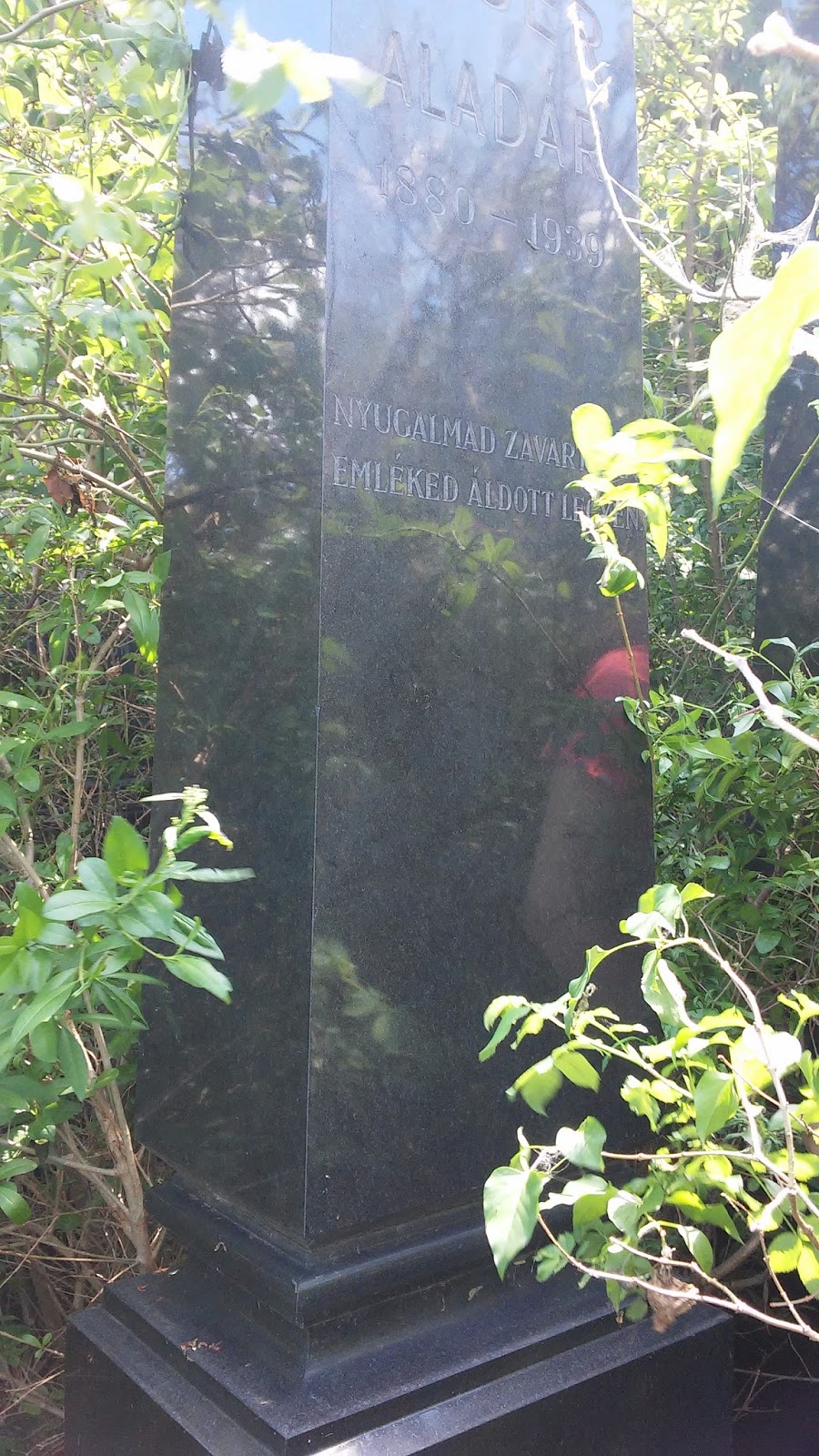
As we entered, we saw a monument in front of us with a list of local Holocaust victims. There was much vegetation on both sides but we could see a few tombstones. A very few. Linda and I split up and began looking for Bauer graves among the branches... and thorns... and trees... and the undergrowth that trapped our legs with every move. BEEG PROBLEMA.
 
It turns out most of the tombstones were behind the monument in the thickest part of the vegetation. Linda found what looked like a whole row - several in fact - of very nice legible tombstones, some of them Bauers, though not our three. She called me over and after getting to the first three or four, worked her way out and let me proceed. So long sunlight, hello forest cover.


I had small hedge clippers in my hand, my phone/camera in my one pocket and a plastic bag with my notebook, pen and glasses. It was very tough going but many of the stones were excellent. It was impossible to read the older ones, not necessarily because they were worn, but because I couldn't get at them properly. I decided to wear the glasses.
I pushed my way in deeper and deeper, cutting my arms on the thorns. (Yes, I was wearing a short-sleeved shirt!) At some point the plastic bag had enough and fell apart. The notebook, pen and my glasses case went into my pants pocket. Then I had enough and decided to try to work my way out, taking a slightly different route. My glasses case was no longer in my pocket. I was not going to try to retrace my steps to look for it. 

Eventually I was out. Without my notebook. the notebook with all the inscriptions that I had written down in Kalocsa. I went back in, this time trying to retrace my steps exactly. The broken vegetation showed the way somewhat. I fought my way out again and mentioned to Linda that the notebook was way more important than the glasses case I had lost. She asked if the glasses were inside and I said no they are ... here... on... my... OH NO! 
 
BEEG PROBLEMA!!

Back in once again, stepping very carefully so as not to crush my glasses by mistake.. After about ten minutes I found the case. The scratches on my arms really hurt. Stung mostly. There was blood on my scalp. Then I saw the glasses. they had fallen lenses up. I probably wouldn't have seen them any other way. After all, I wasn't - your know - wearing my glasses.

The whole adventure was about two and a half hours. Janos was very patient. Linda too. We hadn't found what we were looking for. But in the end, we hadn't lost anything either.

We all exited through the door. I gave Janos most of my remaining Hungarian money. He made a sound which meant either "thank you" or "cheap Americans!"
 
But this was not the mess that we had in Slovakian cemeteries or in the back of the cemetery in Budapest. The terrain is flat.The tombstones are by and large quite good.  And they are our family, hidden there under the jungle.

We just need some Agent Orange or a herd of goats. And someone to haul it all out. A few thousand dollars would probably do it. Once it is properly documented, maintenance would be optional. Maybe I should talk to someone in charge. If there is someone in charge.
 
Next stop Vienna. GPS said three and a half hours. GPS lied. I needed a shower and a change of clothes.

Tuesday, May 9, 2017

Zelig and Bluma - Days Six and Seven: Kalocsa

Linda and I arrived in Kalocsa early Sunday afternoon. We had been told that the old cemetery was unfenced and near the bus station and that the neolog cemtery was locked and we had an address. We wanted the old cemetery. I discussed our Sterns at some length here but a recap is in order. I have the 1862 marriage record for my great-great-grandparents, Fani (Feige) Stern and Simon (Shemaya) Bauer and it names her father Salamon Stern from Kalocsa. No mother's name.

There is a death for a Salamon Stern on 6 May 1862 but we are not sure it's the same man. Sure, the death record says he was born in Paks, not Kalocsa so there may not be multiple Sterns in town, but I was not prepared to
jump to that conclusion. Especially since there are no descendants named Salamon, or its Jewish equivalent Shelomo. Feige/Fani was twenty-one when she married and Kalocsa birth records are available only from 1851. There are births of two sons in 1851 and 1853 to Salamon Stern and his wife Betti Grunwald - but even if this is the same Salamon, who knows if this is the same mother.
The marriage in Kalosca on 29 January 1862, 19 Shevat 5612 of Simon son of Lasar Bauer, age 28, of Kunszentmiklos
and Fani daughter of Salomon Stern, age 21, of Kalosca. (Click to enlarge - it's the second  record on the page.)n
 
So I was fishing, playing "Let's see what happens."

After driving around a bit and finding nothing, we checked in at our hotel. It is small, simple, family-owned and run and inexpensive. And friendly. I'd recommend it to anyone looking for a hotel in the area. Linda went to talk to the owner about the cemeteries and his English-speaking son took her to both cemeteries and the synagogue.

The large sign below is outside the synagogue. There are names on both side, commemorating victims of the Holocaust and other Jewish "victims of Fascism."


The old cemetery is on the main street about five minutes' walk from the bus station. It is clearly visible from the street,.Notice, no fence or wall, but it appears to be in good condition.

I wanted to photograph all the stones, but first we went to look for Sterns, particularly Salamon, who is probably our third great-grandfather. It took about five minutes until Linda called me over to see it. At the far end of maybe the fourth row from the front, standing tall with Hebrew on the front and Hungarian on the back. That is the style of many of the Hungarian Jewish graves.
Linda took pictures of both sides, even before we started to clean it up. His secular name is Salamon, but his Jewish name is not Shelomo. His name is Zelig. As I wrote above, I was concerned because no descendant was named for him. In fact, we do have a Zelig - the elder son of my great-grandmother Regina Bauer, Sigmund Rosenzweig. Uncle Sig lived in Cleveland and died at age twenty-seven during the influenza epidemic in 1918. He left two children. My cousin Lee's middle name is Zelig in his memory.

In my mind, this removed any doubt that this Salamon is our third-great-grandfather. I also learned that his father, my fourth-great-grandfather, is Izak Leib.

The reverse side, in Hungarian, gives his yahrzeit as 16 Iyyar 5622, but this is incorrect. The yahrzeit on the Hebrew side is 6 Iyyar which corresponds to the death record (above). The stone also says he is fifty-six while the death record says fifty-seven. We shan't quibble.

Here is the full Hebrew inscription, with transation. His name "Zelig Stern" appears as an acrostic. The Stern tombstones that I saw later use the same style. (The word in red is not clear.)


We found one other Stern on Sunday - a woman named Bluma, Borbola as a secular name. I was too excited to deal with anything further, so I decided to work on the above inscription Sunday evening and then go back to photograph the cemetery, cleaning stones as necessary, early Monday morning.

Monday morning I was in the cemetery (myself) at twenty past six. After filling in some of the unclear words on Salamon's stone, I went to Borbola. After cleaning, I saw that she is identified as "wife of Zelig Stern." She died on the second of Shevat 5647, 27 January 1887. It doesn't say how old she was.

The wife of my third-great-grandfather without question. Probably my third-great-grandmother, but she could be a later wife. Is she also known as Betti Grunwald? I have to check the Kalocsa death records which I think I have at home.

Bluma's epitaph is in acrostic form and does not identify her parents or her maiden name.

I photographed the rest of the stones in the cemetery as best I could. I found two two other Sterns, both women and Stern is the maiden name for each.

One is Leah (Eleonora), married to Aharon Schiffer. She died at age seventy-six on 6 Nisan 5658 (1898). Her mother is Beila. She is buried next to her husband, both with acrostics.

The second is Mindel (Marie) Engel who died 6 December 1872 at age fifty-five. Her father is Shimon. I do not know who her husband is. Here too, the epitaph is an acrostic.

My Monday photographs are still in my phone and I may have more to say about them later.

Sunday, May 7, 2017

Mud and Monuments - Day Five: Budapest

There was not much kosher to eat during the four days in Zilina, so a decent restaurant was high on my to-do list for Thursday evening in Budapest. But first we had to get there. Linda
The corner of "our" street
arranged an Airbnb in the Jewish section of Budapest based on a recommendation from my cousins Maurene and Yehudah Miklaff, but the GPS had other ideas. It sent us to the same address in Budakesci. That put us into heavy afternoon traffic and we arrived an hour and a half late. And parking is a project.

We did visit a very nice restaurant right down the street from our apartment where Cyndi was able to have her vegetarian food while Linda and I split a platter-for-two of mixed meats and such. Nothing particularly Hungarian about it. (In fact there is a kosher Hungarian restaurant practically next door but we didn't find it until it was too late for our stay in town.)

Then Friday morning before services I visited the kosher mini-market around the corner from our apartment and picked up a few things for the remainder of our trip. I attended services at the local Chabad synagogue (as opposed to their "tourist" service held elsewhere) all
weekend. It used to serve the large Orthodox community before the Holocaust.


The Dohanyi Street Synagogue
Linda went on a Friday tour which included the Dohanyi Street Synagogue where our great-grandfather had been a member and where Cyndi's great-uncle had served as rabbi. The synagogue is neolog today as it was then.

In the meantime, Cyndi and I set off for the neolog Kozma Street Cemetery. She has great-grandparents and others there from both sides of her family. Our local help was not available nor was the last-minute alternate I contacted, so we were on our own.

Much of the very large cemetery (Cyndi says 200,000 burials) has paved roads so we could drive in. Even the non-paved area had tire tracks indicating that people drove on them as a matter of course.

In this cemetery, I have the paternal grandparents of my father's second cousin Shabtai, whom I have mentioned from time to time in the context of DNA matches. Shabtai's father Zsigmund (Yehoshua) Bauer is the brother of my great-grandmother Regina (Rivka) Bauer Rosenzweig. He died in 1938 so Shabtai would have known him as a small child. We did not expect to find new information on his grave, which is at the back of the cemetery.

Shabtai's grandmother is quite another matter. She died in 1928, before Shabtai was born, and he knows little about her except her name. He does not know her parents names, her age or her date of death (other than the year). What made this interesting to me is that her maiden name is Stern, which is also the maiden name of her mother-in-law. That raises the possibility that she is from the same Stern family, hence family of mine independent of her marriage.

Rozsi Stern Bauer's grave is at the back of the cemetery in section 40. It is badly overgrown. Trees, fallen branches, ivy everywhere. And mud. It had rained at nght and in the early morning, though the rain had stopped just before we set out from the apartment. It was quite a jungle. The cemetery is flat and arranged in rows, but not rows that you can just walk along. We were able to count out row twenty-six but we were not at all sure which end of the row was grave number one. Rozsi is number 49.

After an unsuccessful walk through the row, we came upon two women visiting the next section. They didn't speak English or Hebrew, but called for help in the form of Josef, a cemetery worker on a bicycle. We did our best to communicate with him and Cyndi showed him the grave location on her phone. He showed us the stone row markers which confirmed that we had the right row and together we cleaned off several graves searching for the right one.

And there it was. Under much ivy and underbrush. SHERL BOYER, died 13 Menahem Av 5688. Mother's name Mindel.

There was a second inscription below, in German, which began BAUER ZSIGMUNDNE, STERN ROZSI. Definitely Shabtai's grandmother. It included the date 29 July 1928 and once again said her mother was Mindel.

Zsignumdne means "wife of Zsigmund."

It also told us that she was fifty five years old.. No mention of her father. We cleaned it until we could read it and then Josef brought a large bottle of water and the dingy dark grey became almost white.

I sent the photos to Shabtai in Israel Friday afternoon and he responded after Shabbat. He is very pleased.

The bottom inscription after Josef's water treatment.
 We moved along to section 38 where we easily found Cyndi's maternal great-grandmother in the second row. The tombstone also mentions her husband who died later and their son. All this in German. She had seen this stone before after someone from Find-A-Grave send her a photograph. What she had not seen before was the other side of the stone.


Chava bat Rivka, names that Cyndi had not known before. Chava is Cyndi's mother's name.

Then it got interesting. Zsigmund Bauer, Shabtai's grandfather was way back in row sixty-two of section 38C. Grave 19. The entire area was very dense with vegetation. A veritable jungle. And mud. (By this time, we were both pretty muddy ourselves.)


I decided to drive in, looking for row sixty-two. Cyndi thought that was a bad idea, but I was confident. The row markers were missing.


We realized this was not going to work. I tried to turn around and the tires just spun. We tried backwards and forwards. We put sticks under the tires. Cyndi took the wheel and I tried to push. We were at the very back of the cemetery. It was after eleven o'clock. On a Friday. With no language skills.

We walked back to the beginning of the section and saw some other visitors in a car. They ignored us and drove away. We found a cemetery worker who came back to the car with me while Cyndi went off to look for her other great-grandfather.

Back at the car, nothing we tried worked. The man from the cemetery is built like an NFL guard, but his pushing got us nowhere. He phoned another man who came out with a van to use as a tow. Even then it took more than a few minutes, but eventually the car broke free and I backed out some fifty-sixty rows.

I gave each of them a twenty dollar bill. Cyndi thought that was too much but I figured it was worth much more than that to me. This could have been a serious disaster. Often G-d is way better to me than I deserve.

Sunday Linda and I say goodbye to Cyndi as we head south and she stays a few more days in Budapest.

Friday, May 5, 2017

Tattered and Torn - Days Three & Four : Rajec, Domaniza and the Bytca Archives

Rajec
Wednesday we were on our own. First stop Rajec (pronounced Ra-yetz), about ten miles from Zilina. Not only were we on our own but we had no contact information for the person with the key. We did, however, have the precise location of the cemetery so off we went, hoping to find some Rosenzweigs and who knows what else.


We were able to identify the cemetery from the road with no trouble. The door was locked and it was surrounded by a wall on three sides and a chain-linked fence topped with barbed wire at the top end.

Standing on a tree stump, I was able to see over the wall in a few places.

The cemetery seems to be in excellent condition and many tombstones appear, at a distance, to be legible. But we coudn't get inside.

In a group project of this sort, each person brings certain strengths. I am the one who reads Hebrew. Cyndi will pick a conversation with anyone, even though all she speaks is English. Linda? Linda is tall and climbs over walls.

And off she went, the non-genealogist, photographing all the graves in the cemetery from top to bottom.


There were probably eight or ten Rosenzweigs, three of them Jakob. A few others I don't recognize off hand. The non-matching Jewish and secular names doesn't help.

There is a Rozalie (Rachel) Rosenzweig who died in the summer of 1926. She could be my great-grandfather's sister-in-law, but her grave calls her the wife of Yaakov, while my g-gf's brother was Simon. He still may be the same person. The staones are very hard to read and I'll have to work on them later.

Dominiza
Next stop was Dominiza, a very small town not far away. That is where my great-grandfather was actually born in 1858. It was closer to the dusty village image I had from east Galicia, but even it showed some modernity.

Cyndi's directions sent us up to an empty field behind a row of houses - obviously the wrong place. So we followed Plan B, find city hall and ask.

Finding city hall was itself a project and we asked asked a woman named Melania for directions. She is a chemist in a lab in Povazska Bystrica and her English was quite good. She got into our car with her six year old Matthew and took us to city hall where we found someone who said she would search her records for Rosenzweigs and get back to me by email.

Our friends Josef, Melania and Matthew
Then Melania found us a local historian named Josef, who speaks no English, but eventually he found us the remnants of the Jewish cemetery fenced in the back yard of locked house. On the way up, Josef told us that there were basically three Jewish families in town - the Rosenzweigs, the Zelinkas and the Spitzers. As we know, they married each other. As one might expect.

We got a look through the fence by going through the field where our search had started. The cemetery is right behind where the synagogue once stood and has very few stones. But the one we could see was Joseph Spitzer, the husband of Nathan Zelinka's daughter Jeanette, whose grave we had seen Monday in Kotesova.

Josef said he would contact Pavel Frankel in Zilina about fixing it up and would try to get in and send us some photographs.
The house on the site of the synagogue, perhaps where
my great-grandfather and his brothers were circumsized.
Every person we met in Slovakia was helpful and friendly. More of both than we had any right to expect. As we prepared to wrap up that phase of our trip, we could only speak well of our Slovakian experience.

We were tattered and torn not so much physically (though I must replace my shoes when I get home), but by the experience of seeing these places where the various branches of our families lived for generations.

The Bytca Archives
We had one more stop Thursday morning, at the state archives in Bytca. It was across the street from the synagogue, which is undergoing some sort of renovation, or at least fund raising for that renovation.
The archives are upstairs in a grand old courtyard that one could easily mistake for abandoned. Here again, a nice local woman led us to the place after we passed it by a couple of times.
When we went in, we found a working archives with a few microfilm machines, some functioning. A couple of genealogists from Hungary were working with the actual documents, bare-handed. There were a few other researchers there as well. It was all in one small room, with the microfilms stored in other rooms.
We spoke with one of the Hungarian genealogists and their translator Stephan, learning that they had done the genealogy work for former French president Sarkozy. We exchanged contact information and Cyndi will probably follow up with Stephan later on.

Cyndi worked her magic with the archivist and she permitted us to photograph their paper index showing all their microfilm holdings. We will make a list of the Jewish records and perhaps put together a funding project to get them transcribed. As we left, I thought about Marla and Jay Osborne who actually live in places like this in order to get the work done.

Next stop Budapest.

Thursday, May 4, 2017

Slipping and Sliding - Day Two: Povazska Bystrica & Puchov

Actually we started our day in Zilina. Our Airbnb landlord Marek, not Jewish, is doing the restoration of the Zilina synagogue and we had a tour of the ongoing work.

Marek talks of being finished in two weeks.

The synagogue was built in 1931, so it did not fulfill its intended function for very long.  There are no photographs or drawings of the Ark, so they are only guessing on that.
Of course it is not intended as a house of prayer now either, but at least it has returned to the hands of the Jewish community after decades in the possession of the Communists and later the university. Its most recont use was as a movie theater.

Povazska Bystrica
My previous visit to ancestral towns in Europe was seventeen years ago in east Galicia and I had this picture in my head of dusty, dreary towns that looked like something out of the past. I knew in my mind that Slovakia is more modern, but had no idea how much so. (Said the fellow who hasn't had Internet for the past two days.) Povazska Bystrica is a modern city of some fifty thousand souls. I knew it by its Hungarian name Vag Besztercze which no one there seems to know now at all.

My (and Linda's) great-grandfather's parents are buried there - she died in 1905 and he in 1917. We do not have grave locations but it turns out that this would have been meaningless.

We met Peter Simecek, a local genealogist (non-Jewish) who had offered to help us out. He took us to the cemetery. It's on a hill, not as big a mess as Kotesova, but no simple visit. Oh and did I mentioned that it had rained all morning and that it was cold? Lots of mud, slipping and sliding.

Linda, Cyndi and I all took spills just getting into the cemetery. Oh and did I mention that the gate was locked so we had to take an alternate route?

As expected, there are stones in good condition and others which were not legible. Most of the tombstones are on pedestals and many had fallen face down or had been stolen.

These are some of the better ones


There are quite a few Politzers, a name of interest since our meeting with Cousin Lydia the previous evening. (It may be the maiden name of our third-great-grandmother.)

As the previous day, I spent quite a bit of time on the ground, this time in the mud.

The biggest find was Nathan Zelinka, the brother of my great-great-grandmother. (Remember, it is her grave and her husband's that we really wanted to find.) Nathan Zelinka was a major community figure in Zilina, but is not buried there. So here he is fifteen miles away.

Nathan was born about 1821 - based on census records - and had eleven children with his wife Hani Kohn who died in 1882. (We do not know where her grave is.) A few months later he married Mari Milch, who was fifty years old and likely married before.

Nathan's daughter Jeanette (Scheindel) Spitzer was one of the graves we had seen in Kotesova the previous day.

Nathan's stone had toppled over at an angle, but it is face up and very clear, in Hebrew. The pedestal has some German writing which gives his date of death (April 11, 1896) and age (76).
The letters of Nahum appear in the line begining "Your life" and Zelinka follows as an acrostic.
Nathan's father's name does not appear anywhere, but this is obviously our uncle.

What interested me were the two graves to the left. The three are clearly together - a family group. The stones had fallen face down, but the one on the far left had an inscription on the large pedestal telling us that he was a man who lived to age ninety-two. Who is he and who is the one in the middle, with the smaller pedestal? Maybe Nathan's first wife Hani, but that emphasizes the question "who is the man?"

The two stones are face down and likely well preserved but we obviously were not going to lift or turn them.

Mali (Miriam) Zelinka Rosenzweig, Nathan's sister is buried somewhere in this cemetery. My  great-great-grandmother. Almost certainly her husband Ignacz (Yitzhak Yehudah) Rosenzweig is as well. Perhaps she is next to her brother who had died less than nine years previous? Were they close, other than being adjacent in age order? Who knows!

Yitzhak Yehudah Rosenzweig did not die at age ninety-two. Nana always said he was ninety-six, which is why we "know" he died in 1917. Might the stone be in error? One son was in Pittsburgh, another had predeceased him. At least one of the other two was elsewhere, probably Budapest.

I want those stones turned over. I asked Peter if we could hire someone local to do that or perhaps we could get Pavel Frankl in Zilina to find someone to do this. After all, Nathan himself is an important Zilina personality.

I left stones on the three graves. Stones that I had brought from Jerusalem.

Puchov
I had a general interest in Puchov, a town of maybe 20,000 people. According to the census, my third-great-grandfather Simon (Shimshon) Rosenzweig had been born there. I figured it was worth a walk-around even though I had no specific expectations.

Peter took us there and left us in the hands of Michael, whose late father had been in charge of cemetery upkeep.
The cemetery is clean and mostly at the top of a hill. It's generally what we would call "good condition" but again, no so much the tombstones.

The surprise here was that we found some of Cyndi's Deutelbaums. There was a couple whom she knew from the records and an adult daughter who predeceased the mother.

Clearly most Jewish of the families were represented in most of the towns in the area. 

Next up, Rajec and Domaniza.