Sunday, June 1, 2014

Your Mother Went By Salomea?

No, not my mother. Joe's mother. He is where this story kicks off.

Joe's article appeared in the issue of The Galizianer (the quarterly publication of Gesher Galicia) that came out a few days ago. He gave his kind permission to reproduce it here.
The article was originally published in the Winter 2013-2014 issue of L'dor V'dor, the quarterly newsletter of the Jewish Genealogy Society of Maryland and they too have given their permission.

From my side, the story began when the International Tracing Service (ITS) index became fully available at Yad Vashem. My first look was in March 2008 and I found this. (I redacted the address.) 

Josef Nathanson of Baltimore had inquired in 1994 about Yetta Pickholz Schaffer of Lwow, born 1880, which may or may not be a precise year. He also inquired about her son and three daughters. As I have mentioned here on other occasions, east Galician families came to Lwow from all over, so there was no telling if this Yetta was from the Rozdol families or the Skalat families. I had no Yetta or Etta or similar born around that time, so I had no idea who this might be.


I wrote to Mr Nathanson at the address listed on the cards and we had quite a flurry of correspondence over several weeks. I had not yet begun my subscription to ancestry.com and my friend Renee Steinig found the passenger list with the name Salomea. But I still could not identify Yetta, so I could not place the Schaffers into the Pikholz family structure.

Joe had a precise date of birth for his mother, but despite my inquiries, we could not get the record from AGAD.  So there we sat for two years.

In 2010, AGAD received a few more years of records from the Civil Records Office in Warsaw, but there was a lot to be done before they would allow them to be indexed. I paid someone in  Warsaw to do an unofficial search, from which he could give me only extracts.

The search results included two daughters and a son of Yetta and the extract identified the mother as "Jenta Pikholz, c. Salomon Striks i Szejndel Pesel Pikholz." Jenta, not Yetta. And parents we knew. In fact, we had Jenta's 1883 birth record.
Scheindel Pescha's grave - Vienna. Joe's great-grandmother.
Scheindel Pescha was the daughter of David Pikholz and his wife Szerke Kawa. She was born 1846, probably in Rozdol, and died in Vienna in 1925. David and Szerka had four sons that we know of and are in touch with a number of descendants. This is the family I call IF4.
    
One of at least ten ITS cards for Friedrich
Scheindel Pescha was married to Salomon Strix or Strycks or some similar spelling. It varied from document to document. They had five children before Jenta, apparently four who went by some form of Stryks and Mordecai, who was Pickholz. Mordecai had four sons in Vienna, with the wonderfully Viennese names Siegfried, Friedrich, Ernst and Otto. Their Jewish names: Shelomo, Gabriel, David and Avraham. They died in London, Dachau, Haifa and Buenos Aires and I am in contact with children of Ernst and Otto.

Otto's daughter gave me some bits of information on the Stryks cousins, but I was never able to make contact with them.

Oh, and eventually we found Salomea's birth record. She was born ten days earlier than what the family had "known."

Now if we could only get some DNA out of these folks...

Housekeeping notes
I have an article of my own scheduled for the next issue of The Galizianer.

The practical genetics course I am taking next month at GRIPitt carries with it a discount coupon for Family Tree DNA tests for my project members. Thus far three new signups and at least two working on it. Thank you GRIPitt and FTDNA!

Friday, I visited Hevron with my son Devir and my cousin Ari. We photographed twenty-two graves that were not there on my last visit nearly two years ago. (I really must get back to going more often.)  There is an entirely new section with four graves, next to the section with the old rabbinic graves. You can see my Hevron site here. I should have it fully updated in the next day or two.

Sunday, May 25, 2014

Leading into the month of Sivan

  • Wednesday we celebrate the reunification of Jerusalem, forty-seven years ago.

  • Thursday we say the Shelah's prayer for the spiritual and physical welfare of our children and grandchildren.

  • Friday we bring in the month of Sivan. I shall be in Hevron.

Something about each.

The reunification of Jerusalem - 28 Iyyar
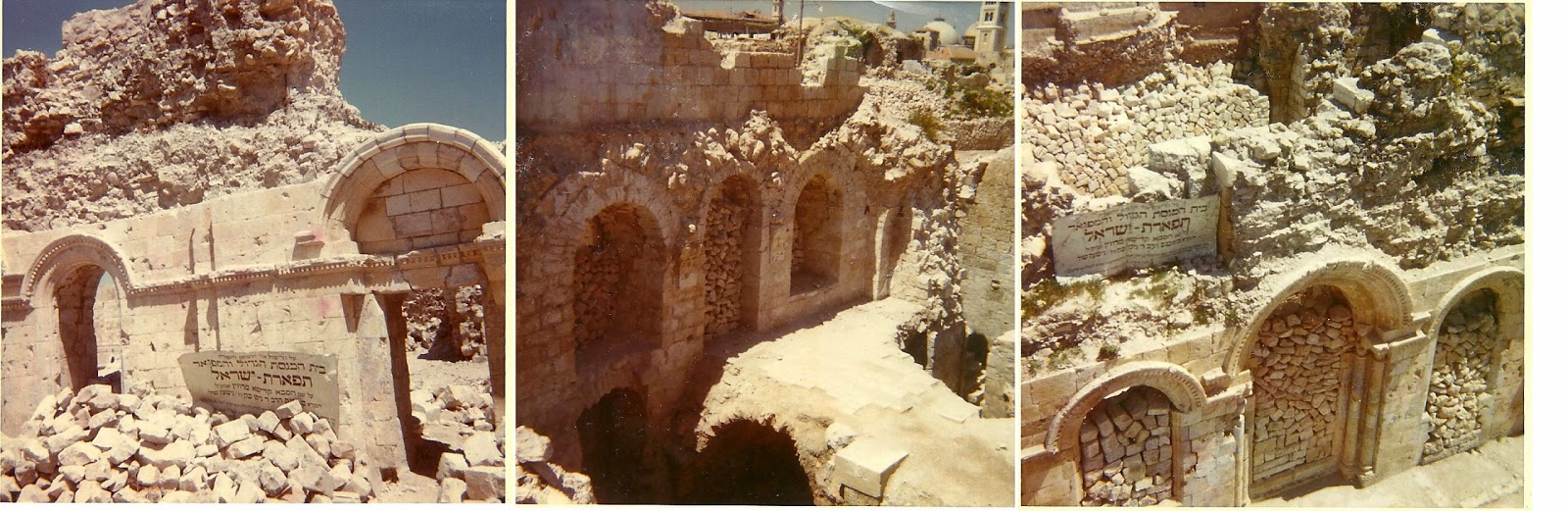
During the lifetimes of many of us, we were blessed to see the reunification of Jerusalem. During the nineteen year occupation of the Old City, the Mount of Olives and other significant places of Jewish heritage, the Jordanian Arabs destroyed synagogues, other buildings and grave sites, in addition to preventing Jews from approaching these places. (My apologies for the quality of these photos, particularly the ink that bled through.)


And the Kotel Plaza was not the great open space we recognize from the last forty-five years.  There was work to be done.


The archealogy on the southern end of the Temple Mount didn't appear ex-nihilo either.


There were the places where residents of the Old City has been murdered and buried in mass graves - in what was then and is now "the Jewish Quarter." As though there can be any other quarter.

 I have been using the word "reunification," not "liberation," for as long as we cannot go up to the Temple Mount, neither it nor we are liberated.

Above the Kotel on the right, the Chief Rabbinate says that it is forbidden to tread on the holy ground, even in the areas that clearly should not be forbidden. (We are reminded from time to time why the Law of Unintended Consequences is sometimes a good thing.)


But back then, we could get close enough to take pictures through windows that open onto the Temple Mount itself.


Whenever I took people into the Old City back then, we would stop and see how it had looked before the Six Day War. We could not get a better view than this.


A word about united Jerusalem vs what they write in the papers. We waited Thursday night at a stoplight up near French Hill. On the island waiting for the light to change, there were two hareidi boys, maybe ten years old, with their backpacks, no doubt on the way home from school. On the same island were three Arab men, forty-ish, probably also on their way home. Sharing the same small traffic island. No one thought a thing of it.

I heard a long interview last week with Steven Pressfield on his new book The Lion's Gate, about the Six Day War, with a great deal about the reunification of Jerusalem. Some lucky family member is going to get a copy from me.

I have written here and here about two non-family members who were buried on the Mount of Olives and whose graves were desecrated during the Jordanian occupation.

We also have a family member buried there - but not from that period. My wife's second cousin Sheila (Sarah Fruma) Goldson Weiner, born in Cincinnati, made aliyah with her husband and four children, had a fifth here in Jerusalem and died on Yom Yerushalayim thirty-four years ago. She was forty-one. I have lost count of her grandchildren, but there have been over thirty for some time. (Her husband is from Memphis and is related to a third cousin of mine who, last I knew, lived in Tuscaloosa.)

We pray for our children - 29 Iyyar
Rabbi Yeshayahu HaLevi Horowitz, born 1558 in Prague, served as a rabbi in a number of communities in Europe, eventually returning to Prague. After his wife died in 1620, he made aliyah to Jerusalem, where he wrote his seminal work "Shnei Luhot HaBerit" and he became known as the Shelah, the acronym of his book. This particular work - which was meant as instructions to his children - was published by his son some years after his 1630 death. The Shelah left Jerusalem after he and other community leaders were jailed for ransom, and lived in Zefat befiore moving to Teverya, where he died. He is buried in the same compound as the Rambam.

His prayer, which he instructed should be said on 29 Iyyar, the day before the beginning of Sivan, the month we receive the Torah, can be found (with translation) here.

Rosh Hodesh Sivan
We have three Pikholz yahrzeits on the first of Sivan, all buried here in Israel. Two are in Holon - one from Skalat and one, a Pikholz spouse, from Rozdol and this one on the right who lived in Efrat and is buried in Kefar Etzion.

I discussed Hevron here a couple of years ago, including its capture in the Six Day War by the Chief IDF Chaplain, Rav Shlomo Goren.

For a few years, before we moved to Jerusalem, Devir and I used to go to Hevron for a sunrise minyan every time Rosh Hodesh would fall on a Friday. Then for awhile we went every Rosh Hodesh.

Devir has been after me to go, as we have not been there is quite awhile and we plan to do so this week.

It will give me an opportunity to update my Hevron Cemetery website..

Houskeeping notes
The panel discussion I am participating in at the Conference in Salt Lake City has been moved to Monday at 4:45 PM.

My own talk is at 9 AM Wednesday and I have just learned that I have been assigned a room with a seating capacity of 480. Methinks someone is being optimistic. My good friend Renee Steinig has agreed to introduce me, as she did three years ago in Washington DC.

The Conference website has a link for a live stream of "Over 50 of the best conference programs," but they haven't announce which those would be. I don't know if being assigned a room for 480 people qualifies as "of the best." We'll find out. Registration for this is $149.

Sunday, May 18, 2014

Uncle Jachiel Had Three Children

My father did not know much about the family history, but he did pass on two tidbits that no one I
Unsigned undated note, written late 1973 or early 1974
spoke to later had ever heard. He told me that his grandfather Hersch Pickholtz, who died when my father was eight years old, had an uncle Selig Pikholz whom I discussed here about thirteen months ago.

And he told me that his grandfather Hersch Pickholtz had a brother Jachiel, who had three children and that his family "never left Europe."

I have no idea why my father knew of these uncles.

My great-grandfather Hersch Pickholz arrived in Baltimore in 1903 and travelled to Pittsburgh, where he added the "t" to his surname.  His older sister Leah Braun and her family had been in Pittsburgh since the mid-1880s. Another sister Bessie was married to David Lozel Frankel and they too lived in the US with the surname Franzos and later some became Francis. According to the 1910 census, Bessie and her husband arrived in 1890.

Based on my father's information, I recorded the brother Jachiel with a wife and three children, in addition to Hersch and the two sisters. I could only guess where Jachiel fit in age order.

It appeared that the four children were born in Podkamen, where we have no records, and Bessie was sent back to Skalat to be married. We knew that Hersch lived in Zalosce, near Podkamen, and when JRI-Poland received access to Zalosce records (births 1877-1890, deaths 1823-66, 1877-97) we saw that Jachiel lived there as well. We see no births for Leah's three children, so they may have lived in Podkamen.

We located a death record for eighteen year old Wolf Pickholz, who died 6 April 1892, identified as the son of Jachiel and Sime. So Wolf would have been born 1873-74. I assume that he is one of the three children of Jachiel whom my father had mentioned, though it is possible that because he died young, he was not included in this count.

I saw no other births or deaths for children of Jachiel, so I assumed that the other children were either born before 1877 or elsewhere - Podkamen, for instance.

JRI-Poland also had a death record for Sime, 6 December 1894, at age forty-six. If she was born in 1848, Jachiel was likely the eldest sibling.

I moved the record next to the headings for clarity. Columns 3 & 4 are missing in the archives' scan.


In column 5, you can see her name on the first two lines. The last four lines tell us that she is the daughter of Aron and Ester Schapira of Skalat. The third line begins with "Ehegat" which Vienna-born Henry Wellisch tells me is an abbreviation for Ehegattin which means "married wife" and that is followed by the name of her husband Jachiel Pickholz. If Jachiel had predeceased her, we would expect the record to say "wdowa" (widow in Polish) or the German equivalent.

On the other hand, there are three choices in column 8 - single, married and widowed - and it's the third box which is checked. So we have conflicting information on this record, but it is more likely that she was a widow.

Then about sixteen months ago, I received an email from Pamela Weisberger asking me this:
Do you know this Pickholz from Zalosce?  Card File of Landowners 1880 in
Lviv archive:  #168/1/2081
Zalosce Card#  29 House # 31 Pickholz Jachil heirs Residential Parcel #95
This card was discovered by Natalie Dunai. I do not have a copy of the card itself, just the transcription.

The card refers to house 31, which we see is where Sime died. Jachiel's son Wolf had also died in house 31. The property was owned in 1880 by Jachiel's heirs, so he must have been dead by then but perhaps not long as the owners were not named.

In any event, it seems clear that Jachiel died before 1880 and the fact that his sister Bessie had a son named Jachiel in 1878 probably means he was dead by then. So he seems to have been in his thirties.

There was nothing else in the Zalosce records telling us anything about Jachiel's other children.

But something else had turned up between finding Sime's death record and Natalie's discovery.

I moved the record next to the headings for convenience.


On 16 December 1899, Jechiel Jakob was born in Loszniow to Arja Meier Tunis and his wife Sara, the daughter of Jechiel and Syma Pikholz of Zalosce. Loszniow is near Trembowla.

Child number two, Sara.

Jechiel Jakob died in 1900 and a daughter Syma Ester who was born in January 1901 died a few months before her second birthday. Another son Moses was born in February 1907 and died later that month.

Two other sons lived to adulthood. Chaim Benzion was born 27 October 1902 and Layzor Izak was born 2 May 1904. My grandfather's first cousins.

The marriage of Arie Meier Tunis and Sara Pikholz was recorded in Trembowla 25 June 1918. It  gives Sara's date of birth as 15 July 1876.

I found Pages of Testimony at Yad Vashem for both sons. One set was submitted by Stanislav Domnovsky of Tel Aviv in 1957. He wrote that he was a "relative." Stanislav died in 1976 and is buried in Kiryat Shaul. I have not followed up who this might be, but he is on my cemetery list for next month.

Stanislav calls Layzor Izak "Leopold" and he was a lawyer, married to Ada Weinberg. Chaim Benzion he calls "Chaim Karol." He was a physician and was killed in Lwow. Stanislav says his wife is Anna Kahane and that they had a four year old son George.

I found this in early 2005. That matters.

At the same time, I found three Pages submitted by Anna Weinfeld of Rehovoth in 1999. One Page was for "Leopold (Layzor)," an attorney, married to Ada Weinber. They had two children, whose names are not mentioned. Children of my father's second cousin. She writes of Leopold "Shot in a group of professionals in Lwow." Her relationship - SISTER-IN-LAW.

Another Page was for "Chaim (Mondek)," a physician with one child. She writes that he served in the Polish army and was taken to the camp Pelashov, near Krakow and that he was "shot to death in the back by a Ukrainian policeman." Her relationship - WIFE!

The third Page was for six year old "Jerzy (Jurek)," born March 1937. This must be Stanislav's George. He was hidden as a Gentile.  She writes further, "He was placed with a Gentile woman and after neighbors told the authorities, he was taken to Skalat  and executed." Six years old. That was July 1943. Relationship - MOTHER!.

I have written before that timing is everything.  Here too. I found these Pages in May 2005. Anna Kahane Tunis Polsiak Weinfeld died in Rehovoth in November 2004.

I should really get to her grave as well.

I spoke with Anna's daughter (from a later marriage) who sent me to a woman named Marta (83 at the time) who knew Leopold and Mondek. She was able to tell me that Leopold had a son living in Wroclaw. I had someone in Poland check and we learned that my third cousin Stanislaw Tunis died in Wroclaw the previous year. I don't yet know if he had children, but I have someone on it.

Anna also submitted a Page of Testimony for Arie Meier Tunis. I assume that Sara died before the Holocaust.

Uncle Jachiel had three children - Wolf born 1873-4, Sara born July 1876. There is another one out there somewhere. Probably born in the early 1870s. My grandfather's first cousin.

Sunday, May 11, 2014

Dear Cousin Ethel, I've been working on what you wanted.

11th of Iyyar 5774             

Dear Cousin Ethel,

I am still waiting for confirmation, but I am pretty sure I have done at least some of what you asked. A bit later than I'd have hoped, considering that I have been saying kaddish for you for the last six months. But nonetheless.

This is what we knew until recently of our Rosenbloom family.


Here is a chart showing the five children of your grandparents (they are in red), the two children that your grandfather had with his second wife and, over on the far right, the two children that the second wife had with her first husband. (I learned the names Abraham and Bela Resnikov a few years ago. And of course, no one knows what became of Jack Bandis - just that your father had some contact with him early on in the US.)

Alta Kaplan and her four children
For convenience, I marked in green the ones who went to America. And on the left, I put the four children of the older sister Alta Kaplan. All we know about them is that Jakov and one other son each had a daughter before Stalin cut off communication.

There is one other person unaccounted for in that generation, which would be the half-sister Mera (your father always said "Mary")  who was a physician in Moscow. The half-brother Moshe Herschel was killed just after the end of WWI and your brother Maurice is named for him.

Those old Yiddish letters that you gave me years ago include one from Mera dated 13 October 1929, asking your father to send her one of those new devices with tubes you put in your ears, to help hear a person breathing. She wrote her mailing address in Cyrillic at the end of the letter, so we know where she was living in Moscow in 1929. She signed her name "M. D. Goldina." That is the only thing we have telling us her married name. By the time we spoke to your father, he did not remember the name "Goldin."

Top: Shayna Liba & Hymen
Bottom: Mera & Moshe Herschel
I made some unsuccessful attempts over the years to try to find Dr. Mera Goldina, but did not have anything to show for it. I figured that perhaps a medical association might have something, but nothing came of those efforts. I posted on discussion groups from time to time, but mostly moved on to other things.

My friend Logan Kleinwaks has a site where he posts all kinds of eastern European directories, searchable by OCR (that's optical character recognition, a way to search the printed page), and recently he's put up Moscow directories for the 1930s, so I decided to have a look. First I wanted to make sure I had the Cyrillic correct, so I posted the name and address on Schelly Talalai Dardashti's Tracing The Tribe discussion group on Facebook, asking for help from Russian speakers. One thing led to another and Luba Tabolova (a native Russian speaker living in the US) mentioned the "D." as a patronymic.

As you may know, Russians use the father's name as the basis for a middle name. I realized that she must have been using her father's second name David rather than Israel or Srul - perhaps because it sounded less obviously Jewish.

So, thinking that Mera might have remained in Moscow, Luba did a cemetery search for "Mera Davidovna Goldina" and she found a grave in the Malakhovskoye Cemetery in Moscow with precisely that name and the years 1903-1990. That means she died five years after your father. But is it the right person?

The same tombstone named Max Yankelovich Goldin 1905-1979, presumably her husband. We had never seen her husband's name before.

This discovery came to us the day after the yahrzeit of your grandmother and namesake, just a couple of days after your own birthday and the week before the yahrzeit of my grandmother, your Aunt Sarah.

I have no idea how long this photograph has been available online. Perhaps recently or perhaps from the time that you could have actually seen it.

We are still trying to figure out how to confirm that this is your father's half-sister. Luba is trying to get additional information from the cemetery.  She also found a phone number for a Felix Goldin whose father is Max who is about eighty years old. Problem is, the phone number is not valid. but we are working on it.

We'd like to see Felix confirm that
a) he is the son of the couple in the cemetery
b) the Mera Goldin in the cemetery is indeed "ours"
c) perhaps that he knows something about the Kaplans.
But we couldn't make contact. Then last week, I checked my new Family Finder DNA matches and found this:
David Goldin. A second-to-fourth cousin. David as in Israel David, Mera's father? If he is Mera's grandson, he would be my half-second cousin. Is this perfect or what? I emailed him.
Dear Sir,

I see that we have a close DNA match - second-fourth cousin.

My grandmother had a half-sister named Mera Goldin who was a physician
in Moscow. Our last conatct with her was in 1929.

Is it possible after all these years that this is your family? If so please tell me
where you are and how and when I can reach you by phone.

Israel David Pickholtz
Jerusalem
A day later, I received a note from a man in Massachusetts, a nephew of David Goldin. David tested at his request but asked that he not have to deal with inquiries such as mine. He didn't say how old David is, but David's father (1910-1983) was born in Greenport NY and lived his whole life there. David's grandfather went to the US from Poland. So David is clearly neither a son of grandson of our Mera.

The nephew gave me David mother's and grandmothers' maiden names and they don't mean anything to me.

Still, the DNA says that David Goldin is a second-third cousin, so the nephew will give me some additional information on those lines.

No one on my mother's side has done DNA testing, so I cannot see if he matches that side.

Luba will continue trying to get information from the cemetery and to make contact with Felix, so I am still hoping we have Mera's grave, even if we don't have any descendants yet.

I'll let you know when we know more.

Israel P.                             

PS - Funny thing. I was speaking to Beverly on the phone and I told her that I thought I had found the missing sister, the doctor. Her first reaction was "Aunt Ethel would be really happy."


Sunday, May 4, 2014

A Party on Chromosome 6

A couple of weeks ago, I received an email from Dr. Steven Turner in the United States telling me that he had some DNA matches with a number of people in our DNA project. At first, he thought he matched eight Pikholz descendants.  I gave him my standard response about our project's being about how to connect our own families with one another, not so much about connecting with non-Pikholz from the pre-surname period two hundred-odd years ago. And I told him that if he matches more than half of our twenty-seven Pikholz testees, we could talk.
That twenty-seven is a new number. We just received results for my double second
cousin, Lee. Our grandfathers are brothers and our grandmothers are sisters. .I really wanted his mother to test, but it didn't work out. Lee ought to match the other Pikholz very much as I do, but that is not the case at all.

I have thirteen matches within the Pikholz group and Lee has eighteen. In additioon, we have a documented fifth cousin named Cyndi on our grandmothers' side, whom I match accordingly. But Lee matches her much closer - probably due to something on his father's side. I have not gone back to check how Lee matches with the non-Pikholz I have discussed here earlier, but for the newest ones, his place in the DNA analysis is prominent.

Yet another reason that we should test as many people as we can and not just say "Well, my third cousin already tested."
So Steve Turner had a closer look via the ancestral surname window on FTDNA and it turns out


he is a match for fifteen Pikholz descendants. That put him across my threshold of 50% and I had a closer look.

He also matches both my Kwoczka cousins, descendants of the brothers of my great-grandmother. In fact, one of those, Pinchas, is better than all of Steve's Pikholz matches but one.

He joined our surname project at FTDNA, making it easier for me to examine his data. He added his mother to the project as well. She matches fourteen Pikholz, and not all the same as Steve. So clearly he has matches with us both on his mother's side and on his father's side.  (Steve's father's family is from Rohatyn, which is between Rozdol and Skalat, so there is some geographic logic to that.)

So I ran Steve's results on a chromosome browser against all his Pikholz matches, as well as his matches within the non-Pikholz who match most of us. There were a number of very interesting matches, but the match on chromosome #6 was remarkable.

Look at his matches with our group on chromosome #6 between the two vertical red lines on the left. He matches nine Pikholz (the ones whose names are underlined in red) and twelve non-Pikholz. He also has four significant matches towards the center of the chromosome, between the blue vertical lines. Now I have to figure out how to do more with those twenty-one matches on the left.

Well, the one thing I know how to do is to look at those same twenty-one people against Steve's mother. Some of them do not match at all and I omitted them from the comparison below.


The whole group on the left has all but disappeared. Those twenty-one matches of Steve's do not come from his mother. But the large matches towards the center, with Terry and Herb, together with the smaller match with Vladimir, are still there, so those must be matches on Steve's mother's side. Plus a match with Pinchas in the same place, that Steve didn't have.

But aside from the DNA party on chromosome #6, there were a number of other interesting areas. I present here, in table form a number of areas in chromosome #10 and one in chromosome #15. The column headings are: name of the person who matches Steve, chromosome number, spot where the match begins, spot where the match ends, "length" of the match in centiMorgans and number of matching SNPs.


On chromosome #10 on the left, there are six areas with interesting matches, some of which are known close relatives (Marla and Hartley in the third and fourth segments are siblings as are Douglas and Pamela in the fifth), but in general, most are people whom we do not know to be related either to us or to each other. But obviously they are. Probably in the 1700s.

The experts tell us to ignore the small matches, the ones with fewer than four or five or eight centiMorgans (depends which expert you ask). The small segments are supposed Identical By State (IBS) which means they are just left over from some really ancient ancestor and not significant for us today. The larger more interesting matches are said to be Identical By Descent (IBD) which means they match because of some relatively recent, theoretically knowable, mutual ancestor.

But look at the matches on chromosome #15 in green, above. (Or below or wherever Blogger has decided to put them today.) These are all very small matches and nine of the eleven are perfect matches. None of the eleven are as close to one another as second cousins. So I take issue with the IBS/IBD distinction especially when a large group share that small match. I mean, it had to come from somewhere, no? And if it were ancient, would it really have preserved itself in so many distantly related descendants - known to be related by other parts of their DNA?

I really have to learn more about this analysis business. Eleven weeks until the course at GRIPitt.

Sunday, April 27, 2014

Perfect Timing

One of the lessons of the Kling family story was that sometimes it's all about timing. Here's another one along those lines.

In the course of my single-surname research on the Pikholz families, I have found old records of several families which don't go beyond AGAD birth records from the late 1800s. One such couple is Feige-Minke Pikholz and Moses Hubel, who had five children, during the period 1877-97. I also have a record for one granddaughter, born 1903. This family has been sitting undisturbed on my website, for several years, waiting for someone to stumble across it..

One evening, I received an email from a woman in Paris, telling me that her grandfather Israel Leib was the son of this couple. (He is one of the five that I have.) We had a couple of tentative email exchanges, and Tuesday evening she mentioned that two of her fathers' brothers - Munio and David - had come to Israel. I found David's 1993 grave easily enough and then searched for Munio in the usual ways. 

I was messing around on Google and up came a five-day old blog entry from a fellow named Dor, who said that Munio was his great-grandfather. I traced Dor (who has a very common surname and whose blog had no contact information that I could find) and several; days later spoke with him and his mother. The family was sitting shiva for the grandmother - Munio's daughter-in-law - but were very pleased to speak with me.

Turns out that Dor was thirteen years old and made the blog as part of a roots assignment for school. I sent him AGAD documents that gave him four more generations and a memorial scroll from Stryj which named a number of Munio's sisters and cousins. Then I went to the National Archives and ordered Munio's Mandatory Citizenship file.

The timing here is remarkable. Dor's blog entry was five days old when I found it. A week earlier, I would not have found him. And he is probably thinking how easy this was. One simple blog entry and presto, all these documents fall into his lap. 

This was four or five years ago and although they have been on my family mailing list ever since, I have not heard another word from Dor, his mother or the woman in France. (Don't you know that I'd love to get some DNA.)

(Thanks to Marcy Baez-Lopez for reminding me about this story. She will be using a version of it in her genealogical society newsletter, Genealogy Detectives, in Cecil County Maryland.)

Housekeeping notes

The IAJGS Salt Lake City Conference schedule is out - at least a preliminary one. I am scheduled Wednesday for both my talk and the panel discussion.
Session Code Session Title Speaker(s) Room Venue
9:00 AM - 10:15 AM
W-04 Beyond a Doubt: What We Know vs. What We Can Prove Israel Pickholtz Grand Ballroom/B 2nd Floor
4:45 PM - 6:00 PM
W-21 Internet Collaboration: How Do We Share Our Family Trees Online? Sallyann Sack-Pikus
Adam Brown
Gary Mokotoff
Israel Pickholtz
Grand Ballroom/B 2nd Floor

Speaking of DNA, we received results last week from a double second cousin of mine. Our grandfathers are brothers and our grandmothers are sisters. So in the larger Pikholz structure, our level of DNA matches should be pretty similar. Not so.

That same day I connected with a non-Pikholz family with many matches to us and four of them joined our project.  They represented two sides of that family and their matches with us were varied. My cousin matched all four of them. I matched none.

Sunday, April 20, 2014

Who Is Zisl Kling?

About three months ago, I introduced the family of Zisl Pickholz Kling, late of Kiryat Yam, near Haifa.

We know she was born to Mordecai (Markus) and Sarah Pickholz in Lwow 23 March 1920. Her husband was killed in the Janowska camp and her baby son died in the ghetto. Her only sister and family were killed in the ghetto - we do not know their names.

Zisl reported that her parents were killed in the ghetto, and we have a record for a man who may be her father, dying in the ghetto, but with no identifying information aside from age 48. That age is reasonable.

The thing is, although we have over sixty pre-War Pikholz descendants named Mordecai and over seventy named Sarah, we have no married couple with these names. (Actually, we have a Moshe Mordecai Pickholz married to a Sara, but she was born 1907, so is too young to be Zisl's mother.)

We know that Jewish marriages were not always registered, so Zisl's Pickholz surname could have come either from her father or from her mother. And of course, the parents could have been born anywhere in Galicia.

As I mentioned three months ago, Zisl's daughter sent me the affidavit that she used in her application for reparations and it opens as follows:
I underlined in blue her name as listed : Kling    Zisl     Pickholz and in red the words: Max  Sara  Ledra, spread out the width of the page.

Max and Sarah are, of course, Zisl's parents. Perhaps Ledra is the surname of the non-Pickholz parent. So I began a search of the surname Ledra.

The first thing that I found on JRI-Poland looked interesting. It was an 1887 birth in Lwow. It was the only listing for "Sara Sounds-like-LEDRA."


Sara Jutte Ladre of Zolkiew and Abraham Jakob Fruchs had a daughter Karolina. What else is there about this couple? I tried Fruchs.


Four more births for the same couple, in 1888, 1892, 1893 and 1894, with the mother's name spelled Ladrer or Laderer. We also have the marriage record. Sara Jutte's mother is Sosche Marjem. Sosche is the same as Zisl. But this cannot be the family of Zisl's mother Sara. Sara would hardly be the daughter of Sara Jutte. I tried some other lookups. First LADRER and then FRUX.


Two more - Fani in 1890- and Zygmunt Henryk in 1896. I tried a few more searches.


Maksymilian, born 1901. Max. Mordecai. Maybe Zisl's father is the Ladre/Laderer and her mother is Sara Pickholz. Maksymilian would have been nineteen when Zisl was born. A bit young, but possible. But if my suspicion is correct that Zisl was the younger of the two sisters, Maksymilian might really be too young. And besides, we have the ghetto record that shows someone with the same name as dying in 1941-2 at age 48. So maybe not.

But if this is indeed Zisl's father, what Sara Pickholz might be her mother?  Well we really don't have many Sara Pikholz without known husbands, of anywhere near the right age. There is a Sure Feige, born 1903 in Skalat to Leib Sass and Friede Pikholz. There are two born 1904 - Sara born in Rozdol to Aron Fuchs and Itta Chane Pikholz and Sara Lea born in Mikolayev to Markus Pikholz and Blime Jubjener.  But these three would have been sixteen-seventeen when Zisl was born. Maybe, but more likely too young.

Of course, there are missing records. But there's not much we can do about that.

We can always try to get Zisl's birth record, but it would not be in the archives as it is less than one hundred years old. That means a more complicated process and a significant expense. And if Zisl's father is the Pikholz, it would not tell us who he is.

Right now I am thinking that 2020 is not so far away. And if Zisl's sister is older, her birth record would be available earlier.

Sunday, April 13, 2014

The DNA of Rozdol


Here is a look at the families of the nine Pikholz descendants of Rozdol families who have tested for our project thusfar.
We believe that Pinkas (upper left) and his wife Sara Rivka are the ancestors of all the Rozdolers.


All nine did Family Finder tests and the three with male lines did Y tests. (Amos, who is our only female line, did an MtDNA test, but for now we have no one to compare him to.)

(We have several Rozdol lines that are not represented here and most of the ones we have could do with additional test participants - particularly the line on the far left. Several people said they would test, both with Family Finder and with Y tests, but did not follow through. A few others simply said "no" or ignored my requests.)

I put the results into the chromosome browser, a tool which shows how up to five people match the person represented by the black background. In this case, the black background is Esther, chosen for that role simply because she matches all the others.

Since the browser can handle only five matches at a time, I did this in two parts - the ones here on the right and the ones just below on the left.

Since Ira (green) and Steve (purple) are fairly close to one another - second cousins - it is not surprising to see that they both match Esther in the same place on chromosome #7.

In fact since a person has two of each chromosome - one from the mother and one from the father -  it is possible that Ira matches Esther's mother's chromosome, while Steve matches her father's (or vice versa) but we shall ignore that for now.

Amos (yellow) and Gadi (blue) match Esther in the same place on chromo- somes #6 and #7.

Gadi and Ira match Esther on chromosome #16 and very slightly on chromosomes #3 and #7.

We also have small overlapping matches between Robert (orange) and Amos on chromosome #12 and between Gadi and Steve on chromosome #15.

On the second browser, we have  the three cousins Micha (orange), Miriam (blue) and Francis (green) and I left Amos there as well.

Micha and Francis match Esther on chromosome #2 and Micha and Miriam have a very small match with Esther on the X chromosome.

But there are also some matches that include both groups. At the left end of chromosome #3, Gadi, Ira, Micha and Francis all match Esther more or less together.

Francis matches Ira on chromosome #6, Steve on chromosome #15 and both of them on chromosome #7. Micha and Gadi have a very small match with Esther at the far right end of chromosome #7.


I have little doubt that we would have a clearer picture if we had additional family members testing, as well as a better grasp of the analytical tools.

While I was at it, I also did chromosome browsers for Esther with the non-Pikholz who match many of us. The left side of the image includes Mark, Lily, Victor, Cynthia and Kenneth. Victor and Cynthia are known to be second cousins. On the right, we have Marla, her uncle, mother and brother - a family I discussed in some detail a few weeks ago.
Please click to enlarge this image.


The matches in Marla's family on chromosome #1 and five others are unremarkable, as we know them to closely related to one another.  What we did not know is that Esther shares these matches with them.

Marla's brother and Victor (both in green) both match Gadi and Esther near the right end of chromosome #12.

When we compare these non-Pikholz matches to the Pikholz marches above, we can see a number of overlapping matches - all with Esther, of course.  We have Amos and Kenneth (chromosome #6), Ira and Marla (#7), Mark and Gadi (#8), Lily and Gadi (#16) and Robert and Marla (#19).

Once again, more data and a better grasp of the tools would help.


Sunday, April 6, 2014

The Woman Who Matches Etta Bryna

I am posting this on Sunday, the sixth of Nisan, the 118th yahrzeit of my great-grandmother
Etta Bryna bat Yehudah HaLevi Rosenbloom. We do not know her maiden name - a subject which I discussed in some detail two years ago.

This is the ancestral line about which I know the least. Even less than what I know about her husband, my namesake, Israel David ben Yaakov Rosenbloom. At least I know his mother's name - Shayna Liba.

In the case of Etta Bryna, we only know what we do because we have a photograph of her grave, with her daughter Shayna Liba standing along side.

Etta Bryna almost certainly died in her mid to late thirties. Her eldest daughter was about eighteen. Her only living son was a few weeks short of his second birthday. Her husband married again soon after she died and the new wife - who had two children of her own - may have discouraged further connections with the dead wife's family.

Perhaps Etta Bryna's family didn't live in Borisov, so seeing them would have involved some effort. Or maybe they were in town and my grandmother's younger brother Uncle Hymen (Chaim Benzion) simply never realized they were his mother's kin. When Uncle Hymen joined Social Security, he wrote "don't know" where his mother's maiden name should have been.

I am sure my grandmother would have known some things about her mother's family, but no one ever asked her.

Today I want to touch on a different side of this problem. DNA testing.

I first dipped my toe into the waters of DNA testing three years ago in connection with the mysterious line of my father's father's father's father. (That may sound trivial, but trust me, it wasn't at the time.) So I decided to order a Y-67 test to see if anyone out there matched my male line.

While I was at it, I decided to do the same thing for the line of Etta Bryna, my mother's mother's mother. The maternal test looks at the mitochondrial DNA which is separate from the 23 pairs of chromosomes we generally hear about.  It passes from mother to both daughters and sons, but only the daughters pass it along to the next generation. MtDNA tends to remain unchanged for many generations, so I decided to pay attention only to perfect matches since my dead end is so few generations ago. The testing company I used is FamilyTreeDNA. I did the test they call "MtFull Sequence," which is the highest level available.

The results came back and I had six matches. I exchanged some correspondence with the six and they were all over the map. My Etta Bryna lived in what is now Belarus and I had these matches with people from places far away - like Hungary. I had no basis for doing anything further and in any case, I had more productive things to do.

Fast forward a year when we decided to begin a DNA project for Pikholz descendants. Most of that project is based on the Family Finder test, which looks at autosomal DNA, the sort that comes undifferentiated from all ancestors. So I did the Family Finder. It was about six months ago when I had another good look at my MtDNA results.

By now I have twelve matches, all from the haplogroup U1b1, like me. None of them gave much information. Two of the twelve posted the basics of their ancestors in what they call a gedcom file. One of those two didn't have enough information to work with. The other went back six or seven generations in a family called Goldberg, in a town named Divin, in the southwest corner of Belarus, about 360 km from Borisov.

Six of the twelve had done Family Finder tests, so I figured that could give me an idea if any of those might be related to be in the more recent generations. Remember, I have no knowledge of Etta Bryna's siblings, so if she had any, their descendants could be as close to me as third cousins - well within the range of Family Finder matches.

Of those six, one was not a match at all - which means that our MRCA (most recent common ancestor) was probably really long ago. Four others showed Family Finder matches likely to be "remote," which generally means five, six, seven, eight generations back. Also not very useful.

One came out close. Well, not  exactly close close, but estimated as a third-to-fifth cousin. For convenience, we'll say fourth cousin. So this could be a descendant of one of Etta Bryna's mother's sisters.  The match is with a woman named Deborah Sirotkin Butler, and I appreciate her permission to refer to her here by name.

Deborah didn't say much about her family on the site, but was receptive when I wrote to her. She is new at genealogy and told me that her oldest maternal name is Margolin (various spellings), from Gomel, in southeastern Belarus about 160 miles (260 km) from Borisov. According to JewishGen, Gomel had some 20,000 Jews in 1897.

No known relative on my mother's side has tested thusfar, but I had a look at my Family Finder match with Deborah to see who else matched both of us.


There are 1690 people who have done Family Finder tests and match both Deborah and me. I suppose I could plug all of them into the chromosome browser to see if any of them match both of us on the same chromosome. Maybe if there were one hundred, I'd do it, but not 1690.

Thirty-four of those 1690 are projected as third cousins or better - to me. I don't know how close they are to Deborah. I could ask her to see what all of these are to her, but I am feeling my way in the dark and I think that kind of thing is premature.

But what is curious is that Deborah matches eight Pikholz descendants and my two non-Pikholz Kwoczka cousins, Baruch and Pinchas. The eight include my father's sister and a second cousin of mine, Terry. But not my father's cousin Herb.

On chromosome 18, with me as the background and Deborah in yellow, we see matches with (from the top) Aunt Betty, Terry and Baruch. There is no match with Pinchas here. So Deborah is related to me some other way that includes my Pikholz (or Kwoczka) ancestors - in addition to via Etta Bryna. Part of the "fourth cousin" that FTDNA projects for Deborah and me must be from this other source.

I also looked at the other six Pikholz matches that Deborah and I share. Three do not match Deborah and me on the same chromosomes, so they are not relevant here, for now..

The other three are interesting. (Deborah is purple here.) Robert, who is from Rozdol, matches us on chromosome 12, but Rita's cousin and Jane match us on the same chromosome 18 that my own family matches!

Deborah is orange here.
And.... I see that Deborah and I both match with nine of the non-Pikholz who match many of the Pikholz. Of those, there are three who match us on the same chromosome. And those chromosomes are #12 and #18! 
 Mark (blue) and Alexandra (green) match us on both, but not on the right parts of the chromosome. On the other hand, Debbie L. (yellow) matches Deborah and me on chromosome 12 in the same place as Robert.

Debbie, Deborah and I also have a nice little match on chromosome 8, that does not include Robert.


So that accounts for nineteen of our 1690 common matches. But of course, I am looking for my mother's mother's side, not Pickholtz Project people.

So what next? I am not sure. I have asked several of my cousins on my mother's side about testing, but thusfar none have replied. That could help - both regarding Etta Bryna's family and with her husband's Rosenbloom line.

Isn't this fun?

I think I will open a Facebook group for descendants of Etta Bryna.  If you haven't been invited, look for it. Maybe with some luck, we'll locate a descendant of her older daughter Alta Kaplan.

Alta in the mid-1920s in Russia, with sons Yakov, Baruch Yosef,
one whose name we don't know and daughter Etta Bryna
Housekeeping notes

I have the three books that my GRIPitt course recommended and I read the first already. It's called FINDING FAMILY: My Search for Roots and the Secrets in My DNA, by Richard Hill. He is an adoptee who describes his quest to find his birth parents. In addition to being an interesting story, it comes with a surprise result which would not have been possible without a little extra bit of testing, after he thought he was done.

I have completed my airline reservations for summer. The major open question is whether I'll be doing my first Shabbat in Baltimore or Pittsburgh. (The other two are in Chicago.) Since I'll be driving from Baltimore to Pittsburgh, I don't have to decide now.

I hope to visit family graves on that drive, in Harrisburg (Kesher Israel & Chisuk Emuna), Johnstown (Grandview), White Oak (New Gemillas Chesed) and Duquesne (Beth Jacob).

One of my two lecture proposals for the IAJGS Conference in Salt Lake City was accepted. I am happy to say it's the better one and the easier one to update.  The topic is Beyond a Doubt: What We Know vs. What We Can Prove

 They also approved a panel discussion called Internet Collaboration: How Do We Share Our Family Trees Online? in which I shall be participating. More on that soon.