Thursday, May 23, 2019

My Upcoming Legacy Family Tree Webinar


Wednesday in two weeks I am presenting a webinar for Legacy Family Tree. It is free but you have to register.

Legacy Family Tree has other webinars which require a paid subscription and they have just announced a 50%-off sale. The sale ends Tuesday 28 May.


Register for the sale here:


Thursday, March 7, 2019

Ancestry's ThruLines

One week ago, I began seeing announcements on Facebook and on the genealogy blogs and discussion groups that Ancestry had announced a new feature called ThruLines. The overview of their fact sheet explained it thus:
ThruLines shows you the common ancestors who likely connect you to your AncestryDNA® Matches—and gives you a clear and simple view of how you’re all related. When you link your public or private searchable family tree to your AncestryDNA results, new chapters of your family story may be revealed. You could see how your DNA Matches fit into your family tree and learn new details about the common ancestors who likely connect you.

Now let's not forget that Ancestry has long had "hint leaves" that tell you about supposed connections. These are not the alerts that FTDNA, MyHeritage and occasionally 23 and Me send out telling you about DNA matches, but are non-DNA tree sources that you can see when you visit the Ancestry site on your own initiative. Here is an example, on the right.

Not interested, push the black IGNORE button. Otherwise push the green REVIEW button and get something like this:
So, I recognize the "owner" as the wife of my cousin, who has essentially copied my own data for this part of her tree. They suggest I have three trees of interest connecting to my third great-grandfather Rachmiel Gordon and this is the first. (In this case, I'd like an ignore button, but there isn't one.)

ThruLines is supposed to be different, apparently based on DNA connections and meant to add new ancestors based on work done by other people. So I had a look.

I have a few things I wish Ancestry would address and they are marked below in red.

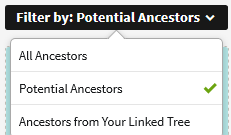
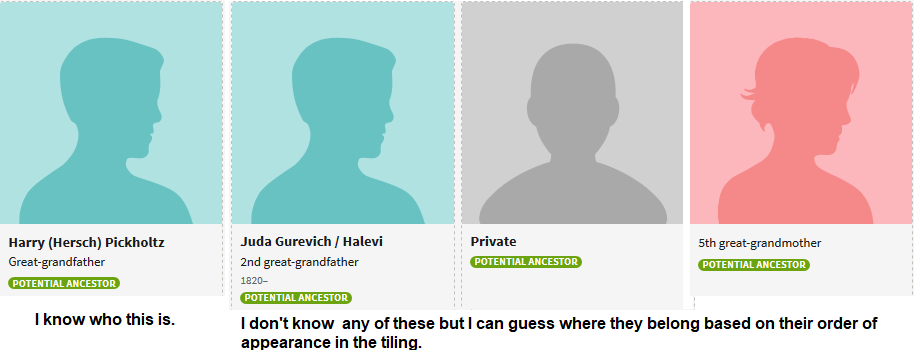
ThruLines tiles my screen with icons of over fifty ancestors, with about twenty marked with a green "potential ancestor" tag. (See the figure at the top of this page.) The icons are huge and would be easier to work with if they were a quarter the size or even smaller. I do not have photographs attached to my tree, but those who do see the actual people, not the pink, blue and grey generic images. I;ll probably add a few when I have a chance.

The "potential ancestor" tags are attached to named, known ancestors, as well as several categories of others.


There were four "potential ancestor" tags on known ancestors, eleven unknown but named people, six marked "private" and the one fifth great-grandmother with no identification. I immediately recognized four of the eleven as named known ancestors - two couples - that are flat out wrong because I know who belongs in those spaces. Somehow without my doing anything about it, one of the two couples has since disappeared. I'd like to know how that worked. And I'd like to get rid of the second couple. This is an example of a need for a "DISMISS" button
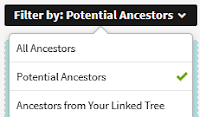
You can filter the ancestor page to make it easier to work with them. For instance, to show only the potential ancestors. Unfortunately when you look at one and then go back to the ancestors page, the filter disappears and you have to set it up again. That should be fixed.

The four named, known ancestors
I have no idea why my great-grandfather Hersch Pikholz and my third great grandfather Simon (Shimshim) Rosenzweig are labelled as potential ancestors. I have both of them on my tree. ThruLines names people who added them to their trees - in one case a cousin Anne on the Rosenzweig side added Hersch Pikholz as a Rosenzweig father-in-law.

In the second case, the tree owner is a fellow named Dov who has not yet responded to my "who are you?" inquiry. He added a mother, Susanna, to the named ancestor Simon Rosenzweig. After I talk to him, I hope to find out what his sources are and whether to integrate this ancestor into my own database and tree.

Incidentally, another researcher also added this same mother, Susanna, to Simon. When I wrote to him to clarify what his source is, he replied "There are 187,000 people in my family tree, data come mostly from the Internet. The data of Susanna and her relatives are derived from MyHeritage.com." Gotta be careful.

The third had no new information aside from the mention of a tree-owner who is a relative of my cousin Jessica's husband Matt. I have seen him in the hints and he is probably getting tired of my asking him who he is. In the meantime, the tag on that ancestor has mysteriously disappeared with no indication why. This is another example of a need for a "DISMISS" button - but if it disappears on its own, maybe not.

The fourth  is Jacob Zelinka. my fourth great-grandfather. I know his father to be Leopold/Levko.ThruLines tells me this:


I know the five children listed here and descendants of three. The owner of the tree that ThruLines shows me has this tree for a client she has been working with for years and is limited in what she can tell me. But ThruLines also shows me this:
Here we lose two of Jacob's children, but have a new one - Josef, who exists alongside Lemel Josef. I have known about this problem for some time and I suppose I shall have to deal with it. I know descendants of both of them. Some of the DNA matches listed are new to me and I'll have to follow those up too.

Three new generations for Etta Bryna?
My mother's maternal grandmother is my most recent brick wall. We know her father's given name and that he was a Levi. ThruLines adds a father, grandfather and great-grandfather - Juda Gurevich/Halevi, Shmerka and Urvater (=ancestor) Gurevich/Halevi - provided by a woman in Germany  who does not identify her connection to these gentlemen. I have written to her and look forward to hearing what she has to offer in the way of evidence.

One of the private potential ancestors is the supposed wife of Juda Gurevich, Tojba Shpunt Spunt, who appears in the tree of my Borisov collaborator Galit. She isn't sure that Tojba really belongs there. I'll address this after I hear from the woman in Germany.

Gershon Kugel's parents
My mother's paternal great-grandfather Gershon Kugel's parents are quite unknown, but ThruLines has names for both - Khaim Kugel and Khana Gitla Kugel. My great-grandmother is Chana, so Gershon's mother's name makes sense. The information comes from a woman I have been in touch with previously and I am waiting to hear what she has to say about the new Kugel ancestral couple.

Her tree has my Chana, but not her known brothers. She also has a second wife for Gershon - Feyga Dvora Kugel and a daughter Sora Mina Kugel (b. 1857). That may work. In any case, there is no indication how the tree owner fits in here - or how she knows what she knows.


The Rosenzweigs of Trencin County Slovakia
My third great-grandfather Simon Rosenzweig, whom I mentioned above, is known to be the son of Solomon and I have long known of some descendants of his brother Nathan Joseph. The cousin Anne, whom I also mentioned above, is a descendant of Nathan Josef and she has promised to get back to me with more complete information.

ThruLines offers me a new generation - Herschel, the father of Solomon - and gives Solomon a daughter and four additional sons. Plus at least one generation of descendants for three of the additional sons.

The owner of the tree here is probably the best of the Trencin County researchers and he gave me his source information (without the document itself and without telling me where it came from). I will accept Herschel and his children on that basis. As well as the new descendants of Solomon.

Oh, and Hershel has another son, Moses with two wives and ten children. Lots of new good information here.

But here it gets complicated and Ancestry makes it difficult to show it all here because the results change depending on which way I go into them. One way it shows Solomon Rosenzweig with three children - Nathan Joseph, Simon and a daughter Hani who married Ahron Pollack. There are three contact people for that Pollack line and I have been in touch with all of them in the past few days.

The problem is that according to the reliable researcher who brought us Herschel, Hani is not the daughter of Solomon, but rather the daughter of Herschel's other son Moses. I am going to let them work it out between them because they have better access to the documentation than I do.

Lesson learned - you cannot assume the ThruLines connections to be correct. You must check them one by one. You can decide to trust specific researchers, but you must be very careful.

Oh, and one more thing. Now that Ancestry has decided that Herschel Rosenzweig is the father of Solomon - which is almost certainly correct - their old-style hints have brought me more than half a dozen other researchers working on the same family. I have dropped notes to all of them.

Keep in mind, if Herschel is wrong, I would still be getting all these new hints to follow up with. Be careful out there!

One more note - they tell you who has done DNA testing but there seems to be no real use of DNA in the ThruLines algorithms. But make no mistake about it, ThruLines is a valuable tool. Keeping track of new developments may be a chore, plus of course running after the other tree owners to figure out what is right and what is false.

Housekeeping notes 
Order here.
European Jews have always married mainly within the tribe. Whether our numbers five hundred years ago in Europe were four hundred or four hundred thousand, the pool was limited. As a result, the members of the tribe today are all related to one another, multiple times.  This phenomenon, known as endogamy, makes Jewish genetic genealogy very difficult, often impossible. There is a similar phenomenon in some other population groups.

I was convinced that this brick wall is not as impenetrable as it seems, at least in some circumstances.

I believe that this book demonstrates that I was correct.

When I decided I wanted to write a book, I was not sure if I wanted to write a “How to” book or a “How I did it” book. The decision was dictated by the facts in the field. Different family structures, widely different numbers of living family members, and other similar factors dictated that writing “How to” would be irrelevant for most researchers.

“How I did it” is more likely to be helpful to the research community and more likely to instill the confidence necessary for such a project.

It is my hope that this book will encourage and inspire other researchers of their European Jewish families and other endogamous populations to say “I can do this!”

Monday, March 4, 2019

FTDNA vs. GEDmatch

My first thirty-one matches on FTDNA's Family Finder are known relatives. This is number thirty-two.
Thanks to Leah for permitting me to cite her here by name.


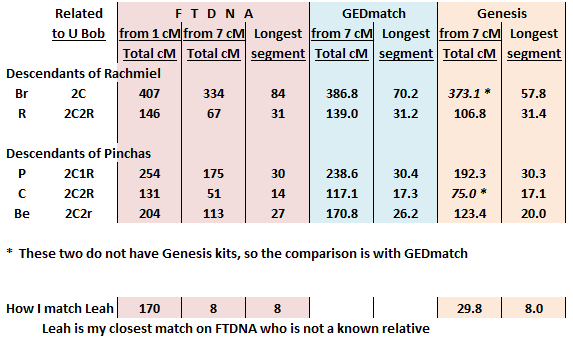
We share 170 cM which looks promising enough that FTDNA suggests that we may be second-third cousins, though I know that is highly unlikely. Our longest segment is only 8 cM, which pretty much disqualifies this as a match at all. It means that we have at least twenty-one segments of 8 cM or smaller, many of which are undoubtedly false - not indicative of any relationship whatsoever - with the others perhaps reflecting some very distant common ancestors.

It looks even more obscure when I look for Leah among the matches of my five siblings. Two of my sisters do not show up as matches at all. The other two and my brother are estimated by FTDNA to be Leah's fifth-remote cousins.

But since I had already begun looking at the match, I asked Leah about uploading to GEDmatch/Genesis. Genesis tells me that Leah and I share 29.8 cM, quite a drop-off from FTDNA's 170. It is no surprise that there is a difference, FTDNA counts very small segments and GEDmatch does not. Those very small segments are not worth much, so advantage GEDmatch.

But there are differences in the algorithms, as well, and I thought it would be useful to revisit that here. For that I looked at my five Kwoczka cousins, descendants of my great-grandmother's two brothers. I compared them to my father's brother, as I myself match only four of the five on Family Finder.


The adjustment of the FTDNA threshold from 1 cM to 7 cM lowered the Kwoczka cousins' matches with Uncle Bob by 73-91 cM. Leah's matches with me went down by 162 (!) cM, about twice as much.

The total matches on GEDmatch are significantly larger than the 7 cM FTDNA matches. I think this has to do with the algorithms.

The Genesis matches are somewhere in between - smaller than the original GEDmatch but larger than FTDNA.

One of the oddities here is the longest segment. There might be some algorithm issue, but there should be no threshold issue. For three of the Kwoczka cousins, there is no significant difference between FTDNA and GEDmatch. For the match between Uncle Bob and Cousin Br, the longest segment according to FTDNA goes from 24,778,179 to 112,771,988. The GEDmatch numbers are very close to these, though the length in cM at FTDNA is 20% greater than at GEDmatch.

The more significant difference is between GEDmatch and Genesis. They start and end at about the same places, but Genesis has a break in the middle, such that GEDmatch gives us a length of 70.1 cM while Genesis has two segments totalling 66.7 cM - nearly the same.


The longest segment between Uncle Bob and Be is different. FTDNA and GEDmatch show near identical results, but Genesis is about twenty-five percent lower. But it is not because of a gap in the segment.
Here the beginning of the segment is significantly different.

I long ago decided that I don't really need to know why these results are different from one company to another. I just have to choose one and work with it. So now that GEDmatch has moved on from the old standard, Genesis is where it's at.


Housekeeping notes 
Order here.
European Jews have always married mainly within the tribe. Whether our numbers five hundred years ago in Europe were four hundred or four hundred thousand, the pool was limited. As a result, the members of the tribe today are all related to one another, multiple times.  This phenomenon, known as endogamy, makes Jewish genetic genealogy very difficult, often impossible. There is a similar phenomenon in some other population groups.

I was convinced that this brick wall is not as impenetrable as it seems, at least in some circumstances.

I believe that this book demonstrates that I was correct.

When I decided I wanted to write a book, I was not sure if I wanted to write a “How to” book or a “How I did it” book. The decision was dictated by the facts in the field. Different family structures, widely different numbers of living family members, and other similar factors dictated that writing “How to” would be irrelevant for most researchers.

“How I did it” is more likely to be helpful to the research community and more likely to instill the confidence necessary for such a project.

It is my hope that this book will encourage and inspire other researchers of their European Jewish families and other endogamous populations to say “I can do this!”

Thursday, February 21, 2019

The Gabriels, The Breines And The Etie Goldes

The Budapest records
Last week, the incomparable Lara Diamond had a blog post abut Hungarian Civil Records on FamilySearch and I figured I should have a look. Before I got to it, she sent me links to nineteen records which mention people named Pikholz, with one spelling or another. There were two births, seven deaths and ten marriages. (Elizabeth Long helped out with deciphering some of these records.)

Two births, two deaths and seven marriages are people I already knew from one particular Pikholz family that lived on Nyar Street - Mozes and his wife Lifsche Kornberg and their children. They are part of a family that I call the IF3 family from Rozdol, where Mozes was born. (Lifsche was from Tarnopol and I have long wondered how they met.) I am in touch with one descendant of that family group and she has even done a DNA test for my project.

Two other records are the marriage (1907) and death (1922) of Matel Lam, whose mother is a Rozdol Pikholz of unclear lineage. The marriage was recorded when Matel and her husband Feiwel Bohrer were in their forties.

Four death records and one marriage appeared to be from the non-Jewish Pikolcz family and I passed them on to Ron McComb who confirmed that they belong to his wife's family..

That leaves one.

Etie Golde Gottlieb
I had never heard of Etie Golde Gottlieb, but I knew her parents Dawid Gottlieb and Regina (Rivka) Riss, my grandfather's half first cousin. Some of the Riss family were recorded as Pikholz and that is why the record showed up in Lara's search.

Dawid Gottlieb was born in Kopicienice and Regina in Kolaharowka (near Husiatyn). Three of the five children I already knew about had been born in Kopicienice and my guess was that the other two were as well. Of the five, two died in childhood, two went to Vienna where one survived WWII. The fifth ended up in Sweden and no one knows what happened to her. Dawid and Regina also lived in Vienna where they died before the War.

So now we have a sixth, this Etie Golde who was born in Kopicienice in 1897 and married in Budapest in 1919, four months after her mother died. Etie Golde's husband Kalman Markovits was from Budapest. I am in touch with several of the Riss cousins and no one ever mentioned this couple. Nor am I aware of any other connections between our Riss family and Budapest.

But the name Etie Golde was familiar to me in another context connected to Husiatyn. Some time ago, I found an 1896 marriage record in Podwoloczysk for Wolf Feldman of Tarnopol and Etie Golde Pikholz, age 32, the daughter of Gabriel and Breine of Husiatyn. It was not at all obvious whether Etie Golde's Pikholz parent was her father Gabriel or her mother Breine, but the record appeared to me to be in error.

I had no couple named Gabriel and Breine, but I did have father-daughter and grandfather-granddaughter pairings, both connected to Husiatyn. And one of them lived in Podwoloczysk. So although this marriage record appeared in some way wrong, I recorded it as is.

The Gabriels and the Breines
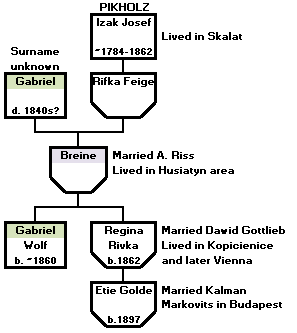
So these (on the right) are all the people we know in the Pikholz family represented in the 1896 Podwoloczysk marriage record. Gabriel and Breine, one of whom is a Pikholz, and their daughter Etie Golde, born about 1864.

We have seven Pikholz named Gabriel from the Skalat area. Etie Golde's father is the second one in the following Gabriel Chart. I cannot attribute the third and fifth in the Chart to specific families and in any case, they both died as infants.


Nachman Pikholz (1795-1865) had a son Gabriel who had a granddaughter Brana. What's makes this family interesting here is that Brana's mother Chana (Gabriel's daughter) was born in Husiatyn and, after her marriage, lived in Podwoloczysk.

This is the first line in the Gabriel Chart above. The Gabriel on the last line is a grandson of this Gabriel, the son of Gabriel's son Moshe.

We might consider that if Gabriel's wife Sara died and he later married a Breine, he could have been the father of Etie Golde. But that is quite impossible as Gabriel died at age thirty in 1852, a dozen years before Etie Golde was born in about 1864. But the Husiatyn/Podwoloczysk angle remains intriguing.

Now we have this new Etie Golde Gottlieb, who has a grandmother named Breine and an uncle and great-grandfather named Gabriel. (That Gabriel is married to a Pikholz, so does not appear on the Gabriel Chart himself.) Etie Golde's uncle is the fourth line of the Chart and another cousin is the sixth line.

Obviously Gabriel Wolf Riss, the uncle, cannot be the father of Etie Golde who married Wolf Feldman, because he would have been only abut four years old when she was born.

We run into many coincidences in genealogy, particularly with repeated naming patterns within a family. But this triple Gabriel-Breine occurrence has me flummoxed, even before we find the name Etie Golde in two of those cases. Yes, I know that the two Etie Goldes are thirty-three years apart, but that too may be one named for the other or both named for the same person. Or maybe it's just a coincidence.

In the meantime, I shall send this blog post to the surviving members of the Riss family. Perhaps they can shed some light.


Housekeeping notes 
Order here.
European Jews have always married mainly within the tribe. Whether our numbers five hundred years ago in Europe were four hundred or four hundred thousand, the pool was limited. As a result, the members of the tribe today are all related to one another, multiple times.  This phenomenon, known as endogamy, makes Jewish genetic genealogy very difficult, often impossible. There is a similar phenomenon in some other population groups.

I was convinced that this brick wall is not as impenetrable as it seems, at least in some circumstances.

I believe that this book demonstrates that I was correct.

When I decided I wanted to write a book, I was not sure if I wanted to write a “How to” book or a “How I did it” book. The decision was dictated by the facts in the field. Different family structures, widely different numbers of living family members, and other similar factors dictated that writing “How to” would be irrelevant for most researchers.

“How I did it” is more likely to be helpful to the research community and more likely to instill the confidence necessary for such a project.

It is my hope that this book will encourage and inspire other researchers of their European Jewish families and other endogamous populations to say “I can do this!”


Tuesday, February 19, 2019

Sharing Your Information

We in the genealogy community often have discussions about how much of our information we share and how frustrating it is when people do not include basic information such as ancestral surnames and geography in their profiles.

Steve Pickholtz asked to share his thoughts on the subject.

So far, I've taken the Family Tree DNA Family Finder test and the 23andMe test. (I also did FTDNA's Y-37 but that is another matter entirely.) My wife took the MyHeritage test and the 23andMe test.  Our daughter took only the 23andMe test. The tests we all took were for different reasons as explained below.

I took the FTDNA test because I am a member of the Pickholtz group and tere is an advantage when all group members use the same testing company.  The 23andMe test will be explained later.  My wife took the MyHeritage DNA test because her family has lived in the same town in New Jersey since before the Civil War.  As a matter of fact, her line can be traced back to Betsy Ross of American flag fame.   My daughter took the 23andMe test for medical reasons only.  She leaves the genealogy part up to me.  Because of a life threatening medical problem my wife has, as does a cousin on my side of the family, we wanted to know if either of us was a carrier to better help my daughter if she were to have children.

All three of these test come with a list of possible relatives, and their ranking DNA-wise to the tester.  That is great.  I know nothing about DNA, so with FTDNA results, I leave it to Israel Pickholtz to sort it out and make sense out of it.  (Israel, has a great understanding of this, and has done a great job interpreting their meanings).

So what is the problem!!!!!!!!!!!  Let me use 23andMe for the example.  This program asks if it can use your name or something else to identify you to the rest of the list members.  Initials or a made up name don't help me when I check the results.  Family names, what's so hard about giving these if you know them?  I look at these always to see if they match any of my known relatives.  Where did your relative come from?  This may not always be known, but if it is, why not give it.  If again, using 23andMe with my wife,  the closest relative based on her DNA came from Ireland.   Guess what, without knowing anyone's family names, nor where those relatives came from, the information didn't help me at all.

These problems can all be found to some extent in the three above programs and I am sure in others.  If you are really interested in learning your roots,  you must give some information.   For those interest in why I wrote this,  in using 23andMe, I found three relatives (not from the Pickholtz line), but from my mother's line.  Three of them gave their real last names which are in my family.  Family stories pay off if you remember the names and places.  They also mentioned family members who live in Philadelphia, where I was born.  What did I do, yes I contacted them and found out they are related.  Two were on my mother's side and one on my father's mother's side.

In closing------- help your self and other researchers by giving out some information.  Why hide it?

Housekeeping notes 
Order here.
European Jews have always married mainly within the tribe. Whether our numbers five hundred years ago in Europe were four hundred or four hundred thousand, the pool was limited. As a result, the members of the tribe today are all related to one another, multiple times.  This phenomenon, known as endogamy, makes Jewish genetic genealogy very difficult, often impossible. There is a similar phenomenon in some other population groups.

I was convinced that this brick wall is not as impenetrable as it seems, at least in some circumstances.

I believe that this book demonstrates that I was correct.

When I decided I wanted to write a book, I was not sure if I wanted to write a “How to” book or a “How I did it” book. The decision was dictated by the facts in the field. Different family structures, widely different numbers of living family members, and other similar factors dictated that writing “How to” would be irrelevant for most researchers.

“How I did it” is more likely to be helpful to the research community and more likely to instill the confidence necessary for such a project.

It is my hope that this book will encourage and inspire other researchers of their European Jewish families and other endogamous populations to say “I can do this!”

Monday, February 11, 2019

Politzer

Customers of Family Tree DNA are familiar with the match alerts we get from time to time, whether our own kits or the kits of members of our projects.
As I manage over a hundred kits, I am not about to stop what I am doing to look at these every time I receive one and in any case, I want to see how a match fits not just with me  but with other family members including those not close enough to warrant an alert. So nearly two years ago, I decided to look at all the new matches across my family members every few months. Then I write to the ones that look interesting and ask them to upload to GEDmatch to see if these matches are on shared segments.

Usually nothing much comes of it. Even when the DNA points to a very specific portion of my family, the match usually doesn't know any of my surnames or even my geography.

Last week I prepared the matches for the past four months and Sunday I sent out messages to the scores of matches who looked even a little bit promising. So let me tell you about Cynthia, who happens to be the wife of a fellow I actually know.

So I asked her to register for GEDmatch/Genesis and after it batched I looked at her top 20,000 matches using the Tier1 one-to-many search. She matches seventy-eight of my kits and I did some chromosome browsers to see how her matches line up in family groups. As usual I was looking for segments of over 10 centiMorgans with multiple meaningful matches with my families.

On chromosome 3, she matches seven of us - four of my parents' children, one first cousin and two second cousins, all pointing to my maternal grandfather's side. All we have there are the surnames Gordon and Kugel. And it was a small match anyway, so probably from a pre-1800 common ancestor.

Chromosome 5 showed a 12 cM match with a pair of second cousins in the Nachman Pikholz branch of the family. Not much with that either - but if Cynthia had the relevant surnames, it could have been nice.

Chromosome 6 had two segments of minor interest - one with some second and fourth Pikholz cousins of mine and another with one first cousin and three second cousins on my maternal grandmother's Rosenbloom side. Here too, we have no other surnames, but we do know that the
family lived in Borisov (Belarus) for at least half of the 1800s.

Both chromosomes 16 and 20 brought matches with small groups of my third and forth cousins on
the Pikholz side.

Chromosome 22 has seven descendants of my Pikholz great-great-grandparents. Both of these ancestors are Pikholz.

Then there is the X, chromosome 23. The relevant matches look like this.


The four nearly identical matches belong to two of my sisters, my father's brother and my fourth cousin Lydia. They all triangulate, so they are all from a common ancestor.

This cannot be from my grandfather, because Uncle Bob gets no X from his father. So we know it's my grandmother's side. So given Lydia, who is part of my grandmother's paternal grandmother's Zelinka family, how exactly does this fit together and who is the candidate for the common ancestor?
Uncle Bob is a third cousin to Lydia's mother
so we and Lydia are fourth cousins.
Nathan / Nahum Zeinka's fallen gravestone
Our most recent common ancestral couple are Isaak and Sari Zelinka, who were born in the mid-1780s. But Lydia's second-great-grandfather Nathan Zelinka received no X from his father, the source of the match between Lydia and Uncle Bob must be from Sari, Isaak Zeinka's wife.

Nearly two years ago, Uncle Bob's daughter Linda and I were in Slovakia, together with our fifth cousin on the Zelinka side, Cyndi and while in Zilina we met Lydia. In the course of taking down her family information, I asked if she knows anything about our third-great-grandmother Sari. Lydia said that she understood that her surname is Politzer. This made sense to me because many years ago, my grandmother had told me that her father was related somehow to Joseph Pulitzer - he of the prize. - but she had no idea how. I have tentatively recorded Sari as Politzer, pending some kind of actual documentation.

So last year, Lydia gave our third-great-grandmother a name and perhaps a family and now we have an actual bit of her DNA.

(Note, I could have seen this with an analysis of Lydia, having nothing to do with Cynthia, but I didn't - so I can thank Cynthia for that.

Caveat - it is theoretically possible that the segment comes from my grandmother's MOTHER's side and that Lydia has some unknown ancestry in Hungary, but I consider this to be a vanishingly small possibility.

The Matching Segments tool on GEDmatch does not include the x chromosome, but on Genesis it does. They call it "Segment Search" and it is on Tier1. There are about three dozen people who share that match with both Uncle Bob and Lydia and I suppose I should write to them. Maybe something else will turn up.

(What I don't understand is why Uncle Bob and Lydia do not show up on Cynthia's Segment Search. I'll have to speak to GEDmatch about that.)

Housekeeping notes 
Order here.
European Jews have always married mainly within the tribe. Whether our numbers five hundred years ago in Europe were four hundred or four hundred thousand, the pool was limited. As a result, the members of the tribe today are all related to one another, multiple times.  This phenomenon, known as endogamy, makes Jewish genetic genealogy very difficult, often impossible. There is a similar phenomenon in some other population groups.

I was convinced that this brick wall is not as impenetrable as it seems, at least in some circumstances.

I believe that this book demonstrates that I was correct.

When I decided I wanted to write a book, I was not sure if I wanted to write a “How to” book or a “How I did it” book. The decision was dictated by the facts in the field. Different family structures, widely different numbers of living family members, and other similar factors dictated that writing “How to” would be irrelevant for most researchers.

“How I did it” is more likely to be helpful to the research community and more likely to instill the confidence necessary for such a project.

It is my hope that this book will encourage and inspire other researchers of their European Jewish families and other endogamous populations to say “I can do this!”

Tuesday, January 29, 2019

A Story From The Neighborhood

Last week I was doing some work for a client involving - among other things - the family of a woman who died in 1953. This is not basically a Pittsburgh case, but this particular woman lived in Pittsburgh most of her adult life. About ten minutes walk from Chez Pickholtz.

Pittsburgh is a relatively easy place to do Jewish research. Ancestry has Pennsylvania death certificates for 1906-1966 and adds more every couple of years.

Carnegie Mellon University has The Pittsburgh Jewish Newspaper Project.
Searching for "Pickholtz" gives 678 results.
And the Rauh Jewish Archives at the Senator John Heinz History Center has burial records from seventy-eight local Jewish cemeteries, updated to 2009. In an inquiry this week, I learned that they "hope to do an update in the next few years, although the project is still in the planning phases, at the moment."
The combination of these three resources can be an extraordinary aid in Pittsburgh-area research, in addition to the standard sources such as census records, Social Security Death Index, immigration and military records.

I learned easily enough that the family of the woman I was interested in were active Tree of Life people. She and her husband are buried there, as are her sister and brother (who married a brother and sister). The home she shared with her husband and her married daughter is less than ten minutes walk from Tree of Life.

She and her husband had two daughters. One predeceased both of them and is buried at Tree of Life, as would be expected.

The other daughter was married and at some point they became affiliated with Beth Shalom, a Conservative congregation, much like Tree of Life, but about twice as far in the other direction. They are buried in the Beth Shalom cemetery. I see nothing that indicates that the husband had a prior affiliation with Beth Shalom, nor did the Rabbi's Assistant there find anything about his wider family. The husband's obituary names a sister who lived in Philadelphia. so perhaps he was not from a local family.

I wondered when and why they joined Beth Shalom. And I was not sure why this question bothered me.

The married daughter and her husband had one son, who died in his twenties, during the lifetime of his grandmother. In the course of my search, I saw the son's bar mitzvah announcement in the Criterion. At Beth Shalom. They were apparently there a long time. I wondered why. Not that it mattered.

I looked at the rest of the page and I saw that another boy was celebrating his bar mitzvah at the Tree of Life that same week. Maybe the fact that the date was taken was what brought them to Beth Shalom.

But the date wasn't taken by just a random Jewish boy from the neighborhood. The date was taken by the only non-relative I ever called "Uncle." (And his wife, also a non-relative, was one of two we called "Aunt.") I guess I was meant to know that.

Housekeeping notes 
Order here.

European Jews have always married mainly within the tribe. Whether our numbers five hundred years ago in Europe were four hundred or four hundred thousand, the pool was limited. As a result, the members of the tribe today are all related to one another, multiple times.  This phenomenon, known as endogamy, makes Jewish genetic genealogy very difficult, often impossible. There is a similar phenomenon in some other population groups.
I was convinced that this brick wall is not as impenetrable as it seems, at least in some circumstances.

I believe that this book demonstrates that I was correct.

When I decided I wanted to write a book, I was not sure if I wanted to write a “How to” book or a “How I did it” book. The decision was dictated by the facts in the field. Different family structures, widely different numbers of living family members, and other similar factors dictated that writing “How to” would be irrelevant for most researchers.

“How I did it” is more likely to be helpful to the research community and more likely to instill the confidence necessary for such a project.

It is my hope that this book will encourage and inspire other researchers of their European Jewish families and other endogamous populations to say “I can do this!”

Sunday, January 20, 2019

ENDOGAMY: One Family, One People - SALE!!

The sale will run from Tu BiShvat until Purim.

Order here.

 
European Jews have always married mainly within the tribe. Whether our numbers five hundred years ago in Europe were four hundred or four hundred thousand, the pool was limited. As a result, the members of the tribe today are all related to one another, multiple times.  This phenomenon, known as endogamy, makes Jewish genetic genealogy very difficult, often impossible. There is a similar phenomenon in some other population groups.
I was convinced that this brick wall is not as impenetrable as it seems, at least in some circumstances.

I believe that this book demonstrates that I was correct.

When I decided I wanted to write a book, I was not sure if I wanted to write a “How to” book or a “How I did it” book. The decision was dictated by the facts in the field. Different family structures, widely different numbers of living family members, and other similar factors dictated that writing “How to” would be irrelevant for most researchers.

“How I did it” is more likely to be helpful to the research community and more likely to instill the confidence necessary for such a project.

It is my hope that this book will encourage and inspire other researchers of their European Jewish families and other endogamous populations to say “I can do this!”
Thursday, January 17, 2019

A Bit More Spira

In my most recent chapter of the ongoing saga "How Spira Became Pikholz," we saw how the perfect Y-DNA matches for 67 markers became a genetic distance of four or five when we upgraded to Y-111.

At that point, we had three Pikholz lines from Skalat in east Galicia, one of which is my own going back to my second great-grandfather Izak Fischel, born about 1810. I am a perfect match with a man we call "Filip" who goes back to Nachman Pikholz born about 1795 and one mutation away from Zachy, whose ancestor Mordecai Pikholz was born about 1805. We are not certain of the precise relationships among those three, though the two younger ones are probably brothers.


The three of us have reasonably close Y matches with two men named Spira and one named Spiro and it is clear to me that we were Spira before we were Pikholz. The question is, how long ago.

The  above chart shows the number of mutations between each pair of testers, for 37, 67 and 111 markers.

My guess was that we split from the other Spiras about nine generations ago. (There are no significant autosomal matches within the group of six.)

Last week, I saw another Spira descendant with a match to us. Like "Z-man," this new tester (who has not yet given permission to cite him by name) did a Y-37 test and he matches the same way that Z-man does. He has not done an autosomal test, but I have asked both him and his first cousin once removed to do that.

This is the new chart.
Upgrading both the new tester and Z-man to Y-111 might give us a clearer picture. If, for instance, they (or one of them) is closer to us than A. Spira and A. Spiro, it would tell us a bit more about the likely timing of the "split." It's time we think about doing that.

Housekeeping notes
I had a nice group at the meeting of the Rishon Lezion branch of the Israel Genealogical Society.