Showing posts with label FTDNA. Show all posts

Monday, September 2, 2024

THE COMPLETE GUIDE TO FAMILYTREEDNA , by Roberta Estes - A Review

Some weeks ago, I was asked by the Marketing Director of Genealogical Publishing Company to review "The Complete Guide to FamilyTreeDNA by Roberta Estes. I first met Roberta (online) ten-eleven years ago and she was a great help to me in my first steps in DNA, so I was pleased to say "yes." I have not discussed this review with Roberta, aside from telling her that I had received a review copy. I don't think we have ever met in person.

The 247-page paperback book is large - 8.5" X 11" (21.5 X 28 cm) - which makes it unwieldy for reading on, for example, public transportation - but this was unavoidable because of the many very large images. I wished that some of them were even larger.

The review copy does not show the colors in the images (perhaps there is color in the text as well, I cannot tell) which detracted from the reading experience and from understanding some of Roberta's points. This is not her fault, of course, and in any case is not relevant for readers of the actual book. (The marketing guy was not able to give me a working link to colored charts.) I am familiar with Roberta's blogs and her charts are always clear and useful, so I have no doubt that this is the case in the actual book.

No one ever wishes for greater detail in Roberta's blogs - at https://dna-explained.com/ - and if you try to take in too much at once, your eyes can glaze over. I certainly do not mean this as criticism, but you have to get used to her style and adjust your reading accordingly.

That said, many of the numerous footnotes are for Roberta's own blog posts where you can find even greater detail, as well as examples from her own work.

The point of view in this book is that of a "normal" researcher and there are only passing references to the endogamy which complicates Jewish research, while enriching our actual Jewish lives.

A bit about my own research, for context. I did my (autosomal) Family Finder more than twelve years ago and my MtDNA and Y-37 a year earlier. I have since done a both Y-111 and Y-700. In advancing my family projects, I have signed up over ninety Pikholz descendants for Family Finders and a dozen for MtDNA or Y-tests, as well as fifteen other family members. This does not include family members who tested with other companies. These numbers include six of my parents' seven children. (The seventh is long deceased and in any case is an identical twin.) Both my parents predeceased my DNA testing.

We have nothing exotic such as Native American and only three people whose fathers are not who they are supposed to be. Only two cases of adoptees
have been identified as part of our family. As the kids say, B-O-R-I-N-G.

So I know a thing or two about testing with FTDNA and working with them afterwards. I have five FTDNA projects, but mostly for the convenience of keeping my families organized and accessible. And I do not trust any site, company or algorithm that purports to do my work for me, DNA or otherwise.


The book is divided into eleven numbered chapters plus a seventeen-page glossary, but no index. To give you an idea of how detailed Roberta is, the Table of Contents runs six and a half pages, with the headings and sub-headings of the eleven chapters.

She begins with Acknowledgements, Introduction and "How To Use This Book," followed by

Chapter 1  - TYPES OF TESTING (beginning on page 6)
Chapter 2  - SETTING YOURSELF UP FOR SUCCESS (page 11)
Chapter 3  - Y-DNA - YOUR FATHER'S STORY (page 24)
Chapter 4  -  MITOCHONDRIAL DNA - YOUR MOTHER'S STORY (page 97)
Chapter 5  - AUTOSOMAL DNA - THE FAMILY FINDER TEST (page 132)
Chapter 6  - X CHROMOSOME - UNIQUE INHERITANCE PATH (page 173)
Chapter 7  - ETHNICITY - MY ORIGINS (page 187)
Chapter 8  - ADVANCED MATCHING (page 207)
Chapter 9  - FINDING, JOINING AND UTILIZING PROJECTS (page 209)
Chapter 10 - THIRD PARTY TOOLS (page 218)
Chapter 11 - CREATING YOUR STEP-BY-STEP ROADMAP (page 225)
GLOSSARY (page 231)

As you can see, the chapter on Y-DNA is by far the largest, nearly as large as Mitochondrial and Autosomal combined.

Now to the book.

The brief How To Use section introduces us to Roberta's gray-shaded, bold-faced tips that appear throughout the book. Read all of them, even if you are only skimming some of the harder sections.

I was please to find that Roberta did not spend an inordinate amount of time on the most basic aspects of DNA - the stuff we learned in high school biology. People are learning what this is all about and we no longer have to spend a third of a lecture or an article explaining the equivalent of oceans and boats in a lecture on immigration. The brief TYPES OF TESTING chapter handles all this well.

That chapter concludes with a paragraph called "Your DNA is Archived for a Quarter Century." That sounds like a long time, but as many of us are already at the half-way point, it raises questions about the future - especially if they develop new products.

In SETTING YOURSELF UP FOR SUCCESS, we learn how to make sure our matches can know enough about us to facilitate the first stages of contact, while not surrendering more privacy than we care to. Many people do not list their known surnames, which makes it difficult to analyze matches. Roberta explains both how to do it and why it is important. This will not help us know anything about our matches, but it will help them know about us.

Part of that setting up is putting in a family tree, a matter on which I myself am negligent.

The chapter on Y-DNA is long and - for a novice - difficult. Y-DNA is different from autosomal DNA, has several types of tests and markers (STR and SNP) and a collection of analytical tools and projects. Because it is difficult, it might be wise to look at the Family Finder chapter first. That way, the novice can enjoy some tangible progress before dipping a toe into the hard stuff. That can help avoid the temptation to throw up your hands in frustration at even the basic understanding.

For "normal" researchers, Y-DNA is closely related to stable surnames. Not so with Jewish research where many of us did not have surnames before 1800 and even afterwards they were not always stable. And even into the late 1800s, many religious marriages were not recorded with the civil authorities, so the "illegitimate" children were assigned the mother's surname. (I would call that an eastern European phenomenon, but it happened with the birth of one of my grandsons!)

As my veteran readers know, I have been able to determine what our name was before it was Pikholz, probably four hundred years ago, and I did not need the Y-700 to do that. Y-111 was sufficient.

The Discover links
Roberta gets heavily into haplogroups and the haplogroup tree. If you only do Y-37 or Y-111 tests, you will be assigned to a haplogroup that goes very far back in time. So far back that Roberta and I belong to the same R-M269 haplogroup. The Y-700 brings that forward towards the present, where my haplogroup is shared by only one non-Pikholz thus far.
 
And only after that does she get to a heading called "Down in the Weeds!"
 
The Y-DNA chapter also includes a thirteen-page survey of FTDNA's "Discover" reports, which show different aspects of your male-line results. It's not for everyone but if you like your results as a narrative, you will find them useful.

Yes, Y-DNA is complicated and working with the results of the Y-700 can be difficult. But FTDNA has projects and if you are fortunate - as I am - to be part of a project with good, active administrators, there is much you can learn. This chapter covers that briefly, but well.

This chapter concludes with four case studies, each coming at Y-DNA research from a different perspective.

Mitochondrial DNA (MtDNA) is passed from women to all their children. The mitochondria is small, so mutations are very infrequent. That - along with the changing surnames in every generation - makes MtDNA less useful for most people. Roberta addresses this in two sentences:

Misinformation, especially on social media, leads people to believe that mitochondrial DNA isn't useful.
As a result, fewer people test, inhibiting the growth of the database which in turn results in fewer matches.

I would like to have seen that in large, colored, bold-faced type. It cannot be overstated. (I speak as someone who ignored the "warnings" and made two significant discoveries using MtDNA.)

Roberta addresses the value of the two partial tests (no longer available but still in the database). Yes, they can be useful. I, for one, have ignored that and will have a look
when I have a chance.

There is much on mutations in great detail, also including reverse mutations, unstable mutations and heteroplasmies. A few years ago, I was able to pin down one of the last in my own family by testing two family members and finding a single variation.

She goes through the steps for using the site, as well as the results - migration maps, ancestral origins, and haplogroups - though I personally do not find these features useful.

There is a one-page discussion of "Advanced Matching for MtDNA." This is an important tool that I have used successfully for years, for both MtDNA and Y-DNA. Unfortunately it has not been working for some weeks and FTDNA's support has not been responsive.

The chapter concludes with four case studies.

Autosomal DNA comes from all the reasonably close ancestors and is represented in the Family Finder test. However because it comes from all ancestors, each ancestor's representation is halved every generation. That limits its usefulness.

Autosomal DNA is what the other testing companies do and Roberta goes right into the subject of transferring results from other companies to FTDNA.

Endogamy plays a major role for groups like Jews. Roberta says she has 7878 matches altogether. I have 38,374 and some of my relatives have even more.

The chapter goes into the "buckets" that automatically sort matches into father's side and mother's side, based in part of your family tree (if you entered one). Endogamy messes with this as endogamous familes have many matches which come from both sides. And as I said above, I don't trust automatic matching functions - but that's me.

In this chapter we learn about triangulation (very important!), matching, and chromosome browsers. That last one breaks down matches into individual chromosomes and segments, allowing analysis of seven matches at once. You must understand the brief section "Do Your Matches Match Each Other?" before you do any actual triangulation and those sections should probably have been consecutive.

The chapter concludes with using spreadsheets and the site's matrix tool for analysis. I, myself, do not use either.

There are no case studies here, but the chapter has a lot of anecdotal bits.

The X chromosome, not to be confused with MtDNA, has one side from the mother but only daughters get from the father. Males do not get any X from their fathers. The number of ancestors contributing to a person's X increases from generation to generation in a Fibonacci Sequence, rather than doubling each generation like autosomal DNA.

Roberta does a nice job summarizing how the X works and how to use it in our research. It is something I need to spend more time on in my own research, though I have not neglected it completely.

Ashkenazi Jewish is the yellow bit
My Origins supposedly tells you where you came from. It may or not agree with what other testing companies say because each company has its own distribution of DNA by geography.

In my case, My Origins has me defined as 100% Ashkenazi Jewish yet I know from my Y-700 that at least my male line is from Spain or Portugal - ie Sephardi Jewish.

Advanced Matching deserves its own chapter, even the brief page and a half, even though it was mentioned briefly earlier. It is important and easy to use. When it works.

Projects is also an important subject which was discussed in earlier chapters. Different kinds of projects work for different research goals. these include surname, haplogroups and geographical projects. There is more than a bit of the luck of the draw here - some projects have active, knowledgeable administrators, some less so.

Roberta discusses two Third Party Tools - Genetic Affairs and DNA Painter. The latter is color-based and is very very popular in the research community. I dabbled when it first came out but did not see that it added to my research.

If I have one major criticism of the book, it is the omission of GEDmatch in this chapter, though it appears in the Glossary. I cannot analyze autosomal matches without it and it is useful even when all the matches are from Family Finder tests.

The final chapter discusses creating a road map or research plan. Just a few pages but they wrap it all up nicely. The last two pages - at least in my copy - look like they were meant to be in the previous chapter, as they return to Genetic Affairs and DNA Painter.

It ends with a brief section called "You don't Know What You Don't Know." A truer statement was never written. Until you get into it, you do not know where your research will lead. In fact, it may be years before the best matches show up. You need this both for yourself and to convince (potential) family members to join with you.

Roberta has produced a fine work. It will sit on a shelf at arm's length and I will no doubt refer to it from time to time, especially when I want to get into areas where I have not been before.

Monday, March 4, 2019

FTDNA vs. GEDmatch

My first thirty-one matches on FTDNA's Family Finder are known relatives. This is number thirty-two.
Thanks to Leah for permitting me to cite her here by name.


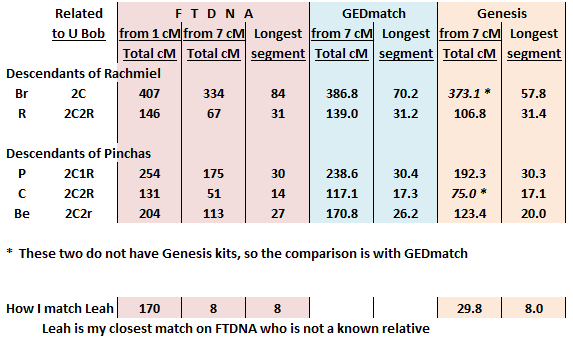
We share 170 cM which looks promising enough that FTDNA suggests that we may be second-third cousins, though I know that is highly unlikely. Our longest segment is only 8 cM, which pretty much disqualifies this as a match at all. It means that we have at least twenty-one segments of 8 cM or smaller, many of which are undoubtedly false - not indicative of any relationship whatsoever - with the others perhaps reflecting some very distant common ancestors.

It looks even more obscure when I look for Leah among the matches of my five siblings. Two of my sisters do not show up as matches at all. The other two and my brother are estimated by FTDNA to be Leah's fifth-remote cousins.

But since I had already begun looking at the match, I asked Leah about uploading to GEDmatch/Genesis. Genesis tells me that Leah and I share 29.8 cM, quite a drop-off from FTDNA's 170. It is no surprise that there is a difference, FTDNA counts very small segments and GEDmatch does not. Those very small segments are not worth much, so advantage GEDmatch.

But there are differences in the algorithms, as well, and I thought it would be useful to revisit that here. For that I looked at my five Kwoczka cousins, descendants of my great-grandmother's two brothers. I compared them to my father's brother, as I myself match only four of the five on Family Finder.


The adjustment of the FTDNA threshold from 1 cM to 7 cM lowered the Kwoczka cousins' matches with Uncle Bob by 73-91 cM. Leah's matches with me went down by 162 (!) cM, about twice as much.

The total matches on GEDmatch are significantly larger than the 7 cM FTDNA matches. I think this has to do with the algorithms.

The Genesis matches are somewhere in between - smaller than the original GEDmatch but larger than FTDNA.

One of the oddities here is the longest segment. There might be some algorithm issue, but there should be no threshold issue. For three of the Kwoczka cousins, there is no significant difference between FTDNA and GEDmatch. For the match between Uncle Bob and Cousin Br, the longest segment according to FTDNA goes from 24,778,179 to 112,771,988. The GEDmatch numbers are very close to these, though the length in cM at FTDNA is 20% greater than at GEDmatch.

The more significant difference is between GEDmatch and Genesis. They start and end at about the same places, but Genesis has a break in the middle, such that GEDmatch gives us a length of 70.1 cM while Genesis has two segments totalling 66.7 cM - nearly the same.


The longest segment between Uncle Bob and Be is different. FTDNA and GEDmatch show near identical results, but Genesis is about twenty-five percent lower. But it is not because of a gap in the segment.
Here the beginning of the segment is significantly different.

I long ago decided that I don't really need to know why these results are different from one company to another. I just have to choose one and work with it. So now that GEDmatch has moved on from the old standard, Genesis is where it's at.


Housekeeping notes 
Order here.
European Jews have always married mainly within the tribe. Whether our numbers five hundred years ago in Europe were four hundred or four hundred thousand, the pool was limited. As a result, the members of the tribe today are all related to one another, multiple times.  This phenomenon, known as endogamy, makes Jewish genetic genealogy very difficult, often impossible. There is a similar phenomenon in some other population groups.

I was convinced that this brick wall is not as impenetrable as it seems, at least in some circumstances.

I believe that this book demonstrates that I was correct.

When I decided I wanted to write a book, I was not sure if I wanted to write a “How to” book or a “How I did it” book. The decision was dictated by the facts in the field. Different family structures, widely different numbers of living family members, and other similar factors dictated that writing “How to” would be irrelevant for most researchers.

“How I did it” is more likely to be helpful to the research community and more likely to instill the confidence necessary for such a project.

It is my hope that this book will encourage and inspire other researchers of their European Jewish families and other endogamous populations to say “I can do this!”

Sunday, October 7, 2018

Zachy's Mutation

For several years, we have seen the identical Y-DNA results for the three Pikholz descendants from Skalat. First at 37 markers and later at 67 markers. The three count back to known ancestors who were born around 1800.

Zachy, who lives here in Israel and whom I have never actually met, counts back to his third great-grandfather Mordecai Pikholz. Mordecai's 1864 Skalat death record says he was fifty-nine years old, so I list him as having been born about 1805. "Filip" (not his real name) lives in Poland and counts back to his second great-grandfather Nachman Pikholz, whose 1865 Skalat death record says he was seventy years old.

My own second great-grandfather is Izak Fischel Pikholz and we are guessing he was born about 1810. Autosomal DNA and the relationships within the families have brought me to the tentative conclusion that Mordecai and Izak Fischel are brothers. These same considerations tell me that Nachman is not a brother - rather an uncle or perhaps a cousin.

At the same time, we saw that we also had a perfect match with two Spiras and a genetic distance of one with a Spiro. In the case of the Spiro and one of the Spiras, this was based on Y-67 tests. The second Spira, whom I refer to as "the Z-man," has only done a Y-37. That brought me to the clear conclusion that we were Spira before we were Pikholz. And probably not that long ago.

Comparing Spira to us (Y-67)
FTDNA said with 99.4% certainty that our most recent common ancestor (MRCA) was within the last nine generations. For reasons that are not clear to me, that 99.4% is the prediction both for the Spira with a perfect match and for the Spiro with a mutation built-in.

Both Spira and Spiro had upgraded to Y-111 and during the recent summer sale, I decided to do the same. Much to my surprise, the additional 44 markers showed three mutations between me and Spiro and four between me and Spira. Whether they were my mutations or theirs, I couldn't tell.

So I upgraded the other two Pikholz kits to Y-111, first Filip and then Zachy. Filip and I remained identical, so clearly the mutations happened before our common Pikholz ancestor. That gave me the clear feeling that our split from the Spira/Spiro family was several generations earlier than I had thought.

Now we have Zachy's Y-111 and he has a mutation, compared to Filip and me. This is clearly in the generations between Mordecai and Zachy because I do not have it. The mutation is at the marker called "DYS712" where Filip and I have a value of 21 while Zachy has 20.

The FTDNA probability chart shows a change in the expected MRCA due to Zachy's mutation, but of course we know for fact that this is not relevant.
I also ran the probability chart to compare my results (and Filip's) to each of Spira, Spiro and the Z-man. I used the same nine generations that I had assumed back in the days of the Y-67 results.

At 37 markers, all three show a 98.3% probability of a MRCA with us at nine generations, despite the fact that Spiro has a mutation that the others do not.

At 67 markers, that rises to a 99.4% probability.

At 111 markers, the probability plummets to 84.5% for Spira and 92.9% for Spiro - despite the fact that in both cases there are four mutations. Apparently Spira's mutations are more significant than Spiro's. (Two of the four mutations are on the same markers and two are on different markers.)

Nine generations still looks good. Less certain, yet a reasonable guess. Perhaps even the early 1700s, if you believe that sort of thing.

Thanks to Igor Schein for his assistance in counting up the markers.

Wednesday, June 14, 2017

The Lydia Conundrum

Lydia
Lydia and Inna are second cousins of mine on my mother's mother's side. They are first cousins to one another. Their grandmother, Alta Rosenbloom Kaplan, is the older sister of my grandmother Sarah Rosenbloom Gordon, who remained in Russia when her sisters and brother went to the US before the First World War.

Lydia's DNA results came in two months ago and Inna's this week.

We now have autosomal DNA from thirteen Rosenbloom second cousins: Lydia and Inna from Aunt Alta, Beverly, Beth and Sam from Uncle Hymen and my first cousins Kay and Leonard, my four sisters,  my brother and me from my grandmother Sarah.

I hope to take DNA from two more of Alta's granddaughters when I visit Moscow next month.

Two of Lydia's matches with the second cousins are over 420 cM. Eight more are between 342 and 387 cM. One is 286 cM. Compare these to the ISOGG definition of second cousins - 212.5 cM - and Blaine Bettinger's Shared cM Project's average of 238 cM and we see that Lydia's matches are much higher than expected. If it were just the vagaries of DNA, some would be higher and some would be lower, but that is clearly not the case here.

So the answer must be Jewish endogamy. All Jews, being related multiple ways, have much larger matches than the general population.

Inna with her daughter, granddaughter and a visiting Israeli cousin
Inna's results are less striking. She has over 300 cM with only three of the eleven second cousins, the highest being Leonard with 386 cM. She has six more between 258 and 296 cM. Then me at 224 cM and my brother Dan at 215 cM.

This appears to be a much more normal distribution, with less influence from Jewish endogamy.

With that, Inna has between three and six matches of over 20 cM, on eight segments with the second cousin group, including matching segments of over 50 cM.

It follows that one of Lydia and Inna, daughters of brothers, has a much greater influence from endogamy than the other. And if I were to tell you that one of them has a non-Jewish mother, hence much less endogamy, you would say that it must be Inna.

You would be wrong. As I was.

Inna's mother is from a normative Ashkenazi Jewish family. FTDNA's MyOrigins calls her 93% Ashkenazi Jewish, typical of our family. There should be lots of endogamy here.

Lydia's MyOrigins shows her to be 45% Ashkenazi Jewish and 46% East Europe non-Jewish, plus some fragments. The normal sort of background endogamy is missing, so I fully expected that Lydia's large matches with us were a result of a close cousin relationship between her Rosenbloom grandmother and her Kaplan grandfather.

If that were indeed the case, Inna's matches would be even larger because she has both the supposed cousin grandparents and the standard, garden-variety Jewish endogamy. But she doesn't. So she doesn't.

Why? Beats me! More important, why does Lydia have these big numbers? What else is going on here? It looks much too large and much too skewed to be "the strange ways of DNA." (Lydia's best match with the cousins is with Kay, whose faher also has no Jewish DNA.)

I cannot wait to see what the Moscow cousins have. One of them is Inna's sister, the other a first cousin to Inna and Lydia. So unless anyone has some suggestions, I expect to revisit this at the end of August.

Housekeeping notes
I'll be speaking on the Hebrew version of
Lessons in Jewish DNA – One Man’s Successes and What He Learned On the Journey
on 19 June at 6:30, for IGS Rishon Lezion, Museum of Rishon Lezion, Ahad Ha’am 2.

Also, my son in Chicago is making his next bar mitzvah the first Sunday in May. If any program directors are looking for something around then, please drop me a note.

Sunday, April 9, 2017

Six Siblings - Part Four: Origins Revisited

Nine weeks ago, aftter we received my late brother's Family Finder results, I began a series called "Six Siblings." Part One was about FTDNA's "ancientOrigins" and "my Origins," neither of which I put much stock in. Parts Two and Three followed and dealt with comparisons among the siblings' matches. I intended Part Four to be about our second cousins and our matches with them, but we have a second cousin in a new line whose test results keep being postponed, so I have busied myself with other things.

In the meantime, FTDNA came out with a new version of myOrigins. An Enhanced Version. In their words:

This simple tool delivers both new and newly refined reference populations, including smaller trace-percentage results previously not available. These latest additions to our populations and the refinement of existing clusters ​provide a deeper look into your family history and what makes you…YOU.

The original myOrigins results for the six siblings, in birth order
Now the first thing everyone does is to look to see what has changed since the earlier version, both in the product and in our own results. If we happened to have saved our results. I wouldn't have saved mine, but as it happened I had just blogged about it in Six Siblings, so I had our results, though not those of other project members.

(Let me remind my readers that I do not take this analysis seriously and certainly do not give much credence to the precision, but as they say, it's for entertainment purposes.)

So what has changed? Well, here is how the results look. Mine, for instance. Can you spell B-O-R-I-N-G? It shows 91% Ashkenazi Jewish, 8% Asia Minor and <2% North African.
So 1% migrated from Western/Central Europe to Ashkenazi Jewish. No other changes.

Blue stars indicate changes
But it is not quite so. Genetic genealogist Diahan Southard posted a chart explaining the differences in terminology and I shall assume she writes with authority.

I had been assuming that my Eastern Middle East and North Africa were an expression of the Sephardic Jewish Diaspora

"Not so" says Diahan's chart. What was previously Ashkenazi Diaspora was actually both Ashkenazi and Sephardic. (Why FTDNA spells only one has a "c" at the end? Who knows!) In any case, they think my 91% is all Ashkenazic and the Turkey-Azerbaijan and North Africa are meant to be just that.

FTDNA explains what the two Jewish groups are, but does not explain why they had previously been grouped together under the heading "Ashkenazi."

So here are the results for the six siblings, again omitting those categories where we have no representation at all. (We appear in birth order.)
  • Each of us is 91-99% Ashkenazi and within 1% of the old version results.
  • The average of our Ashkenazi results went up from 94% to 95%.
  • None of us any Sephardic, as defined by FTDNA.
  • Other than Amy and Sarajoy, the total of out Ashkenazi and Asia Minor is at least 99%.
  • Judith, Amy and I had our Eastern ME changed to Asia Minor. Sarajoy did not.
  • A lot more tiny fragments which are really just for entertainment.

In short, BORING!
For comparison, I looked at the myOrigins for our two closest relatives, my father's sister and brother. Aunt Betty is 99% Ashkenazi and Uncle Bob is 97%, with a few fragments which are not attributed to Asia Minor.

I was not going to write about this at all, but it has been the subject of a lot of talk on genetic genealogy social media. Besides, there have been two other new developments that I have found even less interesting. (Not to disparage other population groups who may have results of significance.

One is the new MtDNA analysis. The company writes
We’re excited to announce the release of mtDNA Build 17, the most up-to-date scientific understanding of the human genome, haplogroups and branches of the mitochondrial DNA haplotree.

As a result of these updates and enhancements—the most advanced available for tracing your direct maternal lineage—some customers may see a change to their existing mtDNA haplogroup. This simply means that in applying the latest research, we are able to further refine your mtDNA haplogroup designation, giving you even more anthropological insight into your maternal genetic ancestry.
My MtDNA has nothing new.

The other is the Ancestry Genetic Communities which they describe as follows:
This new advancement is only possible through the millions of AncestryDNA members around the world who have chosen to participate in the Research Project as well as the massive collection of family trees, only available on Ancestry. The science behind this feature was recently published in one of the prominent scientific journals Nature Communications...
At launch there will be over 300 Genetic Communities all around the world to go and explore, with many more on the horizon. We will compare you to all of them and list the ones you have a connection to based on your DNA. These Genetic Communities dot the globe and are often more specific than what’s possible to discover with an ethnicity estimate, providing a more recent connection to your past.

What they told me? This.
Exactly what I expected? By no means. But interesting? No. About what I would expect from someone who is 91% Ashkenazi.

Housekeeping notes
Actually, as far as housekeeping goes, pre-Passover is nearly complete. Cooking and such remains to be done before the seder Monday evening. (Remember, we have only one here in Israel.)

My pre-holiday letters to the Hebrew-speaking Pikholz descendants have been mailed. The email summaries and holiday greetings will probably go out today (Sunday).

The rabbis of old tell us that just as Nisan was the month of geulah (redemption) from Egypt, so we expect it to be the month of geulah in our own day. Faster please.

Monday, September 5, 2016

Family Tree DNA vs. GEDmatch

Sheva
The last few test results from Family Tree DNA came in ahead of schedule and at the beginning of this week I received the Family Finder results for a woman I will call B. Her grandmother is Sheva Pikholz Weinstein whose children were born in Nemerow Podolia in the 1890s, into the early 1900s, so I'm guessing Sheva was born about 1870.

I have no idea what Pikholz family she belongs to. She never left Europe, so we have no ready access to a grave which might have her father's name.

The other family we have in Nemerow is Nellie Rochester, who was also born about 1870 and who has six great-grandchildren in Kansas City. One of those - Joyce - tested back in the early days of our project, but had very weak matches with only a small number of Pikholz descendants.

When I found the reference to Sheva and her family last year, it was clear that she was probably Nellie Rochester's sister and that her granddaughter - B - was very likely a second cousin of Joyce's father and his brother.

But it took me until my recent trip, when I spoke in Durham, to get the test done.

Results
B's results showed just over eight thousand matches and I fully expected to find Joyce at the top of the list. Not only did that not happen, but B has 155 matches before the first Pikholz descendant shows up and even that isn't Joyce.


At the right are B's first twenty-four Pikholz matches. She has twenty-six more, all of whom are suggested fifth cousins-remote cousins.

Those in purple are Rozdolers, the reds are descendants of my great-great-grandmother Rivka Feige Pikholz, the browns are other Skalaters and those in black - including Joyce - are mysteries.

The numbers in red include matches on the X chromosome.

My regular readers will recognize the first two as my fourth cousins, the great-grandchildren of Uncle Selig whom I have discussed here many times.

The relationship order as determined by FTDNA remains very much of a mystery. B and Joyce have 90 cM of matches with a longest segment of nearly 27 cM - almost fifty percent longer than any other on this list. Yet Joyce is only B's seventh-ranking Pikholz match. And there are other rankings that do not appear to make a lot of sense.

Still, at third cousin-fifth cousin, Joyce is not far from what I would have expected and I am still trying to get a couple of her cousins to test on the theory that Joyce herself may be an outlier.

GEDmatch
We are used to the fact that there are differences between FTDNA results and GEDmatch results. They tell us that it has to do with differences in the analysis, the rounding, the parsing and other catch-all terms that obscure more than they enlighten.

We live with that. But sometimes the pot boils over. This is one of those times.


In the chart above, I recorded the predicted relationships, total centiMorgans and longest segments for the first twenty-four matches both for FTDNA and for GEDmatch and added a "ranking" column for each. At the far right, I added a column showing the difference in ranking between GEDmatch and FTDNA for each person.

Anna and David, who are first and second according to FTDNA's reckoning, fall to thirty-fourth and thirty-fifth according to GEDmatch. Seven others have differences in rank of twenty or more. My father's cousin Herb who is thirteenth on the FTDNA list does not appear on GEDmatch at all, nor does Jane.

Someone phoned me this very day to tell me that she had compared several of her family members and her GEDmatch results are nowhere near her FTDNA results. "Which should I use?" she asked me. I know that the companies' algorithms are proprietary, but nonetheless perhaps someone can explain how these two sources - whom we depend on so much - can be so far apart. And indeed "Which should I use?" is relevant for all of us, isn't it?

Housekeeping notes
The first of my two television interviews with "Tracing Your Family Roots" on Channel 10 if Fairfax Virginia is now available here. I dislike watching or listening to myself, so I have no idea if it's any good.

There are also Seattle recordings which I'll post later.

Tuesday, August 16, 2016

A Month Abroad: Part Three - Seattle

This is the third in my series of blogs on my recent four weeks in the US. Part One (Iberia) is here. Part Two (GRIP) is here.

Time and Place
The International Association of Jewish Genealogical Societies (IAJGS) conference was held this year in Seattle, a place I had never been. I was supposed to have gone to the World's Fair with my parents and brother fifty-four years ago, but chose not to. That's a story for another time. So there was something of a personal closing in attending this conference.

In fact, I had originally planned to skip it entirely due to the fact that the entire conference was scheduled for the period of mourning for the destruction of the Temples in Jerusalem. Not just during "the nine days" - we have seen that before - but with the Tish'a beAv fast Sunday there was no way do get home in time. (It is my personal custom not to do that fast abroad.)

The timing during the nine days of mourning also precluded my participation in any of the entertainment-type aspects of the conference, though I usually skip those anyway just because they do not interest me.

In the end, because of the publication last year of my book "ENDOGAMY: One Family, One People," I decided to submit several speaker proposals and if they were accepted and scheduled for the beginning of the week, I'd come for the first three days, going home to rebuilt Jerusalem Wednesday morning. I appreciate the efforts of the Program Committee to make that happen.

During my three days at the conference, there was a minyan for services three times a day and they were quite well attended. Thanks to Elliot Greene for organizing a Sefer Torah and siddurim.

Program items
In Part One of this series, I discussed my participation in programs that are relevant to my own probable Sephardic heritage and the important Conversos Project, so I needn't repeat them here.

I attended two other DNA talks and one meeting. On Tuesday at 7:30 AM, the legendary Steve Morse spoke about the basics of DNA. Why do I need to hear about the basics of DNA? Well, first of all, Steve is an entertaining speaker and I had never heard him on this particular subject. Furthermore, he has a way of simplifying complicated subjects, which can be useful even if you are already familiar with the material. For instance, Steve addressed the fact that Y-DNA mutations are more frequent than mitochondrial DNA. He pointed out what should be obvious, that even if the mutation rates of the particular alleles are the same, there are so many more in the Y chromosome than in the mitochondria that the appearance of any mutation in the Y ought to make the total Y much less constant than mitochondrial DNA. In fact, the question should be why the mitochondrial DNA mutates relatively quickly.

Another DNA talk was by Mary Kozy on autosomal DNA, at one-thirty Sunday. I must admit that I had never heard of this speaker before and I attended just to see how other people present subject matter that is similar to my own.

At 7:30 Monday I participated in the DNA Project Administrators meeting which was run by Yitzhak Epstein. Janine Cloud was there representing Family Tree DNA. It was a useful meeting. I think Janine had a lot of trouble hearing through Yitzhak's heavy accent.

Just after the lunch break Tuesday, I attended a talk by Rob Weisskirch on "Strategies for Online Research on Immigrants to Argentina." The description is
For many Jewish immigrants, Argentina served as a haven and means to build a new life. With the largest Jewish population in South America and 8th largest in the world, many relatives may currently reside or had resided in Argentina. For genealogists, there are Internet resources that can be accessed at a distance that can help track and locate relatives from the past and current ones as well. This presentation will provide strategies and Internet resources for finding those relatives with ties to Argentina as well as review the history of Jewish immigration to Argentina.
Although I don't have a lot of activity in Argentina, there were bits that I may find useful.

Monday after the lunch break, I attended consecutive talks by Crista Cowan of Ancestry and Todd Knowles of Family Search on what's new with each of their companies' record-searching sites. Both were useful.

Attending Todd's talk was a tough call as it was opposite Brooke Shreier Ganz' presentation on her important "Reclaiming the Records" project. But since I am unlikely to initiate such a project myself, I decided I could skip it.

Monday's lunch break featured a Media Lunch (or rather "lunch"), attended by about a dozen blogger-types and chaired by IAJGS President Marlis Humphrey. It was a very good conversation and Marlis appeared to be open to the comments and suggestions. I made some of the points that I have been trying to make for years - why must the conference be in the expensive months of July and August? What's wrong with June or - holidays permitting - early September. (Does someone think we are all school teachers?) And how about having speakers' proposals include three people who can recommend them, should the Program Committee choose to follow them up.

I was surprised to hear Marlis report that the largest line item in the conference budget is the rental of audio-visual equipment. I would think that some of the member societies could be persuaded to bring such equipment, perhaps in exchange for a free registration. Much was said about next year's conference in Orlando Florida. (Perhaps they will bill it as "The Hottest of Conferences.")

Talks I probably would have attended had I remained for two more days of the conference
Wednesday
Carpathian Puzzle (Alex Denysenko)
Jewish Family Research in Pre-Trianon Maramaros (Vivian Kahn and Sandy Malek)
DNA of the Jewish People (Bennett Greenspan)
Jewish Portugal (Genie Milgrom)
Ancestral Towns Might Not Have Been So Ancestral (Lara Diamond) - I probably would have introduced this one

Thursday
"Next Generation" Y DNA (Rachel Unkefer)
Sub-Carpathian SIG meeting
Open Access - Ethical Questions (Zvi Bernhardt)
Will You Be Able to Get Records in the Future (Jan Meisels Allen, Teven Laxer)

Speaking of things I missed, the Israel Genealogical Society submitted an authorization for me to represent them at the IAJGS Board elections. But that was scheduled for Wednesday so I missed it. I hear it was not the usual rubber stamp meeting.

My own programs
My first program "Lessons in Jewish DNA - One Man's Successes and What He Learned on the Journey" was at 9 AM Sunday, the first speaking slot of the conference. I did the first slot before, but then it was eleven o'clock. I expected a small turnout due to the early start and its being the first day, but I was pleasantly surprised by a fairly full (large) room. Robinn Magid gave a wonderful introduction and our timing was perfect. I could not see the audience well because it was being broadcast live and the lights were in my eyes, but I received many compliments afterwards. There were just enough questions to fill the allotted quarter hour.

The book sales hour afterwards was cancelled.

That afternoon, I spoke on "GEDmatch.com's Lazarus Tool As It Applies to Two Kinds of Endogamy," the maiden presentation of this talk. It was billed as a more advanced lecture, without all the usual ABCs we expect from a talk about DNA. It was in a smaller room, but the sixty-odd places were pretty much all taken and I didn't see anyone walk out. (I was worried about the getting the level right.) Jeanette Rosenberg introduced. Something possessed me to wear a suit and tie instead of one of my usual genetic genealogy T-shirts. People laughed where they were supposed to. I went too quickly, so we finished early.

The book sales hour afterwards was cancelled.

My final talk was one I had given before -  "Beyond a Doubt: What We Know vs. What We Can Prove" - and was held Tuesday afternoon in a room way too large for the audience. Lara Diamond introduced and as we both noted, could have given it herself. It is probably time to retire this one, unless some individual society wants to hear it.

The book sales hour afterwards was cancelled.

In lieu of book sales after each talk as had been promised, each speaker with books was assigned one random hour in the exhibit hall. Mine was 4:15 Monday afternoon. I - and most of the other speakers with books - found this arrangement quite unacceptable, but I did get some traffic and sales.

The folks at the company doing the recording responded to my inquiry about getting copies with "Yes we will get a list of emails from IAJGS and will send all speakers their
presentations."

I look forward to seeing evaluations of my presentations. (I am still looking forward to evaluations of my talks from previous conferences.)

The exhibitors
Since I have mentioned the exhibit hall, let me say that I was surprised by how sparse it was. The big companies were there, but some of those who make this a colorful place were not. I stopped by the FTDNA booth where it is always good to see Janine. She straightened out a few things for me with some of my kits. Bennett was there.

I spent some time at Ancestry. As I mentioned in Part One, I had decided to test with them, so I did that then filled in my basic ancestral tree. For now I don't think I need to do more. As of now, I have fifty "shaky leaves" to check out. Always good to see Crista.

I let my subscription to My Heritage lapse last month as I have not used it since signing up last year. I do not find them intuitive and haven't the time to learn how to best use it and now twice they have promised to remedy this.

For me the conferences have become more about meeting old, new and online friends and less about the lectures. I guess I did that, but there were friends there I never ran into despite the fact that all the lecture halls were in one area. I roomed with Avrohom Krauss, an American Israeli, like myself, from just outside Jerusalem. We know each other mostly from the minyan. We had a rollicking time - not at all appropriate for the nine days.

Part Four is here. And a Part Five is here.

Thursday, July 7, 2016

ROZ!

I could call this post Herb's MtDNA (Part Two) because it's the continuation of something I wrote more than eighteen months ago. I even wrote at the time "I hope there will be a Part 2." But it's worth starting this from scratch. You can go back and reread Part One later.

Prologue - Mutations in Y-DNA
Back when I first started looking at DNA, I had a brief discussion with Bennett Grerenspan of Famliy Tree DNA about the rate of mutations in Y-DNA. At the time, Zachy Pickholz and I had a perfect Y-37 match and I was trying to get a handle on how my g-g-gf and his g-g-g-gf are related. FTDNA's TiP Report said that there was a ~93% chance of having a common ancestor six generations ago and I did not find that answer satisfying.

Bennett  responded:
[T]his is about as close a percentage as you can expect from [Y] DNA since mutations happen unpredictably.
[F]or example I am 36 of 37 with my own father, dad having passed a mutation to me that he did not pass to my brother.
In time, Zachy upgraded to Y-67 and we added a third line from Filip. We all matched perfectly at Y-67 even after 200+ years, so I was not going to spend much time worrying about mutation rates.

Aunt Becky and Aunt Mary
My great-grandparents, Hersch Pickholz and Jutte Leah Kwoczka had seven children who survived childhood.
The seven children in birth order


Aunt Becky and Aunt Mary, being the two older girls, were apparently close. They even crossed the ocean together, barely into their teens, to join Uncle Max. They were the two I never met. Aunt Becky died first, long before I was born and Aunt Mary, though she died last almost exactly forty-one years later, had moved to Florida before I was born. I knew the four brothers and I remember going to see Aunt Bessie before she died in 1953.

Uncle Max had no children. The other three brothers were in business together and their children were mostly the same age cohort - younger than the children of the three sisters - so I knew those cousins (both in my father's generation and in my own) well. And Uncle Joe and my grandfather married sisters. That is why I never knew my second cousin Roz, Aunt Becky's younger granddaughter, even though she lived in the neighborhood and was in my brother's high school class!

I had, however, developed a relationship with Aunt Mary's younger son Herb, though until recently we had met only once, when I was fourteen. When I started with DNA testing, my first priority was the older generation and I was comfortable asking Herb to do both a Family Finder and an MtDNA (Mitochondrial) test on his mother's line.

Herb's Mitochondrial DNA (MtDNA)
MtDNA is passed by the mother to all her children. Males have it but do not pass it on.

Mt great-grandmother, Jutte Leah Kwoczka, had two brothers, so only her descendants are useful for MtDNA in that line.

Aunt Becky and Aunt Bessie each had one son whose only daughters have since done Family Finder tests for our project. But their MtDNA would be their mothers' sides, so they would not help us here. Each of the aunts also had a daughter with one daughter each, but I am not in touch with either of them. One of those is Roz.

Herb's sister had no children.

So Herb is the only source we have for MtDNA in that line - my Kwoczka great-grandmother of Zalosce, my Pollak great-great-grandmother of Jezierna and my third-great-grandmother for whom all we have is a given name, Chaie Sara.

Herb initially did the lowest level MtDNA test and later I upgraded him to the full test.

He has no perfect matches. But as of nineteen months ago, he had thirty matches at a genetic distance of one.  That is, he and they are the same, but one mutation away. That number has grown from thirty to fifty-five but I shall continue referring to them as "the thirty."

It occurred to me then that if the thirty are one group, perhaps the mutation that Herb carries is fairly recent, since he has no exact matches. In MtDNA terms, that can be two or three hundred years ago or it could have originated as recently as Aunt Mary or my great-grandmother. But if it is recent, then I should treat the thirty as if they were exact matches to Herb, for the purpose of further inquiry.

I asked one of the thirty, someone I know who lives here in Israel, to check those matches and when he did not respond promptly, I asked another of the thirty - Dr. Richard Pavelle - who agreed immediately

Dr. Pavelle was a perfect match for the other twenty-nine, which means that our line broke away from theirs. (In theory, they could have broken away from us, but since they are thirty and we are one, that is highly improbable.) I confirmed that by looking at the actual mutations. Herb has one extra mutation: something called C6925Y.

Herb's mitochondrial mutations, representing my Kwoczka great-grandmother's maternal line


So I went to work on the thirty. First I looked at the Family Finder matches of those who had done that test. I didn't see any point in chasing after people who were remote matches or no match at all. There were only a handful of the thirty who were third-fifth cousins or closer to Herb. There was next to nothing coming from any of them in response. I also contacted the nine who had not done Family Finders - FTDNA was willing to offer them a special price. No takers.

The effort petered out, as expected. After all, there was a good possibility that our line had separated from theirs two hundred or more years ago, so what was the point. We didn't know enough to chase down relatives that far back anyway.

Roz
Yet in the back of my head was this nagging feeling that maybe our mutation was very recent. Really really recent. I could call Roz - still in the neighborhood - and have an awkward conversation which would end up costing me a few hundred dollars for nothing. Keep in mind, that in the last two years, I have become acutely aware of the importance of doing Family Finders for as many people as possible, so I'd have to have Roz do both tests.

I had spoken with Roz' cousin Rhoda - who had already tested - so I knew that Roz had no Internet or email, but Rhoda gave me her phone number.

Then FTDNA had their Mothers' Day sale with a package for MtDNA and Family Finder. I called Roz. She knew who I was, knew (from Rhoda, I suppose) that I was working on the family genealogy with the help of DNA and was only too happy to oblige.  I ordered the kit and promised to see her when I come to Pittsburgh for GRIP-July.

FTDNA's track record on getting results on time leaves much to be desired, but Roz' Family Finder results were nearly two weeks early. Roz' results were what I had expected and I have not had the time to look more deeply. I phoned Roz and set up to go to dinner the Monday of GRIP. And I wrote Rhoda.

I also redid the numbers for the Lazarus talk I am preparing for Seattle, to include Roz.

Roz' MtDNA results came in a few hours ago - also nearly two weeks early. She matches Herb at a genetic distance of one. She is a perfect match with the entire group of thirty - now fifty five. Herb's mutation is his and his alone. We cannot know if it was  created by my great-grandmother Jutte Leah or by Aunt Mary. In any case, it ends with Herb.

It looks like we have threaded the needle here and Roz' test was not money thrown away. What it does mean it is that the group of thirty could include some relatives close enough to make the effort worthwhile. We have pretty much pinpointed the MtDNA mutation. Now how do I use this to our advantage?

I'll see Debbie Parker Wayne soon enough - perhaps she'll have some tricks to suggest. I hope there will be a Part Three.

Housekeeping notes
Last call for ordering books in advance for Seattle.  I will have some with me, of course, but if you order now, you are guaranteed my having one signed for you.

Once again, my speaking schedule begins in Buffalo Grove Illinois next Thursday and is laid out in full here.

I submitted two proposals for RootsTech, to be held in Salt Lake City the second week in February. If that works out, I'll be available for speaking, probably with new material. Anyone interested, please drop me a note.

Sunday, May 8, 2016

Cousin Debbie

Debbie
In the course of putting together my summer travel schedule, I did some emailing with Deborah Long, the founder of the Triangle Jewish Genealogical Society in North Carolina. I shall be speaking for them on Sunday 31 July in Durham. (Program directors please note: The Thursday before and the Monday after are still available.)

Debbie did a MtDNA test more than six years ago, but only recently did the autosomal (Family Finder) and her match list came in at the end of April. She sent me a note with all the enthusiasm of the new DNA researcher (including the required exclamation points) showing me that we are second-fourth cousins. She gave me access to her data at FTDNA and I saw that in addition to me, Debbie is a suggested second-fourth cousin to three of my four sisters, my father's sister (Aunt Betty) and my double second cousin Lee. But her best match with my family - and her third best match overall - is Lee's brother Marshal, who is a suggested second-third cousin.

I fiddled a bit within the limited reach of the FTDNA chromosome browser, then helped her upload to GEDmatch where I could do this properly. The matches on GEDmatch are different. Two of her three best matches with my family are Pinchas and Bruce, descendants of the brothers of my great-grandmother Jutte Leah Kwoczka. They are 3.6-3.7 generations away on GEDmatch but only suggested third-fifth cousins on FTDNA. Other matches of under four generations on GEDmatch are Marshal and Lee, Aunt Betty, two of my sisters and my second cousin Susan on my grandMOTHER's side. (Susan is also a second cousin to Marshal and Lee.) FTDNA has Debbie and Susan as suggested fifth-remote cousins.

Debbie and the Kwoczkas
I decided to do several chromosome browsers on GEDmatch, with different combinations of my family and Debbie. First I did the Kwoczkas. I used Pinchas, Bruce and Pinchas' nephew Ben, plus the thirteen (of fourteen) descendants of Jutte Leah that Debbie matches. The results were weak, but there are two of some note. On all the following charts, note that the start and end points are often identical from match to match.

Chromosome 4 has a nice grouping of Pinchas, Ben and Bruce, but without any of Jutte Leah's descendants. The segment is small - not quite 6 cM. Nothing to get excited about, but worth noting, perhaps for future reference. Perhaps, for instance with better results for one of Debbie's relatives.

Chromosome 9 has a match of just over 10 cM with Bruce and matches just under 10 cM with (Aunt Betty's son) Ed, my father's brother Uncle Bob, followed by Aunt Betty, my second cousins Rhoda, Marshal and Lee. Nothing remarkable here, but it does appear that Debbie and the Kwoczkas have a common ancestor.

Debbie's ancestrral surnames and geography:
  • Auerbach [Poland],
  • Chonig [Poland],
  • Dobrzynski [Poland],
  • Galas [Poland],
  • Kozlowski [Poland],
  • Landau [Poland],
  • Munk [Hungary Slovakia],
  • Praskier [Poland],
  • Weisz [Hungary Slovakia]
do not point to anything meaningful vis-a vis the Kwoczkas.

Debbie and Nana
Since there was nothing obvious between Debbie and my Pikholz side, I had a look at my grandmother's side, which also includes Marshal and Lee whose mother is a double first cousin of my father. Nana is Bauer and Stern on her mother's side and Rosenzweig and Zelinka on her father's side.

Outside Marshal, Lee and the descendants of my grandmother, there are only a few others who have tested. Susan, our second cousin, Shabtai - a second cousin of my father on my gm's mother's side, and Fred - a half-second cousin of ours on my gm's father's side. (Fred's grandmother is his only source of Jewish DNA.)

I do not see my 5C1R on the Rosenzweig side among Debbie's matches and although my fifth cousin Cyndi on the Zelinka side is a fifth-remote with Debbie on FTDNA, I do not see a match between them on GEDmatch.

This time the chromosome browser was much more helpful.


Chromosome 2 has a segment with significant matches between Debbie and everyone in the group except Susan, Shabtai and my sister Amy. (Well, Ed's isn't exactly significant, but it's there.) Most are in the 19.5-20.5 cM range and aside from Ed, they all have the same starting point. The significant match is Fred. His match tells us that this segment comes from Nana's father, either the Rosenzweigs or the Zelinkas. Both those families are from Trencin County Slovakia, back into the 1700s.

But we can get more specific, using the matches on the X chromosome.


Here we see Aunt Betty, Uncle Bob and all four of my sisters, with some of those segments identical. This cannot come from my father's father because the X cannot go from father to son. It could come from Nana's mother's side, but nothing hints at that as a source. That leaves Nana's father's side, as on chromosome 2 above, and it cannot be from his Rosenzweig father. It must be, therefore, from my great-great-grandmother, who is a Zelinka. And the line from her to the common ancestor with Debbie cannot have a father-son on either Debbie's side or ours. Since both our side and Debbie's almost certainly have another woman or two on the way to the common ancestor, I do not expect that person to be either a Zelinka or one of Debbie's Munks.

Geography
In citing her ancestral surnames, Debbie mentions Munk from Slovakia. She specifically mentioned the town of Baán in Trencin County..According to the JewishGen Communities database, Baán is the Hungarian name for what is now known as Bánovce nad Bebravou, located at 48°43' N 18°16' . This is Zelinka-Rosenzweig territory, though we do not have anyone in that particular town, so far as we know. But now with Debbie, it seems we do.

Descendants of Rivka Feige Pikholz
I ran a chromosome browser on GEDmatch which includes the descendants of my great-grandfather Hersch Pikholz, one descendant of each of his two full sisters and four descendants of one of his two half-sisters. (The other has no matches with Debbie.) The common ancestor here is my great-great-grandmother Rivka Feige Pikholz.

Debbie has no matches to speak of involving Hersch's two full sisters. There are, however, matches involving Lillian and Erika - a granddaughter and a great-granddaughter of Hersch's half sister Breine Riss.

First of all, Debbie has three segments of 5-6 cM - on chromosomes 1, 3 and 16 - where she matches both Lillian and Erika. So we see a common ancestor between Debbie and Rivka Feige (or perhaps her first husband).

Second, Debbie has matching segments with Lillian and my second cousin Rhoda on chromosome 7. These segments of are also in the 5.5-6 cM range. If these are legitimate segments, they too point to Rivka Feige.


On chromosome 11 (above), Debbie has matching segments of about 7.3 cM with Erika, Uncle Bob, one of my sisters and me. This too, points to a common ancestor for Debbie and Rivka Feige, though once again, the segments are small.

Finally, as an afterthought, I did the same chromosome browser again, adding three kits of descendants of Rivka Feige's two brothers who are not known to have additional Pikholz ancestry. That showed Debbie with one more matching segment in the 8.7-10.3 cM range. This is a segment on chromosome 19 and it includes Jane, three of my sisters and me.

Let us keep in mind that with all the matches of this sort, we cannot see how exactly they match Debbie without getting tests from some of her first and second cousins.

Due Diligence
I ran a chromosome browser on my mother's side - two first cousins and two second cousins on each side. There was nothing significant there with us, but Debbie has two small matches with my two second cousins (first cousins to each other) on my grandfather's side. On chromosome 15, the two matches are nearly 10 cM and have the same starting point. On chromosome 16, the two matches are identical - 5.62 cM. If these are real segments, they are probably on the Jaffe side of those cousins' grandfather. But likely a very long time ago.

Debbie matches thirteen of the fourteen Rozdol Pikholz descendants according to GEDmatch, with three at 4.0 generations or closer. (FTDNA shows only seven matches, with one as close as suggested third-fifth cousin.) Nothing particularly significant there, though there is a <10 cM match with two second cousins on chromosome 9 and another with two 1C1R of chromosome 16. The relevant surnames here aside from perhaps Pikholz, are Blum and Mensch.

Finally, I checked Debbie's matches with the rest of the Pikholz families, descendants of Nachman (b.1795), Peretz (b.1820), Mordecai (b.1805) and a few others whose lineage is unknown. Chromosome 1 has a match of about 8 cM with Irene and Gili, great-granddaughters of Peretz. Chromosome 13 has small overlapping matches with Jacob, Maciej and Maxine, descendants of Nachman.

Debbie also has two sets of matches on the X chromosome - one with Thelma and Daphne who are not know to be related, the other with Ron and Charlie, also not known to be related. These - and the Nachman/Peretz matches - are no doubt indicative of common ancestry, but probably no more than vestigal, from quite long ago.


Housekeeping notes
My London program with Debbie Kennett is barely three weeks away. It is under the joint sponsorship of the Guild of One-Name Studies and the JGS of Great Britain. Order tickets at http://tinyURL.com/GuildDNA.

London will be followed immediate by the Ontario Genealogical Society Conference in Toronto, where I will be giving several presentations.

Those who want to order "ENDOGAMY: One Family, One People" for pick-up in London or Toronto, signed and with no shipping charge, may do so here until 30 May.

You can also order for pick-up at the IAJGS Conference in Seattle, where I'll be giving three presentations. Deadline for Seattle order is 10 July.