Showing posts with label Genesis. Show all posts

Monday, March 4, 2019

FTDNA vs. GEDmatch

My first thirty-one matches on FTDNA's Family Finder are known relatives. This is number thirty-two.
Thanks to Leah for permitting me to cite her here by name.


We share 170 cM which looks promising enough that FTDNA suggests that we may be second-third cousins, though I know that is highly unlikely. Our longest segment is only 8 cM, which pretty much disqualifies this as a match at all. It means that we have at least twenty-one segments of 8 cM or smaller, many of which are undoubtedly false - not indicative of any relationship whatsoever - with the others perhaps reflecting some very distant common ancestors.

It looks even more obscure when I look for Leah among the matches of my five siblings. Two of my sisters do not show up as matches at all. The other two and my brother are estimated by FTDNA to be Leah's fifth-remote cousins.

But since I had already begun looking at the match, I asked Leah about uploading to GEDmatch/Genesis. Genesis tells me that Leah and I share 29.8 cM, quite a drop-off from FTDNA's 170. It is no surprise that there is a difference, FTDNA counts very small segments and GEDmatch does not. Those very small segments are not worth much, so advantage GEDmatch.

But there are differences in the algorithms, as well, and I thought it would be useful to revisit that here. For that I looked at my five Kwoczka cousins, descendants of my great-grandmother's two brothers. I compared them to my father's brother, as I myself match only four of the five on Family Finder.
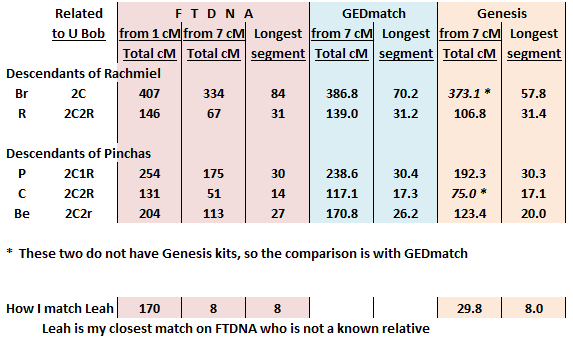

The adjustment of the FTDNA threshold from 1 cM to 7 cM lowered the Kwoczka cousins' matches with Uncle Bob by 73-91 cM. Leah's matches with me went down by 162 (!) cM, about twice as much.

The total matches on GEDmatch are significantly larger than the 7 cM FTDNA matches. I think this has to do with the algorithms.

The Genesis matches are somewhere in between - smaller than the original GEDmatch but larger than FTDNA.

One of the oddities here is the longest segment. There might be some algorithm issue, but there should be no threshold issue. For three of the Kwoczka cousins, there is no significant difference between FTDNA and GEDmatch. For the match between Uncle Bob and Cousin Br, the longest segment according to FTDNA goes from 24,778,179 to 112,771,988. The GEDmatch numbers are very close to these, though the length in cM at FTDNA is 20% greater than at GEDmatch.

The more significant difference is between GEDmatch and Genesis. They start and end at about the same places, but Genesis has a break in the middle, such that GEDmatch gives us a length of 70.1 cM while Genesis has two segments totalling 66.7 cM - nearly the same.


The longest segment between Uncle Bob and Be is different. FTDNA and GEDmatch show near identical results, but Genesis is about twenty-five percent lower. But it is not because of a gap in the segment.
Here the beginning of the segment is significantly different.

I long ago decided that I don't really need to know why these results are different from one company to another. I just have to choose one and work with it. So now that GEDmatch has moved on from the old standard, Genesis is where it's at.


Housekeeping notes 
Order here.
European Jews have always married mainly within the tribe. Whether our numbers five hundred years ago in Europe were four hundred or four hundred thousand, the pool was limited. As a result, the members of the tribe today are all related to one another, multiple times.  This phenomenon, known as endogamy, makes Jewish genetic genealogy very difficult, often impossible. There is a similar phenomenon in some other population groups.

I was convinced that this brick wall is not as impenetrable as it seems, at least in some circumstances.

I believe that this book demonstrates that I was correct.

When I decided I wanted to write a book, I was not sure if I wanted to write a “How to” book or a “How I did it” book. The decision was dictated by the facts in the field. Different family structures, widely different numbers of living family members, and other similar factors dictated that writing “How to” would be irrelevant for most researchers.

“How I did it” is more likely to be helpful to the research community and more likely to instill the confidence necessary for such a project.

It is my hope that this book will encourage and inspire other researchers of their European Jewish families and other endogamous populations to say “I can do this!”

Monday, February 11, 2019

Politzer

Customers of Family Tree DNA are familiar with the match alerts we get from time to time, whether our own kits or the kits of members of our projects.
As I manage over a hundred kits, I am not about to stop what I am doing to look at these every time I receive one and in any case, I want to see how a match fits not just with me  but with other family members including those not close enough to warrant an alert. So nearly two years ago, I decided to look at all the new matches across my family members every few months. Then I write to the ones that look interesting and ask them to upload to GEDmatch to see if these matches are on shared segments.

Usually nothing much comes of it. Even when the DNA points to a very specific portion of my family, the match usually doesn't know any of my surnames or even my geography.

Last week I prepared the matches for the past four months and Sunday I sent out messages to the scores of matches who looked even a little bit promising. So let me tell you about Cynthia, who happens to be the wife of a fellow I actually know.

So I asked her to register for GEDmatch/Genesis and after it batched I looked at her top 20,000 matches using the Tier1 one-to-many search. She matches seventy-eight of my kits and I did some chromosome browsers to see how her matches line up in family groups. As usual I was looking for segments of over 10 centiMorgans with multiple meaningful matches with my families.

On chromosome 3, she matches seven of us - four of my parents' children, one first cousin and two second cousins, all pointing to my maternal grandfather's side. All we have there are the surnames Gordon and Kugel. And it was a small match anyway, so probably from a pre-1800 common ancestor.

Chromosome 5 showed a 12 cM match with a pair of second cousins in the Nachman Pikholz branch of the family. Not much with that either - but if Cynthia had the relevant surnames, it could have been nice.

Chromosome 6 had two segments of minor interest - one with some second and fourth Pikholz cousins of mine and another with one first cousin and three second cousins on my maternal grandmother's Rosenbloom side. Here too, we have no other surnames, but we do know that the
family lived in Borisov (Belarus) for at least half of the 1800s.

Both chromosomes 16 and 20 brought matches with small groups of my third and forth cousins on
the Pikholz side.

Chromosome 22 has seven descendants of my Pikholz great-great-grandparents. Both of these ancestors are Pikholz.

Then there is the X, chromosome 23. The relevant matches look like this.


The four nearly identical matches belong to two of my sisters, my father's brother and my fourth cousin Lydia. They all triangulate, so they are all from a common ancestor.

This cannot be from my grandfather, because Uncle Bob gets no X from his father. So we know it's my grandmother's side. So given Lydia, who is part of my grandmother's paternal grandmother's Zelinka family, how exactly does this fit together and who is the candidate for the common ancestor?
Uncle Bob is a third cousin to Lydia's mother
so we and Lydia are fourth cousins.
Nathan / Nahum Zeinka's fallen gravestone
Our most recent common ancestral couple are Isaak and Sari Zelinka, who were born in the mid-1780s. But Lydia's second-great-grandfather Nathan Zelinka received no X from his father, the source of the match between Lydia and Uncle Bob must be from Sari, Isaak Zeinka's wife.

Nearly two years ago, Uncle Bob's daughter Linda and I were in Slovakia, together with our fifth cousin on the Zelinka side, Cyndi and while in Zilina we met Lydia. In the course of taking down her family information, I asked if she knows anything about our third-great-grandmother Sari. Lydia said that she understood that her surname is Politzer. This made sense to me because many years ago, my grandmother had told me that her father was related somehow to Joseph Pulitzer - he of the prize. - but she had no idea how. I have tentatively recorded Sari as Politzer, pending some kind of actual documentation.

So last year, Lydia gave our third-great-grandmother a name and perhaps a family and now we have an actual bit of her DNA.

(Note, I could have seen this with an analysis of Lydia, having nothing to do with Cynthia, but I didn't - so I can thank Cynthia for that.

Caveat - it is theoretically possible that the segment comes from my grandmother's MOTHER's side and that Lydia has some unknown ancestry in Hungary, but I consider this to be a vanishingly small possibility.

The Matching Segments tool on GEDmatch does not include the x chromosome, but on Genesis it does. They call it "Segment Search" and it is on Tier1. There are about three dozen people who share that match with both Uncle Bob and Lydia and I suppose I should write to them. Maybe something else will turn up.

(What I don't understand is why Uncle Bob and Lydia do not show up on Cynthia's Segment Search. I'll have to speak to GEDmatch about that.)

Housekeeping notes 
Order here.
European Jews have always married mainly within the tribe. Whether our numbers five hundred years ago in Europe were four hundred or four hundred thousand, the pool was limited. As a result, the members of the tribe today are all related to one another, multiple times.  This phenomenon, known as endogamy, makes Jewish genetic genealogy very difficult, often impossible. There is a similar phenomenon in some other population groups.

I was convinced that this brick wall is not as impenetrable as it seems, at least in some circumstances.

I believe that this book demonstrates that I was correct.

When I decided I wanted to write a book, I was not sure if I wanted to write a “How to” book or a “How I did it” book. The decision was dictated by the facts in the field. Different family structures, widely different numbers of living family members, and other similar factors dictated that writing “How to” would be irrelevant for most researchers.

“How I did it” is more likely to be helpful to the research community and more likely to instill the confidence necessary for such a project.

It is my hope that this book will encourage and inspire other researchers of their European Jewish families and other endogamous populations to say “I can do this!”