Showing posts with label Pikholz. Show all posts

Monday, September 18, 2017

Our Genetic Portrait - Part One

DNA Painter
A few months ago, I came to the conclusion that I have been spending entirely too much time on the trees and not enough on the forest. I would hear from people who think they may be related to my family and I'd look at their GEDmatch kits, comparing them to my 110+ project members looking for segments with multiple matches of 10 centiMorgans or more to see what patterns would show up.

Most of them showed some direction, but nothing really specific, appearing mostly to be too far back in time to do anything with, especially without the benefit of common surnames, geography or multiple family kits

I decided I needed to do some chromosome mapping in order to attribute particular chromosomes to specific ancestors. I had used Kitty Cooper's wonderful Chromosome Mapper a few years ago, but I was far from comfortable with it. I circled the Chromosome Mapping course at GRIP next June and wondered if it would relate to the specific issues of endogamy.

A couple of weeks ago, someone on Facebook mentioned a new tool called DNA Painter and I decided to give it a try. This is a report on my first efforts. The chart below shows my first 183 segments - 60 on my father's side and 123 on my mother's side. And there will be more.

In the course of creating this map, I have been in contact with the developer and he has welcomed my comments and questions. There is a lot to like here.

The data comes from the GEDmatch one-to-one and X-one-to one results.

What you are probably supposed to do is take all your matches with a particular person and copy them into the Painter, but this is not a responsible way to deal with families from endogamous populations.

For us, we have to go segment by segment, analyzing each one, looking for matches with multiple people that are based on more than "I match cousin so-and-so, so we must be related IN THE MOST OBVIOUS WAY." Not necessarily. I'll get into that in greater detail on my mother's side.


First note that this profile is called "Israel Pickholtz family," not just "Israel Pickholtz." I saw no reason to use only my own segments when my brother and four sisters have segments from those same ancestors which can only enhance my map. That decision required calling this profile "female" because my sisters have a paternal X, even though I myself do not.

I decided to take the next, obvious step - the ancestral matches of my father's sister and brother, Aunt Betty and Uncle Bob, since all their ancestors are also my ancestors. But their matches are not the same as my father's matches (as represented by his children), so there will be places where the final map will include segments from both my grandfather and my grandmother AT THE SAME PLACE. This is a good thing, because it fills out the ancestors, but it will require extra care when some new person comes into the picture with a match that needs defining.

Mapping my father's side
I began with my fourth cousin Anna, the great-granddaughter of Uncle Selig about whom I have written several times.
This chart may be familiar to you from my DNA presentations.
The circled matches on Anna's chromosomes 3, 8 and 15 are definitely from our second great-grandmother Rivka Feige Pikholz and are the basis of the demonstration that Anna and her half-brother David are descendants of Uncle Selig. I also included Anna's matches on chromosome 21, as these are clearly from the same source.

But I tend to be conservatiive, so on chromosome 15 where Marty and Anna share 50 cM, I decided to record as certain only the 22.6 cM that Anna shares with Marty and Herb. The rest of Anna and Marty's long segment I recorded as "possible," though I could have chosen "very likely." Here is how that segment appears in full.

Another set of Rivka Feige matches came from my father's half second cousin Lia who contributed five segments to the map. These are the Rivka Feige segments from Anna and Lia.


Note that on chromosome 15, one segment is pink rather than red. That is Marty's "possible" segment.

The second easy match was with Debbie from North Carolina, whom I wrote about in May 2016. She has one large match with us on chromosome 2 and and another on the X. The first is definitely from my second great-grandmother Mari Zelinka and the second is either from her or from my grandmother's Bauer/Stern side, but since I have seen no other indication this might be the case, I attributed the segment to the Zelinkas and called it "very likely."

Together with two segments from my fourth cousin Milan in Prague, this is what we have from Mari Zelinka.

There is also a single segment in purple which we received from Mari Zelinka's father - based on a match with my fifth cousin Cyndi Norwitz on chromosome 18.

Two other easily identifiable ancestors on my father's side are my great-grandmothers Regina Bauer and Jute Lea Kwoczka. The first I established using fifteen matching segments with my father's second cousin Shabtai and the second using nineteen segments with my father's second cousin Bruce and another eleven with my third cousin Pinchas. Here is how those appear.


This gives me a total of sixty segments of low-hanging fruit on my father's side, supposedly representing 36% of my the ancestral DNA from that side.

But in fact that is not correct. As you can see clearly on chromosomes 3, 8 and 18 there are overlapping ancestors. Different versions of the same segment from different ancestors. Here is where I have to be very careful when I want to look at matches with new people. And the 36% is nםt representative of all the ancestors on my father's side - it just refers to segments which have at least one ancestor represented.

Perhaps I shall redo the map later, so I can show a separate set of chromosomes for each of my paternal grandparents.

My mother's side is a different story entirely and I hope to tell you about that next week.

For now I shall wish you all a happy, healthy, peaceful and prosperous 5778 and that you and your families should be written in the Book of Life.


לשנה טובה תכתבו ותחתמו

Housekeeping notes
When I visited the cemetery in Vienna a few months ago, I reported that several of the family graves had no tombstones or had tombstones in very bad condition. I was kind of hoping that close family members might address this and I can now report that one actually did. The grandson of Isidor Riss sent me photographs of the stone he put up for Isidor (who died in 1937) and his wife Ernestina who was killed in Auschwitz. 

In other news, I had a look at my Ancestry DNA matches for the first time in a long time and dropped a note to a woman named Andrea whom I didn't recognize but who seems to be fairly closely related. Turns out she is the daughter of a second cousin on my mother's paternal side. I knew her name but we have never met. I asked her to join GEDmatch and she said she would. Meantime we are now Facebook friends.

Thursday, December 4, 2014

Small But Meaningful Segments on DNA

Some short but meaningful segments, all of them about DNA.

(Note: There is now an email sign-up box, here on the right. Thanks to genealogy blogger Lara Diamond for showing me how to do that.)

Lazerizing my mother
Recreating my father's DNA using Lazerus last week was easy. I mean, he has three descendants who have tested, both his brother and his sister and one of his two living fIrst cousins. I didn't need to use the first cousins once removed and the second cousins and I still got about 62% of his 22-chromosome set.

My mother is another story. The same three descendants for Group 1, two of my sisters and I. But my mother's two brothers and two sisters predeceased her and the first yahrzeit of her last first cousin is this Wednesday evening. To top that off, Mother has only one niece and
YOU'VE BEEN LAZERIZED
one nephew we can work with and the nephew has not tested. We do have two of my second cousins on my grandfather's side who have tested. One on my grandmother's side has tested but I cannot get her onto GEDmatch. So all we have for Group 2 are Kay, Ruth and Judy - the last two first cousins to one another.

The resulting kit is about 36.6% of a full set of 23 chromosomes - including the X - if I have the math right. I am quite sure that we have some endogamous segments here from Ruth's father and probably from Ruth and Judy's grandfather, so maybe it's just 32% or 28 %. But since I am not planning on doing anything with my mother's kit for now, it doesn't matter.

I am just trying to get a handle on how many people we need in Group 1 and Group 2 (and how close) in order to get some meaningful results. GEDmatch will not do "one-to-many" comparisons with the Lazerus kit unless it gets over a certain threshhold and Mother's kit passes that test.

Meantime another of my sisters has ordered a test.

Matching my mother-in-law
Tuesday evening Jerusalem time, I posted the following on the Facebook pages International Society of Genetic Genealogy (ISOGG) and Tracing the Tribe, as well as my own timeline.

It provoked quite a few "Likes" and comments.

My point was not to be entertaining, though it certainly got its share of yuks (and some yucks).

My point was to say something about endogamy and how and why I do what I do with autosomal DNA.

I would guess that of those using DNA for recent genealogy (not, for instance, deep ancestry or medical matters), almost all are either looking for new relatives in hopes of working their ancestry back additional generations or are looking for specific unknown individuals, as in cases of adoption and abandonment.

The problem with Jews using DNA to look for new relatives is that when you get right down to it, we are all related, very possibly in the last fifteen-twenty generations and often many fewer.

We keep marrying withing the closed tribe and we share many ancestors, not only with others but with ourselves. So when someone shows up as a suggested fourth cousin (on average about 50 cM of matching DNA), the relationship is usually composed of multiple incidents of more distant cousinhood.  Sixth, seventh and eighth cousins share on average12.5 cM, 6.25 cM and 3.125 cM so there are many ways to use small numbers to build to the 50 cM that makes it look like fourth cousins.

This is not as much of an issue with close cousins. Second cousins share an average of 200 cM, so some distant cousinhoods floating around in the background are part of the margin of error and don't really affect the larger number.

I am not looking for new relatives, nor do I have specific missing fathers or grandfathers to look for. I won't say that what I am doing is unique, but I can say that no one I know is doing it. 

My Pikholz research is single-surname. I have a number of Pikholz lines that go back to 1800-1830, three with pre-1800 patriarchs. I also have a few lines that only go back to the mid- or late-1800s because the name of the partriarch or matriarch is too common to identify further. I am using DNA to figure out how those families connect to one another back then.

Although I am still on the trail of documented proof, I have reduced the number of "free-standing" Pikholz families from Skalat by at least two and have laid the groundwork for at least four more, pending tests that are either in process or in begging-mode. I have also disproven at least two putative connections, when DNA did not show the expected results, (and not due to "false fathers").

I discussed some of that recently here and here, for instance.

This works. Slowly and carefully. Trying not to jump to conclusions. Doing my best to remain relatively free of endogamy.

Yes we are all related. But some of us are more related than others. I think I can demonstrate it. (See "Moshe Hersch" below.)

But back to my mother-in-law
Awhile back, I decided to get a DNA sample from my wife's mother, since she is the last of her siblings and on her father's side, the last of the cousins. I figured some day I might have reason to work on her family and who knows if she will be here by then.

I had no intention of doing anything but skimming the results, for now.

But her results showed matches with seven of the nine descendants of my great-grandparents, four of whom including Aunt Betty and my sister Amy are suggested third-fifth cousins. On the other hand, my sister Sarajoy is among the missing. She also matches both Kwoczka cousins, from my g-gm's family.

My mother-in-law also has remote matches with eleven other Pikholz descendants, including the putative descendant of Uncle Selig. Also Jane, who looks to be quite close to my own family.

So this really does seem focused on my personal family, probably from the Kwoczka side. She does not match any of my four first and second cousins on my mother's side.

My mother-in-law's mother was born in Przasnysz Poland and her father's family is from Kurima Slovakia. I am curious which of her sides is connected to my father's people, so I wrote to some of her first cousins on her mother's side and first cousins once and twice removed on her father's side, asking them to test. We'll see how that goes. The first three have agreed to test..

I have no idea what I am getting into with this.

Meantime, I'll let this exchange speak for itself.

Moshe Hersch
Two posts ago, I wrote about the second cousins Charles and Leonora, whose great-grandmother Sara Pikholz (~1847-1887) is the daughter of Moshe Hersch. I also wrote that the second cousins Jane and Nan are the great-granddaughters of Berish (1837-1918), whose father is also Moshe Hersch.

I suggested that these two Moshe Hersch may be the same person, which would mean that Charles and Leonora are third cousins of Jane and Nan.

At the time, we had test results from Jane, Leonora and Charles. Nan and her two children had submitted Family Finder tests. Nan's daughter's results just came in.
I couldn't have hoped for better than this
And the chromosomes look very good - see the nicely triangulated bits on 2, 16 and 20. Nan's results can only make this better.
 
Nonetheless, there are two things that bother me here. First, if Charles is indeed a third cousin of Jane and Nan, then their parents are second cousins. So why was there no known contact between Charles' mother in Newark and the others in the Philadelphia area either as part of the 1939 immigration or afterwards? I do not think that Charles' mother would have been closer to Sam Marenus (who assisted with her immigration) than to Jane and Nan's family. This does not necessarily indicate a problem with the "one Moshe Hersch" theory, but it does raise a small doubt.

The other is the given names. Berish has children named Olga (Alte), Anna (Chana), Fannie (??) and Odessa-born Vodolya Volodya* (Zev/Wolf). Sara, Berisch's putative sister, had Josie, Perl, Osaias, Leisor, Jenta and Taube. I would have expected at least a few names to appear in both families. Again, it proves nothing, but it makes me uncomfortable.

Small segments
In recent days, there has been quite a bit of very lively discussion on Facebook on the value of small segments of DNA in evaluating matches. The consensus is, and has loing been, that small segments are not really indicative of inherited DNA in any meaningful sense. There are, of course, differences of opinion about what size segments should be ignored because of their smallness.

Blaine Bettinger responded to the debate with a major article, full of numbers and graphs. I have not yet read it but I understand that he presents alot of statistics about the likelihood of small segments being useful and about what exactly is a  small segment.

The article has prompted a new Facebook discussion about the article itself.

It is my nature to distrust rules that put everything into a single category and that's how I feel about small segments. Sometimes they are meaningful and useful, sometimes not.

When I reconstructed my father's DNA using Lazerus (described last week in Genes From My Father), I happily accepted all small segments of whatever size because those small segments were in the DNA of at least one of his children and at least one of his brother/sister/first cousin. If I have a particular small segment, I must have received it from my parents. If my father's brother (or sister) has it as well, then it is eminently clear to me that I got it from my father and that it came to him and his brother from my grandfather. And it is not reasonable to say that a sliver of that small segment might have come from my mother, because my father's people share it.

Whether that segment came down unchanged and intact from one of my great-grandparents can be a matter of legitimate debate. Whether it came unchanged and intact from someone two-three generations further back can be a matter of legitimate doubt.

That's my story and I'm sticking to it.

Housekeeping notes
Seven Eight Pikholz descendants, all from Skalat, have ordered Family Finder tests in the last week.

*Thanks to Liba Zilber for correcting my typing error.

Sunday, August 17, 2014

What DNA Came From Which Ancestors

As I have gotten older, I have become more hesitant just diving into new technology. Invariably, once I get into it, I get used to it fairly easily, especially when I really need what it has to offer.

A few days ago, I finally got into mapping chromosomes with the help of two graphic tools from Kitty Munson Cooper, whom I met in Salt Lake City.

The object of this exercise is to see which bits of my own DNA can be traced to specific ancestors, or more correctly to which ancestral couple. (An extension of that would be to reconstruct the DNA of those ancestors, but that is another story.)

I am going to present here only my paternal side. I expect to see test results from two second cousins from my mother's side and I'd rather wait on those before drawing conclusions there.

Segment Mapper
I have ten known relatives on my father's side who have tested. Seven are descendants of my great-grandparents Hersch Pickholz and Jutte Lea Kwoczka. One - Ralph - is a great-great-grandson of one on my great-grandfather's sisters and the other two are the grandson (Bruce) and great-grandson (Pinchas) of my great-grandmother's two brothers.

The other seven are my sisters Amy and Sarajoy, my father's sister Aunt Betty, my father's first cousin Herb, my double second cousin Lee and two other second cousins Terry and Rhoda.

The chromosome browser provided by Family Tree DNA, allows a comparison to only five people at a time. Kitty's Segment Mapper allows comparison to as many as forty people at once.  Soon enough I'll try more comparisons, but for now all I need is ten.
I left out the X chromosome since that is only from my mother's side.

Ralph has two bright green segments in chromosome 1 and another in chromosome 19, all of them overlapping several descendants of my grandparents. Since Ralph is on my great-grandfather's side, these segments must be from his parents Izak Fischel and Rivka Feige.

Pinchas has the same kinds of matches on chromosomes 1 and 7 and Bruce has one each on chromosomes 1 and 16, so those segments would be from my great-grandmother's parents Mordecai Meir and Bassie.

Chromosomes 4 and 20 have matches only from the four people who come from my grandmother's side - my sisters, Aunt Betty and Lee. None of the other Pikholz appear there. That indicates that the entire length of those two chromosomes are from either my grandmother's Rosenzweig side or my mother's side.

There is a nice match involving Ralph, my sisters and me on chromosome 3, but no one else among my father's relatives. I have not included that because it is quite possible - prehaps even probable - that this represents a connection between Ralph and our mother's side.

Many of the remaining segments are pretty clearly from my great-grandparents, but we don't know enough to say which of them. Yet.

I should be able to add additional segments to my specific ancestors by using someone other than me as the base. That would be the case if Ralph or Pinchas or Bruce matched a handful of my father's family members, but not me. I am not sure there is a tool for this.

Chromosome Mapper
So what does it look like? I ran it through the second of Kitty's tools, the Chromosome Mapper.

As I say, I am trying to be conservative here, so I did not label any of the sections of the middle chromosomes, even though the first figure shows a high likelihood that there are segments on my Pikholz/Kwoczka side.  I'd like a bit more proof there.

I am also aware that all of this is tentative because the chromosomes come in pairs and it is possible that when I have a match with two people at the same place, one might actually be from my mother's chromosome and the other from my father's. I need to figure out an efficient way to check this. (See my remark about chromosome 3 above.)


But thanks to Kitty, the process wasn't hard. I think I am getting the hang of it. I should be able to add some other Pikholz descendants to the segment mapper and we'll see what shows up. But not this week.

Housekeeping notes
We are away for a few days, so I may not be as responsive as usual.

Sunday, May 4, 2014

A Party on Chromosome 6

A couple of weeks ago, I received an email from Dr. Steven Turner in the United States telling me that he had some DNA matches with a number of people in our DNA project. At first, he thought he matched eight Pikholz descendants.  I gave him my standard response about our project's being about how to connect our own families with one another, not so much about connecting with non-Pikholz from the pre-surname period two hundred-odd years ago. And I told him that if he matches more than half of our twenty-seven Pikholz testees, we could talk.
That twenty-seven is a new number. We just received results for my double second
cousin, Lee. Our grandfathers are brothers and our grandmothers are sisters. .I really wanted his mother to test, but it didn't work out. Lee ought to match the other Pikholz very much as I do, but that is not the case at all.

I have thirteen matches within the Pikholz group and Lee has eighteen. In additioon, we have a documented fifth cousin named Cyndi on our grandmothers' side, whom I match accordingly. But Lee matches her much closer - probably due to something on his father's side. I have not gone back to check how Lee matches with the non-Pikholz I have discussed here earlier, but for the newest ones, his place in the DNA analysis is prominent.

Yet another reason that we should test as many people as we can and not just say "Well, my third cousin already tested."
So Steve Turner had a closer look via the ancestral surname window on FTDNA and it turns out


he is a match for fifteen Pikholz descendants. That put him across my threshold of 50% and I had a closer look.

He also matches both my Kwoczka cousins, descendants of the brothers of my great-grandmother. In fact, one of those, Pinchas, is better than all of Steve's Pikholz matches but one.

He joined our surname project at FTDNA, making it easier for me to examine his data. He added his mother to the project as well. She matches fourteen Pikholz, and not all the same as Steve. So clearly he has matches with us both on his mother's side and on his father's side.  (Steve's father's family is from Rohatyn, which is between Rozdol and Skalat, so there is some geographic logic to that.)

So I ran Steve's results on a chromosome browser against all his Pikholz matches, as well as his matches within the non-Pikholz who match most of us. There were a number of very interesting matches, but the match on chromosome #6 was remarkable.

Look at his matches with our group on chromosome #6 between the two vertical red lines on the left. He matches nine Pikholz (the ones whose names are underlined in red) and twelve non-Pikholz. He also has four significant matches towards the center of the chromosome, between the blue vertical lines. Now I have to figure out how to do more with those twenty-one matches on the left.

Well, the one thing I know how to do is to look at those same twenty-one people against Steve's mother. Some of them do not match at all and I omitted them from the comparison below.


The whole group on the left has all but disappeared. Those twenty-one matches of Steve's do not come from his mother. But the large matches towards the center, with Terry and Herb, together with the smaller match with Vladimir, are still there, so those must be matches on Steve's mother's side. Plus a match with Pinchas in the same place, that Steve didn't have.

But aside from the DNA party on chromosome #6, there were a number of other interesting areas. I present here, in table form a number of areas in chromosome #10 and one in chromosome #15. The column headings are: name of the person who matches Steve, chromosome number, spot where the match begins, spot where the match ends, "length" of the match in centiMorgans and number of matching SNPs.


On chromosome #10 on the left, there are six areas with interesting matches, some of which are known close relatives (Marla and Hartley in the third and fourth segments are siblings as are Douglas and Pamela in the fifth), but in general, most are people whom we do not know to be related either to us or to each other. But obviously they are. Probably in the 1700s.

The experts tell us to ignore the small matches, the ones with fewer than four or five or eight centiMorgans (depends which expert you ask). The small segments are supposed Identical By State (IBS) which means they are just left over from some really ancient ancestor and not significant for us today. The larger more interesting matches are said to be Identical By Descent (IBD) which means they match because of some relatively recent, theoretically knowable, mutual ancestor.

But look at the matches on chromosome #15 in green, above. (Or below or wherever Blogger has decided to put them today.) These are all very small matches and nine of the eleven are perfect matches. None of the eleven are as close to one another as second cousins. So I take issue with the IBS/IBD distinction especially when a large group share that small match. I mean, it had to come from somewhere, no? And if it were ancient, would it really have preserved itself in so many distantly related descendants - known to be related by other parts of their DNA?

I really have to learn more about this analysis business. Eleven weeks until the course at GRIPitt.

Sunday, June 30, 2013

PICKHOLTZ, BERNSTEIN and FRIENDS (or maybe relatives)

(Part two of two - see part one here)

Last week, I looked at the Pickholtz-Bernstein family who came to the United States from Skalat in 1890. We do not have all the details of their first years in the US, but the main gap in the story is what happened to David Bernstein, who was eleven months old when the ship sailed.

This week, I want to have a closer look at the other two Skalat families who followed the Pickholtz-Bernstein family on the passenger manifest, almost consecutively.
Lines 206 and 212-214 are people who seem
to be unconnected to the Skalat families.
You can see the actual manifest, but it is easier to work from the transcribed information presented here on the right.

I spent a morning looking at the JRI-Poland vital records for both the Kaczors and the Aberbuchs. (This was complicated by the fact that their "sounds-like" algorithm does not think that Aberbuch sounds like Auerbach, even though the same people are listed both ways.)

I'll spare you the details, but I did find two connections between Aberbuch and Kaczor. The more obvious (but perhaps less useful) is Nuchim Kaczor who married Lea Auerbach. They had six children in the period 1891-1901 in Podwoloczysk and in one of the birth records, Lea is identified as being from Skalat.  I don't see anything connecting them to anyone else in our story.

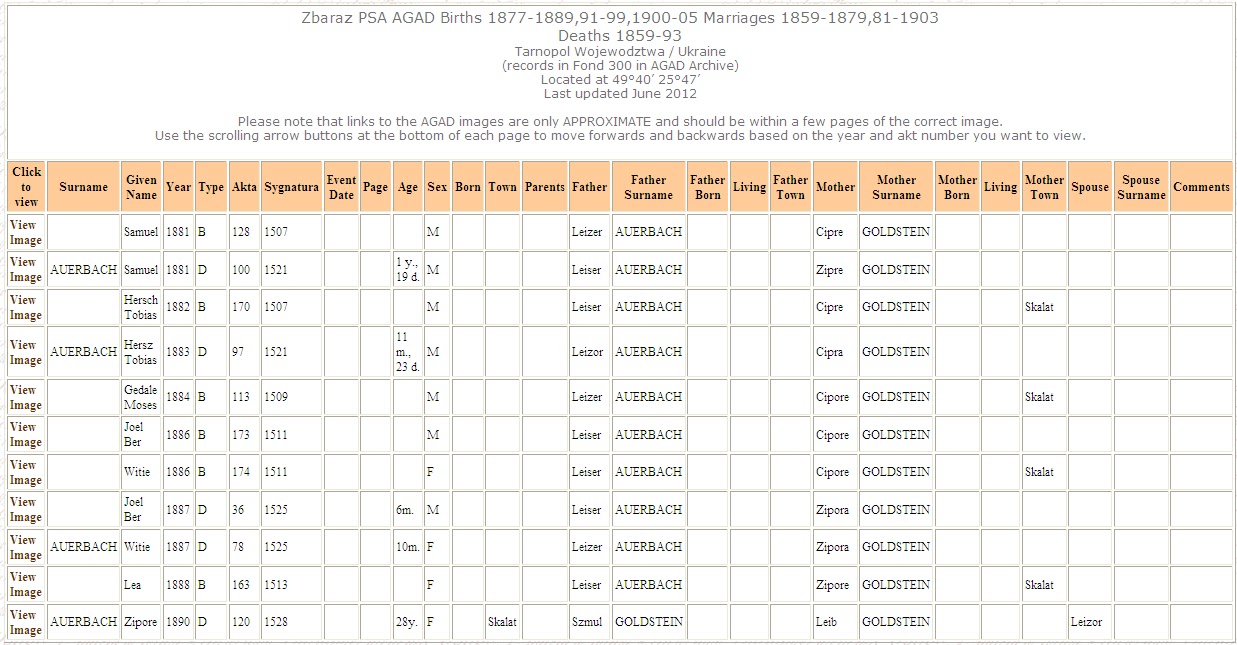
The other is Leiser Auerbach and his wife Zipore Goldstein. They had six children 1881-1888 in Zbarazh. In several of the records, Zipore (aka Cipre) is identified as being from Skalat. Zipore died in 1890 at age twenty-eight having buried four of her children at between six and thirteen months of age.

Here is the thing. Zipore Goldstein, the wife of Leiser Auerbach is the sister of Rifka Kaczor, the wife of Rachmiel from the passenger manifest.

I would not be surprised to find the widower Leiser Auerbach in the United States in the 1890s or early 1900s, but I have not really looked for him there.

I have no idea if Leiser is closely related to Aron from the passenger manifest, but if he is, it would not surprise me one bit.

I saw no connections between Aberbuch and either Pikholz or Bernstein.

The Kaczors of Skalat are a much bigger project. In fact, I know several people who are working on parts of that family - including a client of mine - but to my knowledge no one is looking at all the Skalat Kaczors in a single project.

Probably 340 out of these 357 search results are in Skalat itself. A large family.
I started with a search for "surname sounds like Kaczor" and "given name sounds like Rachmiel." There were thirty-six records in the Tarnopol area - twenty-nine in Skalat and one family of seven in Podwoloczysk. ("Sounds like Katcher" produced those same results.) There is nothing there that tells us anything about Rachmiel's parents, so unless someone dives into this on the American end - death or cemetery records, for instance - there is not much to do on that.

Searches for records which include both Kaczor and Bernstein come up empty and, of course, had there been and Kaczor-Pikholz connections, I would have been all over them long ago. (That said, I have a low priority interest, considering the possibilty that Kaczor, Kaczka and Kwoczka all come from a single source.)

So why is this any more than several families from the same place travelling together? Maybe it isn't. But still, let's see what else we have.

First of all, in discussions a few years ago, Lee Katcher, the late Norman Kotcher and Steve Pickholtz concluded that one of the Kaczors lived with Steve's grandfather while in school. I don't know the specifics - not even if he was from the family on the passenger list - but they felt thatthis was an indication of a family connection. Maybe. Or maybe it was just good friends from the old country.

Then there is a mortgage document in the names of "Berisz Pickholz and Sarah his wife, Rachmiel Katcher and Rochil his wife, [Heren?] Katcher and Catherine his wife and Bluma Barenstein." (Note that Rachmiel's wife was Rifka on all previous documents.) A second document is similar but does not include Bluma. They are identified as being from New York City. The documents are dated June and July 1890 and refer to land purchases in Pittsgrove New Jersey. Pittsgrove is just a couple of miles from alliance where Sarah was buried eighteen months later, so at least Berisch and Sarah must have actually lived there.

Here again, this joint mot\rtgage may be a sign that we are talking about family. Or maybe it was several Skalat families participating in the experiment that tried to make New Jersey farmers out of east European Jews. This plan is probably what put them on the same voyage. How long they remained farmers, who knows. Local Pittsgrove records probably can shed light on that period.

This is Steve's project, but perhaps someone reading this might have something to suggest. I for one have no experience with US land records. Nor do I have the time or inclination to acquire that experience at this time.

BERNSTEIN
This is a good time to make some additional Bernstein comments.
I did an "exactly" search rather than "sounds like" so as not to get all the Braunsteins. Another large family.
There are three researchers listed in the JewishGen family Finder doing this large family. Two of them seem to be active and I am in contact with one of them. Many of these Bernsteins - may all of them - are kohanim.

We have at least one other Pikholz connection in that Bernstein family.

In 1955, a woman named Haya Henkin in Rehovoth submitted a Page of Testimony to Yad Vashem in memory of her sister Betka / Boncia Bernstein of Skalat, who was married to Berl Pikholz. They had three sons - Josef, Moshe and Aharon, all of whom were killed.

I spoke to Haya's daughter Malka on Kibbutz Saad, who also filed a Page of Testimony for Betka. She confirmed that this is the Bernstein family who are kohanim. She did not know anything about her Uncle Berl, so I do not know where he fits into our families.

Neither Haya nor the daughter knew the ages of the children.

Betka was born in 1902, so her husband could be one of several Berls we have who were born in that period. Perhaps we will know later on.

Sunday, April 7, 2013

UNCLE SELIG

I think I have mentioned Uncle Selig briefly once before, but since I have no idea how to search my entire blog history in one go, I cannot be sure. If anyone knows how to do this, I'd be pleased to know for future reference.

Many years ago when I was collecting family genealogy rather than doing actual research, my knowledge
of my Pickholtz was limited to this.

Morris, the youngest of the children of Hersch and Jutte Lea, is my grandfather.

Hersch was probably born in the early 1850s and the sisters were a bit older.

My father then made his only contribution to the family history, telling me a) that his grandfather Hersch Pickholtz had a brother Jachiel and b) that Hersch Pickholtz had an uncle Selig Pickholtz, who lived in the same area.

My father's grandfather died when my father was eight years old, so my father knew him a bit, but he had no recollection of how he happened to pick up this bit of information about Uncle Selig. Surely Hersch had other aunts and uncles. What was significant about this one that he should have been mentioned?

In any case, I made the notation and the picture in my head became this, including the addition of the name of Hersch's mother and the fact that the surname had been spelled Pikholz..

We started the Pikholz Project nearly fifteen years ago and at some point we (Jacob Laor and I) decided to order records from the AGAD archives in Warsaw. This was before JRI-Poland began indexing records from east Galicia, so we were quite on our own.

We began with Skalat, which we had begun to realize was where many of the Pikholz families came from, and as I recall, our first order was for about thirty records - mostly births and a few deaths. We had no idea what we would be getting.

Among those records was the 4 October 1862 birth of Isak Josef to Selig Pick and Chane Kaczka. We knew that some Pikholz were recorded as Pick, but some really were just that, so we could not draw any conclusions about this one.

We also received a death record for Isak Josef Pik, age 78, who died on 21 March 1862 and it appeared that the October baby was named for the man who had died in March.

At about the same time, I ordered some records from Zalosce, where Hersch and family lived, and I learned that my grandfather's older brother Uncle Joe, was not Josef Isak, but Isak Josef.

Other records came in, including the birth in 1871 of Markus to David Zeiler and his wife Mincie Pikholz, the daughter of Selig and Chane. This and other related records made it clear that these Pick/Pik records were ours. So clearly this Selig - even now the only Selig anywhere among the Pikholz descendants - was the uncle of my great-grandfather Hersch Pikholz. And the fact that Hersch and Selig had both named a child Isak Josef, were a strong indication that the Isak Josef who died in 1862 was a common ancestor.

But that created another problem. Isak Josef could be the father or grandfather of Selig easily enough, but ISAK Josef could hardly be the father or grandfather of ISAK Fischel. That's just not the way Galicianers did things.

And there was an additional problem. My father had specifically said - because he had specifically been told - that they lived in the same place. But Hersch and family lived in Zalosce while Selig lived in Skalat. (Well, we knew that Hersch's wife's family, the Kwoczkas, were from Zalosce. Hersch himself seems to have been born in nearby Podkamen, a place with no records. And Skalat was quite a ways from Zalosce and Podkamen.)

So I applied the Sherlock Holmes logic ("when you have eliminated the impossible, whatever remains, however improbable, must be the truth") and came up with this scenario. Selig is not the brother of Isak Fischel but of his wife Rivka Feige, who was almost certainly born in Skalat. For reasons unknown, she married Isak Fischel [surname unknown] and they lived in Podkamen, where he was from. Three of their four children married people from Zalosce and lived there, but the daughter Bassie was sent back to Skalat to marry - that part is not speculation, we know it as truth.

That scenario gives us a new diagram, one that is not influenced by what we have since learned

about the identity of Isak Fischel. It leaves open the precise relationship between Isak Josef the elder and Rivka Feige and Selig - likely their father or their grandfather, but not important for now which.

The movement between the towns and the distances involved blurs the issue of their living "in the same place," so I am not concerned about that for now.

Let me emphasize, that I have not entered these connections in my database. Selig still stands as the head of a family without being connected to parents or to a sister. I'd need actual proof to formally record them together. For now, it's just in the "comments."

But I am also left with the nagging question - why did my father know this? How important was Selig? Maybe he made the trip to visit in Zalosce. Maybe he and Rivka Feige were twins or otherwise particularly close. (We know that Isak Josef had at least one other son who lived in Skalat.) Who knows?

But there is another angle which may open the door to something else entirely.

Jutte Leah Kwoczka, the wife of Hersch came from a family who lived in Zalosce. There are no Jewish Kwoczkas anywhere else. Her father Mordecai Meir was known as Markus. Whenever the subject of Jutte Leah's family came up, it was always "Kwoczka, like duck." It was presented as the Yiddish translation.

There is another similar surname that appears in any number of Jewish communites in Poland - but in east Galicia it is concentrated in Skalat. That would be Kaczka. Selig's wife is Chane Kaczka. Her father is Markus. Perhaps the same family that is Kwoczka in Zalosce, is Kaczka in Skalat. Perhaps not only is Selig related to Hersch but their wives are cousins. That would account for his being singled out among the relatives for special mention.

Or maybe not, but it's worth considering. The most recent batch of records from AGAD includes sixteen records of Kazkas from Skalat, including the death record for Chane, Selig's wife, in 1873 at age forty-five. I have not begun to deal with them and it's not a top priority. But I am telling this story now for another reason.

The newest batch of records also includes the birth in 1896 of Bertha Zeiler, the daughter of Selig's grandson Markus. They lived in Stryyevka, just outside Zbarazh. So we now have a fourth generation for Selig - enough to officially count as a family in the Pikholz Project, not just an unconnected group.

The SELIG family now includes three children - Mincie, Markus and Isak Josef. Markus died in 1859 as a young child. We have no idea what happened to Isak Josef. Mincie and her husband David Zeiler had Markus in 1871 and Fischel in 1888 and maybe others in between. We have wives for both Markus and Fischel and now we have Bertha as well.

At this stage in our research, we celebrate the elimination of independent families which are merged into other families. I hope we shall be able to do that with the Selig family, especially since we are pretty sure how that merger would work. But for now we welcome this new four-generation Pikholz family, the family of Uncle Selig.

- - - - - - - - - - - - - - - - - - - - - - - - - - - - - - - - - -
HOUSEKEEPING NOTES:
Dina Ostrower has been chosen to light one of the six flames at the national ceremony opening Holocaust Memorial Day Sunday (today) evening. Dina is from Stryj and has been a part of the Pikholz Project almost from the beginning. Her mother was Scheindel Pickholz of the DINA family and her father was Matityahu Pickholz of the RavJG family. Matityahu's parents, Baruch and Yocheved, are both Pickholz descendants as well.

You can read Dina's story (or at least look at the pictures, if you do not read Hebrew) here.

Sunday, February 10, 2013

EVERY AVAILABLE RECORD - Part 2 (SPECHT)

The month of Adar is upon us. Here is last year's discussion of some of our Adar yahrzeits, including my paternal grandfather and my Uncle George.
- - - - - - - - - - - - - - - - - - - - - - - - - - - - -
I opened this discussion on acquiring every available record two weeks ago with examples from east Galician records in the archives in Warsaw. I continue this week, discussing American records.

There is some debate about the source of the name Pikholz. "Holz" is German for "wood" and as a result, those Pikholz who changed their names here in Israel took names that are based on words for tree - Etzion, Etzioni, Ilan, Allon etc.

There are two main schools of thought on the name Pikholz - one that it means "woodpecker" and one that it means "gatherer of wood" or some other wood-related occupation. On occasion I wondered if people moving from easten Europe to western Europe may have adopted a translation into another European language. In particular, I wondered if anyone going to Vienna or Germany had adopted the name Specht, which means "woodpecker" in German. I even joined a genealogy discussion list for the surname Specht, but everyone there has thusfar been totally Gentile.

So imagine my surprise when this showed up in my inbox in June 2007.
I recently came across your name on a Jewish Geneology website and I thought you might be able to help me. My grandmother's parents immigrated to the U.S. from the shtetl of Skalat in what was then considered Southeastern Poland, presentday Ukraine. I have been trying to locate some information on our family's history, and I was wondering if you could offer some suggestions on resources or tools for conducting the search. From my knowledge, my grandmother's father was Charles Specht from Skalat and he came to the Bronx NY during the 1910s. I was wondering if you had any info or records on his family. I am interested in connecting with my past. I could find out some more info for you if you need any. Thanks a lot and I look forward to hearing from you. David.
A Jewish Specht. From Skalat, no less, where our family comes from. I had a look at the Italian Genealogy Group marriage index (using Steve Morse's One-Step search utility) and found six Charles Specht who married in new York after 1910. One of those married a woman named Nettie Degen in 1914. David confirmed that this was the correct couple and added that they were second cousins.

There are Degens in Skalat records. We have a Degen-Pikholz couple from Skalat who had three sons in the 1870s. Maybe more, for all I know. So this whole line of inquiry suddenly looked very promising.

I found the 1891 birth of a Nechy Degen in Skalat, but the only Spechts in the area were in the Lwow/Przemysl area. I began to suspect that the connection to Skalat was only through the Degens and that the Specht-Pikholz-woodpecker axis was non-existent. Nettie's parents were Selig Degen and Chaje Perlmutter, neither of whom I recognized, but in theory Selig could have been an older son of the Degen-Pikholz couple.

David knew that his great-grandfather Charles had four brothers in New York - Louis, Harry, Jacob and Aaron, but he knew almost nothing about them. David's grandmother was not helpful. She wrote: 
Thank you for the information about my mother and father: Nettie Degen and Charles Specht.
Unfortunately, we never discussed their life in Skalat. I think it was nothing they wished to remember. My interest is purely curiousity. ... I have no wish to become involved with possible distant relations.
I had a brother and sister, many first cousins, all of whom are now deceased. I was the youngest. Their children, my children's generation, are now in their 60's and the grandchildren are not particularly interested.
My parents left Skalat to come to America to become Americans. We were Jews without religious connections. After the holocaust it was clear that Jews needed a safe haven, so Israel seemed a logical solution. IT must be a very hard life.
I wish you well and all the best.
And a few days later she wrote:
I have already told you all that I know about my family's connection to Skalat. I know of no other names than the legal names they had here in the USA. There is nothing to be gained by pursueing this matter any further. Goodbye.
Well, that certainly sounded final.

But I did want to see where the Spechts came from. I was going to the IAJGS Conference on Jewish Genealogy in Salt Lake City a few weeks later, so I figured it would be easy enough to check the marriage certificates in the library there. I had found the certificate numbers through Steve Morse's site and the Italian database and I had also asked some New York friends to see if we could find any of the graves.

These two grave photos arrived the Thursday I landed in Salt Lake City.

Nettie's birth year matched Nechy from Skalat, so that much looked good. Charles' stone has no Hebrew so we know neither his birth name (which was surely not Charles) nor his father's name. Morris is not one of the names David had given me, but he is Moshe Zvi, so he could be Harry. Morris' father is Joel.

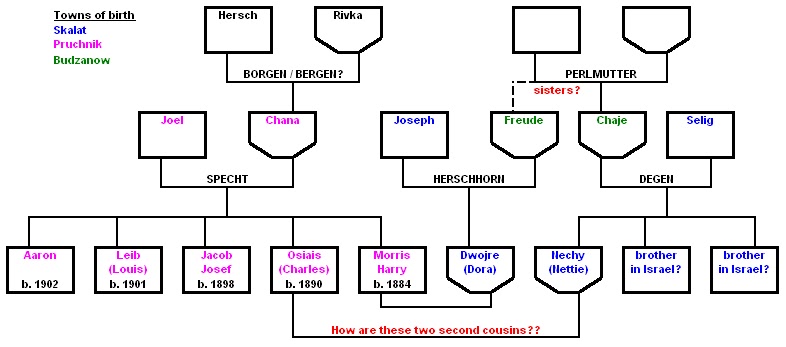
The next morning I paid my first visit to the Family History Library. It is truly a remarkable place. I found the five brothers' marriage certificates. Although the spellings varied, in all five the father was listed as Joel or Joe Specht and the mother was Anna or Annie Borger or Berger or something like that. Nettie's parents are Selig Degen and Ida Perlmutter and Nettie is twenty-three years old, so this matches Nechy from the Skalat birth index.

The witnesses for the marriage of Charles and Nettie are Morris and Joseph Herschhorn.

Joseph Herschhorn is also the name of the bride's father on the marriage record for Harry (aka Morris) Specht - but I had no way to tell if this was the same person as the witness or if that was significant.

But I was looking for their town of birth. Four of the brothers wrote on their marriage certificates that they were from Austria, which was pretty useless. But Jack was more specific.

The word was not 100% clear, but now after looking back at the JRI-Poland index, it is clear that he wrote Jaroslaw. This was my point in including this story in the "Every Available Record" series, before it became the story of the Specht family. There may be no point to get the marriage records of all five brothers, but in this instance only one of the five recorded the specific information that I wanted.

However it turned out not to be precise.

Jaroslaw is a town a bit northwest of Przemysl, definitely outside "Pikholz territory" but not very far. We have a Berl Pikholz of unknown age and origin who lived there in the 1930s, having married a woman from Jaroslaw. And we later found a Pikholz woman from Skalat who married a man from Jaroslaw and lived there with him until the War.

There was a bit more correspondence with David over the next few months. I even received this note from his grandmother:
Thank you very much for your report.
I believe two of my mother's brothers (Degen) migrated to Israel. I think they married and had children. I believe I have some cousins in Israel. I do not know their names.
I don't know if you have access to Israel's records. If so, would you see if you can find anything about them
Looking for long-dead Degens in Israel without knowing their first names is no simple matter, especially when you consider that most Hebrew is written without vowels, making it hard to distinguish between the less common Degen and the way more common Dagan.

It became clear to me that this family was not part of the Pikholz Project and my attention was drawn to other matters.

Then about six weeks ago, David wrote again, more than five years after our last correspondence. I decided that I was going to treat this as a client relationship rather than a potential cousin, all things considered, so nothing much happened.

But in preparing this blog, I reviewed everything and looked at all the source material with fresh eyes.

There is a list of Spechts born in a smallish town called Pruchnik, which is ten miles from Jaroslaw and fifteen from Przemysl. There I saw the children of Joel Specht and his wife Chane Borgen or Bergen, including the five sons plus several others who died in childhood. Charles is listed as Osiais (=Joshua), born in 1890. There are quite a few Specht references, including four children born in Przemysl to another couple named Joel and Chana Specht in 1790-1798. So we know that this family has been Specht for at least another hundred years back and that they were in the Przemysl area all that time.

I went back to a different set of US records and found WWI and WWII draft cards both for Morris-Harry and for Charles, the two oldest of the five brothers. (The WWII cards for what was called the Old Men's Draft.)  Charles wrote that his birth place was "Galicia" (WWI) and "Poland" (WWII) but Morris is more specific. His card for WWII says he is from "Prochnik." From the birth records we know that to be true. Here again, "every available record."

Pruchnik, Jaroslaw and Przemysl on the Polish side of the border. "Pikholz territory" on the Ukranian side.
Note that Pruchnik is in the Jaroslaw district and that explains how Jacob could reasonably have written "Jaroslaw" on his marriage record.

So clearly there is no connection between the Spechts and the Degens other than that they married one another. Except for the bit about their being second cousins. When David wrote six weeks ago, he said that although they were second cousins, they did not know that until they were in New York.

So I went a bit more into the Skalat records. As I said earlier, the birth record for Nechy Degen shows her father as Selig Degen and that her mother is Chaje Perlmutter from Budzanow, which is twenty-two miles SSW of Skalat. There is one other Perlmutter from Budzanow living in Skalat, and that would be Dwojre Herschhorn, the daughter of Joseph Herschhorn and Freude Perlmutter. This is Dora who married Charles Specht's brother Morris-Harry. As both the Degens and the Herschhorns had daughters named Nechy, my guess is that the mothers Freude and Chaje Perlmutter from Budzanow are sisters. That means that Charles and Morris-Harry married first cousins.

The Budzanow records do not show births for either of these Perlmutters, but there are many Perlmutters there. Some of them came from Skalat.

I do not know if this challenge is doable any more than I know if we can find the descendants of the Degen brothers in Israel. For now I am ordering Pruchnik records from Przemysl and my next order from Warsaw will include a few Degen and Perlmutter records from Skalat and Budzanow. Of course, I am NOT going to order Every Available Record, at least not for now. There are limits to these things.

Part 3 in a few weeks.

- - - - - - - - - - - - - - - - - - - - - - - - - - - - - - -
Housekeeping note
I have been invited to speak at the Israel Genealogical Society's Kiryat Tiv'on branch on Sunday evening 17 March. I will be speaking in Hebrew and the subject is
BEYOND A REASONABLE DOUBT: WHAT YOU KNOW vs WHAT YOU CAN PROVE

Sunday, September 30, 2012

DID AVRAHAM WEIDENFELD WORK FOR YAD VASHEM?

MOSHE PICKHOLZ FROM BUDZANOW
About thirteen-fourteen years ago, I received a phone call from Shuki Eckert, a Galician researcher with whom I have some overlapping interests. He was at Yad Vashem and he had found a set of about a hundred Pages of Testimony for Pikholz family members. Did I want them?

Well, of course I wanted them. I had inquired a few months earlier and Yad Vashem had been able to provide me with twenty-four Pages, so this would increase the set considerably.
Undated Page of Testimony
for Moshe Pickholz of Budzanow

Among this new group was a couple from Budzanow, for whom no submitter was listed. The father was Moshe Pickholz, born 1888 in Buczacz, with no parents' names listed. The mother was Tema Pickholz, born 1990 (sic) in Budzanow. Her parents were named as Jonah and Matel. They were shot in the Trembowla ghetto in 1942, as was their unmarried son Munio, who was born in 1920.

As I say, there was no submitter listed, nor was there a date or a place where the Page was filled out, but the style was consistent with the first big names project in 1956-57. The only identifying information was the signature of the person from Yad Vashem who assisted in filling out the form. Weidenfeld.

The Pages for Tema and Munio were the same way.

There is a Pikholz couple whose children were born in Budzanow in the 1880-90s, but Moshe does not seem to have anything to do with them. I have not been able to locate the one living descendant.

Moshe's family sat untouched in my "unconnected" pile for several years.

SIGNED BY J
I had never paid much attention to the signature of the Yad Vashem representative on any of these Pages. Apparently, during the big project in the mid 1950s, Yad Vashem sent people around to survivors, asking them to fill out the forms and helping them to do so. Many of the Pages are unclear or incomplete - perhaps because some survivors filled out so many, perhaps because the task was emotionally difficult, perhaps because it was the person from Yad Vashem doing the writing. In many cases, these helpers were students.

In one memorable case, I was looking at a Page on behalf of another researcher and I was surprised to see that I recognized the scrawled signature of the Yad Vashem helper. I'll call him J and I knew him as the Chief Financial Officer of a company where I worked for a few years around 1980, in Beer Sheva. I showed Dov, another co-worker from that period, twenty-odd years earlier, and he agreed - the signature was J.

J was originally from Nahariyya (on the coast, north of Haifa) and would have been a university student in the mid-1950s, which fit the profile of those sent by Yad Vashem to help collect these submissions.

THE FAMILY FROM BUCZACZ
The Page said Moshe was from Buczacz and there is, in fact, a Pikholz family from Buczacz - a family I have mentioned several times in this blog. Chaim Yaakov Pikholz had four sons and I was in contact with a few of the descendants - who in the course of time have been determined to be my fourth cousins. Most of the living descendants lived in the Haifa-Netanya area. There was also a daughter Taube, about whom we knew nothing. 

Some time later, I learned that there was another daughter, Rivka, who married Binyamin Hersch Bernstein of Radauti, in Bukovina. The couple lived in Radauti. because of the distance, there was probably less contact with these Bernsteins than the Buczacz families had with one another, but here too there are a few living descendants in the Haifa area. Actually, three of the Bernstein children lived in the Haifa area - one other was killed in Bukovina.

The last of the three who had lived here died in 1985 at about age eighty-three. She lived in Kiryat Motzkin and has two daughters. Her husband was Avraham Weidenfeld, who died in 1974.

FROM A MICROFILM IN SALT LAKE CITY
Five years ago, I attended the IAJGS Conference on Jewish Genealogy in Salt Lake City and I took some time to examine any number of record sets at the library there. One of those record sets was for Budzanow and included the marriage record for Moshe and Tema. Ours is the second one on the page.
Moshe Pickholz married Tema Baltuch in Budzanow, 8 August 1911
The groom is Moshe, the son of Juda Mendl Pickholz and Heni Schutzman, from Buczacz, born 1880. The bride is Tema Baltuch, the daughter of Jona Schutzman and Marjem Baltuch, Marjem being from Mikulince. Tema was born 23 August 1884 in Budzanow. (I looked at the Schutzmans and determined that the bride and groom were not first cousins.)

The name Juda Mendl is totally unknown to me among Pikholz descendants. Mendel in any form or combination is rare and we have no other Juda among the Skalat Pikholz families. (There are some Leib and Aryeh, but no one specifically Juda.)

But the most likely solution was that Juda Mendl was a previously unknown son of Chaim Yaakov of Buczacz. After all, that's where Moshe was born. But I certainly did not have enough evidence to record him that way, so Juda Mendl and his son Moshe remained among the unconnected.

BACK TO YAD VASHEM
Some time later, I had the occasion to have another look at the Pages for Moshe and his family (by now online) and I saw how Yad Vashem treated the matter of the missing submitter.

They listed their agent, Weidenfeld, the fellow they sent to help the survivors fill out the forms, as the submitter. I checked with them and they said they assumed that this Weidenfeld had been the submitter himself, as well as having worked for Yad Vashem.

Makes sense to me.

I asked them if they would have any idea who this Weidenfeld was and they hadn't.

Then it occurred to me that perehaps this was Avraham Weidenfeld whose wife - the daughter of Rivka Bernstein - may have been a first cousin of Moshe.

If so, it seemed odd that Avraham Weidenfeld submitted pages only for this one cousin and his family, not for anyone else from the Buczacz family. I looked at pages submitted by anyone named Weidenfeld and saw nothing clarifying. It also seemed odd that if Moshe were the cousin of the submitter's wife, Moshe's parents would not be named on the Page, but his wife's would have

I spoke to Avraham Weidenfeld's two daughters and neither was willing to tell me anything - not even if the signature looks like it might have been that of their late father.

But now I had a more specific question - did Yad Vashem ever employ a man named Avraham Weidenfeld of the Haifa area, in their names project. I gave them an approximation of his age as well. Yad Vashem's personnel department told me that they had no information on who did that work in the 1950s and in general had no record of any Weidenfeld.

So I phoned J. It seemed predestined.

J had lived in Nahariyya, so he probably did his work for Yad Vashem in the Haifa area during the summer or other university vacation periods. So perhaps he knew the others working in that project in the same area. Perhaps they had been in a training seminar together.

J is retired and lives near Beer Sheva. He was very surprised by my call, moreso by my question. He had no idea about any Weidenfeld, but suggested I call his older brother who had been involved in the names project for a longer period of time.

The older brother didn't remember any Weidenfeld, but then he said there was not much contact among the Yad Vashem people in the field. He did tell me that they were not employees of Yad Vashem, but rather worked as part of the Institute of Contemporary Jewry at the Hebrew University. So I tried the Institute and the personnel department at the University, where they thought I was really nuts.

Maybe I am, but it seemed like a good idea.

So for now, I am left with my puzzles and theories. I am recording this so as to be sure not to mislead anyone who might someday examine my database.

IMPORTANT HOUSEKEEPING NOTE
My talk in Givatayim on DNA is 14 October, not 10 October as previously announced.