Showing posts with label Page of Testimony. Show all posts

Sunday, October 21, 2018

Named After A Living Grandfather?

Josef Pikholz was the estate manager in Klimkowce, a town a dozen miles from Skalat and 15 miles from Zbarazh. We know he was alive in 1910. We have no birth record for him, but we have a birth record for a son Wolf in 1874 so we assumed Josef was born around 1850.

Josef's daughter Roza, who was married to Markus/Mordecai Linden, had a son named Josef on 27 August 1911. We know that Jews in Galicia did not name after the living, so we assumed that Josef Pikholz had died by the time his grandson was born.

Most of the Klimkowce records are to be found in the Zbarazh collection, even though Skalat is a bit closer, but we did not see a death record for Josef in either place.

The birth record for Josef Linden, 27 August 1911
When we received new Skalat records four months ago as an Excel file, I saw thist.

I wrote at the time, in this space:
I was surprised to find a 1918 death for sixty-five year old Josef Pikholz in the village of Klimkowce. We had seen earlier that a grandson was named Josef in 1911, but we had not seen a death record for Josef. (We knew he was still alive in 1910.) So now it seems the grandson was given the name of his living grandfather - either after him or for someone else. Not totally unheard of, but unusual nonetheless.
Josef Pickholz, age 65, died in Klimkowce in 1918. Some seven years after his grandson Josef Linden was born. The age was about right and we had no other Pikholz family in Klimkowce. Jacob Laor was certain this was indeed his great-grandfather. How could he be anyone else?

My readers know I am hesitant to jump to comclusions, even though this seemed pretty straight-forward. I was concerned about the grandson who was named Josef in 1911. But it's Jacob's personal family and he is a senior member of our project team, so the best I could do was stall until we could see the record itself.

The record itself - showing the death in Klimkowce on 20 December 1918 and burial in Skalat the next day - was clear.

In the meantime, Jacob came up with another birth record for Markus and Roza - a son Benjamin, born in 1915. The sandak, the witness to his naming, was Josef Pickholz. Well that settles that. Grandson or no, Josef was alive in 1915.

But, nonetheless, I wanted an explanation. Perhaps they didn't hold to the tradition. My grandmother and her older brother were named for their paternal grandparents while they were still living - a fact she surely knew but never mentioned to me. I had come to the conclusion that this was my Slovakian great-grandfather showing that he was not superstitious like the Galizainers.

Or perhaps young Josef Linden was named after someone in his Linden family, perhaps his paternal grandfather. I knew a few cases like that. My father's first cousin Herb was given the same name as his grandfather Hersch Pickholz, who was alive for Herb's first twelve years. He was named, not for his grandfather, but for Hirsch Wachs, who is on Herb's father's side.

In another case I know, a woman whose parents are Chaim and Chaya named her third and final son Chaim while her father was living. It seems that her husband also had parents Chaim and Chaya. His father had died and since he is an only child, it was their only chance to name for his father. They asked her father's permission, which he granted.

That wouldn't work for the Lindens because the marriage record for Markus and Roza shows Markus' father to be Isak. Not Josef.

Markus Linden, son of Isak born 1880 married Roza, daughter of Josef Pickholz and Lany Feldman


Not being in the mood to give up, I had a look at the records for the Lindens in Zbarazh.


And here we see Riwka, Ziwie, Moses Selig and Abraham Leib, children of Josef Isaac Linden and Hinde Fleischfarb all born in the same decade as Markus. Markus' birth is not here, but I am ready to consider that his marriage record had only one of his father's names and that he was in fact Josef Isaac.

And I looked at one more document. Markus' son Leon/Aryeh submitted a Page of Testimony for his father to Yad Vashem.
Markus Linden, born 1880, was murdered in Zbarazh in 1942. His father was Yosef Yitzhak.  I do not know when Markus' father died, but it is clear that he is the one whose name passed to Markus' son in 1911.

Sunday, June 30, 2013

PICKHOLTZ, BERNSTEIN and FRIENDS (or maybe relatives)

(Part two of two - see part one here)

Last week, I looked at the Pickholtz-Bernstein family who came to the United States from Skalat in 1890. We do not have all the details of their first years in the US, but the main gap in the story is what happened to David Bernstein, who was eleven months old when the ship sailed.

This week, I want to have a closer look at the other two Skalat families who followed the Pickholtz-Bernstein family on the passenger manifest, almost consecutively.
Lines 206 and 212-214 are people who seem
to be unconnected to the Skalat families.
You can see the actual manifest, but it is easier to work from the transcribed information presented here on the right.

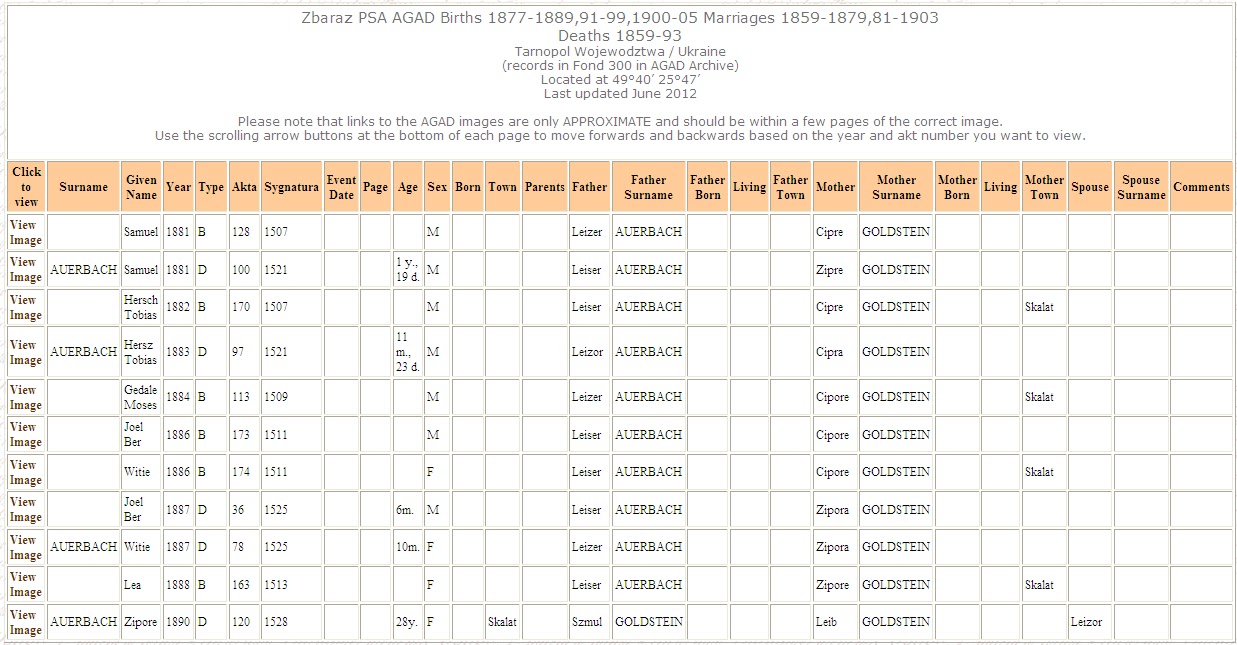
I spent a morning looking at the JRI-Poland vital records for both the Kaczors and the Aberbuchs. (This was complicated by the fact that their "sounds-like" algorithm does not think that Aberbuch sounds like Auerbach, even though the same people are listed both ways.)

I'll spare you the details, but I did find two connections between Aberbuch and Kaczor. The more obvious (but perhaps less useful) is Nuchim Kaczor who married Lea Auerbach. They had six children in the period 1891-1901 in Podwoloczysk and in one of the birth records, Lea is identified as being from Skalat.  I don't see anything connecting them to anyone else in our story.

The other is Leiser Auerbach and his wife Zipore Goldstein. They had six children 1881-1888 in Zbarazh. In several of the records, Zipore (aka Cipre) is identified as being from Skalat. Zipore died in 1890 at age twenty-eight having buried four of her children at between six and thirteen months of age.

Here is the thing. Zipore Goldstein, the wife of Leiser Auerbach is the sister of Rifka Kaczor, the wife of Rachmiel from the passenger manifest.

I would not be surprised to find the widower Leiser Auerbach in the United States in the 1890s or early 1900s, but I have not really looked for him there.

I have no idea if Leiser is closely related to Aron from the passenger manifest, but if he is, it would not surprise me one bit.

I saw no connections between Aberbuch and either Pikholz or Bernstein.

The Kaczors of Skalat are a much bigger project. In fact, I know several people who are working on parts of that family - including a client of mine - but to my knowledge no one is looking at all the Skalat Kaczors in a single project.

Probably 340 out of these 357 search results are in Skalat itself. A large family.
I started with a search for "surname sounds like Kaczor" and "given name sounds like Rachmiel." There were thirty-six records in the Tarnopol area - twenty-nine in Skalat and one family of seven in Podwoloczysk. ("Sounds like Katcher" produced those same results.) There is nothing there that tells us anything about Rachmiel's parents, so unless someone dives into this on the American end - death or cemetery records, for instance - there is not much to do on that.

Searches for records which include both Kaczor and Bernstein come up empty and, of course, had there been and Kaczor-Pikholz connections, I would have been all over them long ago. (That said, I have a low priority interest, considering the possibilty that Kaczor, Kaczka and Kwoczka all come from a single source.)

So why is this any more than several families from the same place travelling together? Maybe it isn't. But still, let's see what else we have.

First of all, in discussions a few years ago, Lee Katcher, the late Norman Kotcher and Steve Pickholtz concluded that one of the Kaczors lived with Steve's grandfather while in school. I don't know the specifics - not even if he was from the family on the passenger list - but they felt thatthis was an indication of a family connection. Maybe. Or maybe it was just good friends from the old country.

Then there is a mortgage document in the names of "Berisz Pickholz and Sarah his wife, Rachmiel Katcher and Rochil his wife, [Heren?] Katcher and Catherine his wife and Bluma Barenstein." (Note that Rachmiel's wife was Rifka on all previous documents.) A second document is similar but does not include Bluma. They are identified as being from New York City. The documents are dated June and July 1890 and refer to land purchases in Pittsgrove New Jersey. Pittsgrove is just a couple of miles from alliance where Sarah was buried eighteen months later, so at least Berisch and Sarah must have actually lived there.

Here again, this joint mot\rtgage may be a sign that we are talking about family. Or maybe it was several Skalat families participating in the experiment that tried to make New Jersey farmers out of east European Jews. This plan is probably what put them on the same voyage. How long they remained farmers, who knows. Local Pittsgrove records probably can shed light on that period.

This is Steve's project, but perhaps someone reading this might have something to suggest. I for one have no experience with US land records. Nor do I have the time or inclination to acquire that experience at this time.

BERNSTEIN
This is a good time to make some additional Bernstein comments.
I did an "exactly" search rather than "sounds like" so as not to get all the Braunsteins. Another large family.
There are three researchers listed in the JewishGen family Finder doing this large family. Two of them seem to be active and I am in contact with one of them. Many of these Bernsteins - may all of them - are kohanim.

We have at least one other Pikholz connection in that Bernstein family.

In 1955, a woman named Haya Henkin in Rehovoth submitted a Page of Testimony to Yad Vashem in memory of her sister Betka / Boncia Bernstein of Skalat, who was married to Berl Pikholz. They had three sons - Josef, Moshe and Aharon, all of whom were killed.

I spoke to Haya's daughter Malka on Kibbutz Saad, who also filed a Page of Testimony for Betka. She confirmed that this is the Bernstein family who are kohanim. She did not know anything about her Uncle Berl, so I do not know where he fits into our families.

Neither Haya nor the daughter knew the ages of the children.

Betka was born in 1902, so her husband could be one of several Berls we have who were born in that period. Perhaps we will know later on.

Sunday, August 5, 2012

THE ADIVI CEMETERY

Zygmundt Migden
Back at the beginning of my research, I found a Page of Testimony at Yad vaShem in the name of Gustaw Migden of Tarnopol. He was killed in Tarnopol in 1943.

The Page listed Gustaw's wife - Freida Pickholz, born in 1886 - and three unnamed children. There was no other information about Freida and I did not recognize her from my work to that time.  The Page was sumbitted in 1956 by their son Zygmundt, a resident of Beer Sheva.

I made some inquiries and eventually learned that Zygmundt had lived in Ashkelon and had died in 1986. But the local burial society didn't have him - not in the old cemetery and not in the newer one. Zygmundt had been born in Tarnopol in 1913 and had made aliyah in 1936, a single man.

I renewed my search for Zygmundt from time to time and the road kept leading to Ashkelon, where it ended abruptly.

In the meantime, new records became available and I found the marriage record for his mother Freida Pickholz. She was born 25 November 1885 to Josef Pickholz and Sussel Gruberg. We knew Sussel, who died in Karlsbad in 1928, but did not (and still do not) know anything about Josef's family. Eventually, I found Freida's two brothers and younger sister. One of the brothers seem to have died young, but the other two lived in Lwow and their small families included several physicians.

According to the Page of Testimony, Zygmundt was one of three children, but all I found was an older sister who died as a child, before Zygmundt was born.

Eventually, I came back to the burial society in Ashkelon and I spoke with someone in the office who looked once again and found nothing. Then she said "Wait a minute" and she gave the phone to an older gentleman who had just walked in. I asked him my question and he said "I think he is in Adivi."

The Adivi Cemetery
Rehavia Adiva was the first mayor of Ashkelon (1965-1972) and when his married daughter died at age twenty-four in 1953, he bought a piece of an orange grove near the cemetery and buried her there. Over the years, he and his wife were buried there as well as assorted others.  Over forty in all.

Rivka Yaakoba Goldberg,
Adivi's daughter
He gave me directions and I went to the site. Follow the dirt road around the side of the old cemetery, then further along a dirt road to the right. Look for the cemetery inside an orange grove on the left.

And there it was. Hidden inside the orange grove. No sign or anything.

I spent the better part of an hour, recording the names on the stones and taking photographs of the four Migden graves. They are side by side - Zygmundt, his wife Helena, their fourteen year old son Gedalyahu and Zygmundt's forty-seven year old unmarried brother Dr. Meir Migden. Meir's grave has a plaque in memory of Gustaw.

When JewishGen inaugurated JOWBR, I decided that I should enter all the graves in this cemetery, but Ashkelon is not on the way anywhere, so it waited.
Adivi Today
About sixteen months ago, I was in Ashkelon with my wife and youngest son and we decided to photograph the whole cemetery. It was easier to find this time, as the orange grave was gone. There were still the dirt roads, but you could see the cemetery from a distance.

There was a sign - a sure indication that someone had taken responsibility for maintenance. In this case, the Council for Preservation of Historic Sites and the City of Ashkelon.

There didn't seem to be any preservation going on - no fence or anything and no obvious maintenance. There has been a bit of vandalism.

We took photographs and made handwritten notes on the ones where the epitaphs were not clear. When I got home, I saw that some of those photos were not good enough, so another visit would be needed before submitting it to JOWBR.

The oppotunity for that came a few days ago. I went to Ashkelon with Dvorah Netzer, to meet my putative cousin Vladimir. Dvorah's Russian-speaking Medved cousins generously agreed to host the meeting and to help with the communication.

After that meeting, Dvorah and I went  to the cemetery to finish the photography and I passed on the pictures and the data to JOWBR that same evening. Occasionally, something actually gets crossed off my to-do list.

Housekeeping notes:
1. Next week begins a three-part series on the huge breakthrough on our family structure, based on DNA testing.

2. A colleague of mine in Europe writes as follows:
I am writing to you because I have an iPhone / iPod / iPad etc game developed, the name is Famble. It is the classical word search game - but the words you are looking for are Jewish surnames. It is so funny if you have to find your ancestral surnames, my wife, who is neither a big genealogy fun, nor plays around with computer games, laughed out when she tried Famble and found both times a friends' names popping up. Here is the link:
 
http://itunes.apple.com/us/app/famble/id543534434?l=hu&ls=1&mt=8

It is also possible to add one's family names to the game, currently it has some 3,000 names in it.
I don't have any of these devices, so cannot venture an opinion. Just passing it on.