Showing posts with label Zbarazh. Show all posts

Sunday, October 21, 2018

Named After A Living Grandfather?

Josef Pikholz was the estate manager in Klimkowce, a town a dozen miles from Skalat and 15 miles from Zbarazh. We know he was alive in 1910. We have no birth record for him, but we have a birth record for a son Wolf in 1874 so we assumed Josef was born around 1850.

Josef's daughter Roza, who was married to Markus/Mordecai Linden, had a son named Josef on 27 August 1911. We know that Jews in Galicia did not name after the living, so we assumed that Josef Pikholz had died by the time his grandson was born.

Most of the Klimkowce records are to be found in the Zbarazh collection, even though Skalat is a bit closer, but we did not see a death record for Josef in either place.

The birth record for Josef Linden, 27 August 1911
When we received new Skalat records four months ago as an Excel file, I saw thist.

I wrote at the time, in this space:
I was surprised to find a 1918 death for sixty-five year old Josef Pikholz in the village of Klimkowce. We had seen earlier that a grandson was named Josef in 1911, but we had not seen a death record for Josef. (We knew he was still alive in 1910.) So now it seems the grandson was given the name of his living grandfather - either after him or for someone else. Not totally unheard of, but unusual nonetheless.
Josef Pickholz, age 65, died in Klimkowce in 1918. Some seven years after his grandson Josef Linden was born. The age was about right and we had no other Pikholz family in Klimkowce. Jacob Laor was certain this was indeed his great-grandfather. How could he be anyone else?

My readers know I am hesitant to jump to comclusions, even though this seemed pretty straight-forward. I was concerned about the grandson who was named Josef in 1911. But it's Jacob's personal family and he is a senior member of our project team, so the best I could do was stall until we could see the record itself.

The record itself - showing the death in Klimkowce on 20 December 1918 and burial in Skalat the next day - was clear.

In the meantime, Jacob came up with another birth record for Markus and Roza - a son Benjamin, born in 1915. The sandak, the witness to his naming, was Josef Pickholz. Well that settles that. Grandson or no, Josef was alive in 1915.

But, nonetheless, I wanted an explanation. Perhaps they didn't hold to the tradition. My grandmother and her older brother were named for their paternal grandparents while they were still living - a fact she surely knew but never mentioned to me. I had come to the conclusion that this was my Slovakian great-grandfather showing that he was not superstitious like the Galizainers.

Or perhaps young Josef Linden was named after someone in his Linden family, perhaps his paternal grandfather. I knew a few cases like that. My father's first cousin Herb was given the same name as his grandfather Hersch Pickholz, who was alive for Herb's first twelve years. He was named, not for his grandfather, but for Hirsch Wachs, who is on Herb's father's side.

In another case I know, a woman whose parents are Chaim and Chaya named her third and final son Chaim while her father was living. It seems that her husband also had parents Chaim and Chaya. His father had died and since he is an only child, it was their only chance to name for his father. They asked her father's permission, which he granted.

That wouldn't work for the Lindens because the marriage record for Markus and Roza shows Markus' father to be Isak. Not Josef.

Markus Linden, son of Isak born 1880 married Roza, daughter of Josef Pickholz and Lany Feldman


Not being in the mood to give up, I had a look at the records for the Lindens in Zbarazh.


And here we see Riwka, Ziwie, Moses Selig and Abraham Leib, children of Josef Isaac Linden and Hinde Fleischfarb all born in the same decade as Markus. Markus' birth is not here, but I am ready to consider that his marriage record had only one of his father's names and that he was in fact Josef Isaac.

And I looked at one more document. Markus' son Leon/Aryeh submitted a Page of Testimony for his father to Yad Vashem.
Markus Linden, born 1880, was murdered in Zbarazh in 1942. His father was Yosef Yitzhak.  I do not know when Markus' father died, but it is clear that he is the one whose name passed to Markus' son in 1911.

Sunday, June 8, 2014

Differently Every Year - Remembering Skalat

The memorial for Skalat
I was not planning on writing about the annual Skalat memorial this year, except perhaps a brief passage at the end. I have written about this previously on this blog - here and here and here. The meeting is important, but not what you would call "interesting." Pretty much the same from year to year.

We met at five o'clock Thursday afternoon, the seventh of Sivan - which outside of Israel is the second day of the Shavuot holiday.

There is a whole row of town monuments along that stretch. Maybe thirty or so. At the other end is Husiatyn, a town near Skalat which I have written about here and specifically about the Zellermayer-Pikholz connections here.  Near that is a monument to Vileika, where many of my mother's Gordons lived in the early and mid 1800s, probably earlier too. There is Pleshchenitsy where my Gordon grandfather's mother, Anna Kugel, came from. And Zbarazh, not far from Skalat, where we had other Pikholz families.

We were about twenty-five or so. Zvika Sarid led us. We lost his mother's brother Mottel Weissman a few months ago, so again we all said kaddish together. We did that last year when Mottel was too ill to attend. Zvika pointed out that there were only four people in attendance who had actually lived in Skalat. The rest were children and grandchildren, plus a few spouses. I wondered about some of the missing. I knew that Tonia Winter was not well, but her daughter always came. And Giza - she is young for a Holocaust survivor. Giza came a few minutes later.

Zvika's daughter Chava took a picture of their mother Yocheved standing next to the monument and I made a comment about the monument's being the same as it was last year. But of course, that is not the point. The point is that while Skalat is frozen in time, Judenrein for seventy-one years, Yocheved is not. She left, made aliyah, married had children and grandchildren. That is what Chava was recording. Her mother growing older.

Some of the topics of discussion at the last few memorials were not mentioned. Nothing about the monuments in Skalat itself or the money to maintain them. No one spoke of plans to go back to visit. Skalat had been planning to make itself a five-hundredth birthday party last August. No one mentioned that either.

Mottel's daughter Chanaleh had written something years ago - perhaps a school project - about the yearly visit of the Rebbe of Husiatyn, who used to spend several weeks in Skalat on his way from his home in Vienna to his father's grave in Husiatyn. This was along the same lines as Tonka Pikholz had written in one of the Skalat memorial books. Tonka herself is buried in Holon and her sister's son and daughter visited her grave, as they always do. Tonka would be a hundred this year.

Zvika read from what Chanaleh had  written, which included something about the Rebbe's friend Yosef Milgrom, on whose property there was a small house in which the Rebbe stayed in Skalat. People came from all around to seek his advice and blessings, including the non-Jews.

Bronia said that no one was left from Yosef Milgrom's family.

So I spoke up. And told this story. Three years ago, I spoke at the IAJGS Conference on Jewish Genealogy in Washington DC, and in the course of my talk mentioned the Husiatyner Rebbe and his visits to Skalat. I spent the following Shabbes in Lakewood NJ, where my son and daughter-in-law and family were spending two weeks at the yeshiva. Someone asked me who I am etc and I said I am a genealogist, so he said that one of the rabbis who was there at the time had just written a book about his family.

I had a look at the book and saw a chapter about the Husiatyner Rebbe. So I went over to the writer, introduced myself and told him that I had just referred to the same subject in my conference talk. Across the table from him, and quite unrelated to him, sat an older woman who said "My husband's uncle Yosef Milgrom, built the hoiuse where the Rebbe used to stay when he was in Skalat."

"Small world" is a cliche, but cliches generally come from some truth. And Bronia was pleased that Yosef Milgrom has living family.

Zvika announced that he wanted to introduce something new for the memorial program. He read from the Hebrew version of the Weisbard memorial book, a personal testimony by Yoel Ben-Porath (Julek  Weinraub), as transmitted in 1995 to Lusia Milch. Zvika wants to "feature" a Skalater each year at the memorial meeting. He already told Zvi Segal that he wants him to prepare something about his father Shammai for next year.

No one wants to be the first to leave. We all hope that everyone will be there next year.

Other cemeteries
I usually use the day in the Tel Aviv area for other cemetery matters.

Gil Mordecai Scharf is a third cousin of my wife's, buried in the military section of the Holon cemetery.

He was a gunner in a tank and was killed during Operation Shelom HaGalil in 1985. He was nearly nineteen.

I went to the Kiryat Shaul cemetery to visit the two Zellermayer graves that I wrote about not long ago. Avraham's grave has his full birth name "Avraham Isak ben Zalman Yehudah." I wasn't sure it would, as his children's graves just have "Avraham." His yahrzeit was the day after my visit.

Also in Kiryat Shaul, I visited the grave of Zvi (Stanislav) Domnivsky. I mentioned him three weeks ago when I discussed the family of my Uncle Jachiel. Stanislav had submitted Pages of Testimony for two of Uncle Jachiel's Tunis grandsons and had defined himself as a relative. I was hoping the gravestone would give me a clue exactly how he was related. But it did not.

From there I went to the Yarkon cemetery to the grave of Stanislav's daughter Lydia.

That did give me some information. It says "My dear mother."

I will have to contact the burial society to see what they can tell me about the son or daughter - who probably has no idea who the Tunis family is.


Housekeeping notes
Occasionally I order records from Polish State Archives other than AGAD, when I need something for myself or for a client.  I made an exception recently when I placed an order with the Przemysl Archives - my sixth time ordering from them.

They are awkward to work with. They require statements explaining how the person placing the order is related to the person in the record, they send poor-quality paper copies by mail rather than scans, they cover up the other records on the page lest someone learn something that hasn't been paid for - and they take a very long time to process the orders even after they have been paid.

But in this case, a family member wanted  ten records on his other side, so I gathered up a few other people and placed an order on 11 September. The records came this week. Finally. One person received the single record he ordered. One got nothing. Another received part of an order. The original fellow who wanted ten got three of the ten, but also a handful of others that he hadn't ordered.

I think I am finished with Przemysl. (As my father would say "Famous last words?")


Sunday, June 30, 2013

PICKHOLTZ, BERNSTEIN and FRIENDS (or maybe relatives)

(Part two of two - see part one here)

Last week, I looked at the Pickholtz-Bernstein family who came to the United States from Skalat in 1890. We do not have all the details of their first years in the US, but the main gap in the story is what happened to David Bernstein, who was eleven months old when the ship sailed.

This week, I want to have a closer look at the other two Skalat families who followed the Pickholtz-Bernstein family on the passenger manifest, almost consecutively.
Lines 206 and 212-214 are people who seem
to be unconnected to the Skalat families.
You can see the actual manifest, but it is easier to work from the transcribed information presented here on the right.

I spent a morning looking at the JRI-Poland vital records for both the Kaczors and the Aberbuchs. (This was complicated by the fact that their "sounds-like" algorithm does not think that Aberbuch sounds like Auerbach, even though the same people are listed both ways.)

I'll spare you the details, but I did find two connections between Aberbuch and Kaczor. The more obvious (but perhaps less useful) is Nuchim Kaczor who married Lea Auerbach. They had six children in the period 1891-1901 in Podwoloczysk and in one of the birth records, Lea is identified as being from Skalat.  I don't see anything connecting them to anyone else in our story.

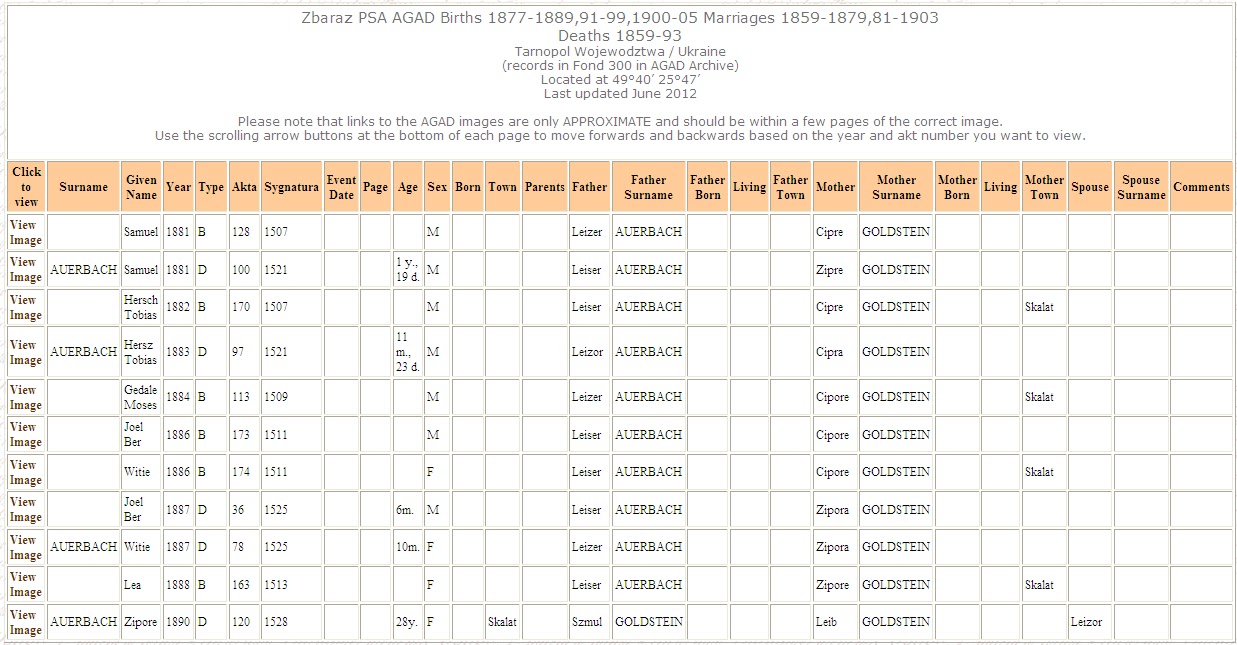
The other is Leiser Auerbach and his wife Zipore Goldstein. They had six children 1881-1888 in Zbarazh. In several of the records, Zipore (aka Cipre) is identified as being from Skalat. Zipore died in 1890 at age twenty-eight having buried four of her children at between six and thirteen months of age.

Here is the thing. Zipore Goldstein, the wife of Leiser Auerbach is the sister of Rifka Kaczor, the wife of Rachmiel from the passenger manifest.

I would not be surprised to find the widower Leiser Auerbach in the United States in the 1890s or early 1900s, but I have not really looked for him there.

I have no idea if Leiser is closely related to Aron from the passenger manifest, but if he is, it would not surprise me one bit.

I saw no connections between Aberbuch and either Pikholz or Bernstein.

The Kaczors of Skalat are a much bigger project. In fact, I know several people who are working on parts of that family - including a client of mine - but to my knowledge no one is looking at all the Skalat Kaczors in a single project.

Probably 340 out of these 357 search results are in Skalat itself. A large family.
I started with a search for "surname sounds like Kaczor" and "given name sounds like Rachmiel." There were thirty-six records in the Tarnopol area - twenty-nine in Skalat and one family of seven in Podwoloczysk. ("Sounds like Katcher" produced those same results.) There is nothing there that tells us anything about Rachmiel's parents, so unless someone dives into this on the American end - death or cemetery records, for instance - there is not much to do on that.

Searches for records which include both Kaczor and Bernstein come up empty and, of course, had there been and Kaczor-Pikholz connections, I would have been all over them long ago. (That said, I have a low priority interest, considering the possibilty that Kaczor, Kaczka and Kwoczka all come from a single source.)

So why is this any more than several families from the same place travelling together? Maybe it isn't. But still, let's see what else we have.

First of all, in discussions a few years ago, Lee Katcher, the late Norman Kotcher and Steve Pickholtz concluded that one of the Kaczors lived with Steve's grandfather while in school. I don't know the specifics - not even if he was from the family on the passenger list - but they felt thatthis was an indication of a family connection. Maybe. Or maybe it was just good friends from the old country.

Then there is a mortgage document in the names of "Berisz Pickholz and Sarah his wife, Rachmiel Katcher and Rochil his wife, [Heren?] Katcher and Catherine his wife and Bluma Barenstein." (Note that Rachmiel's wife was Rifka on all previous documents.) A second document is similar but does not include Bluma. They are identified as being from New York City. The documents are dated June and July 1890 and refer to land purchases in Pittsgrove New Jersey. Pittsgrove is just a couple of miles from alliance where Sarah was buried eighteen months later, so at least Berisch and Sarah must have actually lived there.

Here again, this joint mot\rtgage may be a sign that we are talking about family. Or maybe it was several Skalat families participating in the experiment that tried to make New Jersey farmers out of east European Jews. This plan is probably what put them on the same voyage. How long they remained farmers, who knows. Local Pittsgrove records probably can shed light on that period.

This is Steve's project, but perhaps someone reading this might have something to suggest. I for one have no experience with US land records. Nor do I have the time or inclination to acquire that experience at this time.

BERNSTEIN
This is a good time to make some additional Bernstein comments.
I did an "exactly" search rather than "sounds like" so as not to get all the Braunsteins. Another large family.
There are three researchers listed in the JewishGen family Finder doing this large family. Two of them seem to be active and I am in contact with one of them. Many of these Bernsteins - may all of them - are kohanim.

We have at least one other Pikholz connection in that Bernstein family.

In 1955, a woman named Haya Henkin in Rehovoth submitted a Page of Testimony to Yad Vashem in memory of her sister Betka / Boncia Bernstein of Skalat, who was married to Berl Pikholz. They had three sons - Josef, Moshe and Aharon, all of whom were killed.

I spoke to Haya's daughter Malka on Kibbutz Saad, who also filed a Page of Testimony for Betka. She confirmed that this is the Bernstein family who are kohanim. She did not know anything about her Uncle Berl, so I do not know where he fits into our families.

Neither Haya nor the daughter knew the ages of the children.

Betka was born in 1902, so her husband could be one of several Berls we have who were born in that period. Perhaps we will know later on.