Wednesday, September 26, 2018

The DNA of My Kaplan Second Cousins

Alta Rosenbloom's husband Berl Kaplan
It's been about twenty months since my friend and colleague Galit Aviv found my Kaplan  cousins. I wrote about them a couple of times before that and several times after that, when I visited three of them in Columbus Ohio, Nuremberg Germany and Moscow. And when their DNA results came in.

My grandmother - who died when I was  eleven - never spoke of her older sister's family, but I learned something about them from Uncle Hymen, who had a 1920s photograph of his sister Alta and four children in Moscow. He did not know much about them and only knew the names of three of the four children, but he did say that Alta's husband was Berl Kaplan.

Uncle Hymen (standing) with Alta's family - 1914
When I actually made contact with the cousins, I learned that there were not four but six and they had a photograph of the whole family with Uncle Hymen just before he left for America in 1914 at age twenty. That would probably have been not long before they moved from Borisov to Moscow.

When I visited Moscow last year, I was able to visit Alta's grave and those of all six of her children. Her husband had been killed in some early Soviet-era purge, probably because as a shoemaker he represented some kind of capitalist counter-revolutionary. Whatever the case was, he was never spoken of and the family knew nothing about him.

Actually, they did know that his name was Bor/Boris, but that seems very unlikely both because Uncle Hyman was sure his name was Berl and because he had a son Boris, whom Uncle Hymen knew as Boruch Yosef.

One possible cousin of my Rosenblooms wrote on her passenger list that she was going to
her cousin "A Kaplowitz" in New York and I considered it a possibility that Kaplan had been changed from Kaplowitz, especially since I had a good DNA match with Adam Brown who has Kaplowitz ancestry from Borisov.

Some of our DNA matches are significantly stronger than I would have expected and it crossed my mind that we have another connection to the Kaplans, but I have not been able to turn anything up. As yet.

This is the general structure of my Rosenbloom family from Borisov. It is not meant to be comprehensive. It includes those who did DNA tests for our project (in yellow) and the six Kaplan children who lived to adulthood.
The one with six children who tested is my mother

Maria Kaplan
A few weeks ago, I received  an email from a woamn named Maria Kaplan in Smolensk, who having looked at her GEDmatch results and read parts of my blog and determined that she is likely related to my Rosenblooms.

I had a look at GEDmatch and saw that her best matches with my family are my three Kaplan second cousins. These numbers are large enough to take seriously. (Note that she has a small X-match with Lydia which cannot be from the Kaplans and is almost certainly from Alta Rosenbloom as Lydia's mother is not Jewish. But that is neither here nor there.)

Maria also has matches with two of my sisters and my second cousin Sam, but these are all less than 67 cM with no segment longer than 13 cM.

And speaking of endogamy, Maria matches all three of my Jaffe second cousins whose grandfather was also from Borisov.. The largest of these is 55 cM and the longest segment is 24 cM. And there are no shared segments.

The Kaplan matches include one on chromosome 18 where Maria matches all three of my Kaplans on overlapping segments two of which are in the 19-17 cM range. 

A second segment, on chromosome 22 has 31 cM with Liya and 21 cM with Inna.
Maria's Kaplan grandfather Abram (1906-1995) lived in Minsk and was a shoemaker - as was our Berl. Abram's grandfather Zelik lived in Dokshitzy. My feeling is that Maria's Zelik is a brother to the father of our Berl, but at least for now, that in unknowable. Maria's father lives in Smolensk and she will ask him to test. Once we have his results, I will take a deeper dive into the Kaplan family.

In the meantime, I have introduced Maria to a couple of my younger Kaplan cousins.


Sunday, September 23, 2018

The Murder of the First Pikholz Family in Tarnopol

Early Pikholz families in Tarnopol
We know that there were Pikholz families in Skalat - about 19 miles or 30 km ESE of the provincial capital Tarnopol - just before 1800. Later in the 1800s we find Pikholz families and individuals in nearby Mikulince, Grzmaylow, Kacanowka, Zbarazh, Klimkowce, Husiatyn and Tarnopol and its suburbs. Later we find Pikholz families in Kozivka, Buczacz, Terembowla, Podwoloczysk and elsewhere. Most of these individuals and families are traceable to known Skalat families.

But some are not. Almost certainly they come from our known families but the records don't give enough information to work with. For that matter, we have fifteen-twenty Pikholz deaths in Skalat itself whom we cannot identify.

In the case of Tarnopol, we have a few like this. Pikholz infants named Samuel, Perl, Gabriel, Moses and another young Samuel died during the period 1848-1852. Do they all have the same parents? Maybe, but we don't know.

Menie Beyle Pikholz died in Tarnopol in 1867 at age twenty-six, but she may have been a Pikholz spouse.

Jankel Pikholz was born in Tarnopol in 1854 to Marcus and Ruchel.

The 1910 Tarnopol census shows a Herman Pikholz, age 66, "born in Tarnopol."

These are the earliest records of Pikholz descendants living in Tarnopol. That would have been about 1844.

The murdered family
That changed last week when Gesher Galicia announced the availability of several new record sets including
Tarnopol (Ternopil). TsDIAL, Fond 701/1/328, 331, 332 and 334
 - Jewish deaths, May 1845-December 1869 (10,662 records).
I went to Gesher Galicia's All Galicia Database and searched "Pikholz" using the "Records added in the past month" filter


Among the search results were these:
A whole family - Abram Pikholz, his wife Welle, daughters Esther and Sara - all died on 22 March 1855 and son David died three days later. (I was not familiar with the female name "Welle" but others tell me that it indeed occurs in their families. Perhaps it is a female version of Welwel.)

And it's spelled in the German way, with a "c" - perhaps it was the custom in the provincial capital.

Tony Kahane provided the actual record and wrote:
I found the page from the Tarnopol D 1854-1857 records listing the deaths of the five members of the Pikholz family in March 1855, in Borki Wielkie, near Tarnopol. These deaths were not from cholera (unlike many others in that year). The part of the note that it is easier to decipher (attached screenshot) is line 3 and  the beginning of line 4:
"… in der Nacht v[on] 19. auf 20. d[ieses] M[onat] ermordet …".
These people were murdered in the night of 19-20 March 1855.

Roger Lustig had a look at the German-language note on the right and wrote:
was, at the Sbrutin (?) Inn in Borki wielkie, on the night of the 19th-20th of the month, murdered, and, as a result of Imperial and Royal [something] order of 20 March 1855 No. 4363, 
So the family were murdered at the inn in Borki Wielkie (currently known as Velikiye Borki) six miles ESE of Tarnopol. Were they passing through? Did they live in Borki? Were Abram and Welle the innkeepers? How is this family connected to the deaths of children in Tarnopol whom we had already seen?

Well, they seem to have lived in Borki. An additional record in the new set is this:
One-month old Chajem Moses lived in Borki and died 22 December 1854, three months before the murder. This seems to be the same family, living in Borki. So they were at the inn but lived locally. 
The actual death record of Chajem Moses
 Who is Abram?
The father, Abram, was thirty-two when he died. That seems to make him the first Pikholz in Tarnopol, though there I doubt that he was born there. Who is he? Who are his parents? How does he connect to the known Pikholz families from Skalat? 

The only other Avraham from the Skalat area, born before the 1870s is a son of Nachman Pikholz and he was born about 1841, so there is a good chance he is a son of my third-great-grandfather Izak Josef. In fact, we have no children for Izak Josef between Berl (1816) and Selig (1830) so it is reasonable that there are missing children born in the 1820s. I think I shall record Abram as a probable son of Isak Josef, though he might be a son of Berl (1789).

On the other hand, as far as I know, no Pikholz from the Skalat area named a child Avraham in the years following the murder.

I have contacted Alex Denisenko to see what might be found about the murder and the family. 

UPDATE: Traude Triebel provided a link to a newspaper report. It confirms what we already have and provides no additional information.

Thursday, September 20, 2018

When Spira Became Pikholz - Filip's Y-111

Last month, I posted the results of my Y-111 upgrade which showed that my Y-67 matches that were a genetic distance of zero or one had grown by three or four in the uprade to Y-111.

This is the relevant part of the chart I presented then.


At the Y-67 level, it is clear that our three (identical) Skalat Pikholz descendants came from a common ancestor with a group of Spira descendants. That seemed to indicate that we were Spira not that long ago, likely no earlier than the late 1600s.

But with the Y-111 showing three or four additional mutations, there are two possibilities:
Perhaps the common Spira ancestor was earlier than I had thought and the fact that the 3-4 mutations are all in markers 68-111 rather than markers 1-67.
But perhaps some of those new mutations are mine personally, rather than being a general Pikholz thing.
That is easy enough to test. I am a perfect match with two other Skalat Pikholz descendants. All of our earliest known ancestors were born a bit more than 200 years ago. So if I test the other two, I will see if my new mutations are mine alone or more general.

I ordered upgrades for both and the results for the kit known as "Filip" came in earlier this week. (Filip is not the name of the actual tester.)


Filip matches me perfectly at 111 markers. Needless to say, the rest of his Y-111 matches are the same as mine.

So clearly these new three-four mutations happened BEFORE the births of our earliest known Pikholz ancestors - Filip's in ~1795 and mine probably ten to twenty years later. So all of these mutations happened between the Spira-Pikholz split and the late 1700s.

Over how long a period did those three or four mutations occur? Almost certainly beginning well before the late 1600s. It makes the whole "Megalleh Ammukot" descendancy less likely, at least for the Pikholz family, since he was born in 1585.

The third Skalat Pikholz Y-111 upgrade should have results in the next few weeks.

Monday, September 3, 2018

Quarter Chicken or Burekas - aka The Engineer and The Engineer's Wife

Searching for the Fuchs couple
Four months ago, I was contacted by a woman in Efrat who wanted to find her possible relatives Sigmund (Chaim) Fuchs and his wife Bella, who had come to Israel from the US maybe fifty years ago. (Her sister visited them in Ramat Gan in 1976.)

I was not able to turn up anything significant - not even graves - though Bella appears to have been alive twenty-five years ago. In the meantime she learned that they were not actual relatives, just people her parents knew who were called "aunt" and "uncle."

But something about those names gnawed at me. I was sure I had heard of this couple before. This Chaim and Bella Fuchs.

The Comedians
Two of the premier Israeli comedians of the previous generation were Yossi Banai (1932-2006) and Rivka Michaeli (who is still with us at age eighty). They did a number of sketches together, including one written by Hanoch Levin in about 1970 called "Quarter Chicken or Burekas." It was also known popularly as "The Engineer and the Engineer's Wife."

See it here.

The couple are at a wedding and he keeps worrying whether they will be served a quarter chicken as was the custom in those days, or if the cheapskate family would serve only burekas. She on the other hand was concerned that the hosts and other guests would not realize that he is an engineer (rather than a technician or a clerk) and she an engineer's wife.

They went back and forth on these two subjects for the whole seven minute sketch. Maybe there will be chicken, but not dark meat. Or maybe there will be a choice but they will start serving from the other side of the room. Or there won't be proper fries with it. Or the groom's side won't know they are an engineer and an engineer's wife.

Trust me - if you knew Israel back then, it was very very funny. It is still funny but in a very different way.

At 5:45 of the clip, they decide that they cannot stand the tension any longer and are going home. Home, where no one doubts that they are an engineer and an engineer's wife. Because, as she says, there is a sign on the apartment door "Engineer and Engineer's WIfe, Chaim and Bella Fuchs."

Sometimes we remember very old things. Just because. You never know where a solution will come from.

Friday, August 31, 2018

My Mother's Y-111

I recently upgraded the Y-DNA of one of my Gordon cousins to Y-111. This is my mother;s paternal family.

Results came in this morning.

He has one match at a genetic distance of 2 and the match is also a Gordon. The match has not done a Family Finder, but I have written him about autosomal testing and GEDmatch.

This is what FTDNA predicts about the most recent common ancestor.
He has two matches at a genetic distance of 3. Those two have the same surname, but it is not Gordon.

My cousin has twenty other Y-111 matches, none of whom are Gordons.

I shall be curious to see where this goes.

Thursday, August 16, 2018

My Y-111 Upgrade - What Does it Mean?

I took advantage of the ongoing sale at Family Tree DNA to upgrade my Y-DNA test from 67 markers to 111 markers. (I have already done Big-Y.) These results were due on 5 September, so good for FTDNA for being quick.

At sixty-seven markers, I had perfect matches with two other Pikholz descendants from Skalat. One goes back to an ancestor (Mordecai) born ~1805 who is probably the brother of my second great-grandfather (Izak Fischel). The other goes back to an ancestor (Nachman) born ~1795 who is probably an uncle or cousin to Mordecai and Izak Fischel. Both of those have tested only at sixty-seven markers.

I have seven matches at 111 markers and they and the two Pikholz are my closest matches at 67. (There are some other close-ish matches at Y-37, but I'll ignore most of them for now.)


I was surprised to see the increase in genetic distance across the board, from three to six of the forty-four additional markers. That seems a lot. The most important matches are the two Spira matches which are perfect or nearly perfect with me at Y-67 and now are significantly further away. (There is another Spira - the one we call the Z-Man - who is perfect with me at Y-37, the limit of his test.)

The question is do the new mutations represent a distinction between the Pikholz group and the Spira group, or is this something at least partially particular to my personal line. Perhaps it will tell us something about the distance between Izak Fischel and Mordecai on one hand and Nachman on the other.

I suppose I shall have to upgrade the other two Pikholz kits in order to answer that question. The sale continues for another two weeks.

There are others who match me at a genetic distannce of five or six at Y-67 and are now beyond the match criteria, so they too would represent increases of six or more.

In the meantime, I have submitted this new data to the project managers for their consideration and comments.

Tuesday, August 7, 2018

We Don't Know Our Ancestors

Well, of course we don't know our ancestors. That's why we are doing genealogy - at least most of us. But I am getting at something else here.

I received multiple inquiries every week which begin something like 


Often these inquiries will have the inquirer's grandparents' or even great-grandparents' surnames and geography, but they are generally not names I know from my own families.So I do the due diligence and look at the inquirer's matches with my 120+ family kits and respond as best I can. I limit my remarks to segments of greater than 10 cM - there are usually very few over 20 cM - with multiple matches.

Sometimes I can get a sense of direction. A matching segment may appear to come from the same pool as my maternal grandmother's Rosenblooms who lived in Borisov or from my father's maternal grandmother's Bauer and Stern family from Hungary or my faher's paternal grandmother's Kwoczkas from the Tarnopol area or some other fairly well defined part of my family. Occasionally, as in the case of Cousin Debbie, we can determine that our Trencin County third-great-grandmothers are probably sisters, but we have no surnames or parents' names to work with, so cannot make the absolute connection.

Sometimes I will see something that appears to be on the other side of some of my cousins. In one such case, I was able to connect my second cousins Beverly and Sam on their mother's side with their third cousin Melissa. The common ancestors are their Berger great-great-grandparents whose names both sides knew. But that only worked because both sides knew the relevant surnames and given names.

Debbie's case is an example of another phenomenon - being related in multiple ways, the result of endogamy.
But it is rare when my responses blame endogamy for our inability to define a match. Usually it's just an inability to recognize our own ancestors. On my mother's maternal side, the only surname I know is Rosenbloom. Of my grandmother's eight great-grandparents, I know one surname. Of her sixteen great-great-grandparents, I know one surname. And that does not even consider the validity of the names we know. My great-grandfather is Israel David Rosenbloom, my namesake. But was his father's father Rosenblolom? Who knows! And we know nothing of his wife's family.

My mother's father once told my mother that their name was "always" Gordon, not changed from something else. But aside from my great-grandmother's birth name - Kugel - we have no other surnames. So you can match my mother's family all you want, but the probablility that we can recognize a match is very low.

My father's side is a little better. On my grandmother's father's Trencin County Slovakia side, we have the surnames Rosenzweig and Zelinka in the area since the mid-late 1700s. And one of the mothers may have been a Politzer.

My grandmother's mother's side has more names - four for certain, perhaps five - but none of my Bauer/Stern matches knows any of those names. Or the accompanying geography.

On my father's father's side, my great-grandfather had two Pikholz parents and we have nothing further back besides the estimation that Pikholz was once Spira. And my great-grandmother Kwoczka, whose mother is a Pollak.

None of this is an endogamy problem. It's all about not knowing our own ancestors names beyond the last few generations and not knowing how far back those surnames are valid. And of course, those who make inquiry about DNA matches usually ndon't know their families any better than I know mine.

This kind of large match that my family has with Tara's mother has nothing to do with endogamy, even if we are related multiple ways. It's all about our inability to recognize our ancestors.


Dr. Jeffrey Paull - best known in the genealogy community for his work on the Y-DNA of certain rabbinic families - wrote elegantly about this a few days ago in reply to someone on JewishGen's DNA Testing discussion list. (Emphasis mine.)
The reason that this situation occurs so often among Ashkenazi Jews is
not necessarily due to Jewish endogamy, although that may play a role
at very distant relationships.  There is, instead, a much simpler and
more obvious explanation ... that generally speaking, Ashkenazi Jews
have very limited knowledge of who their ancestors were.

Let's go back to your statement: "However, when I was in touch with
that match we shared all the family names we could think of and none of
them were the same."  The key phrase in that statement is: "all the
family names we could think of."

Let's take the example of you having a genetic match at either the 3rd
or 4th cousin level.  At the 3rd cousin level, you share one pair of
great-great-grandparents out of a total of eight pairs.   At the 4th
cousin level, you share one pair of 3rd-great-grandparents out of a
total of sixteen pairs.  Do you know all 16 of your great-great-
grandparents, and all 32 of your 3rd-great-grandparents, including
their maiden names?  Very few Ashkenazi Jews do.

What typically ends up happening is that Jewish genetic matches compare
notes, just as you did.  They rattle off a list of surnames that they
are familiar with, which represents only a partial subset of the total
number of lineages that they are descended from.  Their genetic match
does the same thing for the partial subset of lineages that they know
about.  More often than not, these two partial subsets do not overlap.

If all Ashkenazi Jews had family trees that extended back at least five
generations to their 3rd-great-grandparents, there is no doubt that they
would be able to identify a large percentage of their 2nd, 3rd, and 4th
cousin genetic matches through autosomal DNA testing, the same way that
many non-Jews are able to do.  Jewish endogamy plays very little role at
these relationship levels
, as demonstrated by autosomal DNA studies.
He referred readers to this article. In this context he calls endogamy "a convenient scapegoat." Harsh, perhaps, but not inaccurate.

As I detailed above about my own family, of sixteen great-great-grandparents -  the ancestors who produce fourth cousins - I know all eight surnames on my father's side but only three of eight on my mother's side. More than sixty percent of the surnames on my mother's side are completely unknown at that level.

If we go up a generation to third-great-grandparents - the ancestors of my fifth cousins - I know four of eight on my father's father's side, five to seven on my father's mother's side and three of sixteen (less than 19%) on my mother's side.

Jeff adds:
An additional complicating factor that enters into the equation for
Ashkenazi Jews, involves their surnames themselves.  Most Ashkenazi
Jews acquired their surnames in the early part of the 19th century in
the Russian Empire, where, for reasons related to the Jewish surname
laws, many related people acquired different surnames, while other
non-related people acquired the same surname.
And I add not only that but when surnames came into play, they were not always the same within a family. Three brothers may have taken three totally different surnames. And of course we have the phenomenon of children receiving the mother's name because the Jewish marriage was not regeistered with the civil authorities.

And Jeff continues:
Adding to this complication is the fact that many Ashkenazi Jews changed their
surnames upon immigrating to America.  This surname instability is a
complicating factor that most non-Jews do not have to contend with,
and again, it has nothing to do with Jewish endogamy. 
And I add that name changes, truncations and spelling varieties did not only occur due to emigration to America. It happened within Europe as well. And Mandatory Palestine and elsewhere.

"We don't know those names. We don't know that geography" are the true brick walls.

Housekeeping notes
Blaine Bettinger has announced the creation of DNA Central. Please have a look. I have already joined.


Family Tree DNA has announced a sale during August for both new and upgraded tests.

Tuesday, July 31, 2018

The Descendants of Chana Chaje Pikholz

Background
I last wrote about the family of Mordecai Pikholz (~1805-1864) and his relationship to Izak Fischel Pikholz, my second-great-grandfather, about two months ago - here and here. I am pretty sure that they are brothers but I have nothing conclusive.

Here is the structure as we know it.
The purple-shaded area is the family of Chana Chaje.
People in yellow in parentheses have tested. For instance Dalia, a descendant of Chaim Yaakov.
Judy, Charlie and Leonora are also descended from Isak Josef on the top left.
In my posts two months ago, I discussed the Family Finder results of Ruth (at the bottom in green). We now have results for her first cousin Dana and their third cousin Moshe. (Ruth and Dana are also second cousins  as their non-Pikholz grandmothers. are sisters.)

Mordecai's eldest daughter Chana Chaje (~1823-1896) was married to a man named Eliezer (~1822-1878). We do not know his surname but he was a Levi, a family tradition backed by Moshe's Y-37 test. He may have had a generic Levite surname such as Segal or Halevi, or it may have been something else. In any event, the family was known as Pikholz, including Eliezer himself as we see in his death record, where he is listed by the nickname "Leiser."
Moshe's autosomal matches
Moshe has interesting segments with multiple matches on five chromosomes.

On chromosome 4 he has matches of nearly 11 cM with descendants of Rivka Feige, my g-g-gm, from her first husband Gabriel Riss. This is pretty clearly a Riss segment. Of course we have no idea who Moshe's common ancestor with the Riss family might be.

On chromosome 11, Moshe has a segment of nearly 29 cM with Ruth, 17-20 cM with Charlie and Nan and 12 cM with Dana. Charlie is a descendant of both Mordecai and Izak Josef, while Nan is a decendant of only Izak Josef. Izak Josef has no Y-DNA descendants, so we can tie him to Mordecai only through autosomal match such as this.

On chromosome 13, Moshe has a segment of 31.5 cM with Ruth and 16.3 cM with Dana. I would guess that this segment came from Eliezer the Levi, Chana Chaje's husband, rather than from Mordecai Pikholz or his wife Taube. This makes it less likely that Eliezer is closely related to the family in some other way, such as through Mordecai's wife Taube.

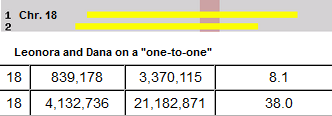
On chromosome 18, Moshe has 43 cM with Leonora and 42 cM with Dana on largely overlapping segments. (Leonora and Dana have a match on that segment of 38 cM, with a smaller segment almost immediately adjacent.) These are three mutual third cousins. Lara Diamond's Ashkenazic Shared DNA Survey shows third cousins sharing a longest segment anywhere from zero to 91 cM, with an average of 26.66 cM. (Her sample size is 397.) So this layman thinks that a single segment of over 40 cM is large and a share of that size among three mutual third cousins is fairly rare. This segment is probably from Eliezer the Levi.

Finally on chromosome 20, Moshe has a segment with Leonora of 60 cM including nearly 57 cM with Dalia.
The segment also includes matches of 24-32 cM with my cousins Fred and Herb, Barbara and Dana - and smaller segments with three cousins who are strictly Izak Josef descendants and my cousin Roz. These matches add weight to the connected nature of the families of Mordecai and Izak Josef, but without shedding much light.

I also ran Moshe's prominent segments on the Matching Segments Tool at GEDmatch and found quite a few non-Pikholz on most of them. I will probably write to those above whatever threshhold I set - perhaps 25 cM - and if the past is any indication, those who bother to respond will tell me that they don't know anything. But if even one can add to our knowledge, it is worth the effort.

Dana's autosomal matches
I discussed Ruth's matches previously but since she and Dana are so closely related (both first and second cousins) I cannot discuss Dana without mentioning Ruth.

On chromosome 4, Dana and Ruth have a matching segment of nearly 40 cM. Leonora matches a bit more than half of that segment. On the other end of that segment, Judy has a
match of nearly 20 cM, my father's sister has a match on just over 20 cM and my cousin Rhoda has a match of 12 cM. Those last three match Dana and Ruth either through Izak Josef or because Izak Fischel and Mordecai are brothers.

On chromosome 5, Dana has 27-28 cM with two of Izak Josef's descendants and 11 cM with one of my cousins. Ruth shares part of that. That is another segment shared by Mordecai and Izak Josef's descendants.

Looking further at chromosome 5, I saw two large-ish matches with strangers on the Matching Segments Tools.
Two strangers match this segment with Dana and Izak Josef descendants. I wrote to them.


Dana's matches on chromosomes 13 and 20 are covered by what I wrote about Moshe above.

On chromosome 18, Dana has the one large segment with Moshe and Leonora that I discussed above plus one more with Charlie of 25 cM together with smaller matches with Ruth and Nan.


The general overview
Dana's matches with the Isak Josef and Isak Fischel descendants are sronger than Moshe's but weaker than her close cousin Ruth's. My feeling is that the difference between Dana and Ruth is just the vagaries of DNA, while the difference between the two women and Moshe is real. Perhaps if Dana's brother tested, he would be closer to Ruth than Dana is. Perhaps if Moshe's sister tested, she might be closer to Dana and Ruth than Moshe is.

The one I really want to test is Esther, the granddaughter of Tema. She is one generation older than the other descendants of Chana Chaje, though she is chronolocally younger than some of them. Esther seems to have moved since my last contact with her.

Four years ago, I wrote about three or four marriages between the Pikholz family and the Zellermayers. I expect that there is something further here - perhaps Izak Josef's wife. I am not sure at this time how I might determine that.

Monday, July 23, 2018

Revealing The Depths

My "toe in the water" moment for DNA was a Y-37 test over seven years ago, but it was a year later that I became serious and ordered a Family Finder and I really don't do much on the Y side. That is mostly done by Rachel Unkefer, whose team is working on the line in which I am a subject.

Nonetheless, my first big success was after another Pikholz descendant from my g-g-gm's town of Skalat tested at my request and our Y-37's matched. His g-g-g-gf Mordecai Pikholz was born about 1805 and my g-g-gf Izaf Fischel Pikholz was probably a bit younger. I am fairly sure that they are brothers.

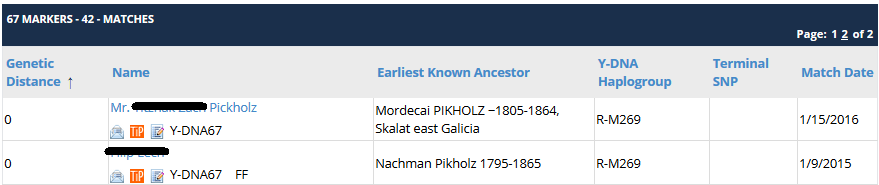
A third Pikholz descendant from Skalat tested as well. He goes back to Nachman Pikholz, born about 1795. I tend to think that Nachman is a cousin or an uncle of the other two, but I really don't know. What I do know is that all three of us have upgraded to Y-67 and our matches are perfect.

The Genetic Distance of zero (on the left) signifies a perfect match over 67 markers.


Two years ago at the IAJGS Conference in Seattle, a colleague Madeleine Isenberg Ellen Zyroff told me that her mehutan fits this group as well. His ancestral surname is Spira and they came from Sub-Carpathian Hungary, later Czechoslovakia.


His haplogroup is R-A9700, differentiated from R-M269 due to results of SNP tests. Mine is R-A9700 as well.

I had previously discussed the possibility that the Pikholz family might have lived in Sub-Carpathian Hungary before arriving in Galicia, so this made sense to me, though I have no actual evidence. Then following the Seattle Conference, I wrote a blog post on the subject, including the following:
The Friday before I left for the US, I received a note from Dr. Jeffrey Paull, who does work on rabbinic Y-DNA lines, that another Spira had tested with results that matched ours perfectly on 37 markers. (Our tests are 67 markers.) This new Spira, who had tested at Jeff's request, claims descendancy from the Megalleh Amukot, Rabbi Natan Neta Spira who was born in Cracow in 1583 and claimed a Sephardic heritage. The paper trail for this man is being verified.
I refer to this second Spira at "the Z-man."

Since then, a third Spira has appeared at a genetic distance of 1, as has a Weinstein descendant. The latter has not replied to my several attempts at contact. He is a "2" to the third Spira, so their mutations are different.

There is also someone with a genetic difference of 2 from us, from that same area. He too has done SNPs and is in haplogroup R-A9700.

The Z-man does not appear here because he has only tested for 37 markers, not 67 like the rest of us.


 Jeff Paull is still working on the Z-man's putative connection to the Megalleh Amukot, whose "known" male line descendants include Rav Pinchas of Korets (1728-1790). But what appears clear, almost beyond a doubt, is that before we were Pikholz, we were Spira. And not so far back either. Now, when we have a Pikholz-side match with someone new, I include Spira as a surname of possible interest.

The Megalleh Amukot angle intrigues me. He was a kabbbalist and the Encyclopedia Judaica says he was

"intoxicated" with numbers; he was concerned less with using the qualities of numbers in order to elucidate matters of Kabbalah and halakha than in employing the Kabbalah as material for showing his great power with different numerical combinations, and there is no doubt that he had an extraordinary mathematical mind.

Well, having a great affection for numbers myself, I am willing to accept him as a male-line ancestor, with open arms. Not to mention that I already have a grandson named Neta.

 My son's Hassidic rabbi in Chicago says that it is appropriate to mention such an illustrious ancestor on my tombstone. (Note to self...)

Today, the thirteenth of Av is the yahrzeit of the Megalleh Amukot, Rav Natan Neta Spira. Three hundred eighty-five years ago. He is buried in Cracow.

The stone says that it was said of him that the prophet Eliyahu spoke with him face to face.

They say that he wrote two hundred fifty-two commentaries on the word "Vaethanan," which is this week's Torah reading.

I bought his two-volume book on the Torah and don't understand a word of it.

May his memory be a blessing for all of us, descendants and non-descendants alike.


Housekeeping notes
Family Tree DNA sent me a notice last night offering to upgrade me to Y-111 for only $29 and I have taken them up on it.

Sunday, July 8, 2018

Pinkas

I have long said that one of the advantages of a surname such as Pickholtz is that it is both uncommon and unusual, so most anyone who has ever met one of us will remember. Since I have been working with genealogy records, I can add to this that many people recognize the name and send me references that I otherwise might not see.

The newly released AGAD records at JRI-Poland have produced several of these in the last two weeks.

The great Logan Kleinwaks sent me two records. The first is a marriage record from Chodorow, a town which I do not think appears in any of my family records.


I know the father of the groom, Aba Pickholz from Zurawno but this is the first I have seen his wife or any children. And here his son Mojzesz Jozef is being married.

The second is a death record from Bobrka, which appears in a few Pikholz records, mostly in regard to spouses.


On 20 January 1920, Nuchym Pickholz the son of Abraham and Taube died at age 76. They have him marked as a female, but that has to be just a clerical error.

We actually have someone who nearly fits, in this 1855 birth record..


Nachim Bikholz, the son of Abraham and Taube was born in house 295, a known Pikholz house. So this is the birth of the man who died almost sixty-five years later at age seventy-six. Wait, that cannot be right. The age on the death record almost certainly wrong and I will probably record it as such.

So Logan gave me two records which added significant information about people I already knew.

Early last Friday morning I received a record from Mark Jacobson who was working on Boryslaw records. The first is a death record for a woman we know.


Sara Tallenberg (sometimes Thalenberg), the wife of David Samuel Pikholz, died on 4 June 1920 at age 83.

Mark came back to me a bit later with a Drohobycz death record for someone who is clearly her son. As Mark said a couple of times as we discussed it, "This family definitely wanted to be found today."

Pinkas died 15 May 1921 at age sixty. His parents are clearly identified. But although I have birth records for this couple beginning 1865, I do not have this older child. At least if I do, I do not have him attributed to these parents.

As I discussed a few weeks ago, we have a number of David Samuel in the Rozdol Pikholz family. Three of them have sons named Pinkas and all three of those have death information. So this must be someone else.

There are two Pinkas who are about the right age for the death record (based on the ages of their children) whose parents are unknown. The first lived in Stryj with his wife Feige Nestel and their first child was born probably 1877 or 1888. They have living descendants.

The second was married to Esther Neuman. They lived in Zydachow and had four known children, the first was born in 1890 and lived for two days. Their second child was named David Samuel and he lived to age five and a half. I have no idea what became of their two younger children. The David Samuel angle was intriguing, but I had nothing to connect this man in Zydachow to Drohobycz. But a second look made it clear.

The Pinkas who died in 1921 in Drohobycz lived, in fact, in Zydachow. It says so right on the death record.

So we now have four David Samuel Pikholz from the Rozdol area, with sons named Pinkas, after the patriarch of the Rozdol Pikholz family.

As Mark said, "This family definitely wanted to be found today."

"Today." Last Friday. The Torah portion we read yesterday begins "Pinehas ben Elazar ben Aharon Hakohen..." So on Friday we identified this Pinkas.

The one whose unnamed first son was born on the second day July 1890. The 24th of Tammuz, 128 years ago yesterday.

Tuesday, July 3, 2018

64.2 centiMorgans

A few weeks ago, Beth Long - Hungarian researcher extraordinaire - asked me to join a project she was working on regarding a woman born during the Holocaust but has no idea who her parents are. More on this another time, perhaps with a guest blog by Beth herself.

But there is one corner of this project which warrants a spotlight now. One of my favorite soapboxes.

The woman - we'll call her the Holocaust Baby - did a DNA test at Ancestry and uploaded her results to GEDmatch where she found a number of matches of interest. Two of those - male first cousins to one another - match her in the 220-260 cM range. (All the DNA information cited here is based on GEDmatch on-to-one searches with the standard threshold of 7 cM. These do not include the X chromosome.) That is second cousin territory.

A third first cousin tested and his match is 336 cM.

There are several segments where these three cousins match the Holocaust Baby, particularly on chromosomes 7 and 8.

The first question was which side of these cousin is relevant, their grandmother's side or their grandfather's side. Beth tested two second cousins on their grandfather's side (orange) and their matches with the Holocaust Baby are less than 50 cM.

Wrong direction.

The connection with the Holocaust Baby must be on their grandmother's side. Beth built trees and went after the relatives.

The grandmother had a brother (green) and two of his grandchildren tested. One matches with 323 cM, also second cousin territory.

The other, with only 64.2 cM - well, who knows!

A second cousin once removed of the original three testers (in blue) is in the testing process.


The grandmother had a sister (pink) with a living grandson from her first husband and two great-grandchildren from her second. They would be second cousins and second cousins once removed to the original blue testers.

Here too, the sizes of the matches point to an as-yet-unidentified sibling of the blue grandmother, though 423 cM is high for a second cousin. But of course these Jewish families are subject to the vagaries of endogamy, where people are related multiple ways.

We have proceded beyond this and results there are not in, but that is not the point of this article. The green second cousin with the 64.2 cM match is way out of line with everyone else. I expected that he is not really a second cousin. The genetic father (or grandfather) is not who he is supposed to be.

But that is simple enough to confirm. We compared the 64.2 cM cousin to the rest of his known cousins, his green close cousins and the blue and pink second cousins..


At 64.2 cM he may not look like a second cousin to the Holocaust Baby, but he matches everyone else quite well. He has a particularly large match with his first cousin, at 1158.6 cM. So there is no misattributed paternity here. This man is a second cousin to the Holocaust Baby - at least as much of one as the the others with the "normal" matches..

Here is what Blaine Bettinger's Shared cM Project says about second cousins.

64.2 cM is way below the expected 213 cM for second cousins. It is below the 95th percentile which goes as low as 99 cM. Note that the pink cousin who matches the Holocaust Baby with 423 cM is also outside the 95th percentile, but in the other direction. And these two match each other within the norm.

So the lesson here is that norms are just that - norms. The ninety-fifth percentile still excludes five percent and five percent of the matches will be out there on the fringes. It is easy to say "This doesn't look like a good match." Easy - even lazy.

For this project it doesn't matter, but I would be curious to see what kind of match the Holocaust Baby would have with Mr 64.2's siblings, if he has any.

I have said this before. You have to test everyone. I expect I will find opportunities to say it again.