Friday, June 8, 2018

An Extraordinary Victory For DNA

This article was published in the "Journal of One-Name Studies," the quarterly magazine of the Guild of One-Name Studies, of which I am member 6934. This piece appeared in Volume 13, Issue 2, April-June 2016.

I present it here now, two years after publication, because it was recenty honored with a "Guild Award of Excellence." It appears in blog form rather than directly from the Journal to enable readers to enlarge the images.
My flagship research is the single-surname Pikholz Project, the study of a Jewish family from the three provinces of east Galicia, which is Ukraine today but Austria before WWI. In 2012, I began doing genetic research and as I write this, over seventy Pikholz descendants have tested for me, We have done most of our testing with FamilyTree DNA and our analysis with FTDNA and GEDmatch.

In the 1800s, the Pikholz families lived in two east Galician towns, the larger group of families from Skalat (4926N, 2559E) between the provincial capital Tarnopol and what was then the border with Russia. My own family lived in Skalat. We know of five Pikholz men from Skalat who were born in the period 1780-1805 and four of the five have living descendants. At the start of our DNA project, we had fifteen other Pikholz families of four or more generations whose heads had been born about 1810-1870; thirteen of those have living descendants. One of the goals of both the DNA project  and the traditional research is to attach those fifteen "younger" families to the five older men.

In November 2014, I happened across an Ancestry.com online tree featuring Sarah Pikholz, her husband Eisig Baar and twelve children.  The tree had them in Czechoslovakia with non-Galician given names such as Gustav, Victor, Rudolph, Emil and Berti, but I quickly found the first three births in Jagielnica in east Galicia. The first child was born in 1865 so I figured that Sarah was born in the early 1840s. I had no candidate for this "new" woman. Every other Sarah that I had in that period either died in childhood or married someone not named Eisig Baar.

Milton, the great-grandson of Sarah, who had posted the tree at Ancestry, hadn't a clue about Sarah's parents or siblings. Indeed, east Galicia and Jagielnica meant nothing to him. None of the records I was able to find were helpful except some Holocaust-era police records which cited the Jewish names of the children.

My attention was drawn to the son Gustav, whose Jewish name was Gabriel, a rare name in the Pikholz database. Rare but not unique. Breine Pikholz, the wife of Avraham Aron Riss, named the first of her seven children Gabriel Wolf (Wilhelm) in 1860. Breine's father was Gabriel, so he must have died young, as eastern European Jews do not name after the living. Breine's mother – based on a late birth record of two of Breine's children, filed after Breine's death – was Ryfka Pikholz. Both Breine and Sarah named their first daughters Rivka, with the secular name Regina.

There are other matching names among the children of the two women, but Moses, Juda, Josef and Rosa are too common for us to infer that the women are closely related.


Because of the names of Gabriel and the eldest daughter Rivka, it appeared to me that Breine and Sarah are sisters. I turned to DNA for help; perhaps the descendants of Breine and Sarah – putative third cousins – could appear to be closely related. Milton was willing to do an autosomal test, what FTDNA calls "Family Finder". Between Milton and me, we are in contact with five of Milton's second cousins – two from Gustav and three from Josef – but they have been unwilling to test.

On Breine's side, Wilhelm's granddaughter tested as did the two grandchildren of Isidor, first cousins to one another. Here too, there is a Josef with three grandchildren who have been unwilling to test. And Breine's youngest, Rosche, has a grandson from her elder daughter. But Rosche also has a living daughter, Lillian, who lives in Chicago.  I have tried unsuccessfully to contact her over the years.

Breine's three great-grandchildren matched one another exactly as expected. But Milton's results were a surprise. His very first match was with my father's brother, followed by my second cousin Lee, Breine's great-granddaughter from Wilhelm and my father's first cousin Herb. Milton's matches with his putative third cousins from Isidor are more distant. The closer is twenty-second on his match list and a suggested second-fourth cousin. The other is a distant "suggested fourth-remote cousin."

Figure 2 shows chromosome browsers for Milton and the three Riss cousins from the vantage point of each, using a threshold of 3 centiMorgans. The three Riss cousins match each other as expected, but Milton (the first diagram and the orange segments in the other three) has very little in the way of matching segments with the three Riss cousins.


This was not good enough for me to accept that Breine and Sarah are sisters, though it certainly does not indicate that they are not. Third cousins can be tricky like that..

But since I already had their Family Finder results, I compared each of the four to the other Pikholz families from Skalat, where over sixty descendants had tested for the project. All four clearly matched one particular Pikholz branch much more than any of the others. This is the branch which begins with (Isak) Josef (b. ~1784) and Rojse. (Note that both Sarah and Breine named children Josef and Rosa.)

Using both documents and DNA analysis, I had already determined that Isak Josef and Rojse had at least four children – Moshe Hersch, Selig, Berl and my great-great-grandmother. Clearly Ryfka, the mother of Sarah and Breine also belonged on that list, a daughter of Isak Josef and Rojse. But my great-great-grandmother was Rivka Feige and Isak Josef and Rojse certainly didn't have two daughters named Rivka/Ryfka.

The obvious theory was that after Ryfka's husband Gabriel died young – how young we don't know but Breine named her first son for him in 1860 – Ryfka, who was a young widow with two small children, was married off to an indeterminate cousin Isak Fischel Pikholz with whom she had four children. That is how their social safety net worked. A young widow or widower with young children was married off to a family member – the dead wife's sister or a niece or cousin or in-law. We don't have precise ages for the four children of Rivka Feige and Isak Fischel but the wife of the eldest was born about 1847, which would fit the scenario.

I am not concerned that the one is Ryfka and the other Rivka Feige. We know the name Ryfka from a birth record from 1888 when Breine is already dead and Riyfka herself had been dead  for many years. So the name provided by her grandchildren or son-in-law may well have been incomplete.

By this time, in early summer 2015, Lillian had agreed to meet me during my upcoming trip to the US. Lillian is one generation older than Breine's other living descendants (or Sarah's), so her Family Finder would be twice as good. But it was more than that. Last year, I asked my third cousin Joe in Denver to do a Family Finder for the project and also a Mitochondrial DNA (MtDNA) test. That would show his maternal line going back to Rivka Feige. Only Joe, his brother and his sister's two children could do that test as there are no other all-female lines. He said "What do you want to prove?" and I said "I don't know but maybe I’ll need it some day."

If Ryfka and Rivka Feige are the same woman, Joe and Lillian would have identical MtDNA. If they do, it would not be proof, but it would be supporting evidence. If they do not, Ryfka and Rivka Feige cannot be the same woman and I go back to the drawing board.


Lillian's Family Finder results came back in early October. Her first three matches are her known close cousins. Fourth is my father's cousin Herb, perhaps Lillian's half-second cousin. Her sixth match is Milton – a good sign. Ninth is my father's sister. Five more of my personal family are suggested second-third cousins and nine are suggested second-fourth cousins. This looked very good indeed. But if the MtDNA doesn't match, we have nothing.

A few weeks later, Lillian's MtDNA results came in and she is a perfect match to Joe. That is not a unique match, to be sure – there are over ninety other people with the same perfect match who would be connected further back in time. But together with the Family Finder results, it is enough for me to declare Ryfka and Rivka Feige to be the same woman and to merge the families.

There is another lesson from this particular inquiry. Milton's matches with the three cousins of his own generation – his third cousins – are not on their own convincing. But when I compare all four to the other Pikholz descendants, the pattern becomes quite clear, even obvious. When looking at third (and fourth) cousins, we must keep in mind that they may match other people better than they match each other and in ways that can clarify their relationships with each other. Of course, if some of Milton's cousins would test, we might find that they match the Riss group much better than does Milton.

DNA is supposed to be good, but not usually that good.

And another lesson - Do It Now
 

Thursday, May 31, 2018

Mordecai and Izak Fischel - Part Two

A few days ago, I explained why I am now convinced that my second great-grandfather, Izak Fischel Pikholz, is the brother of Mordecai Pikholz who was born about 1805. With that, the heads of the Pikholz families from Skalat set up like this, including the names of their known children.:
As I wrote then, "I cannot prove it, but I am quite convinced ... I will not write this in my database, except in the comments, and I will not draw a chart with solid lines. But I think and believe it to be the truth."


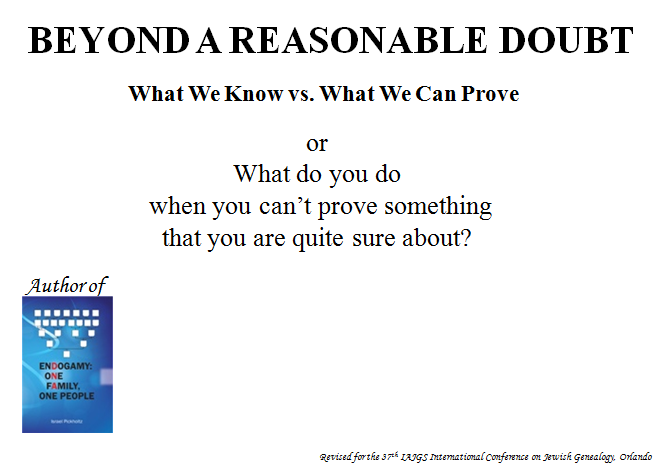
I have a lecture called "BEYOND A REASONABLE DOUBT What We Know vs. What We Can Prove." In it, I advance this rule (on the right):

The idea that Mordecai and Izak Fischel are brothers is not proven and does not even rise to the level of "What I Know." It needs more that just "one more piece of evidence." So what follows here is based on conjecture. But since I think and believe it to be correct, it is worth recording what follows from that conclusion.

So who is the father of Mordecai and Izak Fischel? He cannot be Nachman who would have been only about ten years old when Mordecai was born. He is highly unlikely to be Berl, who was about sixteen when Mordecai was born - but I see no connections between these two families. It could be Izak Josef, who is old enough and the families appear connected, but IZAK Josef would not have had a son IZAK Fischel and in any case Izak Fischel was married to Izak Josef's daughter.

Well, first of all there is this.
Leib Pikholz, a sixty-four year old "shop assistant" died in house 198 in Skalat on 24 February 1844. This is the only mention we have for this man. Born in about 1780, he is an excellent candidate.

However Mordecai's son Aryeh Leib's second child was born about 1856, so that Aryeh Leib would have been too old to have been named for a man who died in 1844.

It is probably a good assumption that the father of Mordecai and Izak Fischel is a brother of Nachman, Berl, Izak Josef and this Leib, so the structure looks like this, with two prominent missing names.

There is another thing to consider. There are additional Pikholz families from Skalat, families we can trace back only as far as 1840-1880. There may be clues among them about those early names.

Four of those families have known living descendants. So going from left to right...

Wolf is not a name we know in the Skalat Pikholz families, so that does not point anywhere. He has a granddaughter here in Israel whom I hear from from time to time, but she knows nothing about her family as her mother died when she was fourteen months old. She has politely declined my repeated requests for DNA.

Yaakov the son of Leib was born about 1870. I have met two of his granddaughters here in Israel. A great-granddaughter in Arizona is a participant in our DNA project, but there are no significant matches with other parts of the family. This Leib may have been born in the 1840s and my guess he is that he is a grandson of Leib 1780-1844.

Israel has living granddaughters (first cousins) here in Israel who are singularly uncooperative. Their DNA would be valuable. Jachiel's three daughters went to the US and I am in contact with grandsons of two of them. They have given me DNA and I fully expected that they would be DNA-compatible with Mordecai's descendants.They are not. Nor do they appear well connected to anyone else.

Esther married Markus Stern and most of that family went to the US before WWI. I am in contact with one great-granddaughter who keeps promising to give me DNA and contact information for some of her cousins. I asked again about ten days ago.

There are also a number of families with no known living descendants.

Kopel has known descendants up to the Shoah but nothing pointing back in time.

There is another Leib here who may be another grandson of Leib 1780-1844 - or he may be the same as above with a different wife. Or neither.

Maybe Fischel comes froim the same source as my Izak Fischel. Or not.

Of this group, David Samuel is the most intriguing. David Samuel is a name which goes back to the first generation of the Rozdol Pikholz family and its appearance in Skalat may hint at the common ancestor connecting the Skalat and Rozdol branches.

Of course, both Moshe Hersch and Aryeh Leib appear multiple times in the early Skalat generations so they are prime candidates for the blank name at the top of the chart. Or his father. Or father-in-law.

And I am not ruling out Jachiel as the father of Mordecai and Izak Fischel.

Or maybe I am hallucinating again. It's been known to happen.

Sunday, May 27, 2018

The Relationship between Mordecai and Izak Fischel

Part One

Mordecai and Izak Fischel
Mordecai Pikholz has three known daughters and four known sons. Descendants of six have participated in our DNA project. They appear in red on the following chart.
Devorah and Szulim married descendants of Izak Josef Pikholz,
whose relationship to Mordecai is unknown
According to Mordecai's 1864 death record, he was fifty-nine, therefore born about 1805. His Y-67 DNA is identical to mine.

My Y-DNA comes from my second great-grandfather Izak Fischel Pikholz, whose parents and siblings are unknown. His wife Rivka Feige is the daughter of Izak Josef Pikholz (b. ~1784) and based on the ages of her daughters from her first marriage, was probably born about 1815. My guess is that Izak Fischel was born 1810-1815, but he may well be either older or younger.

The analysis
Over the last few days, I had a chromosome-by-chromosome look at how Mordecai's descendants match one another and how they match the descendants of Isak Josef. These are the results for chromosome 3. I restricted the data to segments of twenty cM or more.
The red lines are Mordecai's descendants. Those who tested are shaded - Mordecai's descendants in red, descendants of both Mordecai and Izak Josef are in yellow, descendants of Isak Fischel (and Izak Josef) are in green and descendants of only Isak Josef are in blue.

Several of the testers are composites. For example, Judy and Leonora both match at least one of the eight descendants of Morris (my grandfather) on segments of 35 cM and it doesn't matter which or how many of those descendants are involved. We do know it is the same segment, as Judy and Leonora match each other there and this segment is almost certainly an Izak Josef segment rather than one that reflects a relationship between him and Mordecai.

Eight interesting chromosomes
I present here the eight chromosomes which have significant matches between each of the four descendants of Mordecai who are not descendants of Izak Josef, with the descendants of Izak Fischel, that is the red group and the green group.

On chromosomes 4, 11 and 18, the only "red tester" is Ruth.
Ruth has matching segments as large as 46 cM with the descendants of Izak Fischel's son Hersch.

Ruth has matching segments as large as 32 cM with the descendants of Izak Fischel.

Ruth has a matching segment of 21 cM with the descendants of Izak Fischel's son Hersch.


Barbara matches Isak Fischel's descendants on chromosome 13 and on 14 with Ruth.
Barbara has a matching segment of 20 cM with the descendants of Izak Fischel's son Hersch.
Barbara and Ruth have matching segments as large as 26 cM with the descendants of Hersch.
Lloyd and Dalia match Isak Fischel's descendants on chromosome 7, while Lloyd's cousin Mike matches on chromosome 16.
Lloyd and Dalia have matching segments as large as 43 cM with the descendants of Hersch.

Mike has a matching segment of up to 29 cM with many of the descendants of Izak Fischel's son Hersch.


Finally, Barbara and Dalia match Isak Fischel's descendants on chromosome 20.
Barbara and Dalia have matching segments as large as 32 cM with the descendants of Izak Fischel.

I cannot prove it, but I am quite convinced that Mordecai and Izak Fischel are brothers. I will not write this in my database, except in the comments, and I will not draw a chart with solid lines. But I think and believe it to be the truth.

I still want to test descendants of Tema, Gittel Riwka and Chaim (at the left of the chart at the top). If they have matches similar to Ruth's, I will know that these are legitimate Mordecai Pikholz matches and not, for instance, from the husband of Ruth's great-grandmother Etel.

I will have more to say about this in a few days (I did call this "Part One," after all) but I have other things to do right now.
My granddaughter is getting married this evening.

Tuesday, May 22, 2018

No Jews in Skalat

According to Yad Vashem's Pinkas Kehillot, there were 3256 Jews in Skalat in 1890, out of a total population of 5889. Now there are none. The Germans - with the willing, enthusiastic help of the local Ukranians - killed as many as they could. The last of the official killing was on the holiday of Shavuot, seventy-five years ago. Some were left hiding in the forests, but the community was gone. Skalat was declared Judenrein.

The old shul, eighteen years ago.
More recently a warehouse
In some sense, the community lives on among the survivors and their descendants, a group in which I count myself even though no ancestor of mine has lived there for nearly 150 years. I have been attending the annual memorial for Skalat for eighteen years, the day after Shavuot, at the town monument in the cemetery in Holon. Part of a row of monuments which includes other "Pikholz towns" (Zbarazh and Husiatyn) and a couple of my mother's ancestral towns (Pleshchenitsy and Vilieka).

Since the illness and passing of Chaim Braunstein, Zvika Sarid has been running the ceremony, such as it is. Until this year, it has been his mother Yocheved Sarid who has made the phone calls to remind everyone. Her husband Yitzhak died twelve years ago and her older brother Motel Weissman died four years ago at age ninety. And now in her ninety-second year, Yocheved has passed the phone-calling duties to Edna Nakdimon of the second generation.

The last few times I have written about the Skalat, I found it depressing. The number of actual survivors who are well enough to attend has dwindled and participation of the second and third generation has waxed and waned. Mostly waned. We barely reached twenty two-three years ago. I was pleased to see that the numbers were up this year. We were thirty

Yocheved spoke about her own experiences during the dark days. Tova Zehavi - known to everyone as Giza - talked about finding life in the forest, beginning with the Kol Nidre service there. Bronia spoke about the day the Germans came. I do not remember hearing Giza and Bronia speak at such length during previous memorials.
Yocheved with the microphone, Bronia in blue, Giza in between
Yocheved's four children were all there as was her sister's son and grandson, the latter a captain in the army, in uniform. Shammai Segal's family was well-represented, as usual, including grandchildren.

Henia is one who has not attended for several years. A monument to her father's town of Jawarow is in the same row. Her mother was born in Skalat but is no longer well enough to attend the memorial. Henia is finishing a book about her mother Tonia's Kaczor family. I helped her with some of the research eight or ten years ago. Now she is ready to do DNA. I suggested she do her mother's as well, while she still can. Who knows what might turn up.

So this is where we meet. Once a year. We all said kaddish together.

There are no Jews in Skalat. May their memory be for a blessing.


Wednesday, May 16, 2018

More Rozdol Solutions

Following my recent post about the critical 1901 Pinchas Pikholz death record, Mark Halpern sent me the Excel file with the full set of newly indexed Rozdol records - 1898-1914 deaths and 1903-1916 marriages.

Marriages
There are nine marriages which include people named Pickholz, all of them people I know. The new records fill in birth dates and names of the spouses' parents. Some of that is new. Some of the birth dates are not what I have from the actual birth records, but there is always a risk in trusting birth information from death records..

Two of the marriage records are particularly valuable as they identified the parents of the Pickholz grooms. In both cases the men are over fifty years old and reflect the 1915 registrations of Jewish marriages that had no doubt been held years earlier.

One is Dawid Pickholz and his wife Tauba Gitel Muhlrad for whom we have four chldren born 1888-1903. The other is Israel Pickholz and his wife Gitel Bauer for whom we have six children born 1886-1902. These two men are brothers, the children of Abraham Pikholz and Taube Kraut of what I call the IF3 family. I already had their birth records but had nothing to connect those two adult men to those specific births. Until now.


Births
There are thirty-two newly indexed births. Twenty-three are young children, all but three I already knew of. In some cases I already knew they died because there were notes to that effect on the birth records. I have recorded the three new ones and will get them onto the project web site when I have a chance.

The adults are between the ages of thirty and eighty-five. Five of the nine have no new information except death years and ages. A sixth is Pinkas whom I discussed earlier this week.

Then there are the other three.

Sara Rosenzweig is the wife of (Israel) Hersch Leib Pikholz. He was born in 1835 and according to this index entry, she would have been born about 1837, so this should be an easy call - especially as there is no one else it can be.

The birth records of her children show her parents as Israel and Golda, but the parents here are Markus and Rojse. My guess is that the death record is wrong - perhaps in the transcription, perhaps in the original. But until the scan of the original is available, I cannot make a judgement.

Dawid Wolf Pickholz died in 1904 at the age of 64, so he would have been born in about 1840. His parents are Israel Joel (known to have been born in 1807) and Itta Chane. Looks pretty straight-forward. The problem is that I know him to be the son of Israel Joel's eldest son Moshe. But maybe not. It certainly makes more sense for Dawid Wolf to have a thirty-three year old father than a thirty-three year old grandfather. (Until now we had no age for Dawid Wolf, whose eldest son was born in 1862.)

Moses' descendants said he had ten children and we know of nine besides Dawid Wolf, so if he is not Moses' son, there is likely another who has not been identified.

I expect that the death record is correct and I will have to move Dawid Wolf up one generation, but I will have to locate my notes that led to the original decision. (Dawid Wolf has known living descendants in Chicago.)

Sara Pickholz died in 1909 at age 69. Her parents are Isak and Feige.

This is a perfect match for a birth record from 13 October 1840 for Sara Bikholz who was born to Izig and Feyga in house 295, a house where Pikholz births took place over many years.


But it is not simple at all. On 7 July 1840, Sara Rifke Pikholz was born to Izak and Feige, also in house 295.


This is part of the Isak-Feige problem that I alluded to earlier this week. There may be two couples named Isak and Feige Pikholz and these two birth records are for two different children. (To be clear, the existence of these two birth records is not the only thing pointing to two identically-named couples, but it is the one in front of me now.)

The problem is complicated and over many years I have come to believe that it is intractable. But perhaps the death records can tell us something. This one, in the name of Sara, is the only one I have seen so far. I have not seen one for Sara Rivka in the families of her probable descendants. There is one child definitely named for her in 1911, but that is after this 1909 death record. If there were a Sara Rivka from one of the descendant families, born before this 1909 death record, I could say with confidence that Sara and Sara Rivka are two different people.

The odd thing is that there is no reference at all to "Sara" other than the birth and the death. It would be a tough sell to say that a woman known as Sara Rivka in all her documents would be just Sara at birth and death, even if we could explain away the second birth record.

There may be a solution here, but I believe that if I find it, it will be from some place unexpected.

Monday, May 14, 2018

I Have Waited Nearly Twenty Years For This Record

Throughout the life of the Pikholz Project, we have taken as axiomatic that all the Pikholz families from Rozdol are descended from Pinkas and Sara Rivka. Two sons are documented - Israel Joel (1807-1882) with 798 known descendants and Aron (1818-1883) with 81 known descendants.

Anther presumed son is David, the father of Hersch. Hersch was born in 1835 and his mother is Gittel Kraut. And there is evidence of a Samuel, though I have long suspected that Samuel is David's middle name.

There is evidence of a son Berl, about whom we have no information and no known descendants.

And we have four families headed by a couple named Yitzhak and Feige from this first generation. It may be, however that there are two couples - Yitzhak who married Feige and Feige who married Yitzhak, both having children at the same time, all named Pikholz. (For my own convenience, I call these families IF1, IF2, IF3 and IF4.

We also have two families headed by Pinchas, one of whom may have been born to Yitzhak and Feige in 1832 or perhaps to Israel Joel. And a Gittel born about 1840. And another Yitzhak of unknown parentage born in the 1850s.

This has been my best guess of the structure for more than a dozen years.
The four red bars are my conjecture.


Both Hersch and one of the two Pinchas have sons named David Samuel born in 1860 and 1861, and it has been my feeling that Hersch and this Pinchas are brothers. But there was no documentation. Pinchas has a grandson named Pinchas who was born in 1904 and I have long hoped that a death record for Pinchas would identify his parents by name. But we only had access to death records until 1897 - and there is no death record for this Pinchas. So I waited. and waited.

Every time Mark Halpern announced new records from the AGAD archives being released to JRI-Poland, I would ask him about Rozdol deaths. And I waited.

And I worried because even if there were a record, it may not identify his parents.

A couple of months ago, Mark announced a large set of new records and this time it included Rozdol deaths for 1898-1914. This morning, Mark announced that those Rozdol records are now indexed. I went straight to the death record for Pinchas. And here it is.
From the JRI-Poland index. The actual record is not yet available, but this is good enough.


Pinchas died in 1901 at age seventy and his parents are David Samuel and Gittel. Not only is Pinchas definitely the brother of Hersch, but we now have documentary evidence that their father David is in fact David Samuel, as I had suspected.

I can now get to work merging the two families in my database and my web site. The merged family will have eight generations and 271 documented descendants.

The new records include thirty-one other Rozdol deaths with the name Pikholz from this period. There are likely others from married daughters. Plus nine marriages during the period 1909-1916. I will wait with all those until I see the Excel version. Today I celebrate.

Friday, May 4, 2018

Sometimes We Rethink

For several years now, I have been giving a presentation which includes the statement
Because once I, the family expert,
write it down, will it ever
be seriously re-examined?
If I say something is so, will my research heirs question my decision - if indeed they ever see it as a decision? Will even I myself reconsider it without some new overwhelming piece of evidence?

The theories
One of the first things I decided to check out when I began working with this new-fangled DNA thingee was the matter of the four Pikholz descendants who lived in Podolia, outside our usual east Galicia. The four - Necha, Moses, Chaim and Yakov - all appeared to have been born 1868-1878 and I had the feeling they might be siblings.

Moses, from Nemerow, boarded a ship in Hamburg bound for New York via Liverpool. That is the last we see of him. We never even see him arriving in either port. Or any other.

Necha, also from Nemerow, married Ruben Rechister of nearby Braclav and they emigrated to the US where she was known as Nellie Rochester. The Rochesters lived for about twenty years in Kansas City then most of the family moved on to California.

Chaim lived in nearby Tetiev where he and his family were killed in a pogrom in 1919.

Yakov was born in 1878 in Tulcin and has a living grandson who immigrated to Israel from Russia after the fall of the Soviet Union. We actually have Yakov's birth record which shows his father as Mikhail the son of Mordecai.

I had two non-competinng theories about who these people were. First the obvious possibility that the four are siblings. Second, we have a known Mordecai Pikholz born about 1805 in Skalat and it appeared to me that Yakov's grandfather is likely this same Mordecai.

Testing the theories
So after my "Immediate and Stunning Success" as outlined in Charper One of my book "ENDOGAMY: One Family, One People", I decided that I could test both theories using DNA. I could not test any descendants of Moses or Chaim, but I was in contact with Yakov's grandson and some of the great-grandchildren of Necha, whom I suspected were second cousins once removed to Yakov's grandson.

Second cousin once removed is eminently testable using autosomal DNA. And of course since we already had Y-DNA for Mordecai from Skalat, Yakov's line would be easy enough to compare.

Yakov's grandson did both tests, the autosomal Family Finder and the male line Y-37.

I was in touch with the families of two of Necha's grandsons - brothers. The elder has two children and the younger, four. The elder brother's daughter promptly agreed to test and I figured we were on the way to proof. They were the sixth and seventh Pikholz descendants  to test for our project.

The end of the theories
When the results came in, what looked like a simple confirmation, turned out quite the other way. The Y-DNA of Yakov's grandson did not match Mordecai of Skalat. It was not even close.

Both Family Finder tests showed some matches with the other Pikholz family members, but they did not match each other at all. Whatever they were, it was not second cousins once removed.

I did not get what I had hoped for but I got the truth. "No" is also an answer and this was a DNA success.

In the meantime...
The number of Pikholz descendants who tested increased from seven to about eighty and with it, the number of Pikholz matches for both Yakov's grandson and Necha's great-granddaughter..

We began using GEDmatch as our standard for analysis, rather than the less useful tools that Family Tree DNA provides. For instance, a one-to-one comparison of Yakov's grandson and the Rochester great-granddaughter is not exacty non-existent.
There are twenty-two segments totalling some 60 cM with the three largest segments only 6.1, 5.8 and 4.6 cM. Certainly not much more than nothing.

Sheva
We found a woman named Sheva Pikholz Weinstein from Nemerow, about the same age as Necha Rochester, with a living granddaughter in North Carolina. If Sheva and Necha are sisters, then we can test possible second cousins once removed. In fact, Family Tree DNA shows Sheva's granddaughter and Necha's great-granddaughter as suggested third-fifth cousins with a longest segment of 27 cM and a total of 80 cM.Blaine Bettinger's Shared cM Project says that second cousins once removed share on average 123 cM, with a high of 316 cM and a low of zero. Our match looks low but not outrageously so.

Lara Diamond has some preliminary data for an Ashkenazic Shared DNA Survey which shows second cousins once removed sharing an average of 170 cM, with a high of 446 cM and a low of zero. In this context our match is certainly to small to qualify.

GEDmatch shows Sheva's granddaughter and Yakov's grandson with a longest segment of 14.8 cM with a total of 50.6 cM. This is well below second cousin territory.

A second Rochester test
I have been saying ever since those first tests that perhaps the Rochester great-granddaughter is an outlier and that her cousins might give us better resuts. Eventually one of those cousins tested, a male, with MyHeritage.

He uploaded to GEDmatch and his match with Sheva's granddaughter are even weaker than his cousin's. A total of 65.2 cM with a longest of 15.5 cM. And only one segment that he shares with both his cousin and Sheva's grandaughter, and that shared segment is only 8.3 cM.

So it looks definitive that Sheva and Necha are not sisters. They are likely cousins but could be aunt and niece. The matches we see are reasonable for second cousins twice removed.

An unexpected conclusion
This throws a monkey wrench into one of the more obvious conclusions, one I hadn't even been looking at. I have assumed all along - though I never wrote it as such - that whatever the status of Chaim and Yakov, Necha was the older sister of Moses, both being from Nemerow. That is the kind of conclusion that many researchers would record as fact and never given it another thought.

If however, as it seems, that Sheva and Necha, both from Nemerow, are NOT sisters, then perhaps Moses is Sheva's brother, not Necha's. Or perhaps Moses is the brother of neither Sheva nor Necha. This is an unexpected result of the rethink and another good example of why we must proceed with caution before drawing concusions. Because if I write it down, will anyone ever question it? Will even I revisit it?

And what of Yakov?
When Yakov's grandson tested, we had almost no experience with Pikholz Y-DNA. We have since determined that three known Skalat male lines are precise matches in the "R" haplogroup and that four known Rozdol male lines are also precise matches in a different part of the "R" haplogroup.

Only one other person with the Pikholz surname has done a Y-DNA test and he is also "R." We don't know how he connects to any other Pikholz family.

Yakov's grandson is J-M172. The records call his male line ancestors "Pikholz" (or Pikgolts), so it does not appear that the name Pikholz came from a maternal ancestor, in the Galician way. Yakov's mother's surname is known so it is pretty clearly that there is no such scenario.

I think it is time to bite the bullet and label Yakov's grandson as the product of a non-paternal event - an adoption or some other event that broke the Pikholz male line. Label in my own mind. Label as a "maybe" in the comments. Certainly not to label a certain NPE. But I think that;s what we have.

I still think that Yakov's grandfather Mordecai is likely the Mordecai (b.1805) whom we know and Yakov may well be the brother of Necha. Or Sheva. But I haven't a clue how we might demonstrate that. (Come to think it, I have an idea. We'll see if it goes anywhere.)